|
I-290 Eisenhower Expressway/Blue Line Forest Park Branch corridor coordination
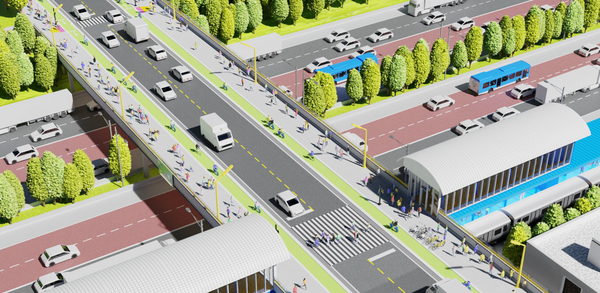
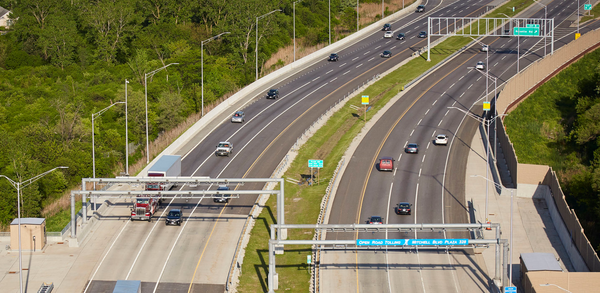
The Illinois Department of Transportation (IDOT), Chicago Transportation Authority (CTA), and Chicago Metropolitan Agency for Planning (CMAP) are working together to create a unified vision for the I-290 Eisenhower Expressway/Blue Line Forest Park Branch corridor. This partnership aims to accelerate work to improve the current operation, ongoing maintenance, and long-term investment in multimodal transportation facilities along the corridor.
Despite the importance of the corridor, its highway and transit facilities are deteriorating and leading to traffic safety concerns, significant congestion, flooding risks, and pedestrian and transit accessibility issues. Given these challenges, both IDOT and the CTA have active and near-term projects to improve existing conditions. IDOT’s projects include addressing roadway conditions and improving drainage systems, while the CTA is completing trackwork upgrades and improving train station accessibility. However, due to the length and multimodal nature of the corridor, coordinating and financing near-term improvements continues to be a challenge.
The complexities and challenges along the corridor prompted this new partnership between the CTA, IDOT, and CMAP, which was formalized through a Joint Statement of Understanding (JSOU) signed in December 2023. The JSOU outlines the importance of creating and implementing a unified vision for work along the corridor, in addition to identifying principles that address infrastructure deficiencies, improve mobility, and enhance safety and accessibility, among others.
The JSOU also includes a commitment to jointly fund a corridor development office (CDO). The CDO will provide critical strategic support to advance progress along the corridor. CDO responsibilities include long-term corridor program visioning, coordinating and sequencing projects, developing funding plans, supporting coordination with federal partners, tracking progress, and strategic communications and messaging. CMAP continues to work with our region’s partners to support innovation in project delivery.
|
|
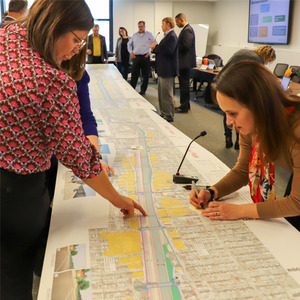
CMAP hosted a local technical assistance workshop facilitated by the USDOT’s Build America Bureau to continue to build momentum and address barriers to progress along the corridor. Attendees included the core project partners, local partners, and federal partners, among others. |
|
lean and Equitable Transportation Act introduced, offers extensive range of transit and climate policy proposals
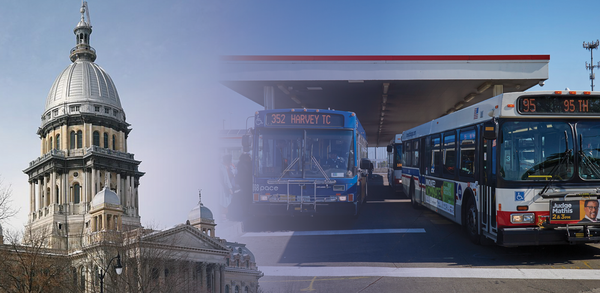
, which includes elements from the Plan of Action for Regional Transportation (PART), was filed this week. The Metropolitan Mobility Authority Act includes reforms to transit governance, organizational structure, funding, and more. In 2023, the PART report was developed in response to a state law directing CMAP to work with regional partners and develop bold policy solutions to address the transit fiscal crisis. PART outlined three areas that must work in tandem to address the $730 million fiscal cliff facing our region in 2026 and strength our transit system: system improvements, funding solutions, and governance reforms. These options together would support and strengthen transit service across northeastern Illinois. Likewise, o
A companion appropriations bill was also introduced with the initial intent to provide $1.5 billion in additional operating funds each year to transit across the region.
Additionally, the Clean and Equitable Transportation Act — the omnibus bill containing the Metropolitan Mobility Authority Act — includes two other pieces of proposed legislation that would impact CMAP’s work. The Zero Emission Vehicles Act provides several provisions accelerating zero emission vehicle adoption in Illinois. The Transportation Choices Act establishes a statewide greenhouse gas target and sets several compliance mechanisms and analytical requirements for IDOT and metropolitan planning organizations across the state.
CMAP staff are reviewing the bills and will provide legislators and other stakeholders feedback in alignment with the PART report, the region’s comprehensive plan ON TO 2050, and other related work. CMAP looks forward to further collaboration with our transportation partners, stakeholders, and members of the General Assembly to strengthen transportation choices across our region and state.
Interested in learning more about the options outlined in PART? Read our new Action Guide which summarizes the report’s actions for the state.
|
|
Active Transportation Infrastructure Investment Program
The Federal Highway Administration recently announced the launch of the Active Transportation Infrastructure Investment Program (ATIIP), a new competitive grant program created by the Bipartisan Infrastructure Law.
ATIIP projects will help improve the safety, efficiency, and reliability of active transportation networks and communities; improve connectivity between active transportation modes and public transportation; enhance the resiliency of on- and off-road active transportation infrastructure and help protect the environment; and improve quality of life in disadvantaged communities through the delivery of connected active transportation networks and expanded mobility opportunities.
Should you still be in need of additional funding to plan or build bike and pedestrian facilities, we encourage you to see if ATIIP funding might be right for your project. Applications must be submitted electronically through grants.gov no later than 11:59 p.m., Eastern Daylight Time, on Monday, June 17.
|
|
Summer 2024 Future Leaders in Planning program accepting applications
Future Leaders in Planning (FLIP) is CMAP's summer program for high school students in northeastern Illinois. FLIP is a free leadership development program for students to explore the field of urban planning and learn about the issues that shape our region and communities. High school students from Cook, DuPage, Kane, Kendall, Lake, McHenry, and Will counties who want to learn about urban planning and our region and share ideas about how to make northeastern Illinois a better place to live, go to school, work, and play are encouraged to apply.
This year's program runs from Monday, July 15 through Friday, July 19, from 10:00 a.m. to 4:00 p.m. It will take place in-person at CMAP's office in the Old Post Office in downtown Chicago, and will include field trips to various sites throughout the region. The program is completely free to students, and includes snacks, meals, public transportation to and from sessions, and swag.
Applications are due by 11:59 p.m. on May 22, 2024.
|
|
Regional Transportation Plan developments
Progress on the 2026 Regional Transportation Plan (RTP) for northeastern Illinois is steadily advancing following its introduction at CMAP’s April Board meeting. This plan will serve as a comprehensive framework that guides transportation investments and policies throughout the region. The RTP will build on the goals, objectives, and strategies provided in the region’s current long-range plan, ON TO 2050.
At CMAP, project teams are engaged in various critical initiatives essential for shaping the RTP. Among these efforts is the inventorying of local, regional, and state transportation plans that are relevant to northeastern Illinois. This review serves as a foundational step in informing the RTP vision and goals and will support upcoming engagement with stakeholders.
In the near future, work will begin to assess existing conditions related to the regional transportation system. Throughout the summer and fall, the RTP project team will also coordinate with local, regional, state, and federal partners to inform the RTP goals and objectives. These efforts aim to foster meaningful and inclusive participation from transportation partners and community stakeholders. Together, we can plan for a transportation system that works better for everyone.
|
|
Transportation Improvement Program conformity analysis open for public comment
CMAP released a conformity amendment to the FFY 2024-28 Transportation Improvement Program (TIP). This amendment is open for public comment, from Friday, April 19, to Tuesday, May 21.
Conformity analysis is part of the transportation modeling process that evaluates the impact on air quality of projects in the ON TO 2050 plan update and the FFY 2024-28 TIP, as amended. On-road vehicle emissions are reviewed to determine that the region will reach national ambient air quality goals.
Please review the ON TO 2050/TIP Conformity Analysis and TIP Amendment 24-08. Comments regarding the individual TIP conformity amendments may be submitted to CMAP by mail, email (transportation@cmap.illinois.gov), or phone (312-454-0400).
|
|
CMAP's updated Land Use Inventory now available to download
Are you interested in how policies have affected land use in your community? CMAP has updated the latest Land Use Inventory for 2020. CMAP updates the inventory every few years, with data going back to 1990 that can track changes over time.
The Land Use Inventory is a resource for planners, transportation agencies, federal and state agencies, university researchers, non-governmental organizations, consulting firms, and more. It can help you understand land uses when creating a comprehensive plan and tracking progress toward goals. For example, you can monitor what impact policies have had on transit-oriented development.
|
|
Household travel survey pilot phase begins
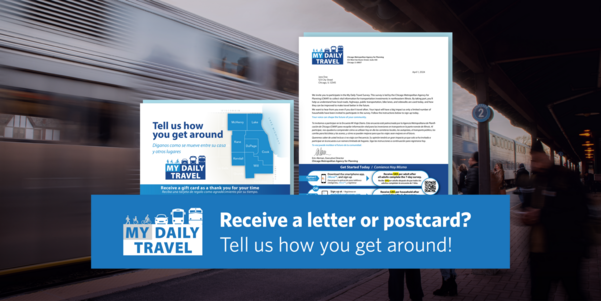
CMAP's household travel survey, also known as My Daily Travel, launched its pilot phase last month with 27,000 invitations mailed to households across northeastern Illinois. The survey collects vital information for transportation investments in our region, helping us better understand how local roads, highways, public transit, bike lanes, and sidewalks are used today. It also provides current data for our travel demand model. The pilot is expected to run through May, with the full survey scheduled to begin this fall.
|
|
Countywide safety action plans kick off
CMAP is working with six counties in northeastern Illinois to create safety action plans in response to increasing traffic fatalities — particularly among pedestrians and bicyclists — over the past several years.
What’s new? The countywide safety action plans have kicked off! Planners are establishing steering committees and community outreach strategies to understand challenges and opportunities in each county. Stay tuned for information on how you can get involved.
|
|
CMAP joins Illinois Tollway Stakeholder Advisory Team
CMAP Executive Director Erin Aleman will represent the agency on the Illinois Tollway’s Stakeholder Advisory Team (SAT). The group met in April for its first of three convenings.
As the Tollway advances planning efforts for the next multiyear capital plan, the SAT members will help inform the next capital plan, while also serving as a representative body of the region and ensuring more voices are heard in the planning process.
The SAT is comprised of regional, state, and local leaders representing sectors such as business and commerce, organized labor, planning and transit agencies, civic organizations and educational institutions, and governments. The Tollway will produce a final report that will be used by the technical and financial staff to review, revise and evaluate potential capital program projects and priorities.
|
|
Electric Vehicle and Mobility Infrastructure Framework
As part of the City of Chicago’s goals to reduce transportation carbon emissions and advance environmental justice, the Chicago Department of Transportation (CDOT) is developing a framework plan to equitably advance electric vehicle (EV) and e-mobility infrastructure improvements. This framework will serve as a roadmap for CDOT to evaluate, plan, and identify opportunities to create greater accessibility to EVs and e-mobility, streamline the regulatory and design process for public charging infrastructure deployment, and pilot curbside charging. Along with Chicago’s continued work to advance active transportation options like walking, biking, and taking transit, this EV and Mobility Infrastructure Framework will guide investments to support a more equitable and sustainable future for Chicago residents.
Provide CDOT with input to help them better understand how to improve EV and e-mobility access in Chicago. The questions are related to your familiarity with EV and e-mobility infrastructure, mobility needs, and perceived barriers and benefits of electric modes of transportation.
|
|
US Department of Transportation Public Engagement Workshops
The USDOT Office of the Secretary’s Office of Public Engagement is organizing a series of in-person public involvement workshops in different locations across the country, between April and July 2024. The workshops will engage transportation practitioners on ways to deliver opportunities for meaningful public engagement, as well as community leaders and the public on the transportation decision-making processes and how stakeholders can ensure their voices are heard.
The workshops will include a session about making equitable transportation decisions and will contain breakout sessions and small-group activities focused on highlighting meaningful public engagement strategies in transportation planning.
Mark your calendars for an in-person workshop on July 30 in Chicago, with other in-person locations offered across the country, as well as virtually.
|
|
|
|
|