|
It feels like summer already with the weather we are having and heritage in is full bloom this April with the range of events and initiatives taking place.
This update includes information on the County Cork Heritage Grant Scheme 2025 and a range of further grant schemes, as well as heritage initiatives and news from around the county and right up to the National level.
News and details now in full ...
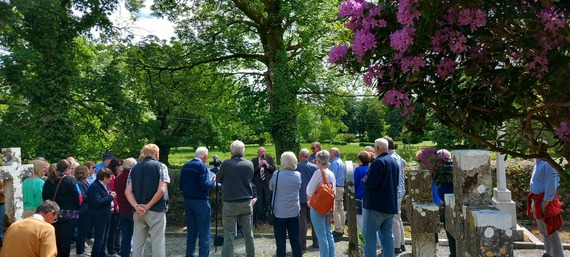 Cork County Council has opened applications for the County Cork Heritage Grant Scheme 2025. The scheme was established in 2021 to recognise the unrivalled heritage of the county and the numerous community and voluntary groups who actively engage with their local heritage, protecting and promoting it for locals and visitors alike.
Funded by Cork County Council and the Heritage Council, the fund is designed to acknowledge and support Cork County’s many heritage groups in undertaking activities that support the objectives of the County Cork Heritage Plan. In total, 26 groups were awarded funding last year for a range of initiatives including Heritage Week projects, video documentaries, conservation plans, exhibitions, archives, natural heritage projects and heritage publications.
Mayor of the County of Cork, Cllr. Joe Carroll welcomed the return of the scheme saying, ‘Over 100 projects have been supported with a funding allocation of over €125,000 since this scheme was launched in 2021. This level of support is not just an investment in our past, but a recognition of the work being done today by heritage groups throughout the county, to inspire and inform our collective future, these projects are creating a legacy for future generations’.
Chief Executive of Cork County Council, Moira Murrell added, ‘Having a rich heritage and active community groups who safeguard and promote it at local level is a vital part of place making. The County Cork Heritage Grant Scheme demonstrates the Council’s commitment to supporting local heritage and sense of place. Cork County Council is grateful to the Heritage Council for its continued support of the scheme, and we look forward to seeing the range of projects put forward this year.’
For further details of the County Cork Heritage Grant Scheme 2025, including applications forms, please click below.
The closing date for proposals and application forms is 17:00 on Thursday 17th April 2025, which can be made online; emailed to corkheritage@corkcoco.ie or delivered to ‘County Cork Heritage Grant Scheme 2025’, Cork County Council, Floor 3, County Hall, Cork. For further information email corkheritage@corkcoco.ie or phone (021) 4276891.
Cork Heritage Grant Scheme 2025
Click here for further information and to apply.
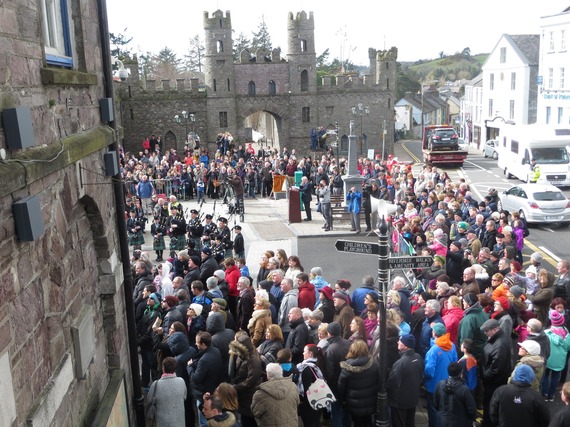 In 2024 Cork County Council announced the development of a comprehensive guide to commemorative events across County Cork from 2025 to 2040 and the next phase is now underway. With over 400 events already identified by consultants and submitted by the public, this ambitious project will serve as a vital resource for documenting and celebrating the evolving commemorative landscape in County Cork over the next fifteen years.
Funded by the Commemorations Committee of Cork County Council as well as the Department of Tourism, Culture, Arts, Gaeltacht, Sport and Media, and under the guidance of Mac Conmara Heritage Consulting, the project aims to reflect the county’s rich history and diverse cultural contributions. The guide will present a wide-ranging exploration of monuments, commemorative spaces, and memorial initiatives, addressing both historical and contemporary events, as well as notable individuals and movements that have shaped the county’s past and will influence its future.
Mayor of the County of Cork, Cllr. Joe Carroll spoke about the importance of the project and welcomed the momentum already generated: “This guide will become an essential tool for locals, visitors, historians, and cultural enthusiasts alike, offering a supportive resource for memorials, monuments, and commemorations throughout Cork for the next fifteen years. I am confident that this project will enrich County Cork’s commemorative and cultural legacy and will ensure that our commemorative landscape continues to inspire and educate future generations.”
Tara Brady from Mac Conmara Heritage Consulting, who are leading the project under the direction of Cork County Council’s Heritage and Commemorations Office noted: “We have already made tremendous progress with almost 400 events and figures identified, either by our team or submitted by community groups, local historians, and the public. However, we are determined to ensure that the guide will reflect the full breadth of County Cork’s remarkable history and culture, so we encourage everyone, from local heritage groups to individuals, to submit their ideas for commemoration.” Tara also outlined how “It can be an event, a notable person, or an important historical moment, the significant dates of which fall between 2025 and 2040. It is a great chance for the public to help shape how we remember the county’s legacy for future generations”.
The guide will highlight significant historical periods, and will focus on the county’s vibrant cultural legacy, exploring ways to commemorate Cork’s writers, artists, poets, musicians, and other key cultural figures. Additionally, it will explore the enduring impact of County Cork’s connection to the Irish diaspora, and the achievement of people from the county overseas.
The project is calling on community groups of all kinds across the county to get involved - such initiatives should be truly collaborative, and the more people who contribute their knowledge, stories, and ideas, the richer and more inclusive the guide will be.
The public is invited to digitally submit their ideas at County Cork Commemorations 2025 - 2040 or email tara.macconmaraheritage@gmail.com with their information. More information can be obtained by ringing 086 2747230.
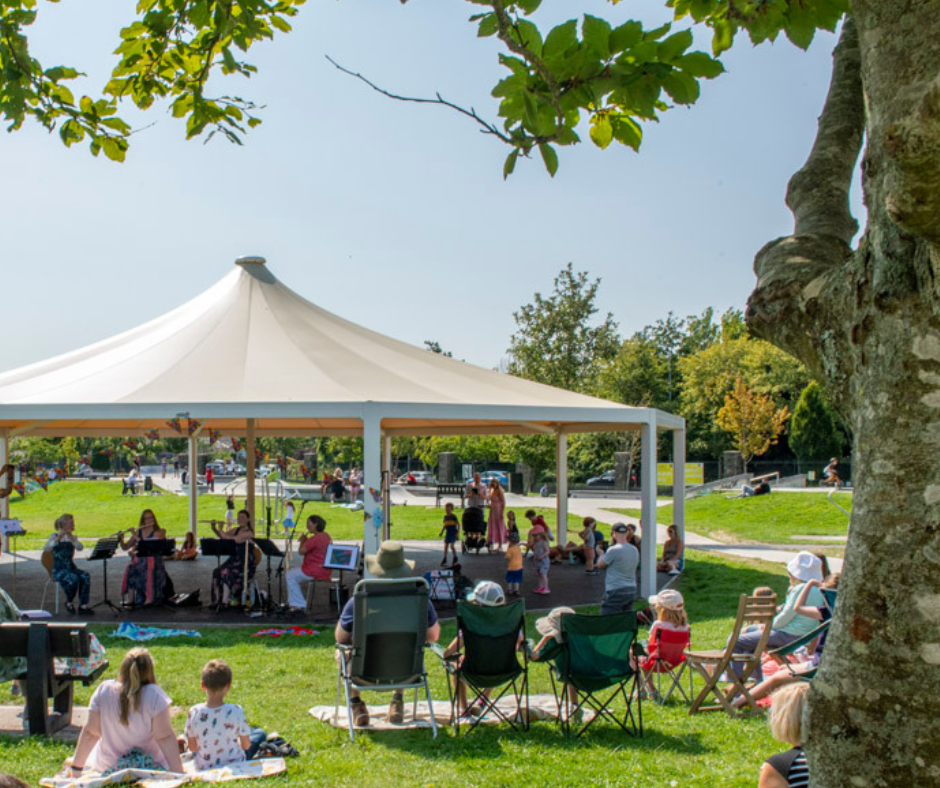 Cork County Council has launched its Irish Language Events and Initiatives Grant Scheme for 2025. This is the third year of the programme, launched in 2023 to provide funding for Irish language events, projects, and initiatives within the County of Cork.
It supports projects that utilise and promote the Irish language, including festivals, concerts, family friendly community days, conferences, films, plays, or any art form that celebrates and encourages the use of Irish in a way that benefits and includes the community.
Mayor of the County of Cork, Cllr. Joe O’Carroll welcomed the return of the scheme, ‘I am encouraging organisations throughout the county, who may be in the process of organising events through Irish, to apply for this grant. Whether your organisation is based within the Gaeltacht, or whether it is in another area of the county, or in a school or sports club, or anywhere that Irish is being spoken and used as an integral part of your event, it would certainly be worthwhile considering this grant.’
Chief Executive of Cork County Council, Moira Murrell added, ‘Cork County Council is proud to support Irish language events. Grant schemes help groups to organise events and initiatives which celebrate the Irish language. The increase in applicants and grant recipients last year is very encouraging, in total, 16 events and initiatives were supported in 2024, up from 11 in 2023.’
The successful projects in 2024, included local conversational groups and activities in Beara, Ballinhassig and Kilmurry; two film festivals in Youghal and Schull; a conference; an Irish language play in Castletownbere; arts projects, festivals, and exhibitions on Cléire, Bere Island and in Cobh; as well as musical events at Fota House and in the Múscraí Gaeltacht.
The maximum amount granted for any event is €1,500 under this scheme. Organisations may apply for more than one event within the application period, and these will be considered subject to availability of funding and the initiative meeting the grant criteria.
This scheme is open to applications until close of business on Friday May 9th, 2025. Further information and details on how to apply please click below.
Irish Language Grant Scheme
Click here for further information.
 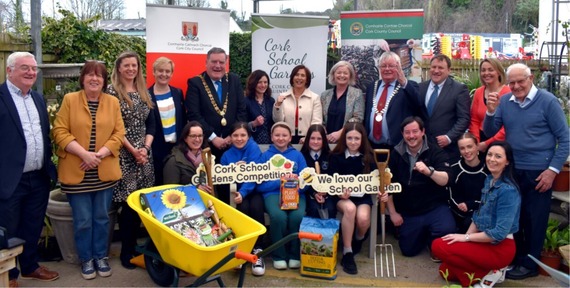 The sun shone down on Atkins Garden World as the Mayor of County Cork, Cllr. Joe
Carroll, launched of the annual School Garden competition for Primary Schools in County Cork.
The Mayor of County Cork, Cllr. Joe Carroll, said “Activities that that can help children to learn the importance of nature while staying active are crucial for health and wellbeing. Since its establishment in 2012, the Muintir na Tire School Garden Competition has inspired thousands of students across Cork County to embrace the outdoors and Cork County Council is very proud to have supported the competition each year I urge all schools around the county to consider signing up this year, whether a new entrant or a long established participant, we want to see students from every town and village involved.”
Muinefliuch National School, winners of the Best School Garden in Cork County in 2024, were represented by Emma O Doherty, Regina McGuire and pupils Sophia and Sara.
The closing date for online entries is Good Friday, the 18th of April. For full competition details and entry form visit:
https://www.muintircork.com/competitions-and-programmes/cork-school-gardens.
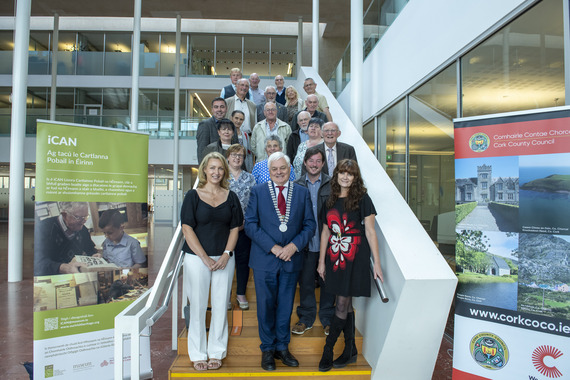 This year, the County Cork Heritage Office will be inviting more Local History & Heritage Groups to join the Irish Community Archive Network (iCAN) and develop their own community archive on the Heritage Cork portal. We would like to invite you to attend an information session to find out more about this exciting initiative, how it could benefit your group, and whether this is something you would be interested in getting involved in.
Information Session
The information session will take place via Zoom from 7pm to 8.15pm on Tuesday 10 June. If you would like to attend, please RSVP to ican@museum.ie and corkheritage@corkcoco.ie by close of business on Monday 2 June.
Please include the name of your group and the name/s and email address/es of the attendee/s.
About iCAN
iCAN currently supports 43 member groups across counties Clare, Cork, Galway, Mayo, Sligo, Tipperary and Wicklow. Its aim is to support community groups to collect, digitise and make accessible their local history and heritage online. Groups accepted into iCAN can avail of a subsidised Community Archive website, relevant training and upskilling programmes, and much more. Each member group is guided step-by-step as they develop their community archive website to professional standards, while being supported by a network of volunteers and heritage professionals on an ongoing basis. This is a collaborative programme where we all work together for the benefit of our local history and heritage.
iCAN is an initiative of the National Museum of Ireland, delivered in partnership with the Heritage Council and participating Local Authority Heritage Officers, and community volunteers in Ireland and abroad.
 March 24 2025:
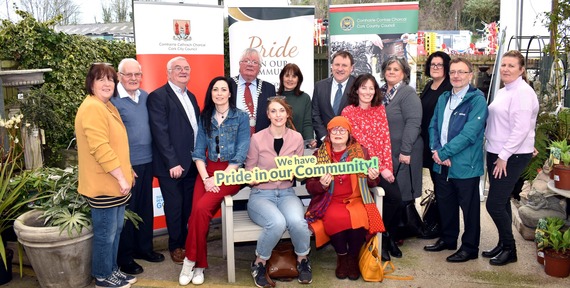
The sun shone down on Atkins Garden World as the Mayor of County Cork, Cllr. Joe
Carroll, launched of the annual Pride in Our Community competition for Community
and Tidy Towns Groups in County Cork. Speaking at the launch the Mayor said that ‘he was proud and delighted that Cork County Council continue to support this wonderful competition.’ He went on to thank all the community groups taking part for making Cork such a wonderful place for all. He urged all Community and Tidy Towns Groups in County Cork to take part.
Cork County Council was represented by Seamus De Faoite, Niamh O Dwyer, Finbarr O Keeffe, Debbie Hennessy, Pauline Falvey from the Environment Directorate. The Cork County Federation of Muintir na Tire was represented by Yvonne Cahalane, Sean Holland, Pauline O'Dwyer, Tara O Donoghue and Denis Kelly, while Atkins Garden World was represented by Manager Cornelia Creedon. Carrigaline Tidy Towns winners of the Pride of Cork County Award in 2024, were represented by Maura Allen, Marie O’Mahony and Niamh Brody.
The 2025 competition is accepting applications up until 2 June, 2025, and for more information visit https://www.muintircork.com/competitions-and-programmes/pride-in-our-community.
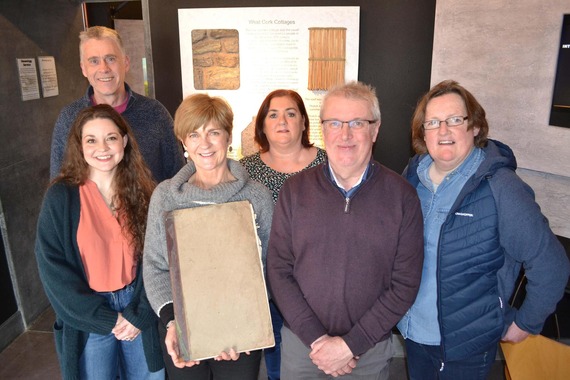 Cork County Council’s Skibbereen Heritage Centre has uploaded another tranche of previously unavailable burial register records to its online database. This brings the total number of burial records now available on their website www.skibbheritage.com to 97,923 burials, all of which are available to access free of charge from anywhere in the world.
The latest upload features graveyards primarily from North Cork and also includes three graveyards from Bandon in West Cork. In total, the records from 143 graveyards in County Cork are available to the public.
Mayor of the County of Cork, Cllr Joe Carroll said, ‘I would like to commend the small team at Skibbereen Heritage Centre, supported by Cork County Council, who have been diligently working on this important digitisation project for several years. It is a huge body of work to have almost 100,000 burial records available online for people in County Cork and across the globe to discover their ancestor’s final resting place.’
All of the information is on the Skibbereen Heritage Centre website www.skibbheritage.com including a map of all the sites covered to date as well as a searchable database. The team at Skibbereen Heritage Centre hope to continue this project over the 2025/6 winter period, with the support of Cork County Council, to upload more records next spring.
The graveyards included in the 2025 upload are Abbeyswell (Kilgobnet), Aglish, Araglen (Araglin), Ballyhea, Ballylough, Banteer, Castlemagner, Castletownroche (Kilsane/Kilsone), Clonfert, Conna, Cooline, Drishane, Holycross, St Brigid’s Buttevant, St Lachteen’s Grenagh, St Mary’s Millstreet and three Bandon graveyards, St Peter’s Ballymodan, Kilbrogan and the Old Ballymodan Graveyard.
 Cork County Council is inviting owners of vacant, under-utilised and derelict properties in County Cork to attend information sessions about the supports available to them.
A series of Vacancy and Dereliction Drop-in Days will be held at libraries in Bantry, Kanturk, Charleville, Bandon, Clonakilty, Skibbereen, Passage West, Macroom, Fermoy, Youghal, Mallow and Midleton throughout the month of April.
Staff from Cork County Council’s Town Regeneration Office (TRO) will be available to provide property owners with information about how to avail of grants and other supports to assist in bringing their properties back into use, and to answer any queries property owners may have.
The Town Regeneration Office and Vacant Homes Office of Cork County Council, work collaboratively across County Cork to identify vacant properties, engage with owners and implement the Derelict Sites Act where necessary.
Cork County Council has surveyed 2,823 properties to confirm if they are vacant through its Residential Vacancy Survey. Currently, 123 properties are listed on the Cork County Derelict Sites Register. In addition, over 1,100 Vacant Property Refurbishment Grant applications have been approved by the Council across County Cork since the scheme launch in 2022.
Mayor of the County of Cork, Cllr. Joe Carroll said, ‘These drop-in days will be an excellent opportunity for owners of properties that are in need of improvement to learn about supports available to them, and to start plotting a route out of vacancy and dereliction. I encourage owners of such properties in these towns to take the opportunity to go along and get advice about bringing their properties back into use.’
Chief Executive of Cork County Council, Moira Murrell, noted, ‘Cork County Council is focused on tackling the issues of vacancy and dereliction in our towns, and is committed to finding innovative and proactive ways to meet the housing needs of the people of Cork County. This initiative will allow owners of vacant and derelict properties to access the information they need to reactivate properties and, by doing so, to support the regeneration of our towns and villages.’
The full schedule of Drop-In Days for April is as follows:
- Bantry: Thursday 10th April 10:00 – 12:00 • Kanturk: Thursday 10th April 10:00 – 12:00 • Charleville: Thursday 10th April 14:00 – 16:00 • Bandon: Friday 11th April 10:00 – 12:00 • Clonakilty: Friday 11th April 14:00 – 16:00 • Skibbereen: Tuesday 15th April 10:00 – 12:00 • Passage West: Thursday 24th April 14:00 – 16:00 • Macroom: Friday 25th April 10:00 – 12:00 • Fermoy: Tuesday 29th April 10:00 – 12:00 • Youghal: Tuesday 29th April 14:00 – 16:00 • Mallow: Tuesday 29th April 14:00 – 16:00 • Midleton: Wednesday 30th April 14:00 - 16:00
For more information email [email protected] or phone 021 4285317. A second round of Drop-in Days is proposed for additional towns in May.
The National Built Heritage Service (NBHS), Department of Housing, Local Government, and Heritage has just announced the launch of the 2025 Conservation Advice Scheme for Vacant Traditional Houses. The Conservation Advice Grant Scheme for Vacant Traditional Houses is an expanded funding scheme to provide grants for expert conservation advice to owners of vacant traditional houses who are availing of, or considering, the Vacant Property Refurbishment Grant. The Conservation Advice Grant Scheme provides grants to cover 67% of the costs (up to a maximum grant of €5,000) of having a conservation expert with proven and appropriate expertise:
- visit a vacant or derelict traditional building
- conduct a survey, and
- compile tailored conservation advice for the property owner.
This expert advice will include a report which outlines the condition of the building and identifies conservation improvements which would restore it to use while enhancing its character, energy efficiency, integrity, and amenity.
Stream 1 of the scheme is open to owners of vacant traditional houses in villages, towns and cities where the building is a Protected Structure and/or an historic structure within an Architectural Conservation Area. Buildings previously used for commercial purposes also qualify for the scheme where the intended use is as a single dwelling or a single dwelling over a shop.
Stream 2 of the scheme will provide grant support for the provision of expert conservation advice to private owners of vacant traditional farmhouses, where the building one of the following:
- A farmhouse which is a Protected Structure.
- An historic farmhouse located within a rural Architectural Conservation Area.
- A vernacular farmhouse that has no statutory protection.
Vernacular farmhouses comprise modest homes constructed by people without formal training following long established folk traditions, using materials such as thatch, stone, slate, earth, wattle and unsawn timber.
The aim of the scheme is to help owners of traditionally constructed houses to understand the heritage value and potential of these structures and to prompt them to consider investments which could protect and enhance that value.
The deadline for application is the 2nd May 2025, only eligible and fully completed applications will be accepted. Please note that as this is a competitive application process, only the highest scoring projects will be chosen in line with the available funding budget. Unsuccessful applications will not be carried through to any subsequent approved grant scheme. All applications will be assessed under the following criteria:
- Heritage interest of the building
-
Vernacular interest: Please note that only Vernacular buildings will score under this category.
- Reuse potential of the building
- Demonstrated experience of chosen Conservation Professional - in particular in relation to historic buildings, vernacular buildings and energy upgrading
- Best value for money of costings provided
Please see the following link for further information and relevant documentation: gov.ie - Conservation Advice Grant Scheme for Vacant Traditional Houses
Application forms can be accessed here: gov.ie - Conservation Advice Grant Scheme for Vacant Traditional Houses
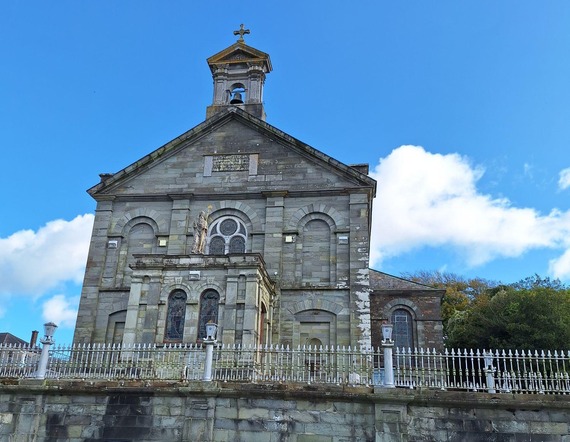 Funding of over €480,000 has been awarded by the Department of Housing, Local Government and Heritage to support the repair and restoration of 22 historic buildings in Cork County, under the Built Heritage Investment Scheme (BHIS) and the BHIS Historical Thatched Buildings (HTB). Both schemes are run in collaboration with the country’s 31 Local Authorities.
Welcoming the allocations, Mayor of the County of Cork, Cllr. Joe Carroll said, ‘County Cork boasts an extensive array of built heritage, with almost 3,000 protected structures and 52 Architectural Conservation Areas. The funding allocated this year under the BHIS has increased nearly three-fold from 2024, highlighting the growing benefit of this scheme in our county. This allocation is a very welcome investment to support essential heritage conservation efforts at 22 unique properties. I wish all applicants success with their projects.’
The Built Heritage Investment Scheme (BHIS) has played a significant role in the protection of built heritage sites in Cork since its inception in 2016. Funding has been provided for a variety of essential works such as the repair of doors and windows, including fine stained-glass windows, as well as repointing and repairing carved stone and much more.
Under the 2025 BHIS scheme, 18 Cork County projects set to undertake conservation works will benefit from funding to the sum of €441,274. A wide range of buildings including schools, churches and cathedrals, Georgian and Victorian shops and townhouses, as well as late medieval country houses will receive support to help conserve and enhance our historic buildings and streetscapes.
The BHIS Historical Thatched Buildings grant will provide funding for thatch repairs in sites across the county. Thatched houses are a significant part of our national identity and this scheme supports their owners in caretaking these wonderful sites, so that they continue to be part of our lived environments for generations to come. This year, 4 projects located in Mallow, Garrynagoul, Youghal and Mitchelstown will benefit from funding to the sum of €42,753.
https://www.corkcoco.ie/sites/default/files/2025-03/built-heritage-investment-scheme-projects-pdf.pdf
https://www.corkcoco.ie/sites/default/files/2025-03/historical-thatched-buildings-projects-pdf.pdf
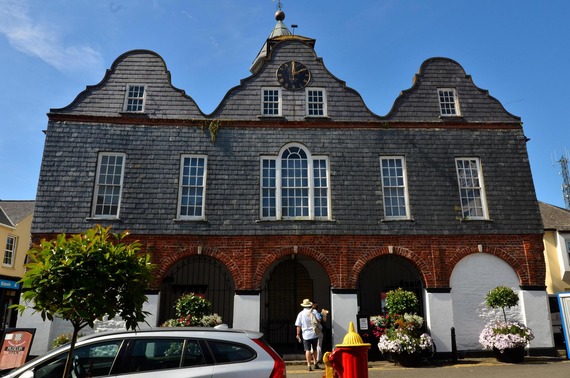 Cork County Council has been awarded more than €72,000 for the repair and protection of Kinsale Museum through the Historic Structures Fund.
The Department of Housing, Local Government and Heritage’s National Built Heritage Service (NBHS) funding will be used to carry out repairs to internal plaster, external ironmongery, masonry walls and drainage of the iconic building. The clock on the front elevation will also be repaired to bring it back into use.
Kinsale Museum is located in the 400-year-old former market house and courthouse on Market Street in the centre of the town. Built in 1610 and serving as a courthouse from 1705, it went on to hold the inquest into the 1915 sinking of the HMS Lusitania.
The mixture of materials used in the museum’s front facade adds textural variation whilst enlivening the appearance of the building. The structure is enhanced by the retention of features such as the clock and cupola. The profile and location of the building make it vulnerable to storm damage and the proposed works will build resilience to enable it to withstand these effects.
Mayor of the County of Cork, Cllr Joe Carroll said, ‘Kinsale Museum is a beautiful, fascinating building from an architectural and historical perspective and is a landmark building in the heart of the town. It has been sensitively maintained, now serving as a museum highlighting the rich history of Kinsale. This funding will help to preserve this wonderful structure, protecting its legacy and ensuring that it can continue to be used by the people of West Cork and visitors for centuries more to come.’
The Cork County Council owned and operated museum is dedicated to telling the history of Kinsale and the surrounding area, covering important national and international events such as the 1601 Battle of Kinsale and the sinking of the Lusitania. The museum also explores local maritime history and the curious story of the Kinsale Giant.
Kinsale Museum is open from 10am to 5pm Tuesday to Saturday in the summer season (1st April to 31st October) and Wednesday to Saturday in the winter season (1st November to 31st March).
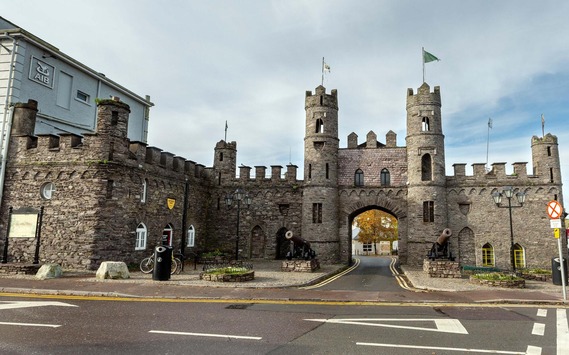 The Mayor of the County of Cork, Cllr Joe Carroll has welcomed Heritage Council grants totalling €450,000 for conservation works on two historic buildings. Cork County Council successfully applied for funding for St Peter’s Church, Castletownbere and Macroom Castle Gate Lodge through the Historic Towns Initiative 2025.
St Peter’s Church is set to receive €250,000 to refurbish and preserve the building, transforming it into a dedicated community centre. The former Church of Ireland facility dates back to 1841 and was acquired by the Castletownbere Development Association in 2018.
Macroom Castle Gate Lodge has been awarded €200,000 towards sensitive restoration and conservation works to weatherproof the structure for the future. Located in the heart of Macroom’s main square, the Gate Lodge is of significant culture and historical importance to the local community and is a symbol of the town.
Mayor Carroll said, ‘These two buildings are of great architectural and historical interest and the works being undertaken are a wonderful example of heritage-led regeneration delivering for and enhancing our County towns. I would like to acknowledge the significant community investment and effort in both towns, in particular Castletownbere Development Association, whose vision to acquire St Peter’s Church to develop a community centre will soon come to fruition. A flagship heritage attraction could be created in Macroom Castle Gate Lodge, and I look forward to Cork County Council and Macroom Castle Demesne working together to achieve this in the years to come.’
The Historic Towns Initiative is a joint undertaking by the Department of Housing, Local Government and Heritage and the Heritage Council which aims to promote the heritage-led regeneration of Ireland’s historic towns.
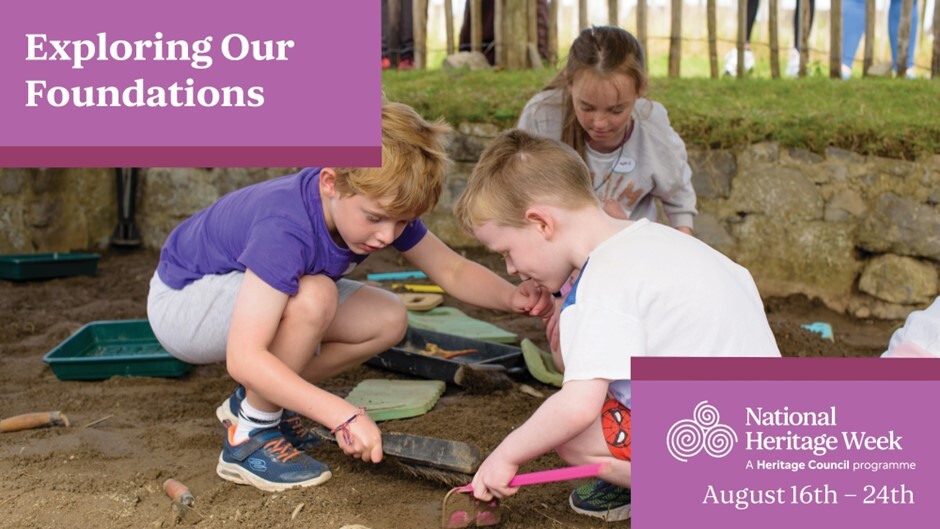 Save the date- National Heritage Week 2025 takes place from August 16th-25th. The Heritage Council invites you to get involved under this year’s theme: “Exploring Our Foundations.”
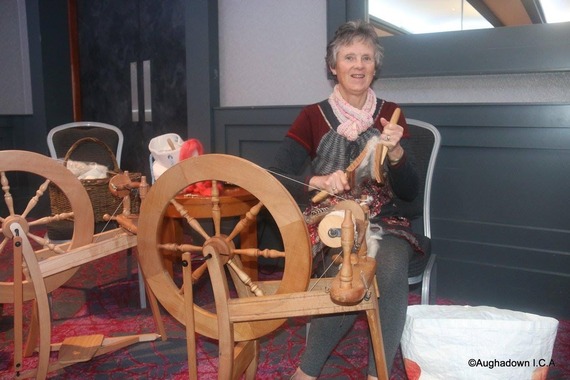 An inspiring new exhibition that explores Ireland’s rich textile heritage will open in Kinsale Library on the 17th of April. The exhibition ‘A Stitch in Time: The Clothes We Wore, The Future We Weave’ revisits practices from the past to inspire a more sustainable future.
Treasured clothing traditions from the past, including the Kinsale Cloak and a variety of pieces from the Mizen Spinning and Textile Group will be on display, as well as tools such as spinning wheels and looms. Visitors will also discover a range of historical photographs, personal stories and handcrafted items, alongside insights from primary school children on sustainable living.
Welcoming the exhibition, Mayor of the County of Cork, Cllr. Joe Carroll says, ‘We hope this unique presentation encourages visitors to reflect on how past generations valued quality over quantity and how their practices can inspire us to change how we produce and consume clothing. Whether through repairing, or choosing renewable materials, we can learn from the past to make better choices for our future’.
Supported by Creative Ireland, ‘A Stitch in Time: The Clothes We Wore, The Future We Weave’ is the culmination of a series of workshops led by Cork County Council’s Heritage Specialist in Residence Shannon Forde. Held in local libraries and primary schools, the workshops explored themes of heritage and sustainability, focusing on crafts, transport and food to uncover the ways in which our ancestors were living sustainably.
This exhibition opens in Kinsale Library on the 17th of April and runs until the 13th of May. Kinsale Library is open Tuesday to Saturday from 9.30am to 5.30pm.
 The Heritage Council is currently undertaking a review of the Museums Standards Programme for Ireland (MSPI) and would very much like to hear your views on it, whether you currently participate in the programme or not.
Your assistance with this survey will really assist in improving MSPI and the support that can be provided through same for the cultural heritage sector. The survey takes around 14 minutes to complete. It is completely anonymous.
For further information about MSPI, please see our website here.
Click here for MSPI Review Survey
Following a successful opening round in 2024, the Royal Irish Academy is pleased to announce that the RIA Commemorations Bursary scheme for 2025-2026 is now open. Supported by the Department of Tourism, Culture, Arts, Gaeltacht, Sports and Media, the scheme aims to encourage new local research and local history studies (local, national and regional) as a means of recognising the significant contribution of local historians in furthering fields of study relating to the Commemoration of events associated with the early years of the state as well as other significant historical anniversaries, events and themes.
The purpose of this grant is to provide support for the direct costs of research up to a maximum of €10,000.
The scheme is open for applications until 15th May 2025.
For further details see here. Any queries can be directed to grants@ria.ie
 Role: Oral History Network of Ireland (OHNI) Administrator (half-time, work from home role, flexible to accommodate occasional evenings and very occasional weekend events, immediate or soon as possible start)
Fixed Term Contract: 1 May 2025 – 31 March 2026
Reporting to: Elizabeth Kiely, Chairperson, Oral History Network of Ireland
Position Summary
The Oral History Network of Ireland (OHNI) is a voluntary organisation supporting and promoting oral history in Ireland. With funding support from the Heritage Council of Ireland, the Oral History Network of Ireland is seeking to recruit a highly organised and proactive office administrator to remotely manage the day- to-day operations of the organisation. In this role, the administrator will serve as the backbone of the team, coordinating administrative activities, streamlining workflows, and creating efficiencies alongside OHNI’s steering committee. The ideal candidate will be someone, who has an understanding and an appreciation of oral history and cultural heritage and understands what is involved in the administration of heritage events and voluntary organisations. It is a role that will suit someone with excellent organisational competencies, who gives attention to detail, has a hands-on attitude and good communication skills.
Main duties and responsibilities
- Manage OHNI email account and respond to email enquiries and correspondence in a timely way or consult the required team member(s) to answer queries.
- Undertake day-to-day administrative duties and maintain organisational files and records.
- Assist with the mailing lists and mailshots, preparation of organisational audits, budgets, reports and submissions, and the collection of organisational data.
- A key aspect of the role will be (on behalf of OHNI) to assist with website maintenance and liaise when required with the relevant company responsible for re-designing and maintaining the website, update the OHNI organizational website, add content when required and to track visitors to the OHNI website.
- Attend the Steering Group and other meetings on request, taking notes, tracking actions and issuing meeting minutes in a timely manner.
- Assist the organisation to develop and implement its regional network plan.
- Be a conduit of information and effectively communicate between steering group members, board members, members and stakeholders.
- Assist with tasks pertaining to the OHNI annual conference organisation and administration.
- Assist with public relations, event promotion and event administration.
- Support OHNI sub-committees in administrative capacities when needed.
- To always consider the environmental impact of OHNI’s work and take steps to reduce its impact and support OHNI team and members to do likewise through the development of an organisational environmental impact plan.
- Comply with Irish law, Health and Safety Standards, GDPR and other organisational protocols.
Selection Criteria:
Essential
- Previous experience of at least two years in office administration or heritage organisational role or other comparable experience.
- Knowledge and experience of oral history or heritage.
- Previous experience of engaging and collaborating with community groups.
- Strong organisational and timekeeping skills.
- Proficiency in computer skills and familiarity with Microsoft Office Suite (Word, Excel, PowerPoint, Outlook).
- Excellent interpersonal and diplomatic skills.
- Excellent oral and written communication skills.
- A team player with the ability to work proactively and independently when required.
- Willingness to be flexible to work remotely or in person as required.
- Fluency in English – spoken and written.
- An understanding of health and safety, GDPR and key protocols.
- A willingness to acquire any training beneficial to the role.
Desirable
- Administrative experience in an organisation similar to OHNI.
- Knowledge and experience of website updating and maintenance.
- Ability to travel for work as required and including overnight stays.
- Experience of report writing.
- Fluency in Irish.
Conditions
Remote Working Role (in person attendance required at some events) with an immediate / soon as possible start.
Fixed Term Contract: A one-month probation will apply followed by regular reporting and submission of time sheets to OHNI Chair /Project management team.
Reasonable vouched subsistence and other expenses incurred will be reimbursed.
Ability to travel for work if required.
Basic salary: €24,000 for 11 Month Fixed Term Contract Period working 20 hours per week.
Application Details:
To apply, please submit a cover letter of no more than two pages explaining your interest in the position and your suitability and a curriculum vita/resumé with the name and contact details (telephone and email address) of two referees by email to info@oralhistorynetworkireland.ie ‘OHNI Administrator Role’ should be used in the subject line of the email. It is intended that shortlisted candidates will be interviewed on Wednesday the 30th of April 2025 and the shortlisted candidates should inform referees to expect requests for references. The closing date for applications is 11.59pm Irish Time, Monday the 21st of April 2025.

The first recipient of the Research Ireland Heritage Council New Foundations Award is Dr Jonathan Cherry, DCU for his project ‘Minor placenames in Ireland: promoting and facilitating 'citizen humanities' in safeguarding intangible cultural heritage’. For more information on Dr Cherry and his work, see here.
Join our team! Hedgerows Ireland CLG is seeking a part-time Executive Officer. They will support our operations and help us deliver strategies towards our vision of a network of native hedgerows managed for nature. Closing Date: 5 pm, Friday 9th May. Read more and apply: www.hedgerows.ie/careers (link in bio).
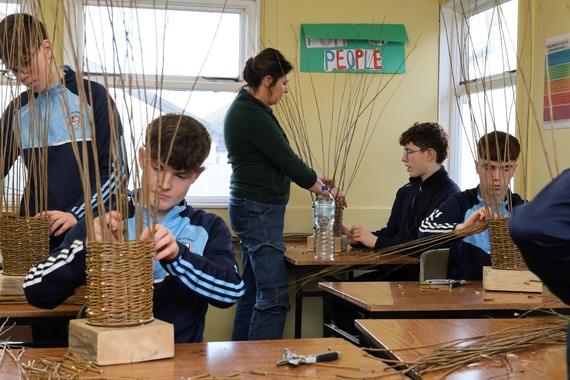 The Heritage in Schools Transition Year (TY) Pilot, which is testing a methodology for rolling out our successful Heritage in Schools programme at post-primary level, was launched last September. The pilot programme facilitates visits from heritage specialists on our panel to TY groups in post-primary schools. Visits cover various aspects of our cultural, natural and built heritage.
So far, students have engaged in a variety of activities such as historical and environmental research, exploration of their natural, built and archaeological heritage outdoors, practising heritage skills, and the analysis of cultural heritage in the form of artefacts and documents.
To date over 6% of post-primary schools have engaged with the pilot, and we’ve delivered over 120 visits across all four provinces. The pilot will continue to run until the end of May, meaning there’s still time to receive a visit from one of our specialists! To register to take part, TY teachers/coordinators should email eodonnchadha@heritagecouncil.ie
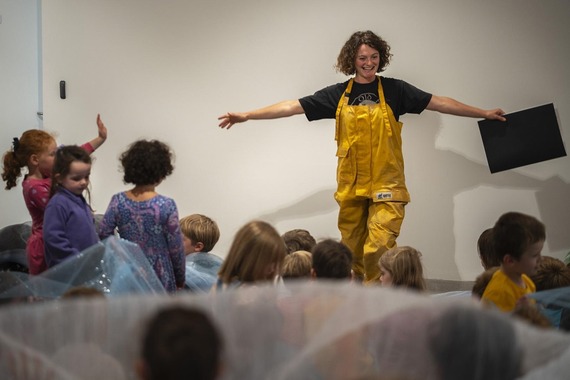 Cork County Council has issued an open call for events to celebrate culture, creativity and the arts as part of Culture Night 2025.
This year, Culture Night / Oíche Chultúir will take place on Friday, the 19th of September. It sees cultural venues open their doors late and communities come together to deliver free cultural events for all.
In 2024 over 17,000 people came out to celebrate Culture Night attending outdoor film screenings, electronic music workshops, underground music events, community parades, and so much more. County Cork hosted 166 events in 132 venues.
Cork County Council’s Library and Arts Service is now inviting arts organisations, community groups, artists and others to submit proposals for events that will be programmed as part of Culture Night.
Cork County Culture Night will take place in the 17 Culture Night Hub Towns of Fermoy, Mitchelstown, Mallow, Charleville, Clonakilty, Skibbereen, Bantry, Bandon, Kinsale, Carrigaline, Passage West, Macroom, Baile Mhuirne, Midleton, Youghal, Cobh and Watergrasshill, as well as on the islands and in other locations across the county.
Welcoming the call for creative proposals, Mayor of the County of Cork, Cllr. Joe Carroll commented, ‘Culture Night is an opportunity for communities to come together to celebrate our rich arts offering in the county. From brass bands to rocks bands, and arts centres to town centres, Culture Night is a true celebration of the arts. We look forward to receiving proposals from the community.’
For Culture Night 2025, Cork County Council will support events that provide opportunities for families, youth audiences, adults, and older people to participate. Initiatives that have the capacity to animate public spaces in innovative and creative ways are also sought. There are a limited number of grants available to support the delivery of events throughout the county.
Applications must be submitted online. The deadline for submission of proposals to Culture Night is 5.00pm on Friday the 18th of April 2025.
For further information and application details follow the link below.
Culture Night Events
Click here for further information and to apply.
Minister for Housing, Heritage and Local Government James Browne TD and Minister of State for Nature, Heritage and Biodiversity Christopher O’Sullivan TD have today [2 April 2025] announced €800,000 in funding under the National Parks and Wildlife Service (NPWS) Peatlands and Natura Community Engagement Scheme 2025. This year the scheme will support forty-five community groups with their conservation work in seventeen counties around the country.
Minister of State for Nature, Heritage and Biodiversity Christopher O’Sullivan TD said: “The health of our natural world is inextricably linked to the health of our communities. Successful conservation efforts must be driven by and rooted within those communities. Local knowledge, and a sense of ownership are vital to safeguarding our precious ecosystems and species and mitigating the impact of climate change. This scheme is an example of how we will solve the biodiversity crisis in Ireland by fostering strong partnerships, empowering local initiatives, and putting communities at the heart of nature conservation."
Minister for Housing, Local Government and Heritage James Browne TD said “Community and voluntary groups play a vital role in conserving nature and heritage around the country. Funding provided through the scheme will support these groups to engage their own communities in their conservation efforts and protect their natural heritage for future generations. I am really impressed with the diversity of projects and wish them well with their work.”
The Peatlands and Natura Community Engagement Scheme supports local initiatives for the conservation and revitalisation of Natura 2000 Special Areas of Conservation (SAC) and Special Protection Areas (SPA) and all peatland areas. It is aimed at community-led and volunteer groups and promotes awareness of, and engagement with our natural heritage and environment.
A list of all the projects awarded funding this year, including four in the County of Cork amounting to €69,868, can be found here:
Projects awarded funding under the Peatlands Natura Community Engagement Scheme 2025
The Minister for Rural and Community Development and the Gaeltacht, Dara Calleary TD, alongside the Managing Director of SuperValu, Mr. Luke Hanlon, have today, March 24th, launched the 2025 SuperValu TidyTowns competition.
In place since 1958, the competition, administered by the Department of Rural and Community Development and the Gaeltacht and sponsored by SuperValu, continues to be one of the most recognised sustainable, environmental and community initiatives in the country.
Speaking at the launch of the competition in Ballincollig, Minister Calleary said; “I am delighted to be here in Ballincollig, Ireland’s Tidiest Town for 2024, as we launch the 2025 SuperValu TidyTowns competition. This year we celebrate 67 years of this wonderful competition, which continues to thrive year on year - its success benefits us all.”
There are almost 1,000 active TidyTowns groups, and last year saw over 900 entries to the SuperValu TidyTowns competition. This saw over 30,000 volunteers giving up over 1 million hours of their time, all year round, to come together to make our communities cleaner, brighter and more vibrant places.
Minister Calleary continued: “TidyTowns groups have been instrumental in supporting and enhancing the government’s objective to ensure towns are sustainable, resilient and thriving hubs of commercial and social activity. I would encourage everyone to reach out to their local group and volunteer, you will be surprised at the benefits that can accrue to you and to your wider community. I would like to say a special thank you to our national sponsor, Supervalu, now in their 35th year of sponsoring the competition. SuperValu have been wonderful partners on this journey and I look forward to continuing this partnership in the coming years.”
Speaking at the launch today, Luke Hanlon, Managing Director of SuperValu, said: “The launch of the SuperValu TidyTowns competition is an exciting time for committees and volunteers nationwide, as we look forward at what can be achieved to enhance our communities in the weeks and months ahead”.
Minister Calleary concluded by thanking the TidyTowns volunteers throughout the country and wishing them well in the 2025 competition. An tAire: “Ba mhaith liom gach rath a ghuí oraibh go léir i gcomórtas 2025. Táim ag súil le hiontrálacha álainn na mbailte agus na sráidbhailte a fheiceáil agus bualadh leat ag an searmanas bronnta níos déanaí sa bhliain.”
The closing date for receipt of entries for this year’s competition is Monday May 12th, 2025. Entry to the competition will only be accepted by email to the TidyTowns@drcd.gov.ie email address. Entry forms for the SuperValu TidyTowns competition are available at www.tidytowns.ie.
Full details of the competition are available on www.tidytowns.ie or www.supervalu.ie.
Minister for Rural and Community Development, Dara Calleary TD, has today (Wednesday, 19 March) launched the 2025 Town and Village Renewal Scheme which is designed to support the revitalisation of rural Ireland and to build greater resilience in to our town centres through regeneration projects.
This year’s Call For Proposals will allow one additional application for one larger scale project (up to €300,000 category) for those local authorities with an inhabited offshore island and/or Gaeltacht areas.
The Fund will support projects throughout Ireland with a focus on stimulating town centre economic and social regeneration through sustainable employment creation.
Launching the 2025 Scheme, Minister Calleary said: “I’m delighted today to launch the 2025 Town and Village Renewal Scheme which will provide funds to develop projects in every corner of the country. The Town and Village Renewal Scheme continues to have a hugely positive impact in Ireland’s rural towns and villages and this investment will further strengthen this work. Rural development continues to be a key priority for the Government and we will continue to support the revitalisation and resilience of rural Ireland, transforming our towns and villages – creating better places to live, work and participate in their local community.”
Three funding streams are available under the Town and Village Renewal Scheme; the Main Scheme, the Project Development Measure and the Building or Land Acquisition Measure.
Projects will align with the objectives of the Government policies Our Rural Future, Town Centre First and Our Living Islands with a focus on:
- driving town centre regeneration;
- supporting town or village centre plaza development;
- development of green spaces or recreational amenities in town or village centres;
- the enhancement of our streetscapes;
- supporting town or village centre markets;
- upgrading or refurbishing community centres;
- bring vacant and derelict buildings back into use as multi-purpose community spaces;
- supporting vibrant and sustainable Gaeltacht communities and island communities on Ireland’s inhabited offshore islands.
The Minister continued: “The Project Development Measure has been hugely successful in providing an opportunity to develop a pipeline of significant, well developed projects therefore will be funded under the TVRS again this year.
In response to the continuing demand to revitalise our towns and villages, the Building or Land Acquisition Measure will provide up to €500,000 per local authority to purchase up to three vacant or derelict buildings or lands for regeneration purposes.
I am strongly encouraging local authorities to work closely with communities to put forward projects that are ambitious and will make a positive difference.”
Notes:
Since the launch of the Town and Village Renewal Scheme, over €177 million has been allocated to almost 1,800 projects. The Scheme has made an important contribution to supporting vibrant and sustainable communities in towns and villages throughout Ireland. The Scheme is administered through the local authorities, who are required to work closely with local communities and local businesses to develop and implement proposals. The Scheme typically funds rural towns and villages with a population of up to 10,000 people. Larger rural towns with a population of up to 15,000 people may be eligible where the application is particularly strong and the project will have a significant impact on the town in question.
Applications
The closing date for the submission of applications under the TVRS Building and Land Acquisition Measure is May 2nd, 2025 and for the Main Scheme and Project Development Measure is July 25th, 2025.
Each Local Authority is invited to submit applications of varying scale under the 2025 Scheme as follows:
Main Scheme
- 3 applications funding €50,000 to €300,000 per application
- 1 application funding €50,000 to €500,000 per application
Project Development Measure
- 2 applications funding of up to €50,000 per application
Building or Land Acquisition Measure
- Up to 3 applications total fund of up to €500,000 per local authority
Types of activities that may be supported under the Main Scheme of the 2025 Town and Village Renewal Scheme include:
- Regeneration projects that assist in revitalising and building resilience in our rural towns and villages, in line with the Town Centre First Policy, through planned and sustainable regeneration.
- Development projects that will drive greater economic activity and footfall, address vacancy and dereliction and ensure the re-use of heritage and other existing buildings.
- Projects to support vibrant and sustainable Gaeltacht communities and/or island communities on Ireland’s inhabited offshore islands.
- Upgrade or refurbishment to community centres (where there is a clearly identified need / rationale – an additional questionnaire applies).
- Support for the development of remote working facilities. Given the number of hubs supported to date, any application received which includes the establishment of a hub (see Appendix 2 for hub classification guide) must expressly demonstrate a clear demand/need for such a facility and that clear additionality will be delivered - any such applications will be required to provide information in relation to need/demand/additionality and engagement with relevant stakeholders.
- Projects to support the establishment or regeneration of town or village centre markets (e.g. farmers’ markets, open-air markets, local trader markets, artisan markets or similar) – i.e. ground works, provision of stalls, equipment, and services provision. Markets must be built on ethical and sustainability principles to ensure longevity and must be developed with high visibility and improved public realm which will attract a high level of footfall.
- Projects to develop town / village centre plazas, public outdoor dining spaces, parks, green spaces (including allotments and community gardens) and recreational spaces/amenities (to include outdoor sports facilities such as skate parks, basketball courts, tennis courts, etc.) in town centres to make them vibrant hubs for community enjoyment, and to increase footfall for local businesses. Where a proposal includes a plaza, outdoor dining space, amphitheatre or similar, consideration should be given to appropriate public lighting which supports mobility, accessibility, safety and security to ensure the spaces can be used for evening and night time activities. Applications for funding will only be considered where the properties and/or lands are publicly or community owned or leased.
- Projects to support the upgrade and enhancement of shopfronts and street facades (including murals) in towns and villages. Local authorities are encouraged to engage with local business and property owners to examine how group projects can add colour and vibrancy to main streets.
- Projects that bring vacant and derelict buildings and sites back into use as multi-purpose spaces. This includes the renovation of vacant and derelict buildings or development of sites within the town or village as multi-purpose community assets. Multi-purpose use includes enterprise spaces, arts, tourism, youth hubs, parks, parklets, allotments, play areas and other community uses.
- Projects that support and enhance the night-time economy in line with recommendations from the Night-Time Economy Taskforce.
- Enhancement of heritage assets (e.g. local museums/tourism attractions focused on historical aspects of the area, heritage sites/buildings, etc.) located in towns and villages, including energy efficiency measures.
Today [25/03/25] marked the first meeting of the Leaders’ Forum on Nature Restoration, bringing together senior decision-makers from national representative organisations, business, academia and government to shape the vision for the national Nature Restoration Plan. Over eighty representatives attended the event, reflecting a wide range of interests, from marine environments to farming and pollinator populations.
Following the enactment of the Nature Restoration Law across the EU in July 2024, the National Parks and Wildlife Service (NPWS) was appointed to co-ordinate the development of the Plan, and engage with a wide range of stakeholders. An Independent Advisory Group, chaired by Dr Aoibhinn Ní Shúilleabháin was appointed at the end of 2024 to engage all parties and advise the Minister on the content of the Plan.
Addressing the Leaders’ Forum, Minister of State for Nature, Heritage and Biodiversity Christopher O’Sullivan T.D said:
“We are facing urgent challenges, from biodiversity loss to climate change, and nature restoration has never been more critical.
This event is the first step in an extensive consultation process to co-create a National Nature Restoration Plan that is ambitious, achievable and inclusive, delivering benefits for nature, our communities and our quality of life. To succeed, we need an all of society response including environmental, scientific, academic, farming, forestry, fisheries stakeholders across both public and private sectors.
I look forward to actively participating in these important conversations, hearing the valuable insights and ideas that emerge.”
This high-level, cross-sectoral dialogue was the first in a series of meetings designed to drive a coordinated, strategic approach to nature restoration and ensure long-term environmental and economic resilience. The Forum convened key stakeholders to discuss the overarching trajectory of the national restoration plan, develop a vision, and address the challenges of restoring ecosystems at scale. The discussions underscored the urgent need for integrated policies, investment in nature-based solutions, and the alignment of restoration efforts with broader climate and biodiversity goals.
Dr Ní Shúilleabháin said:
"This first meeting of the Leaders' Forum will provide a strong vision for Ireland's Nature Restoration Plan, as outlined by key stakeholders from across the country. In coming up with this plan, it is vital that agricultural, environmental, scientific and industry viewpoints are incorporated so that we have a coherent, ambitious and implementable plan that delivers benefits for biodiversity, society and the economy.”
In addition to the Leaders’ Forum, a Community Conversation Programme will take place later in the year. This initiative will be a locally led, participatory engagement process designed to inform and hear the views of local groups and individuals across the country. The programme will provide communities with an opportunity to contribute directly to the national restoration agenda, ensuring that local knowledge, priorities, and concerns shape the policies and actions that will restore and protect nature.
The Leaders’ Forum on Nature Restoration will convene again in late summer, with future discussions focusing on key thematic areas such as financing restoration, integrating nature into economic planning, and leveraging technological innovations for ecosystem recovery.
Niall Ó Donnchú, Director General of the National Parks and Wildlife Service said:
“If this Plan is to be successful, then it needs to be undertaken in partnership. It must reflect different perspectives and experiences, many of which were heard today. I would like to thank all of those who attended this first event for their rich engagement and discussions, all of which will inform the Independent Advisory Committee.”
Notes:
The Nature Restoration Regulation (EU2024/1991) came into force in August 2024. The Regulation is the first continent-wide, comprehensive law of its kind, and sets binding targets to restore degraded ecosystems, in particular those with the most potential to capture and store carbon and to prevent and reduce the impact of natural disasters. The National Parks & Wildlife Service (NPWS) have been appointed by Government to coordinate the development of a national Nature Restoration Plan (NRP) arising from the Regulation, to be submitted to the EU Commission by 1 September 2026.
The Independent Advisory Committee on Nature Restoration was appointed in November 2024. More information about the group and its members at this link:
https://www.npws.ie/news/ministers-announce-membership-advisory-committee-ireland%E2%80%99s-nature-restoration-plan
 Update from the National Biodiversity Data Centre:
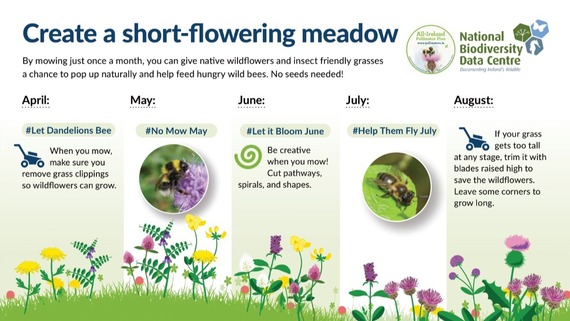
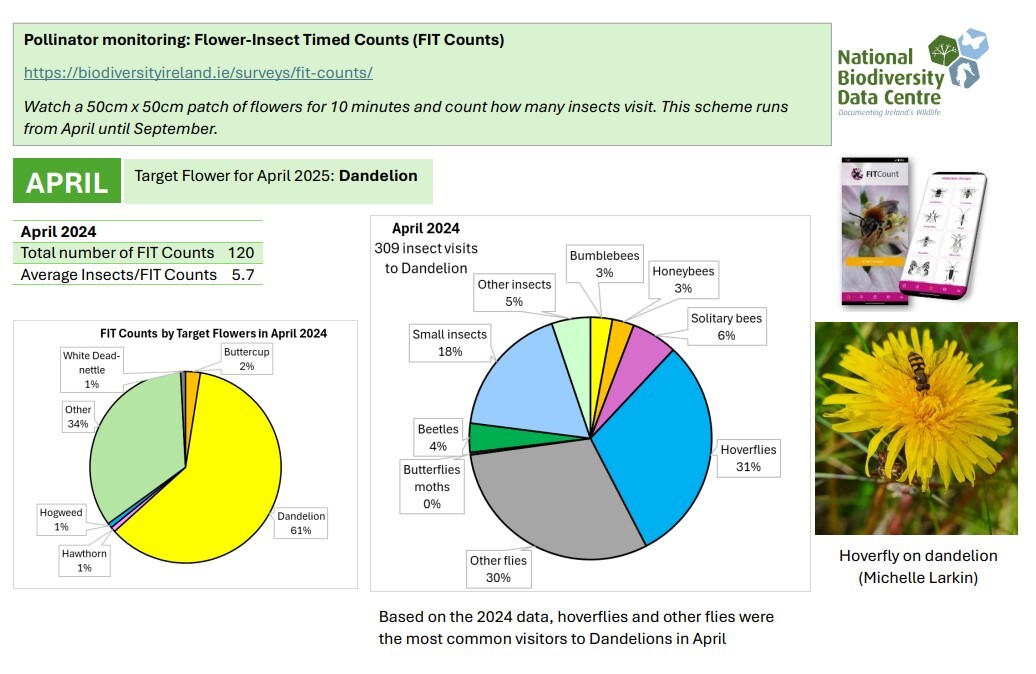
This month will see the biggest bloom of Dandelions. These native wildflowers are vital sources of nectar and pollen. Records sent to the National Biodiversity Data Centre in 2024 showed that Dandelions were the most popular food source for wild bees. Help feed hungry pollinators this month and #LetDandelionsBee.
Reducing mowing even to once a month can help feed our hungry pollinators. By mowing less, you are giving native wildflowers a chance to pop up naturally. Over time this will result in pockets of species-rich grassland: a vital habitat providing food and shelter for pollinators. If you're taking part in No Mow May this year and you're worried about grass growth, cut your lawn before the end of April. This will ensure the height is manageable when it’s time to mow again. Make sure you remove grass clippings to help wildflowers grow.
You can also read a fascinating blog below, summarising a recent scientific study that shows how 'wiggly' mowing can help pollinators!
An additional year each of historic Births, Marriages and Deaths are now available to view on the website www.irishgenealogy.ie. The records now available online include:
- Birth records – 1864 to 1924
- Marriage records – 1845 to 1949
- Death records – 1864 to 1974
Minister for Arts, Culture, Communications, Media and Sport, Patrick O’Donovan TD, welcomed this latest release: “This release of an additional year of register data by the Civil Registration Service is part of the ongoing partnership between my Department and the Department of Social Protection.
“The aim of this continuing project is to make all these historic records freely and easily accessible to all members of the public and broader diaspora via the www.irishgeneaology.ie website.
“I’m sure both new and returning visitors to the site, will welcome the addition of these records for continued research.
“I know that this annual update is eagerly anticipated and will be of great benefit to anyone carrying out research on their Irish ancestry.”
Minister for Social Protection, Dara Calleary, TD, added: “I am delighted to make these additional records available to the Department of Arts, Culture, Communications, Media and Sport so that members of the public and the Irish diaspora can access records to support family history research.
“These records of civil registration in the State are a very rich source of information.
“At this time of year we are particularly reminded of our predecessors who have emigrated and established lives across the globe. These valuable records enable that connection to remain strong.”
The years covered by the historic records of Births, Marriages and Deaths available on the www.irishgenealogy.ie website are:
Births: 1864 to 1924
Marriages: 1845* to 1949
Deaths: 1871** to 1974
* Civil Registration of Marriages in the Roman Catholic Church only commenced in 1864.
**The Civil Registration Service are currently working on updating the remaining records of Deaths dating back to 1864. These will be included in future updates to the records available on the website.
The Minister for Arts, Media, Communications, Culture and Sport, Patrick O’Donovan TD, has today [31/03/25] announced a new phase of the Night-Time Economy support scheme to support established grassroots music venues. The scheme was developed following a recommendation in the revised Night-Time Economy Action Plan in recognition of the contribution that grassroots music venues make to the music industry by nurturing emerging acts, and the challenges these venues face.
A total fund of €500,000 has been allocated to the Grassroots Music Venue Support Scheme (GMVSS) which aims to support small established venues that promote themselves and are known in the community as live music venues or dance venues, with grassroots music performance forming a core part of their programming.
Funding of up to €15,000 will be made available for programming events that showcase the talent of emerging, grassroots artists performing live or electronic music that they have written or created themselves. Under the scheme, venues are required to ensure that all artists and freelance crew are paid. Venues may also apply for funding towards production and crew costs, PR, advertising, ticketing, the hire of equipment, the hiring of security staff and event insurance costs.
For further information, on eligibility criteria and allowable costs please visit the guidelines for the scheme here.
Speaking at the launch of the scheme today at Cleary’s, Newcastle West, Minister Patrick O'Donovan said: “Grassroots music venues are an integral part of the music ecosystem in Ireland and are vital to our communities. I want to support these venues so they can give opportunities to new and emerging artists and give them spaces to perform, develop their skills, and build their audiences. Many of the big acts that we see today in large arenas, started their careers performing in grassroots venues, so it is important that we support these venues to allow them to continue to provide these much needed opportunities for up and coming musicians and DJs.”
The Grassroots Music Venue Support Scheme has been developed in consultation with representatives from the Live Venue Collective, grassroots music industry, Give Us The Night and the NTE Advisors.
Applications will be assessed on a first come first served basis.
Guidelines for the new scheme are available here.
Applications can be made for the new scheme here from noon today.
The Scheme will remain open until noon on 15 May 2025 or until the fund is exhausted, whichever occurs first.
Today [09/04/25], the Government has approved the Revised National Planning Framework (NPF) which, subject to the approval of both Houses of the Oireachtas, will create the conditions for accelerated housing delivery in Ireland. This follows a comprehensive NPF revision process which has been underway since June 2023.
This milestone decision firmly sets the direction for Ireland’s growth and development to 2040, creating the policy environment to release unlocked potential and to address critical priorities, in particular housing, infrastructure and climate. The revised NPF will now directly inform the wider Government policy agenda, the actions of a broad range of public and private bodies, including homebuilders, the renewable energy sector, infrastructure agencies and domestic and international investors.
Speaking today, the Minister for Housing, Local Government and Heritage, James Browne TD emphasised: “Ireland has changed dramatically since the National Planning Framework was first drafted in 2018, and this revision reflects those changes – setting out a clear and strategic policy approach. We are planning for a significant increase in the capacity to deliver housing across the country to meet our population projections and associated housing requirements.
Our growing population places greater demands on housing and infrastructure, and we need to plan for the provision of the right number of homes in the right places – including new sustainable communities at brownfield and greenfield locations along existing or planned high capacity public transport corridors. This Government is committed to delivering housing and crucially, we are also focused on creating the best possible conditions for delivery. The revised NPF provides the conditions we need to have in place to accelerate homebuilding.
Once approved by the Oireachtas, this Plan will shape necessary reviews of current regional strategies and local authority development plans to reflect today’s reality and to ensure the zoning of land for residential, employment and a range of other purposes meets our country’s needs. Having regard to the need to ensure that current local authority development plans can be updated as quickly as possible to reflect the update housing requirements, I also intend, following completion of the NPF Revision process, to provide further clear direction and guidance relating to housing requirements and I fully expect local authorities to translate this revised NPF into their own local plans as speedily as possible.
Ireland needs a step change in the delivery of housing. With a revised NPF, and the new Planning and Development Act being implemented this year, we are making sure that the vital conditions for the accelerated delivery of new homes is provided for in the planning system.”
One of the drivers of change was the need to plan for a population of between 6.1 to 6.3 million people by 2040, and plan for approximately 50,000 units per annum over that period, to meet additional population and employment growth over and above the original 2018 NPF projections. This reflects the latest research and modelling by the Economic and Social Research Institute (ESRI), which forecasts substantial population growth over the next decade. The Revised NPF, with the subsequent provision of updated planned housing requirements at a local authority level, aims to ensure that housing supply meets both new demand and addresses existing need, creating a sustainable future for housing in Ireland.
A copy of the Final Draft revised NPF can be accessed at: https://www.npf.ie/
Minister for Rural and Community Development and the Gaeltacht, Dara Calleary TD, has today (Friday, 4th April) opened the 2025 CLÁR programme for applications. The budget for this year’s programme has increased to €11 million.
Under the initiative, funding will be provided across three measures:
- Development of community facilities and amenities including sports facilities, youth clubs, teenage spaces, playgrounds, sensory gardens, walking tracks and much more.
- Support for community transport such as cancer care support, community first responders, meals on wheels vehicles, or for persons with reduced mobility.
- Tailored funding for our offshore island communities under the specific ‘Our Living Islands’ measure.
The level of funding for community facilities and amenities has increased from €50,000 to €65,000, with a new option this year for local authorities to apply for funding of up to €100,000 for 2 larger scale projects.
To further support Gaeltacht areas, local authorities will be permitted to submit one extra application this year in respect of a community facility in a Gaeltacht area.
Announcing the details of the programme, Minister Calleary said:
“The CLÁR Programme has for many years provided funding to develop and support our rural communities making them more resilient, and more inviting places to live, work and visit.
The CLÁR programme continues to adapt to the needs of communities. Having reviewed the eligible measures for this year, I am delighted to increase the overall grant aid per project and to allow for projects of up to €100,000 which will make a real and tangible difference to communities.
I have also added specific provision for Gaeltacht projects which, alongside our island measure, provides targeted support to these communities.”
Also speaking at the launch, Minister of State for Community Development, Charities and Rural Transport, Jerry Buttimer TD, said:
“The CLÁR programme has provided over €84 million since it was reintroduced in 2016. Over 2,700 projects have been approved in that timeframe and communities nationwide are enjoying the benefits that the CLÁR programme has brought to their community.
We have all seen firsthand this year the importance of our community facilities and, under the CLÁR programme, these will be further supported in some of our most rural areas.”
Minister Calleary concluded by saying: “In line with the Programme for Government commitment, my officials have commenced a review of CLÁR eligibility. I hope to be able to expand the areas eligible under the programme in 2026 having considered the outcome of that review.”
Full details are available on the Department’s website.
Note:
The CLÁR (Ceantair Laga Árd-Riachtanais) programme provides funding for small scale projects in designated rural areas that have experienced significant levels of de-population. The scheme was re-opened in 2016 to support the development of remote rural areas through small-scale capital projects involving collaboration between local authorities (LAs) and communities, as well as for other community-based organisations.
Areas targeted under the CLÁR Programme are parts of counties: Carlow, Cavan, Clare, Cork, Donegal, Galway, Kerry, Kilkenny, Laois, Limerick, Longford, Louth, Mayo, Meath, Monaghan, Offaly, Roscommon, Sligo, Tipperary, and Waterford, Westmeath, Wicklow and all of County Leitrim.
A national map of CLÁR areas, together with individual county maps, is available; here
 Update from Biodiversity in Schools:
We are thrilled to announce the Pollinator Project 2025 is now open!
The Pollinator Project is Ireland's largest & longest running pollinator education programme for schools, now in its 14th year.
We have again joined forces with the wonderful SIRO.
We have FREE teaching kits for up to 9,000 young people across Ireland to train as pollinator ambassadors for their school.
All schools can also take the Pollinator Pledge on our website for access to your FREE certificate, signage, classroom worksheets & online training invite. Also available as gaeilge.
Our Gold Bee trophy is looking for a new home too! We're seeking Ireland's most outstanding pollinator-friendly school. As well as our Gold Bee trophy you'll also receive a €1,000 biodiversity hamper.
Many thanks again to our sponsor SIRO, Ireland’s 100% fibre broadband network, connecting communities across Ireland.
Open to Pre, Primary, Secondary and Homeschools within ROI & NI.
For everything you need to take part please visit our website:
https://www.biodiversityinschools.com/pollinator-project.html
 Update from National Biodiversity Data Centre:
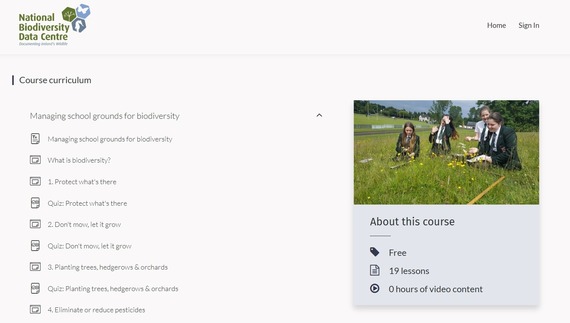
The All-Ireland Pollinator Plan is delighted to launch a new online course ‘Managing School Grounds for Biodiversity’, developed in collaboration with the Department of Education in the Republic of Ireland. It is available through the National Biodiversity Data Centre online learning platform.
This free course is aimed at caretakers, groundskeepers, and those responsible for caring for school grounds. From pesticide alternatives to plant lists, biodiversity-friendly mowing tips to ideas on getting the school community involved, this is an opportunity for any school wanting to manage their grounds for nature, no matter their size, space, or previous experience.
Read more and access the free course
 Update from the National Biodiversity Data Centre:
This scheme runs from April to September. FIT Counts are an important way that you can help us monitor pollinators. Download the free FIT Count App, watch a 50x50cm patch of flowers for 10 minutes and count how many insects visit. You can carry out a FIT Count anywhere, and on any flower, but where you can, please use one of our 15 target flowers. In April, its especially useful to carry out FIT Counts on Dandelion. You do need to wait until it’s sunny and at least 13C though!
In 2024, 784 validated FIT Counts were submitted by 135 different volunteers. The average number of insects per FIT Count was 7 (down from 9 in 2023). The most common insect group recorded were hoverflies followed by other flies then bumblebees. The most common habitat FIT Counts were carried out in was grassland with wildflowers.
Learn more about FIT Counts
 Update from National Biodiversity Data Centre:
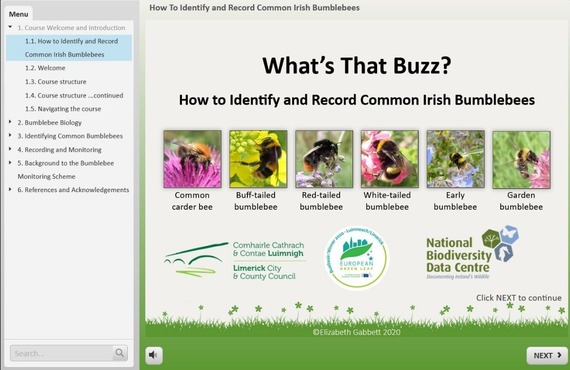
Within the National Biodiversity Data Centre, we have been monitoring bumblebees since 2012, through a citizen science scheme called the Bumblebee Monitoring Scheme. Volunteers within this scheme walk a fixed ~1km route once a month from March to October and count the number of different bumblebees they spot. Beginners are very welcome, but it does require a time commitment in learning how to identify the different bee species. This scheme has been slowly building through our amazing volunteers, but we still need to add another 20 walks over the coming years. March is the best time for beginners to join, as in early spring there will be fewer different species for you to learn to identify. If interested in becoming a volunteer, you can take our free course in identifying bumblebees which also explains how the scheme works.
On an island scale, the scheme helps us understand if bumblebees are increasing or declining. At site levels, it's a great way to assess the impact of actions you are taking in support of the Pollinator Plan. If you decide you’d like to give it a try, please email me directly so that I can add you to my mailing list to receive the Monitoring Scheme monthly newsletter with hints and tips.
Bumblebee Monitoring Scheme website
Free online bumblebee identification course
Members of the public can now tune in again this year to ‘Nestflix’, two new livestreams which show pairs of Chough as they go about building their nests, raising their young and carrying out noisy ‘conversations’ with each other. Chough are vocal birds which means that the livestream comes with one of nature’s livelier soundtracks.
Over the past few years, the National Parks and Wildlife Service (NPWS) at the Department of Housing, Local Government and Heritage has installed cameras at two locations around Co. Cork to observe and better understand the behaviour of Chough and what helps them to breed and thrive. Following last year’s cliff-hanger, two pairs of Chough recently returned to Mizen Head and Clonakilty and are now beginning to build their nests.
Minister of State for Nature, Heritage and Biodiversity Christopher O’Sullivan TD said: “As someone born and raised in West Cork, the distinctive call of the Chough has been part of the soundtrack of my life. I have often had the privilege of watching these playful pairs of Chough swooping and soaring along coastal cliff-tops. Not everyone has the chance to see this beautiful bird with its bright red beak and red legs. Projects like this offer greater public access and understanding about bird life and what we can all do to protect our birds by protecting its habitats and reducing disturbance to nesting sites.
Ireland is of outstanding global importance for this species, supporting over 60% of the biogeographic population of this species and Ireland is committed to ensuring this special bird thrives through a network of eighteen protected sites, four of which are located in Co Cork.”
The Chough is the rarest member of the crow family in Ireland and is largely confined to the south and west coasts. There are around 900 pairs of Chough breeding in Ireland and Co Cork is the stronghold for the species with 30% of the national population. Due to its scarcity in Europe, Chough are protected under Irish national legislation and also the EU Birds Directive, and Ireland has designated a number of Special Protection Areas (SPAs) to help conserve it.
Clare Heardman, Ecologist with the NPWS said: “Chough traditionally nest in crevices in sea cliffs, but some are changing their nesting habits. In Cork more than a third of Chough are now nesting in buildings such as cattle sheds, hay barns and abandoned buildings. This has facilitated the installation of the live nest cameras so the public can get a rare insight into a normally hidden part of the Chough’s life.
The Chough featured in both livestreams are currently building their nests but it won’t be long before they lay. Last year the Mizen pair laid their first egg at the end of March, and the Clonakilty pair at the beginning of April. Up to five eggs were laid in each nest in 2024, with the chicks hatching from late April. During incubation the male feeds the female at the nest, but once the chicks hatch both parents provide for their hungry brood. After four to five weeks, the chicks fledge and leave the nest. So there will be lots of activity over the coming months for people tuning in.”
Livestream links:
LIVE Irish Chough Nest - Mizen Peninsula, Co Cork
LIVE Irish Chough Nest 2 - Clonakilty, Co. Cork
About the Chough
The Chough is a member of the crow family, larger than the jackdaw and distinctive for its bright red beak and red legs and characteristic call. The Irish name of the species – Cág cosdearg translates as red-legged jackdaw. They are insectivores, using their curved red bills to probe the ground for insects and other invertebrates including beetle larvae and ants.
Ireland holds a very large proportion of the world biogeographic population of Chough. Coastal and maritime areas and habitats in Ireland are very important to this species, which breeds in the south, west and northwest of Ireland from County Wexford to County Donegal.
Update from National Biodiversity Data Centre:
The next version of the AIPP will be developed across 2025. We want the next Plan to be the most ambitious yet. Please submit your ideas/suggestions - however big, small or radical! Submit ideas at any time and as often as you like – submissions welcome up until 30 June 2025.
Submit your ideas
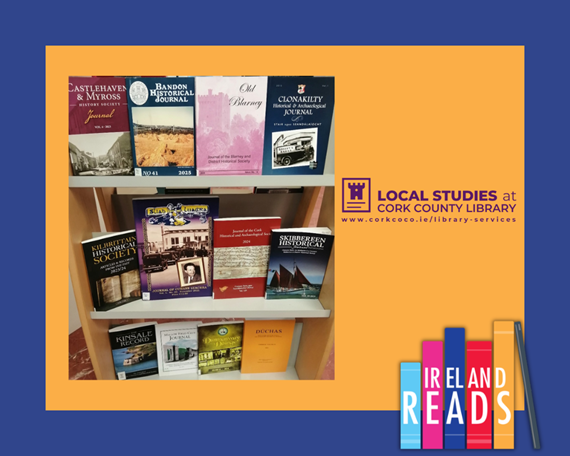 The Local Studies Library is the main repository for Cork County Council Library’s collection of books and resources on the local history of our county. Our mission is to curate and make accessible the rich cultural heritage of Cork. The field of local studies is the study of the history and heritage of a particular area. The definition is broad in its scope, and it can include research into the social, political, economic, and cultural life of people who lived in a particular townland, village, or town through time. Many resources can be used to research a local area but one of the essential sources of information on local history are journals produced by local history societies. These societies are located across the length and breadth of the county.
The meticulously researched work of historians and local history groups captures the fascinating history of their local area and the journals that they produce form an integral part of our collections. These journals form a corpus of historical knowledge that is unique to an area, and they often offer a deeper historical insight into the history of a locale that may not be covered by more general history books. Many of these journals continue to be produced by local history groups and new additions are added to our collections annually.
Physical copies of the journals can be read in the Local Studies Library with some copies available across the branch network.
Did you know that we have over 35 journals produced by historical societies from across the county? To view the current listing of journals in our collections, please visit Cork Local Studies Journals
Why not visit the Local Studies Library and access a wealth of material on the history of your local area. We are open Monday to Friday (9am - 5.30pm).
Local Studies Library, Floor 2, Cork County Council Library Building, Carrigrohane Road, Cork T12 K335
Contact details: 021 - 4285640 or localstudieslibrary@corkcoco.ie
Local Studies Library | Cork County (corkcoco.ie)
Fancy some comhrá agus craic? A dhaoine uaisle, Carrigaline Library is looking for expressions of interest for an Irish language conversation group. Please ask at the desk or call 021 - 4371888. Má ta tú líofa nó má cúpla focal agat, cuirfear fáilte mhór romhat.
Festival season is fast approaching and while there is so much to think about, making your festival or event sustainable has many benefits.
To help festivals and events become more sustainable Cork County Council’s Environment Awareness Office has outlined some practical steps to help you get started and eliminate much of the unnecessary waste. Many of these steps were implemented by festivals all over Cork County in the last number of years.
There is also a Green Festival Toolkit available online to help festival organisers implement waste reduction initiatives at their events.
The Department of Housing, Local Government and Heritage has published a new report on ‘Energy Upgrading of Traditional Buildings for Low Embodied and Life Cycle Emissions’ which may be of interest. This was an action of the Climate Change Sectoral Adaptation Plan for Built and Archaeological Heritage. The report is available to view here /download here:.
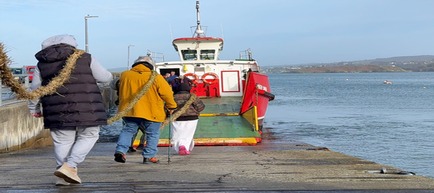 Date/Time: 25 March to 25 April 2025)
Event: Sea and Stone Exhibition
Location: LHQ Gallery at Cork County Council Library Building, Carrigrohane Road, Cork
Additional Information: An exhibition that celebrates creativity on the seven islands off the west coast of Cork opened at LHQ Gallery on Saturday the 22nd of March. The ‘Sea and Stone’ exhibition showcases a selection of works from the past two years of the ‘Creative Places West Cork Islands’ project, presented alongside creative artefacts that are unique to the islands, including painted plaques, knots and ropes, Irish knitting, leatherwork, books, paintings and films. The exhibition runs until Friday the 25th of April.
Creative Places West Cork Islands is an islands initiative funded by the Arts Council and Cork County Council. The project aims to build sustained arts investment and create opportunities for local arts programmes across the seven islands of Cape Clear / Oileán Chléire, Sherkin Island / Inis Arcáin, Heir Island / Inis Uí Drisceoil, Long Island / An tOileán Fada, Whiddy island / Oileán Faoide, Bere island / An tOileán Mór, and Dursey island / Oileán Bao. The exhibition title ‘Sea and Stone’ is borrowed from the islands’ cultural newspaper published as part of the ongoing project.
LHQ Gallery at Cork County Council Library Building, Carrigrohane Road, Cork is open to the public from 9:00am to 5:30pm from Monday to Friday, except for Bank Holidays.
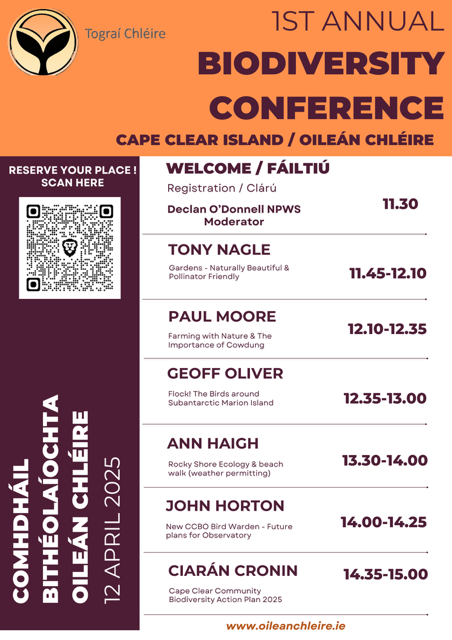 Date/Time: Saturday 12 April 2025 from 11:30 to 15:30
Event: Comhdháil Bithéolaíochta - Biodiversity Conference
Location: CDM's Cléire (Cape Clear Island), Cork
Additional Information: Welcome to the Comhdháil Bithéolaíochta - Biodiversity Conference taking place at CDM's Cape Clear Island! Join us for a day with experts, talks & questions, an engaging walk to the rocky shore, and networking opportunities focused on preserving and celebrating biodiversity. Learn from experts in the field about everything from the value of cowdung to the birds of SubAntarctic Marion Island and the Bogs of Cape. Connect with like-minded individuals who share a passion for protecting our diverse ecosystems. Don't miss out on this unique event! Event organised by Tograí Chléire and for more information go to the Eventbrite link form linktr.ee/tograichleire
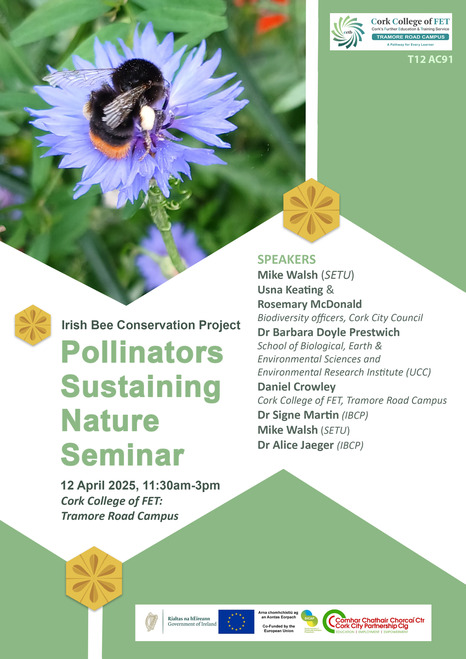 Date/Time: Saturday 12 April 2025 from 12:00 to 15:30
Event: Pollinators Sustaining Nature Seminar
Location: Cork College of FET, Tramore Road Campus, Cork
Additional Information: The Irish Bee Conservation Project would cordially like to invite you to attend the following Seminar on 12th April 2025 in Coláiste Stiofain Naofa between 12.00 and 3.30. On the day there will be 7 speakers from different areas of biodiversity who will contribute 20 - 25 minutes of knowledge on their specific area of expertise.
Invited Speakers on the day:
- Barbara Doyle Prestwich, Biological Earth & Environmental Research Institute UCC
- Usna Keating and Rosemary McDonald, Biodiversity Officers Cork County Council
- Signe Martin and Dr. Alice Jaegor, IBCP
- Daniel Crowley, CSN
- Mike Walsh, SETU.
The main purpose of this Seminar is to lead the way forward in fostering a greater understanding of pollinators and a healthy society. A Panel will be formed on the day with experts and advisors from all walks of life to assist in paving the way to the creation of pollination sanctuaries in Irish Society.
The Irish Bee Conservation Project would like to thank you for taking the time to read this information and hope that you will be able to join us on the day to learn more about the very important and now crucial area of pollination, not only from an Irish viewpoint but also from a global perspective.
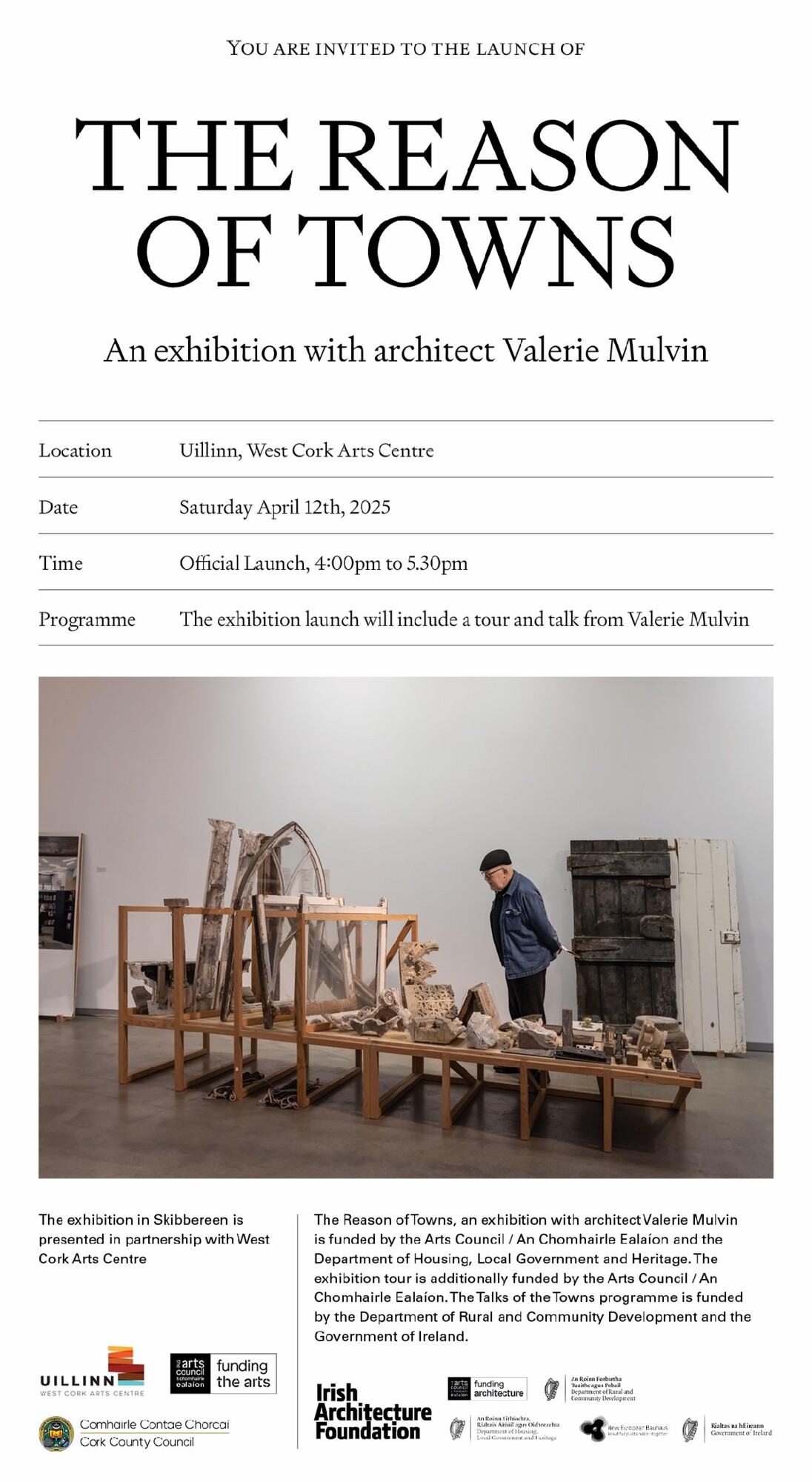 Date/Time: Saturday 12 April 2025 from 16:00 to 17:30
Event: The Reason of Towns – An Exhibition with architect Valerie Mulvin
Location: West Cork Arts Centre, Uillinn, Skibbereen, Co. Cork
Additional Information: Opening at Uillinn: West Cork Arts Centre, Skibbereen, as the final stop in a national tour across Ireland in 2024 and 2025, The Reason of Towns is an engaging and ambitious exhibition by the Irish Architecture Foundation (IAF) of the work of one of Ireland’s most renowned architects, Valerie Mulvin.
Curated, commissioned and produced by the IAF, this touring exhibition features models, drawings, texts, and a series of slides, notes, personal memorabilia, building fragments and more. Together these reflect just a fraction of three decades of work on the subject of towns by Mulvin and her practice, McCullough Mulvin Architects, gathered and published in Mulvin’s book Approximate Formality, which was a starting point for the exhibition.
In addition, The Reason of Towns exhibition presents three specially commissioned films. The Space Is the Thing is a spatial-portrait of Clones, Youghal, Dungarvan and Templemore, describing their ‘ordinary-spectacular’ forms. Of Pride and Place documents ten optimistic stories of action and change by architects working in towns across Ireland. Finally, the third film is an interview with Valerie Mulvin by broadcaster Vincent Woods, reflecting on her work and the subject of the exhibition.
On national tour since August 2024, The Reason of Towns has been engaging communities in Birr, Co Offaly; Belmullet, Co Mayo; Trim, Co Meath; Dublin city; and Thurles, Co Tipperary. Skibbereen is its last scheduled stop in Ireland.
 Date/Time: Saturday 12 April 2025 at 14:00
Event: Athmhúscail (Reawake) by Sonia Caldwell
Location: West Cork Arts Centre, Uillinn, Skibbereen, Co. Cork
Additional Information: Uillinn: West Cork Arts Centre is delighted to invite you the opening of Athmhúscail (Reawake) by Sonia Caldwell on Saturday 12 April at 2.00pm. The opening event will include an introduction to the exhibition by the artist Sonia Caldwell.
Through this exhibition, artist Sonia Caldwell delves into our evolving relationship with spirituality and religious institutions, highlighting our ongoing need for a spiritual dimension in life, and the growing importance of a nature-centered approach to religious belief and practice.
Sonia Caldwell is a sculptor whose work primarily revolves around stone, but in recent years, she has expanded to include clay and plant-based materials, employing a variety of techniques. This reflects a deep connection to her local environment and the wider areas she explores. The act of collecting and processing materials is a crucial aspect of her creative process.
Her practice is grounded in craftsmanship and the inherent qualities of the materials she works with, often using locally sourced or handmade materials. Kilkenny limestone, millions of years old and favoured by many Irish stone carvers, is a recurring choice in her work. The rhythm of sculpting stone is meditative, reinforcing her belief that the rhythm of craft, like the rhythms of seasonal and spiritual practices, should be an integral part of our lives.
Throughout her life, Sonia has sought a more profound way to celebrate seasonal events—one that moves beyond the superficial offerings often presented in our post-religious, secular world. As society undergoes significant changes, so too do our relationships with Christianity and religious institutions. While traditional religious upbringing has provided solace for many, it is becoming increasingly clear that these structures are changing, leaving us uncertain about what direction lies ahead.
At the same time, we find ourselves reassessing our relationship with nature and rethinking the philosophical foundations of modern society. Criticism has often been directed at the Biblical notion of "dominion over the earth," with many questioning its impact. In this context, some look back to pre-Christian Ireland, or to the period when early Christianity coexisted with older spiritual beliefs, in search of meaning.
This exhibition acknowledges that abandoning one form of spirituality without replacing it with something else goes against the deeply ingrained human need for focus and a way to navigate life’s challenges. We seek to connect with others, mark seasonal transitions and share in collective cultural experiences, while remaining open to alternative views. Unfortunately, the belief that one’s path is the only true path has often been the source of religious fundamentalism, leading to suffering and division. This exhibition emphasises the importance of a spirituality that is inclusive and unifying, rather than divisive
ATHMHÚSCAIL EVENTS
A conversation with the artist Sonia Caldwell and Celtic monk and priest, Dara Molloy
Wednesday 23 April at 5.30pm
To expand on the themes explored in Athmhúscail (Reawake), an exhibition by Sonia Caldwell, we have invited Dara Molly to join Sonia in conversation about his personal beliefs and spiritual journey in modern Ireland. Aligned with the themes of the exhibition, this talk will delve into the spaces left by the decline of traditional religious connections. It will also explore our relationship with nature, reflecting on how earlier spiritual traditions fostered a greater respect and understanding of the natural world, and consider our hopes for the future.
The event is free of charge, booking on Eventbrite here
Join us on Tuesday 29 April at 1.00pm for a Gallery Tour and Talk with artist Sonia Caldwell for her exhibition Athmhúscail (Reawake). Free of charge, no booking required, all welcome.
Join us on Saturday 10 May at 12 noon for a Gallery Tour and Talk with artist Sonia Caldwell for her exhibition Athmhúscail (Reawake). Free of charge, no booking required, all welcome.
Date/Time: Saturday 19 April 2025 at 20:00
Event: Talk by Niall Stewart – Kinsale in Medieval Times
Location: Temperance Hall, Kinsale, Co. Cork
Additional Information: Organised by Kinsale Cultural and Heritage Society, local historian Niall Stewart will give a talk on ‘Kinsale in Medieval Times’. All welcome.
Date/Time: Tuesday 22 April 2025 at 20:00
Event: Talk by Patrick O'Callaghan - The Old Kerry Road - Butter Road
Location: Berrings National School, Berrings, Co. Cork
Additional Information: Organised by Inniscarra Historical Society, Patrick O’Callaghan will give a talk on ‘The Old Kerry Road – Butter Road. All welcome.
Date/Time: Thursday 24 April 2025 at 19:30
Event: Illustrated Talk– History of the Tidy Towns
Location: Temperance Hall, Kinsale, Co. Cork.
Additional Information: Organised by Kinsale History Society, a talk on the history of the Tidy Towns, will take place in the Temperance Hall on Thursday 27th April at 7.30 p.m. All welcome.
Date/Time: Friday 25 April 2025 at 8pm
Event: Kilmurry Historical & Archaeological Association (KHAA) AGM.
Location: The Heritage Room, Independence Museum Kilmurry
Additional Information:
Update from Kilmurry Historical & Archaeological Association:
The AGM will give us an opportunity to review KHAA activities in 2024 and keep you updated as to future events and plans.
Election of Officers will also take place.
We are always seeking volunteers to support our work, which encompass tasks such as organising, fundraising, curating, manning the reception desk on Saturdays/Sundays from 2-5 pm, guiding, assisting with exhibitions, and stewarding at events. Full training will be provided as required.
If you are interested in lending a hand, please reach out to us. We would be delighted to connect with you. Email: kilmurry.historical@gmail.com.
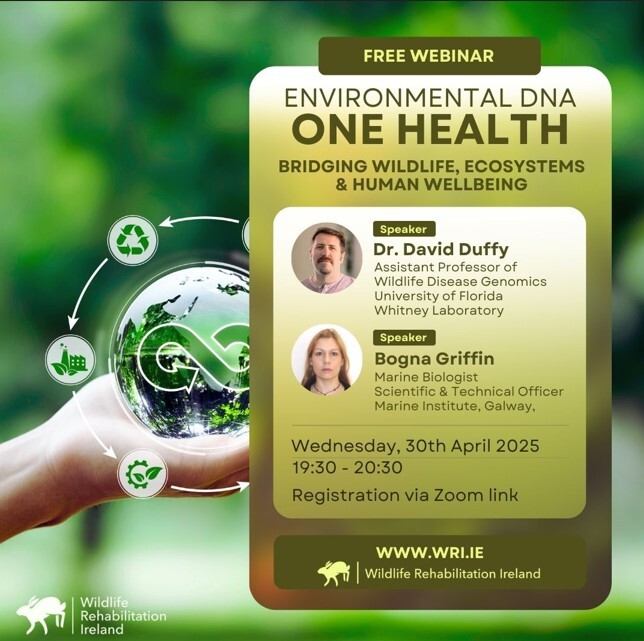 Date/Time: Wednesday 30 April 2025 from 19:30 to 20:30
Event: Webinar – Environmental DNA One Health
Location: Online (see details below)
Additional Information: Register in advance for this meeting: https://us02web.zoom.us/meeting/register/Rf4_FDvlTg-kAgM4p020hw
After registering, you will receive a confirmation email containing information about joining the meeting.
Environmental DNA (eDNA) is revolutionising the way we study and protect wildlife, offering a non-invasive method to detect species, monitor biodiversity, and even track diseases in the environment. At the same time, the One Health approach recognises the deep connections between human, animal, and ecosystem health. But how do these two fields intersect? This webinar will introduce participants to the fundamentals of eDNA and One Health, exploring how cutting-edge scientific techniques can enhance conservation efforts, improve disease surveillance, and provide early warnings for emerging environmental threats.
Bringing together experts from Ireland and beyond, this session will feature insights from David Duffy and Bogna Griffin. They will discuss real-world applications of eDNA in wildlife conservation and its role in understanding health risks that affect animals and humans alike. Whether you’re a conservationist, veterinary professional, scientist, or simply curious about new ways to protect nature, this webinar will provide an accessible introduction to these important topics and their growing relevance in Ireland and internationally.
Date/Time: Wednesday 7 May 2025 at 14:00
Event: Lusitania Commemoration
Location: Signal Tower at the Old Head (2 p.m.) and St. Multose Church, Kinsale (6pm)
Additional Information: On May 7th there will be a commemoration at the Signal Tower at the Old Head at 2 p.m. to commemorate the Lusitania and again at Saint Multose Church at 6 p.m. for the unveiling of a memorial to the victims of 1915, followed by a display of photographs on the Lusitania in the church. All welcome.
Date/Time: Monday 12th May 2025
Event: Seminar: Five years of the Community Monuments Fund
Location: Haddington House, Dublin 4
Additional Information: The National Monuments Service is hosting a seminar entitled ‘Five years of the Community Monuments Fund. Reflections on the past, planning the way forward’ on Monday 12 May 2025, in Tom Johnson House, Haddington House, Dublin 4, DO4K7X4. The seminar will include presentations on best practice in CMF projects from a range of professionals and organisations and will also be a forum for discussion. Further details will be provided in due course and those who wish to express an interest in attending should email cmf@housing.gov.ie with Community Monuments Fund Seminar in subject line before the 14 March 2025. While the National Monuments Service will endeavour to facilitate as many colleagues as possible, due to limited capacity it may not be possible to accommodate everyone.
Date/Time: Tuesday 20th May 2025 at 20:00
Event: Talk by Anne Donaldson - From Cork to New York - a story of 19th century emigration
Location: Vicarstown National School, Vicarstown, Co. Cork
Additional Information: Organised by Inniscarra Historical Society, Anne Donaldson will give a talk titled ‘From Cork to New York – A Story of 19th Century Emigration’. All welcome.
For queries on any of the above or heritage queries in general email:
corkheritage@corkcoco.ie
|