IDL's Legislation
HB588 - Wildland Firefighter Differential Pay
Suppressing wildland fires is an inherently dangerous job given exposures to flames, smoke, aircraft accidents, and the rough and remote terrain that is often far from medical facilities. IDL competes against surrounding states and the federal government to recruit and retain qualified wildland firefighting personnel. Because other jurisdictions provide their wildland firefighters hazard differential pay equal to 25% of hourly rates while engaged in fire suppression activities, we face a significant recruitment and retention impediment. Additionally, when firefighters from other jurisdictions that offer hazard pay are deployed on IDL fires, they receive hazard pay at our expense. This bill compensates IDL's wildland firefighters for working under dangerous conditions and helps protect Idaho's public and private forests and rangeland by allowing us to offer Wildland Firefighter Differential Pay, which will improve firefighter recruitment and retention.
- Dustin Miller and Scott Phillips met with Representative Holtzclaw, Chairman of the House Commerce & Human Resources Committee on January 25.
- Dustin Miller and Scott Phillips met with Senator Patrick, Chairman of the Senate Commerce and Human Resources Committee on January 25.
-
HB588 was unanimously approved for printing on Feb. 9. Rep. Dixon is carrying the bill.
- IDL is working with the House Commerce and Human Resources Committee to schedule a hearing for the bill.
- Learn about this bill in IDL's Wildland Firefighter Differential Pay Information Packet, a comprehensive document that explains the purpose of the bill, provides talking points and other relevant information.
-
HB588 received its first reading hearing on Feb. 21 in the House Commerce and Human Resources Committee.
- Idaho's timber protective associations and forest products industry testified in support of the legislation.
- The bill earned a unanimous "do-pass" recommendation from the committee.
- IDL issued a news release about HB588 on Feb. 22.
- The bill was read for the second time on the House floor on Feb. 23, and was moved to the legislative body's Third Reading Calendar.
-
Status - The bill passed in the House on 2/25 with a vote of 49-19-2, and is scheduled for its third reading in the Senate.
- IDL is grateful to Rep. Dixon for carrying the bill in the House.
- Sen. Woodward has agreed to serve as the floor sponsor for the legislation in the Senate.
HB468 - Preventing Damage to Endowment Land
The Land Board seeks to keep endowment land open for recreational use by the public when such use does not impede the Board's constitutional mandate to maximize long-term returns for the beneficiaries. While most recreational users behave responsibly, occasionally members of the public cause substantial damage to gates, fences, timber, or areas closed to motorized vehicles. Currently, those who damage endowment land may only face misdemeanor or felony charges, but prosecuting attorneys are reluctant to bring such heavy-handed charges forward for minor offenses. This bill establishes infraction-level charges for violating restrictions on the use of endowment land, provided the public is given notice of the restrictions.
HB755 - IDL Budget
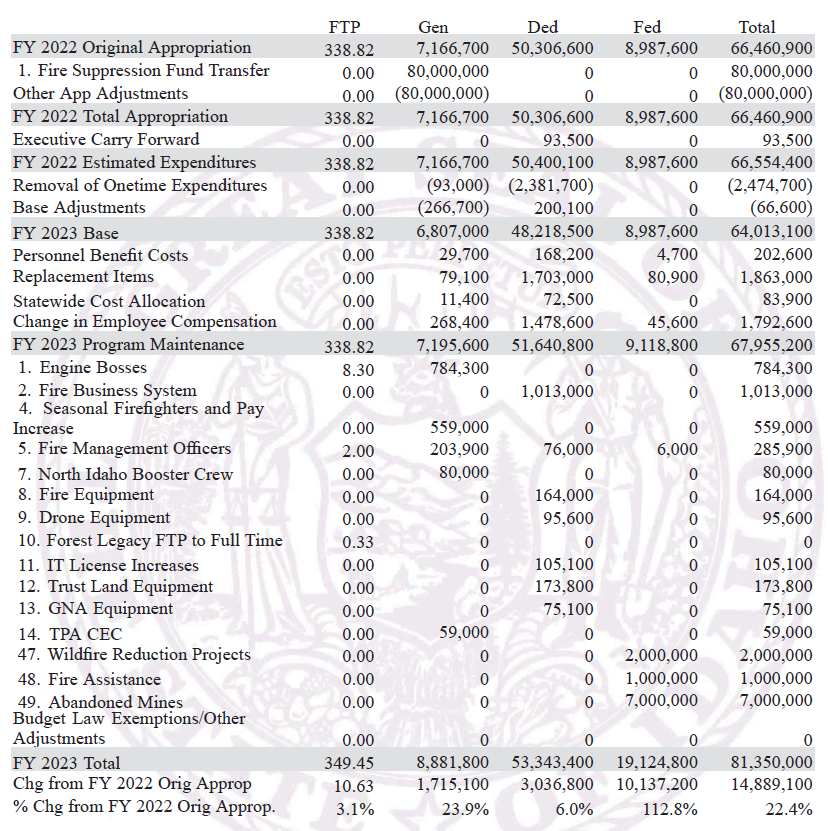
IDL's budget was considered by JFAC on 2/28. Sen. Crabtree carried the motion to appropriate funds to our agency and Rep. Nilsson Troy seconded it. All but two members voted in approval.
The committee largely approved the recommended budget with the following changes:
- 2 of the 3 FTEs for FMOs requested were approved
- $95,000 of the $105,000 requested for drones was approved
- $80,000,000 instead of $150,000,000 was transferred to the suppression account
- The committee did not approve funding $600,000 for the fire consultant
On 3/2 JFAC made a minor technical correction in our budget. This correction did not impact IDL's appropriation.
Status - House passed 49-19-2, and it is scheduled for second reading in the Senate
IDL FY2023 Budget Fiscal Note
Non-IDL Legislation
HB686 - EFIB Budget
- Overall, this appropriations bill recommends 4 FTEs and totaling funding in the amount of $833,500, which represents a 5.7% increase over the prior fiscal year.
- Here's a link to the bill's Fiscal Note.
- The Joint Finance-Appropriations Committee considered the EFIB budget on Feb. 21:
- Sen. Cook made a motion to recommend a FY2023 budget for the agency totaling $833,500, which represents a 5.7% increase over its FY2022 appropriation.
- The budget includes a $15,000 salary increase for the Manager of Investments designed to help close the compensation gap between Idaho's incumbent and comparable positions in other western states.
- Rep. Youngblood seconded the motion, which passed unanimously.
- A video of the hearing, with the EFIB budget discussions beginning at the 20 minute mark, can be downloaded from the Idaho Legislature's website.
-
Status - Passed out of the House 68-0-2; Passed out of the Senate 34-0-1
HB479 - UTV Definition
- This legislation removes the maximum wheelbase criteria on the definition of a UTV (utility type vehicle)
- On Feb. 9 Director Miller and Scott Phillips met with Rep. Monks, the bill's sponsor, to discuss the legislation
-
Status – Passed out of the House 67-0-3; Passed out of the Senate 34-0-1; Signed by the Governor 3-14-22
HB504 - Educational Reimbursement Program
- This legislation adds to existing law to establish an educational reimbursement program
-
Status – printed and referred to Commerce & Human Resources
HB587- Department of Lands
- This legislation creates a gubernatorial appointed ombudsman to oversee IDL trust land related operations and requires IDL staff engaged in trust land management work to have "significant industry experience" to be eligible for IDL employment
-
Status - printed and referred to House Resources & Conservation Committee
HB629 - Idaho Administrative Procedure Act
- This legislation establishes an independent Office of Administrative Hearings
-
Status – Passed out of the House 41-25-4, scheduled for second reading in the Senate
HB665 - Constitutional Defense Council
- This legislation removes the Attorney General from the Constitutional Defense Council
-
Status - Passed out of the House 55-13-2; Referred to Senate State Affairs
HB696 - IDL Legal Representation
- This legislation removes the responsibility of the Office of the Attorney General to provide legal representation to the Department of Lands and allows the Department of Lands to hire or contract its own legal counsel
-
Status - reported printed and referred to State Affairs
HB737 - State Government and State Affairs
- Adds to existing law to prohibit contracts and investment practices involving companies that boycott certain production industries.
-
Status - read the first time and referred to the House Business Committee
HCR 41- EFIB
- Directs the Endowment Fund Investment Board to divest from Russian governmental assets and certain other assets connected to Russia.
-
Status - Passed out of the House 61-0-9; Passed by the Senate with a voice vote
S1251 - State Lands, Exchange
- This legislation amends the existing law to provide for written agreement of permittees and private right holders prior to the exchange of federally managed lands
-
Status – printed and referred to Resources & Environment Committee
S1252 – Taylor Grazing Act
-
This legislation amends existing law to revise provisions regarding grazing preference rights to clarify that grazing preferences are compensable property rights
-
Status – printed and referred to Resources & Environment Committee
S1339 - Public Records
- This legislation clarifies who serves as the custodian of public records and requires public records requests to be submitted to designated custodians
-
Status - Passed out of the Senate 32-1-2; Referred to House Judiciary, Rules & Administration
S1372 - Lands, counsel, attorney general
- This legislation changes the relationship of the Office of the Attorney General with the State Board of Land Commissioners(Land Board) and the Idaho Department of Lands. It allows the Land Board and the Department
of Lands to hire independent counsel in consultation with the Director of the Department of Lands
-
Status - Passed out of the Senate 29-6-0, sent to House
S1397 - Idaho Administrative Procedures Act
- This legislation requires that temporary rules only be used in emergency situations where negotiated rulemaking is not feasible.
- Status - reported out of committee and sent to 14th order for amendment
S1405 - State Government and State Affairs
Rulemaking
In general, the Legislature first sets broad policy mandates by passing statutes, then state agencies create more detailed administrative rules based on those statutes. Administrative rules are designed to facilitate the implementation of laws. This process allows for the public and more detailed scientific, economic, or industry expertise to help guide how statutes are implemented by state agencies.
Log Scaling
The Idaho Board of Scaling Practices is proposing adoption of a new cubic log scaling manual to give another option as to how logs are scaled. This is an alternative to the current "Idaho Log Scaling Manual" and is not meant as a replacement. The current rules allow for cubic log scaling but the board does not have a manual that establishes the rules and procedures for cubic log scaling. A rule is needed to maintain a consistent cubic scale volume anywhere within the state should parties elect to scale in cubic volume. This rulemaking does not change any of the fees currently imposed and the fees noted are the previously approved and codified fees.
Forest Practices
The Forest Practices Advisory Committee voted to recommend language to the State Board of Land Commissions which will simplify the "Shade Rule" next to fish-bearing (Class I) streams and refine the definition of Class I streams to apply only to aquatic life beneficial use. Changes will make compliance easier and less costly with the objective being to retain management options for landowners while still affording appropriate protections to stream shade and large organic debris recruitment.
Rules specific to the use of ground-based equipment on steep slopes have also been updated due to technological changes in the industry which allows machinery to operate safely on steep slopes while minimizing soil disturbance. These technological advances have resulted in a reduction in injuries and improvements in harvest efficiency. The proposed changes will reduce the rule set length, simplify the language, promote rule understanding, and provide economic benefit while maintaining or enhancing water-quality protection.
Public Trust
With this rulemaking the overall regulatory burden has been reduced by decreasing both total word count and the number of restrictive words in this new chapter. Application fees have been increased to cover the costs of reviewing applications, and appraisals, if needed, will now be paid for by the applicant and will not be performed by department staff. The director's approval authority is increased from $10,000 to $25,000 which corresponds with approval authority for easements on endowment lands.
Reauthorization of Existing Fee Rules
This rulemaking publishes rule chapters previously submitted to and reviewed by the Legislature.
Reauthorization of Existing Non-Fee Rules
This rulemaking publishes rule chapters previously submitted to and reviewed by the Legislature.
Legislative Hearings, Deadlines & Events
February 4 - Bill and Joint Resolution Legislative Services Office RS Deadline
- An RS is a “routing slip” number used by the Legislature to identify draft legislation. RSs may or may not become bills and cannot be posted on the Internet until they achieve official bill status. (Read More)
February 8 - Idaho Farm Bureau Federation Legislative Dinner
- Dustin Miller and Scott Phillips were invited to represent IDL at the event, scheduled for 6:00 pm MT at the Riverside Hotel in Boise.
February 9- House Commerce and Human Resources
- The committee held a print hearing for RS29124, will hear H0468, IDL's legislation for Wildland Firefighter Differential Pay
February 9 - Idaho Mining Association Legislative Dinner
- Dustin Miller and Scott Phillips were invited to represent IDL at the event, scheduled for 5:30 pm MT at the Idaho State Historical Museum, located at Julia Davis Park in Boise.
February 14 - 36th Day Deadline for Committee Introduction of Bills, Constitutional Amendments & Joint Resolutions (S. Rule 11 & H. Rule 6)
-
Senate Rule 11 establishes time limits on members of the Idaho Senate introducing bills. House Rule 6 establishes similar time limits for members of the Idaho House.
March 3 - Association of Logging Contractors
- ALC board members will be at the statehouse and will likely set up a meeting with Dustin Miller and Craig Foss.
- ALC is hosting a reception from 4:30 - 7 pm at the Crystal Ballroom.
March 7 - 57th Day Transmittal Date & Target Date for All Transmittals Between Houses
- Joint Rule 20 sets the time frame that amendments to the state constitution must be introduced on or before and transmitted between legislative bodies. Transmittal describes the process of moving approved legislation from one body to the next.
March 25 - Target Date for Sine Die
- The phrase sine die, Latin for "without a day," describes the conclusion of a meeting by a deliberative body, such as the legislature, without setting a day to reconvene.
Reports Due to the Legislature
Annual Report
Annually on or before December 1, IDL is required to report to the Board concerning the condition, management and financial transactions of the department.
GNA
IDL shall report to the legislature and federal agencies, as appropriate (at least annually) as to the status and performance of any proposed or executive agreements under GNA. (A new fact sheet is in progress that might be included with this report/Shared Stewardship Information sheet could be included also.)
Land Exchange
On or before January 15 of each year, the Land Board shall submit a report of al state endowment lands exchanged and acquired and all appraisals, and review appraisals conducted, to both houses of the legislature and to the audit division of the legislative service office.
Procurement
Each agency must report annually to the legislature on all qualifying contracts entered into by the agency the previous year. It must include the following for each contract: the amount, the duration, the parties, and the subject.
OHV Fund
IDL shall annually publish a report specifically identifying the uses of money allocated pursuant to the subsection.
Idaho Timber Plates
IDL shall prepare an annual report (available on request) that is sent to ITD regarding revenues and expenditures associated with funds collected for the special license plate.
Germane Committees
|