Idaho’s January unemployment rate increases to 3.7%
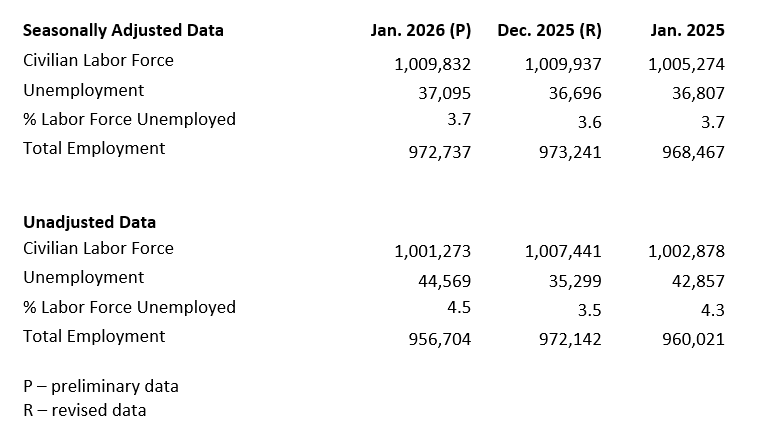
Idaho’s seasonally adjusted unemployment rate increased between December and January, from 3.6% to 3.7%.
December’s labor force decreased by 105 people to 1,009,832 while the labor force participation rate – the percentage of people 16 years or older who are either employed or looking for work – decreased by 0.1 percentage point between December and January, down to 62.8%.
Total employment decreased by 504 (-0.1%) to 972,737 and unemployment increased by 399 (1.1%) to 37,095.
Idaho’s nonfarm jobs had a net decrease of 2,400 (-0.3%) for a total of 879,700 in January. Industry sectors with the greatest over-the-month losses included Construction (-4.4%); Arts, Entertainment and Recreation (-4.1%); Federal Government (-2.2%); Administrative, Support and Waste Management Services (-1.2%) and Real Estate and Rental and Leasing (-0.9%).
Industries that experienced job increases in January included Accommodation and Food Services (2.1%); Private Educational Services (1.1%); Nondurable Goods Manufacturing (0.9%); State Government (0.9%) and Transportation, Warehousing and Utilities (0.6%).
Four of Idaho’s six Metropolitan Statistical Areas (MSAs) had over-the-month nonfarm job losses in January. Lewiston saw the largest decrease at 1.0%, followed by Coeur d’Alene (-0.4%), Pocatello (-0.2%) and Idaho Falls (-0.1%). Boise and Twin Falls experienced no change.
Year over Year
Idaho’s 3.7% unemployment rate for January 2026 was the same as in 2025. The labor force grew 0.5% (4,558), as the number of employed Idahoans increased by 4,270 (0.4%). The number of unemployed Idahoans increased by 288 (0.8%).
Total nonfarm jobs increased by 0.8% (7,000). Most major industry sectors gained jobs except Arts, Entertainment and Recreation (-9.6%); Federal Government (-6.2%); Wholesale Trade (-3.8%); State Government (-2.4%); Information (-2.2%); Nondurable Goods Manufacturing (-0.9%) and Accommodation and Food Services (-0.1%).
Three of Idaho’s MSAs had year-over-year nonfarm job gains in January. Twin Falls had the greatest increase at 1.4%, followed by Boise (0.7%) and Coeur d’Alene (0.3%). Pocatello and Lewiston experienced decreases of 2.0% and 1.3%, respectively. Idaho Falls saw no change.
National Comparisons
Nationally, the unemployment rate decreased between December and January, down to 4.3%. The number of unemployed decreased by 135,000 (-1.8%) to 7.3 million. Total nonfarm payroll employment rose by 126,000 (0.1%) to 158.6 million.
 --end--
* Editors / News Directors – please note:
February, March and April data will have nonstandard release dates due to the annual Bureau of Labor Statistics benchmarking process. Benchmarking includes revisions to state labor force estimates based on new inputs and population data. Nonfarm jobs are benchmarked using reported employer data.
Upcoming Idaho release schedule:
April 20, 2026 – Statewide labor force and nonfarm jobs data for February 2026
May 4, 2026 – Statewide labor force and nonfarm jobs data for March 2026
Find more labor market information at lmi.idaho.gov
|