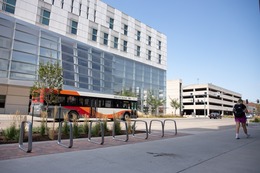
 What is Bus Rapid Transit (BRT)? It's a design approach to mass transit that combines efficiencies like dedicated travel lanes from light rail systems with the flexibility of bus systems, which can be extended beyond a travel corridor and into other parts of a city.
Earlier this year, the cities of North Liberty, Coralville, and Iowa City, as well as Johnson County, the University of Iowa, and the Metropolitan Planning Organization of Johnson County (MPOJC) all contributed funding to a feasibility study of BRT along the CRANDIC corridor.
Key highlights from the recently completed report include:
- An initial estimated ridership of 3,665 passengers for a BRT system between the cities, increasing to 4,360 in 2045. For comparison, Iowa City Transit had a weekday average ridership of 3,443 in FY23.
- Buses arriving every 15 minutes at each stop with an end-to-end travel time of 27 minutes.
- Total annual operations cost is estimated at $2.35 million.
- Total capital cost is estimated at $92 million.
The complete study, which includes a proposal for an adjacent bike trail, is available on the MPOJC website.
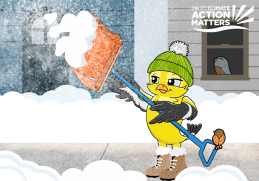 Climate Action mascot Goldie has advice on determining whether more insulation is needed, as well as information on how the City may cover the costs! Click Goldie's image above for a quick video, or learn more at www.icgov.org/insulate.
 Scott Hawes
Habitat for Humanity Executive Director
 How do you take climate action?
At Iowa Valley Habitat for Humanity, we build a very energy efficient home. We use spray foam insulation, install energy recovery ventilation systems, and seal exterior framing with caulk. We're also crazy about electrification, so we install heat pumps and solar panels as often as possible. By successfully reducing energy consumption, we reduce our impact on the environment and lower utility bills for the folks we serve. It's a win-win!
Why is it important to take climate action?
Climate change is the most important challenge of our time, and without immediate action our future will be much more bleak. Through green building initiatives at Iowa Valley Habitat for Humanity, we work really hard to build a better future.
What can others do to take climate action?
For those with the means, I highly recommend investing in electrification. Starting with relatively low-cost investments like home weatherization- check out Green Iowa for an energy audit- and adding extra insulation to the attic, and then eventually graduating to larger investments like swapping a gas furnace for a heat pump, switching to electric appliances, and installing solar panels will make a big impact. For those who aren't able to make those larger investments right now, reducing food waste, using public transportation, and composting are a few ways to take climate action that come with very little cost.
Iowa City’s Climate Action Commission meets monthly

Access upcoming and past meeting packets at the Climate Action Commission web page.
|
|