|
RRVT to HTT Connector Trail Project Update
Mike Wallace, Conservation Director
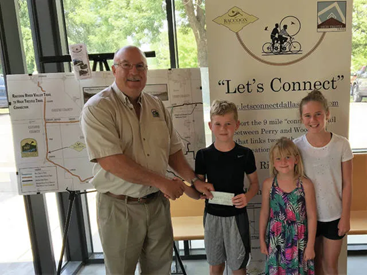
“Phase VI of the Raccoon River Valley Trail to High Trestle Trail Connector Project.” What is that? Well, it’s the Phase we have been waiting for. Phase VI is the FINAL phase of construction for connecting the Raccoon River Valley Trail (RRVT) to the High Trestle Trail (HTT). This project connects the towns of Perry to Bouton and on to Woodward. This 9-mile trail project, which is actually an extension of the HTT and thus will be named “High Trestle Trail,” has been in the works for many, many years (but who’s counting now?). The significance of this is that the final Phase was recently bid out and a contractor has been selected to do the construction of this section of the trail. What is even more significant is that the design specifications for this phase stipulate the project completion date of August 16, 2024. This answers the never-ending question, “when is the connector project going to be done?” There is a good possibility that the actual work will be completed before the August 16 deadline. Either way, it will be done in time to allow for plenty of late summer riding opportunities.
|
|
|
|
Click to view Stivers Ford website
|
|
Click to view Kyle's Bikes website
|
|
|
Click to view Spurgeon Manor website
|
|
Click to view Moss Bros. website
|
|
Taking Action for Wildlife Diversity
Curt Cable, Deputy Director/Biologist

I must preface this article with an apology for the number of acronyms I am about to use. If there is one thing we can all agree on, it is that government agencies are great at creating acronyms.
Dallas County Conservation Board was recently awarded a grant through the Habitat Management Grants Program via the Wildlife Diversity Program with the Iowa Department of Natural Resources (IDNR). This grant program seeks to fund high-quality habitat management projects within the State of Iowa. The project must be focused on reconstruction and/or restoration of non-game wildlife habitat. The ultimate goal is to increase and preserve habitats used by Iowa’s Species of Greatest Conservation Need (SGCN). Steps are outlined in the IDNR’s “Iowa Wildlife Action Plan” (IWAP) which, if carried out successfully, will produce cleaner water and air and create a healthy environment for people and wildlife. Within this plan is a list of SGCN and the habitats they prefer. Kuehn Conservation Area is already home to many of the species listed.
|
|
|
|
Click to view EBC website
|
|
Click to view Van Wall website
|
|
|
Click to view Shottenkirk website
|
|
Click to view Elite Electric website
|
|
The Joy of Christmas (Bird Count)
Mike Havlik, Environmental Education Program Coordinator
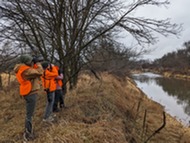
It was a cold and rainy Saturday just before Christmas. I walked into Patrick’s Restaurant in Adel for lunch. I had reserved the party room for the Dallas County Christmas Bird Count, thinking there might be ten people there and that having us in one place would be beneficial for the wait staff. Plus, birders are generally social and would be sharing their rare finds and morning adventures. When I walked in, I was dumbfounded. The room was full of people joyfully chattering, as I expected. What surprised me was the sheer number – nearly 30 people! These brave souls had spent the morning scouring the wild and not so wild areas of Dallas County looking for birds. I caught myself scanning from one end of the room to the other. There were a dozen things I needed to be doing, but I was just staring. It finally struck me: I was in awe that all these people had chosen to volunteer during a busy holiday season on a raw and gloomy day. But, why?
|
|
|
Bill Wagner Special Collection
Pete Malmberg, Museum Curator

Forest Park is very pleased to feature one of Bill Wagner’s unique collections of small, original art pieces for the spring of 2024. The pieces are quite valuable and could only be displayed in special locked cases that the museum now features in Wagner Gallery. These beautiful pieces showcase Bill’s great love of all kinds of art. He admired many different artists from all over the world and corresponded with many of them. Signed prints, etchings, and original sketches were among his most prized possessions. He described them as owning a little piece of that artist, author, statesman, celebrity, or interesting individual.
|
|
|
Calendar of Events

We offer many educational public programs to help you experience the wilds of Dallas County! Click below for details of all our public programs coming up in January, February, and March.
|
|
|
DCVWQMP: An Acronym Worth Deciphering
Zach Moss, Naturalist/Natural Resource Manager
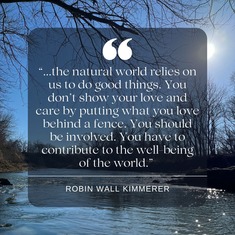
During a recent public program, the participants and I spent time marveling at the miracle of the substance of water. This H2O has many amazing properties on the molecular level that make life possible—come hang out with me by the river sometime if you’d like to ponder these properties together. It makes up 60 to 70 percent of our body, about 71 percent of our planet’s surface, and it’s the substance that researchers look for in outer space to search for signs of extraterrestrial life. Iowa’s recent drought periods have shined a bright spotlight on the value of water in our state.
Because water is so vital to our existence, I’d bet my life that you have taken a sip of H2O in the past few days. Thanks to the federal Safe Drinking Water Act of 1974, the water coming out of your tap is rigorously and frequently tested before it’s pumped through pipes to your kitchen sink (Unless you have a private well. You can get your well tested for free through the county Environmental Health Department). However, the rivers and creeks flowing through Dallas County severely lack abundant, timely water quality data.
|
|
|
Awesome Opossums
Erica Northwick, Naturalist

Spring is here, and that means we’ll start seeing more wildlife as they shake their winter survival strategies. In this species highlight, we’ll talk about a critter who’s probably happy to not have its tail frozen off anymore (literally)!
Opossums are small mammals with mostly gray, sometimes brown, fur that ranges from dark to light. They have hairless toes, tails, and ears. Their fac es are long and cone shaped; they’re about the size of a house cat. But what makes them so special? Let’s find out, and clear up some misconceptions about them!
We only have one species of opossum in the U.S. and Canada: the Virginia opossum (Didelphis virginiana). Opossums are a marsupial, like kangaroos and wallabies. This means we have a native marsupial right in our backyards! The Virginia opossum is our only marsupial, which is just one reason why our local opossum is so unique.
|
|
|
Turkeys Rule the Roost
Greg Sieck, Natural Resource Manager
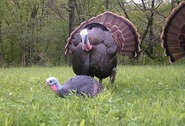
The most sought-after bird in America during spring is the Wild Turkey. This creature is known for its thunderous gobble; a blood-pumping experience best understood when heard firsthand. The spitting and drumming of this wild bird has the power to raise every hunter's heart rate.
Scouting plays a crucial role when pursuing these birds. While in certain cases they may roost in the same area, it is important to note that their location can vary from day to day. These birds can be found on almost all of our public hunting areas in Dallas County. However, the areas can differ in quality, amount of hunting pressure, and accessibility.
|
|
|
The Great Mulberry Dilemma
Matt Merrick, Natural Resource Manager
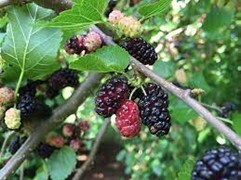
As I go into my fifth spring season as the trail manager for Dallas County Conservation Board, I feel like it’s safe to say the mulberry tree is one of the biggest dilemmas I face on a seasonal basis. It almost never fails: when May and June roll around, the phone calls start coming in. “Mulberries on the trail” is something I hear on a daily to weekly basis. What is the problem, and what are we doing to help steer it in the right direction?
The mulberry tree is widespread in Dallas County. It is usually found as an understory species near powerlines and fence rows. You will typically find two species of mulberry along the trail: red (Morus rubra) and white (Morus alba). Red mulberry is our native species, while white mulberry is considered a “naturalized species.” White mulberry, which is native to Asia, was planted in the eastern U.S. in the 1800s. Not long after, white mulberry spread westward, and began hybridizing with red mulberry. Red mulberry is not very common anymore, and in a lot of regions it is declared endangered. If you see a mulberry, it’s most likely white mulberry or a cross between the two. Telling the difference is very challenging without a proper field guide or genetic testing.
|
|
|
The Dallas County Conservation Board was established in 1962 to protect, preserve, and enhance our natural resources by providing opportunities to improve the public's quality of life through environmental education, ecosystem management, outdoor recreation, and historic preservation. |
|
|
|
|