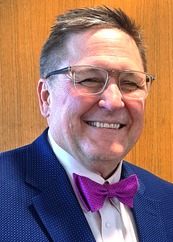
Jon Dunwell was appointed Commissioner to the IUC by Gov. Kim Reynolds on October 5, 2026, to fill the remainder of a term that runs through April 30, 2029. He replaces Erik Helland, who resigned in September.
Dunwell, who lives in Jasper County, is a former state legislator who had served in the Iowa House representing District 38 since October 2021. He resigned that position to accept the IUC role. During his tenure as a legislator, Dunwell served as an Assistant Majority Leader and as Vice Chair of the Administration and Rules Committee and the Administration and Regulation Appropriations Subcommittee. He was also a member of several legislative committees, including Agriculture, Environmental Protection, Judiciary, Local Government, State Government, and Transportation. Additionally, he served on the joint International Relations Committee.
Dunwell’s professional career includes experience as an executive coach and vice president of a national financial services firm and a background in pastoral ministry in Minnesota, Florida, and Iowa. He most recently served as Director of Outreach and Engagement at The FAMiLY Leader.
|
Through leadership roles at the regional level, IUC Chair Sarah Martz and Commissioner Joshua Byrnes are helping to spearhead efforts across the Midwest to ensure that large computational loads fairly absorb the cost of the transmission infrastructure built to serve them.
Both Martz’s leadership within the Organization of MISO States (OMS) and Byrnes’s role on the Southwest Power Pool (SPP) Regional State Committee (RSC) allow the Commission to advocate for transmission planning and cost allocation frameworks that protect existing ratepayers from subsidizing the significant network upgrades needed to serve large loads. Their active engagement in MISO and SPP stakeholder processes helps drive regional policy toward cost-causation principles, ensuring large electricity customers contribute their fair share toward long-term grid reliability.
OMS recently published a position statement laying out specific elements that MISO must incorporate in order to address the concerns of states on cost shifting.
While state utility commissions regulate local retail rates and approve certificates for line construction, jurisdiction over wholesale regional transmission cost allocation rests with the Federal Energy Regulatory Commission (FERC). However, participation in Regional State Committees provides state regulators with significant formal input into regional transmission organization (RTO) filings before they reach FERC. By leveraging their seats on the MISO and SPP state committees, Chair Martz and Commissioner Byrnes ensure Iowa’s ratepayer interests shape the foundational wholesale rules, directly influencing how billions of dollars in regional grid expansion costs ultimately flow down to state-level utility bills.
General application period for LIHEAP begins November 1
Assistance with heating bills through the federal Low Income Home Energy Assistance Program (LIHEAP) is available to help qualifying Iowa households pay part of their residential heating costs.
The general application period for renters and homeowners who fall within federal poverty guidelines begins November 1; households with a resident age 60 or older, a disabled resident, or those who are in housing crisis could submit applications beginning October 1. The application period for everyone continues through April 30, 2027.
LIHEAP is administered by the Iowa Department of Health and Human Services. Customers facing hardship in paying for utility service can work with their local community action agency to apply for LIHEAP energy assistance funds, which also protects those customers’ households from utility disconnection.
However, LIHEAP is not designed to pay a household’s total energy costs. The program will provide supplemental assistance based on several factors, including total household income, household size, dwelling type, and type of heating fuel. A LIHEAP payment is made directly to your utility or heating fuel vendor, with limited exceptions for applicants whose heating source is included in their rental payments.
Information on LIHEAP and community action agencies is available on the Iowa HHS website, or find out more about how to apply on the IUC’s LIHEAP webpage.
Beyond LIHEAP, Iowa law requires utilities to operate a fund that allows customers to voluntarily contribute money for deposit in a low-income heating assistance fund. These programs all assist low-income consumers with paying energy bills and paying for weatherization of their homes.
Disconnection moratorium
Iowa’s winter moratorium, during which time electric and natural gas utilities forgo service disconnections for qualifying utility customers, is November 1 through April 1.
Iowa Administrative Code rules require that electric and natural gas utilities do not disconnect service during the five-month period for households certified by a community action agency as eligible for LIHEAP or its companion weatherization assistance program. Additionally, customers who inform their electric or natural gas provider that they are applying for LIHEAP receive a 30-day stay of disconnection to allow that application to be processed by the customer’s community action agency.
Although qualified applicants cannot be disconnected for nonpayment during the moratorium period, the IUC encourages LIHEAP-certified customers to continue paying toward their energy bills to avoid accumulating high debt and facing potential utility service disconnection once the moratorium period ends.
The telecommunications industry is currently in a nationwide transition from “plain old telecommunications services” provided over copper lines to newer technologies such as wireless and voice over internet protocol services (VoIP).
To speed up that transition, the Federal Communications Commission (FCC) adopted an order on March 26, 2026, with changes that include reducing the filing requirements associated with FCC rules for network change disclosures, streamlining rules for discontinuance applications under 47 U.S.C. § 214, and granting blanket section 214(a) authority for carriers to grandfather legacy voice services. The order also explicitly preempts any state or local laws that would require telecommunication providers to maintain copper infrastructure after the FCC has approved the provider’s application to discontinue telephone services.
Since the FCC issued its order, the IUC has seen an increasing trend of customers receiving notifications from their providers that traditional landline telephone services are being discontinued. For example, both CenturyLink (Lumen) and AT&T notified the FCC and their respective customers of their intent to discontinue landline services this month. CenturyLink discontinued service in 20 Iowa communities; AT&T is ending copper-based landline service statewide.
The IUC anticipates this trend will continue. If you, as a customer, have traditional landline telephone service and receive notification from your provider that your service is being discontinued, you will likely need to change the type of service you receive or find a new provider. Alternative communications options include service through a VoIP provider or cellphone service provider.
The IUC has limited jurisdiction over telecommunications but is available to assist customers with reaching their provider to learn more about the changes. Learn more on the IUC’s new Landline Phone Service webpage.
The IUC travels statewide for its “One Call Road Show” to promote 811 safe digging awareness and ensure compliance with Iowa’s underground utility laws. Through its interactive Road Show, IUC staff not only educate the public on 811 safe-digging practices, but they also provide excavators and utility companies with tools that help them understand One Call better and know what to do if there’s damage to a utility.
Complementing its broad public outreach, the One Call team extends its 811 education initiative into classrooms by tailoring programs specifically for school-age children and youth groups. Designed to build safety habits from an early age, these interactive school visits teach students what underground utilities are, why color-coded locator flags matter, and how calling 811 keeps communities safe.
Younger students participate through engaging visual aids, stories, and activities, while older middle school and high school students receive practical lessons on public safety and how to be safe around underground utilities.
By instilling these concepts early, the program not only prepares young Iowans with essential life skills, but also encourages them to share safe-digging principles with their families at home.
In addition to its in-person outreach, the One Call team also recently added helpful online tools to use in connection with digging projects, including a preconstruction checklist, an excavator hit line form with emergency response protocol and incident investigation reporting guide, and a utility damage investigation form. All forms can be found on the Iowa’s One Call Law page on the IUC website.
The IUC adopted new rules this summer that will minimize impacts of large-scale electric transmission lines planned in Iowa.
The revised IUC rules, which took effect on July 29, govern the electric transmission line franchise process under 199 Iowa Administrative Code (IAC) chapter 11 and set new safety standards in the Iowa Electrical Safety Code, 199 IAC chapter 25, for lines operating at a maximum voltage of 170,000 volts or greater. The change will apply only to petitions filed after January 1, 2027.
The new rules address safety and technical issues and set restrictions on noise, electric field strength, and guy wires. The IUC sent a letter to the Midcontinent Independent System Operator (MISO), the electric grid operator that serves a majority of Iowa, encouraging the grid operator to consider Iowa’s rules when awarding competitive proposals for new transmission lines in its Tranche 2.1 portfolio.
“We believe that evaluating proposals according to these standards can ensure MISO’s competitive process will be effective, the most viable project will be chosen, and the final selection will be aligned with Iowa’s regulatory environment,” IUC Commissioners said in the letter.
MISO CEO John Bear thanked the IUC for a “collaborative and timely approach so these rules can be factored into our Long Range Transmission Planning process” and added that “clear and timely state rules like this should help ensure the timely execution of these facilities.”
On October 21, MISO announced its selections for two projects that include construction in Iowa: a 345/765 kV project in Marshalltown, Lehigh, Montezuma and East Adair (MARS) and a Minnesota/Iowa project that extends from East Adair to the state line (EASL). MISO wrote to the IUC that Iowa’s new codes and standards were “carefully incorporated into MISO’s evaluation processes for the MARS and EASL projects.”
The IUC appreciates its ongoing collaborative relationship with MISO on this matter of critical importance to landowners and surrounding communities at a time when large-scale transmission projects are being planned through the state.

Jeff Michlik joined the IUC in August as manager of the Regulatory Analysis bureau. Michlik and his family relocated to Iowa from Arizona, where he had spent more than 20 years as a regulatory analyst with both the Arizona Corporation Commission and as a Public Utilities Manager with the Residential Utility Consumer Office.
Michlik was involved in water, wastewater, electric, and gas rate cases before the Arizona Corporation Commission, most recently in the areas of Revenue Requirement, Cost-of-Service Studies, Rate Design, and Adjustor Mechanisms. He is also a certified public accountant licensed in Arizona and a certified rate of return analyst with the Society of Utility and Regulatory Financial Analysts.
|
The U.S. DOT’s Pipeline and Hazardous Materials Safety Administration (PHMSA) visited the IUC July 7-9, 2026, to conduct an evaluation of the pipeline safety program activities carried out by the agency in calendar year 2025. The evaluation included a review of annual Progress Report documents, pipeline program procedures and records, and an observation of an on-site pipeline operator inspection conducted by IUC staff.
PHMSA monitors state pipeline safety programs, and annual evaluations are required under Sections 60105(e) and 60106(d) of Title 49 of the United States Code to ensure compliance with the Pipeline Safety Act and to provide information that will allow PHMSA to determine the state’s total pipeline safety grant score for the upcoming year.
PHMSA assesses the overall performance of a state’s pipeline safety program by scoring information contained in the required pipeline safety program Progress Report and by conducting a program evaluation.
During the July visit, PHMSA scored IUC’s Gas Pipeline Safety Program 100 out of 100 points for the program evaluation review and 50 out of 50 for the progress report review. Progress report metrics relate to the state’s leak management, incident investigations, and damage prevention program and its inspector qualification, inspection, and enforcement activities.
The IUC released its finalized Operational Plan for fiscal year 2027 in August. The plan includes the agency’s FY 2027-29 Strategic Plan.
All executive branch agencies submit an annual Operational Plan that describes the agency programs, associated operational goals, and specific action steps toward achieving positive outcomes on behalf of Iowans and stakeholders.
The IUC has four strategic initiatives driving the operational goals for FY 2027:
1: Build Employee Excellence
2: Enhance Public Transparency and Stakeholder Engagement
3: Prepare for and Evaluate Energy Load Growth and Market Dynamics
4: Pursue an Efficient and Effective Regulatory Environment
The IUC Operational Plan can be found on the Iowa Department of Management’s website.

Pipeline Safety manager appointed to APGA board
Sanel Lisinovic, Pipeline Safety and Engineering bureau chief, has been named to the American Public Gas Association’s Security and Integrity Foundation (APGA SIF) Board of Directors. Lisinovic serves with 11 other board members, several of whom are fellow PHMSA pipeline safety program managers in their respective states.
The SIF promotes the security, operational integrity, and safety of natural gas distribution and utilization facilities. Specifically, the group focuses on the nation’s small gas distribution infrastructure, such as the nearly 50 municipal gas utilities in Iowa. The group is responsible for tools such as the Simple, Handy, Risk-Based Integrity Management Plan (SHRIMP) that are critical in assisting smaller natural gas utilities in meeting the complex safety standards required for natural gas pipeline operation.
In his role on the Board of Directors, Lisinovic will have direct input into creating and updating guidance for these small but critical gas utilities serving communities in Iowa and those across the country.
|

Electric Safety manager named to NARUC critical infrastructure group
Ryan Rush, the IUC’s Electric Safety and Engineering bureau chief, was appointed last month to the NARUC Staff Subcommittee on Critical Infrastructure. Ann Rendahl, NARUC president, congratulated Rush in a letter, stating participation with the group “is vital to advancing thoughtful, resilient approaches to safeguarding the systems and services that underpin our nation’s energy sector and public well-being.”
The group has a dual focus: helping state regulators assess and manage risks to the reliability, security, and operational resilience of essential utility infrastructure (energy, water, telecommunications, and gas), and evaluating policies regarding cyber incident reporting, protection of critical energy infrastructure information, and defense-community energy partnerships.
|

Chair Martz reappointed to lead MISO working group
IUC Chair Sarah Martz has been appointed to a second yearlong term as chair of the MISO Regional Expansion Criteria & Benefits Working Group, which provides a forum for stakeholders to discuss existing or proposed criteria and cost-allocation policies for regional and interregional cost-shared transmission projects. The reappointment extends Martz’s term with the group to October 2027.
|
Iowa Code § 476.8 obligates the IUC to ensure that public utilities provide their customers with reasonably adequate service. To that end, the IUC has asked electric utilities for the fifth consecutive year to provide insight into their winter preparedness plans by answering questions about the previous and upcoming seasons.
The IUC opened Docket No. INU-2026-0003 to gather information from the utilities about peak loads, planning reserve margin, major event energy alerts, outages, fuel availability and more. While rate-regulated utilities are required to submit information in the docket, all other electric utilities are welcome to share information as well. The information is due October 29.
For the second year, the seasonal preparedness inquiry includes discussion about grid hardening and resilience. The IUC hopes providing the information will ensure utilities are prepared to appropriately handle the rapid energy demand that comes with extreme weather events.
The IUC began gathering seasonal preparedness information in 2022 and also asks utilities each spring to submit their summer preparedness planning efforts.
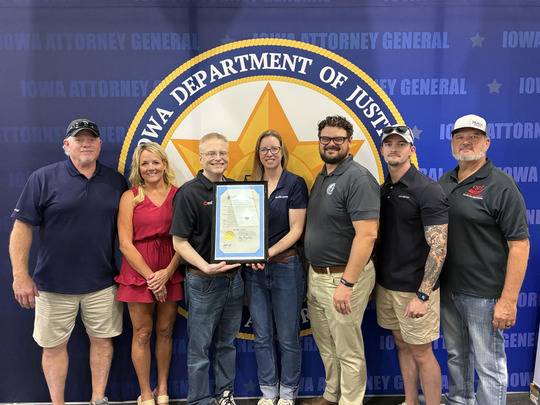 Chair Sarah Martz joined representatives of the Iowa Attorney General’s office, Iowa One Call, Common Ground Alliance and others at the Iowa State Fair to recognize 811 Day, which supports safe digging and the requirement to submit a utility locate ticket before beginning any excavation project. Gov. Kim Reynolds signed a proclamation recognizing August 11 as 811 Day in Iowa. IUC Safety & Engineering staff, including our summer interns and One Call Investigator Greg Witzenburg, also worked shifts in the Iowa One Call booth at the fair to educate the public on safe digging practices and Iowa’s law. | Photo by Greg Witzenburg, IUC
Safety Minute
Approximately 1,200 Americans die each year from unintentional carbon monoxide (CO) poisoning, and more than 100,000 people visit emergency rooms after CO exposure, according to the National Carbon Monoxide Awareness Association (NCOAA). CO is an odorless, colorless gas that can cause severe illness when high levels are present in the air — and it can be deadly in minutes.
November is carbon monoxide awareness month, and the IUC joins NCOAA and utilities nationwide in highlighting CO risk factors and prevention efforts.
The onset of cold weather is a good time to review the installation and working condition of fuel-sourced appliances in your home to make sure you do not have a CO leak.
Additionally, follow these tips to avoid CO exposure:
- Install CO alarms on every floor and test them monthly; only 49% of American homes have working CO detectors.
- Install an exhaust fan over gas stoves.
- Open the flue damper when using a fireplace and check flues, chimneys and vents regularly to ensure they are not obstructed by debris such as snow or leaves.
- Hire a professional to install or inspect, clean, and maintain furnaces, stoves, fireplaces, and chimneys.
- Ensure wood-burning stoves are properly vented and doors fit tightly.
- Do not use unvented fuel-burning space heaters, fuel-fired grills, gas-powered engines, or generators indoors or within 20 feet of a building or structure.
- Never heat your house with a gas oven, camping stove, or charcoal grill.
- Do not idle a vehicle in a garage, even if the overhead door is open.
The most common symptoms of CO poisoning are headaches, dizziness, weakness, upset stomach, vomiting, chest pain, and confusion. If you think you have CO poisoning, get fresh air immediately and seek appropriate medical attention.
If you suspect a CO leak in your home, contact your gas utility for a home evaluation and do not return until a professional has determined the home is safe.
To learn more, visit the U.S. Environmental Protection Agency website for ways to protect your family from CO poisoning.
IUC staff provide a short presentation at each monthly Commission meeting that focuses on safety around utilities.
Public Hearings
-
E-22550: MidAmerican Energy Company - 9 a.m. October 29, Hampton Inn, 2204 River Road, Council Bluffs
-
GCU-2026-0001: Central Iowa Power Cooperative’s application for a generating certificate, Nov. 17-19, Double Tree by Hilton, 111 E. Second St., Davenport
-
GCU-2026-0002: Interstate Power and Light Company’s application for a generating certificate, December 7-11, Radisson Hotel, 1200 Collins Road N.E., Cedar Rapids
Informational Meetings and Other IUC Proceedings
-
RMU-2025-0199: Oral presentation regarding proposed rule changes – 9-11 a.m. October 29, IUC Hearing Room
-
E-22574: MidAmerican Energy Company’s proposed electric transmission line project in Adair, Ringgold and Union counties, noon November 2, Iowa State Savings Bank Building at Union County Fairgrounds, 301 S. Grace St., Afton
-
E-22574: MidAmerican Energy Company’s proposed electric transmission line project in Adair, Ringgold and Union counties, 5:30 p.m. November 2, Homestead Hall, 2214 U.S. Highway 169, Mount Ayr
Monthly Commission Meetings
No meetings are scheduled for November or December. Follow the IUC Hearing and Meeting Calendar for future meeting dates.
Holiday Office Closures
- November 11 – Veterans Day
- November 25-27 – Thanksgiving
- December 24-25 – Christmas
- January 1 – New Year’s Day
IUC and OCA offices are closed on official State holidays, though EFS and IUB 24/7 remain available. Filings will be processed on the next working day. Office closures are also posted on the IUC website, iuc.iowa.gov.
|