New federal actions take aim at cost-shifting
As Iowa continues to attract large-scale technology manufacturing and artificial intelligence (AI) data centers, a common and valid concern for many Iowans is: Will these massive facilities drive up my monthly electric bill? On June 18, 2026, the Federal Energy Regulatory Commission (FERC) took a major step in attempting to ensure the answer is a firm "no."
FERC issued "show cause" orders to the nation's regional grid operators, including the Midcontinent Independent System Operator (MISO) and Southwest Power Pool (SPP), which manage Iowa’s bulk power grid. These orders mandate that grid operators reform their rules to handle massive new power demands without shifting the financial burden onto regular consumers.
Protecting Regular Consumers
A primary pillar of FERC’s new directive is ratepayer protection. Key guiding principles of this federal push are that grid operators and transmission-owning utilities will be required to update their procedures to address the following:
- Better protection from cost shifting for non-data center customers
- More transparency on what upgrades are being planned for data centers and the associated costs
- Reforms relating to the study process for data centers and their effect on the grid
FERC has asked the states for guidance on these reforms, and the IUC is actively engaged in that process. At the same time, the IUC is also utilizing its local authority over retail electric rates to make new large electric customers like data centers pay the costs of grid upgrades needed to serve their facilities.
FERC’s action provides a crucial regional backstop. It aims to ensure that as Iowa fuels the digital economy, the multi-million-dollar energy infrastructure costs required to support it are borne by the tech developers themselves, not Iowa families and small businesses. Grid operators’ tailored regional protection plans will be submitted to and evaluated by FERC over the next year.
Iowa law requires electric and natural gas utilities to operate customer contribution funds (CCF) that accept voluntary donations to assist low-income customers. The funds help supplement energy assistance for winter heating bills and support weatherization measures that improve household energy efficiency. Utilities may operate the funds under names such as Project Share, RECare, or I CARE.
Each utility administers its own fund and establishes a board or committee to determine how funds are distributed. Assistance may be provided directly by the utility or in coordination with a local community action agency.
During fiscal year 2025, more than 9,800 customers contributed approximately $2.61 million, including matching funds. Utilities distributed approximately $2.67 million to 7,503 households, with average assistance of $356 per household. Funds not distributed during a fiscal year are carried forward for future assistance.
Customers interested in making a one-time or recurring contribution should contact their local electric or natural gas utility.
Annual reports due September 30
Utilities must file an annual report of CCF activity for the previous fiscal year with the IUC by September 30. Reports covering July 1, 2025, through June 30, 2026, should be submitted using the 2026 form and filing instructions provided by the IUC. The information is compiled into the annual statewide CCF report submitted to the Iowa General Assembly.
A reminder letter about the filing will be sent to the company contact of all electric and natural gas utilities in the state on July 30, along with the form and instructions.
The IUC’s electronic filing system (EFS) now requires users to create an account before filing or searching for documents. Utility staff that are responsible for submitting CCF reports should complete the registration process before the filing deadline. Registration instructions will be included with the annual reporting materials and are also available on the IUC website.
The most recent statewide report and CCF resources are available on the IUC’s Utility Customer Contribution Funds Report webpage.
Iowa’s Uniform Rules on Agency Procedure, chapters 2500 through 2506 in title 7 of the Iowa Administrative Code, were revised by the Iowa Legislature as provided for in SF 2463. The IUC filed its rules that correspond with the agency’s approved opt-out exception.
As of July 1, rules references reflect the new corresponding chapter numbers shown below.
- Contested Cases - 199 IAC chapter 7 is now 199 IAC chapter 2506
- Waivers - 199 IAC 1.3 is now 7 IAC chapter 2504
- Rulemakings - 199 IAC chapter 3 is now 7 IAC chapters 2501 and 2502
- Confidential Treatment - 199 IAC 1.7(3) is now 199 IAC 2505.9, 199 IAC 1.7(4)(c) is now 199 IAC 2505.5(4), 199 IAC 1.7(1) and 1.7(4)-(8) are now 7 chapter 2505
- Declaratory Orders - 199 IAC chapter 4 is now 7 IAC chapter 2503
Additionally, 199 IAC 1.7(9) will be addressed in Docket No. RMU-2025-0199 as part of the clean-up docket along with Uniform Rules cross-references.
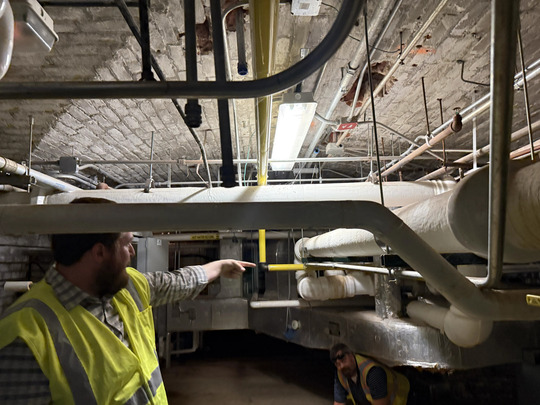 IUC Utility Attorney Carter Wright inspects natural gas piping systems located underneath the Iowa Capitol during a routine inspection held as part of the Des Moines Unit review conducted over two weeks in June by the Pipeline Safety and Engineering bureau. | Photo by Sanel Lisinovic, IUC
As a PHMSA state partner, the IUC is responsible for participating in a pipeline safety program for natural gas utilities across the state of Iowa. Within the agency, it is the Pipeline Safety and Engineering Bureau that implements the program, which involves inspecting records, programs, procedures, and facilities for natural gas utilities across the state.
Larger utilities that serve wide geographical areas are divided into “units” to allow the IUC to focus on one particular area of the state at a time. Each unit is inspected at least once every three years by the pipeline safety inspection team. During the inspection, the IUC focuses on records, such as utility responses to leak calls, patrols to identify pipeline safety issues, construction documents, and much more. The IUC also conducts a field inspection throughout the unit, involving stops at pressure monitoring stations, commercial areas, retail shops, schools, places of public assembly, and residential neighborhoods, to name a few. Depending on the geographical size of the unit, along with the number of customers served in the area, a unit inspection may take two to three weeks to complete.
This year it was time for the Des Moines Unit inspection, a rather large undertaking involving locations in more than 40 metro communities. The entire IUC pipeline bureau took part, including office personnel, attorneys and engineers who don't normally join in on inspections. It was an opportunity for the pipeline office staff to learn more about what the on-the-road inspectors do when they visit inspection sites four days a week, year-round.
One of the most interesting stops was at the Iowa Capitol, where the team had to crouch and crawl around the basement to inspect the gas meters. While most new gas meters are installed on the outside of buildings, older meters, particularly those in populated areas or on historical buildings, may be located inside.
This creates a unique access challenge for inspectors, but, as gas inspector Dan O’Connor often says, “If we don’t look at it now, when will we get the next chance?” Just because a portion of the gas utility system is difficult to access doesn’t make it any less important to check for compliance with safety requirements!
Meetings to share utility plans with the public have different functions
MidAmerican Energy Company recently filed a natural gas rate case, and you may have seen information about upcoming consumer comment meetings or a scheduled virtual meeting to be held as part of the proceeding. While consumer comment meetings are held for rate cases, the IUC also holds another type of meeting — informational meetings — for proposed infrastructure or generation projects across the state.
The IUC can require that a consumer comment meeting be held by a rate-regulated utility during a rate case so the public can “express their views regarding the [rate] case before the commission as well as the general quality of service provided by the utility,” as stated in 199 Iowa Administrative Code (IAC) 26.9(1). That meeting’s purpose is to allow utility representatives to explain the details of its rate case proposal and answer questions from the public; the IUC schedules a presiding officer to oversee the consumer comment meeting.
Consumer comment meeting locations are approved by the IUC and always held in communities served by the utility. Usually multiple consumer comment meetings are scheduled to reach the utility’s customers throughout the state. Because consumer comment meetings are not required by Iowa Code and are held at the discretion of the IUC, the meetings may occur after the application is filed and while review is pending by the IUC.
At consumer comment meetings the presiding officer will not talk about the facts of the case or answer questions, because the IUC’s role is to serve as the decisionmaker in the proceeding. The presiding officer can talk generally about the process of the rate case.
Informational meetings also educate public
Separately, an informational meeting is required before a petition or application is filed by a utility for an electric franchise, pipeline permit, or generating certificate, with limited exceptions. The IUC will also preside over this type of meeting and will present information to potentially affected landowners. The company will then present information regarding its proposed project.
If the informational meeting is for a transmission line or pipeline project, a meeting must be held in each county where real property or rights will be affected. If the proposal is for a generating certificate that crosses into multiple counties, the informational meeting will be held in the county with the “greatest portion” of the proposed site. As generating certificate informational meetings are not required by Iowa statute if just cause is shown, and the company requests it, those informational meetings can be waived at the discretion of the IUC.
The easiest way to remember it is this: If there is a consumer comment meeting coming to a community near you, it has to do with costs to ratepayers. If there is an informational meeting scheduled, a rate-regulated company is proposing to build something.
IUC leadership represented our state this month at the NARUC Summer Policy Summit in Minneapolis. A number of educational sessions, policy discussions and convenings by various stakeholders were held from July 18 to 23.
Commissioner Josh Byrnes participated on a panel hosted by the North American Electric Reliability Corporation (NERC) and Midwest Reliability Organization. The session focused on long-term reliability assessments and adapting them based on the evolving challenges shaping electric reliability. He also participated in a panel on utility infrastructure and rural landscapes that highlighted the importance of engaging and educating local communities when planning and implementing utility infrastructure projects.
Commissioner Erik Helland moderated a panel hosted by the Financial Research Institute that was focused on the challenges and implications of distressed water system acquisitions. The session explored effects to ratepayers and trade-offs between necessary capital investment, rising rates, and long-term community benefits.
Commission Chair Sarah Martz participated in the panel “Big Loads and Big Stakes,” focusing on perspectives of commissioners from all regions of the country on the Federal Energy Regulatory Commission's Section 206 show cause orders addressing the interconnection of large-load customers.
IUC Commissioners and staff attend utility regulatory conferences like NARUC to exchange knowledge and best practices with colleagues and experts from across the country. These meetings also frequently provide a forum to bring the unique viewpoint from the Midwest and Iowa to conversations on regional and national energy policy.
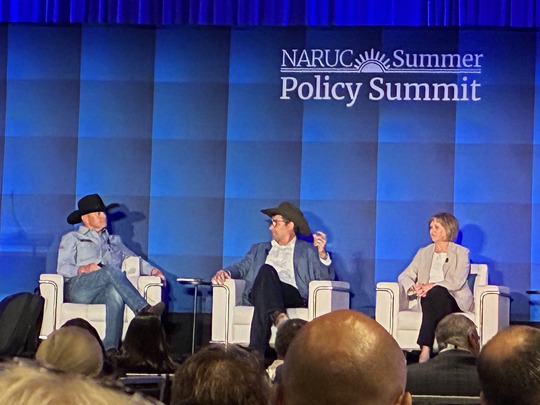 “Cowboy Commissioner” Josh Byrnes, center, participated in the panel on Utility Infrastructure and Rural Landscapes on July 20. He donned a cowboy hat to demonstrate the importance of knowing your audience, with Idaho Commissioner Edward Lodge, left, a rancher known for regularly wearing cowboy hats. | Photos by Stephanie Weisenbach, IUC
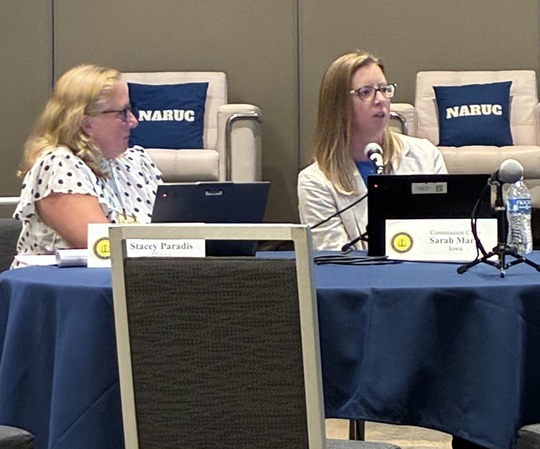 IUC Chair Sarah Martz, right, addressed attendees at the session Big Loads and Big Stakes on July 21. The session examined high-demand load growth and recent FERC rulings, sharing insights on how federal regulatory changes directly impact grid planning and policy at the state level.
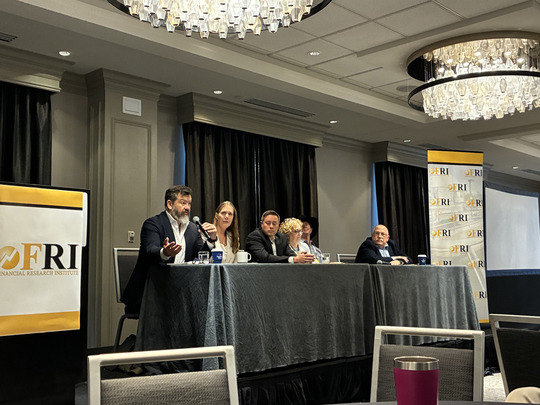 Commissioner Erik Helland, left, moderated a panel about the challenges and implications of distressed water system acquisitions at the NARUC Summer Policy Summit in Minneapolis.
The IUC annually submits a strategic plan and an operational plan to the Department of Management to inform Iowans about the mission, activities, and goals of the agency. COO Nichol Toomire shared the FY 2027-2029 plans — the IUC’s roadmap for the next three years — at the monthly Commission public meeting on July 13. The IUC's strategic plan has been posted to the DOM Agency Strategic Plans webpage for public transparency, and the FY 2027 operational plan has been posted to DOM’s Agency Operational Plans webpage.
Both plans were structured using feedback from State of Iowa employee surveys and external stakeholder feedback to create a SWOT analysis (strengths, weaknesses, opportunities, and threats), and build a clear, actionable path for the coming years. This path will focus on efficient workflows to result in a better regulatory environment, including standardized regulatory processes and proactive preparation for rapid energy load growth across the state.
The reports state operations over the next three years will be driven by four key strategic initiatives:
-
Building Employee Excellence: Prioritizing workplace safety and cultivating a high-performing workforce with improved employee engagement processes.
-
Enhancing Public Transparency and Stakeholder Engagement: Empowering communities, improving the consumer experience, evaluating our Dual Party Relay Services, and modernizing our core IT systems.
-
Preparing for and Evaluating Energy Load Growth and Market Dynamics: Proactively managing state energy policy and supporting legislative development.
-
Pursuing an Efficient and Effective Regulatory Environment: Improving agency operations through real-time data dashboards, standardized project management, and streamlined administrative workflows.
The IUC will continue its vision of being a regulatory expert and solutions-oriented partner through the practice of our guiding principles: Act with integrity, seek continuous improvement, treat everyone with respect, embrace ownership, value innovation, encourage everyone to learn, and practice open communication and transparency.
The agency’s strategic plan and operational plan are two of three reports required to be submitted to the state each year. The IUC Annual Report, with results of percentages toward reaching key performance indicators, is finalized and submitted to the Department of Management each year in December.
During the 91st General Assembly’s 2026 legislative session, the IUC monitored legislation impacting agency jurisdiction and procedures. Key legislation passed and signed by the Governor includes:
- Senate File 2463, which updated uniform agency procedure rules, established compliance deadlines, and created a process for agency-specific emergency rulemaking to enable unique rules on topics overlapping with the uniform rules. The IUC has opened Docket No. RMU-2026-0107 to implement these provisions.
- House File 2227, which established land restoration standards for the construction of certain electric transmission lines. This legislation requires the IUC to adopt rules to implement the new law, which is the purpose of the open Docket No. RMU-2026-0008.
- House File 2583, which created new requirements for the filing of emergency plans, notification of significant outages, and information-sharing during emergencies for owners of certain new electric transmission lines, and established penalties for non-compliance.
- House File 2799, which established a new fund in the state treasury for electric transmission system expansion plans, analysis, and load forecasting. It requires the IUC to direct electric utilities to remit payments through assessments. The Iowa Economic Development Authority (IEDA) will use these funds to commission a periodic report, conducted by Iowa State University, to be posted on the IEDA website. The IUC will adopt rules to implement the assessment provisions.
- Senate File 2304, which addresses the recovery of infrastructure costs by rate-regulated water and wastewater utilities between rate cases. The IUC will adopt rules to establish implementation procedures.
The legislative session lasted from January 12 to May 3. The 92nd General Assembly’s 2027 legislative session is scheduled to begin on January 11.
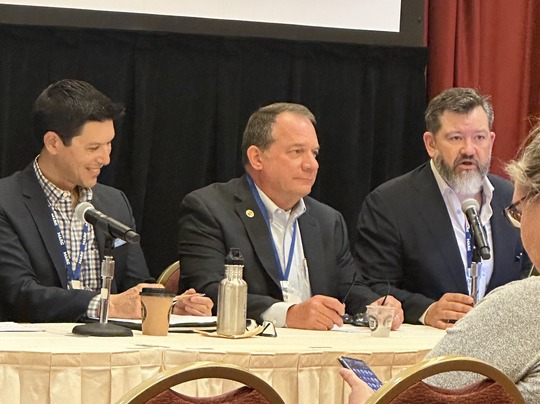 Commissioner Erik Helland, far right, moderated the panel discussion “Every Drop Counts: Balancing Water Reliability, Affordability, Safety, and Environmental Responsibility” on June 9 at the MARC 2026 Annual Conference in Madison, Wis. | Photo by Ryan Rush, IUC
In storm season, downed power lines pose a severe threat for drivers or pedestrians who may come in connect with a live wire. Whether it’s a line on the road or a wire draped over a vehicle after an accident, the ground around that point becomes "energized" and creates a phenomenon called “step potential.”
Think of the downed high-voltage wire like a stone thrown into a pond and creating concentric circles or ripples around the landing point. Electricity also radiates outward in concentric circles, or has a ripple effect. The voltage is highest at the center and decreases as it moves away from the source, or center point.
Viewing the man in the diagram below, you can see his back foot is touching the 10,000 volt ring and his front foot lands on the 7,000 volt ring. His body becomes the bridge for that 3,000 volt difference, meaning 3,000 volts of electricity will travel up one leg and down the other to bridge that gap. This can happen whether the ground is wet or dry. Because the current enters and exits through the legs, it passes through the lower torso, which can cause muscle contractions, severe internal burns, and even cardiac arrest.
How to Stay Safe
-
If you are in a vehicle, stay there. You will remain safe because the tires and the metal frame act as a path for the current around you. Only exit the vehicle if it is on fire.
- If you have to leave a vehicle that carries a current, jump clear of the vehicle with both feet together, or make a “no-touch jump.” Do not touch the car and the ground at the same time. If you do, you become the path to the ground — touch potential — which is just as dangerous.
- If you are on the ground when a live wire falls nearby, do not take steps at a normal stride; instead, do a “penguin shuffle” keeping both feet on the ground at all times (never letting one heel pass the toes of the other foot). This shuffling technique is critical for minimizing the potential voltage difference between your feet and is essential for safety. Keeping your feet together and shuffling with your soles along the ground keeps both feet in the same “voltage ripple.”
Bottom Line
If you see a downed line, treat it as live and keep at least 33 feet (roughly the length of a school bus) away from the wire. It may not be jumping around or sparking like we see in TV shows, but that doesn’t mean it’s not live. Call 911 immediately and wait for professionals to arrive and de-energize the area before trying to assist anyone trapped in a vehicle.
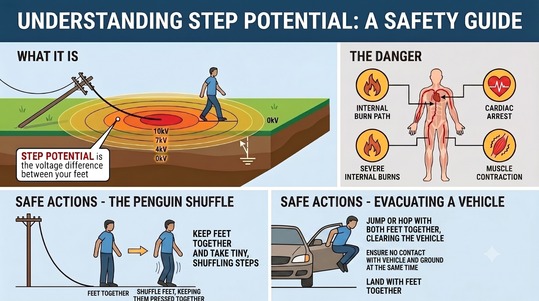 Safety Minute
IUC staff provide a short presentation at each monthly Commission public meeting that focuses on safety around utilities. This presentation from May 2026 is a helpful reminder during rainy and windy weather.
Note: Users must create an account in EFS to view or file documents linked below.
Public Hearings
-
E-22543, MidAmerican Energy Company - 9 a.m. August 11 & 12, Heartland Museum, 119 Ninth St. S.W., Clarion
-
E-21292 and E-22550, MidAmerican Energy Company - 10 a.m. August 26, Council Bluffs Public Library, Meeting Room B, 400 Willow Ave., Council Bluffs
-
PSA-2026-0001, Black Hills Energy Co. - 9 a.m. August 27, IUC Hearing Room
-
E-22554, ITC Midwest - 10 a.m. October 15, Nevada Fairgrounds Community Building, 90 I Ave., Nevada
Informational Meetings and other IUC proceedings
-
E-22570, ITC Midwest - 12:30 p.m. August 13, Dixon Fire Department, 306 Davenport St., Dixon
-
E-22573, ITC Midwest - 10:30 a.m. September 23, Scott County, TBD
-
E-22573, ITC Midwest - 2:30 p.m. September 23, Clinton County, TBD
Consumer Comment Meetings for utility rate request proceedings
-
RPU-2026-0001 - MidAmerican Energy Company
- 6 p.m. September 8, Hilton Garden Inn, 4640 N. River Boulevard N.E., Cedar Rapids
- Noon September 9 - Virtual; go to calendar at iuc.iowa.gov for meeting link
- 6 p.m. September 9 - Holiday Inn Airport Conference Center, 6111 Fleur Drive, Des Moines
- 6 p.m. September 10 - Sioux City Convention Center, 801 Fourth St., Sioux City
Commission Monthly Meetings
- August 19
- September 16
- October 21
Monthly Commission meetings begin at 9 a.m. unless otherwise noted. Meetings can be observed via the IUC’s YouTube channel. To join meetings with virtual options, find the link on the IUC calendar online.
Holiday office closures
IUC and OCA offices are closed on official State holidays, though EFS and IUB 24/7 will remain available. Filings will be processed on the next working day. Office closures also will be posted on the IUC website, iuc.iowa.gov.
|