|
 June 2026
|
|
Inside this issue:
Department of Education Resources
|
Upcoming Deadlines
|
Due Date
|
What's Due
|
|
June 1
|
Deadline for District Budget Amendments
|
|
June 9
|
SBRC Hearing
|
|
June 15
|
AEAs: IDEA PBC Claims (Part C and Birth to 3) Open
|
|
June 15
|
LEAs: IDEA PBC Claims (Part B) Open
|
|
June 30
|
Last Day to Pay Postsecondary Enrollment Options (PSEO) Tuition Due to Eligible Postsecondary Institutions
|
|
June 30
|
Last Day to Complete the Community Eligibility Provision (CEP) 2026-27 Intent Form
|
|
July 1
|
Emergency Operations Plan Due (if updated)
|
|
July 1
|
Joint Employment Whole Grade Sharing Applications Due
|
|
July 1
|
Vehicle Information System (VIS) Updates Due
|
|
July 15
|
Last Day to Bill for Second Semester Regular and Special Education Tuition
|
|
July 15
|
Special Education Billing Application Due
|
|
July 15
|
AEAs: IDEA PBC Claims (Part C and Birth to 3) Due
|
|
July 15
|
LEAs: IDEA PBC Claims (Part B) Due
|
|
July 15
|
Last Day to Submit Foster Care Transportation Claim
|
|
July 31
|
Foster Care Claim Certification Deadline (certification required for acceptance of funds)
|
|
July 31
|
Special Education Claims Due - Foster Care, District Court Placed, Nonpublic, High Cost
|
|
July 31
|
Juvenile Home Program Claim Due (AEAs only)
|
Staff Contact Information
|
|
|
The 2026 legislative session brings a number of legislative changes. The Department’s letter to the field is anticipated to be sent in early July. Additional information regarding legislative implementation will be made available at that time.
|
|
|
The Department has completed its review of special education expenditures in FY26 for select districts. In preparation for continuing and implementing new fiscal monitoring procedures beginning July 1, 2027, the Department is hosting a statewide webinar to share lessons learned and reiterate allowable expenditures to special education weighted funds, federal dollars, and special education support services funding.
Date: Tuesday, June 30, 2026
Time: 9:00 am
Join the meeting:
https://IDOE.zoom.us/s/82055485855
OR
Call: 720-928-9299 Webinar ID: 820 5548 5855 Passcode: 314219
The FY27 Local Education Agency (LEA)/Area Education Agency (AEA) State Aid Payments Schedule is available on the Departments State Payment Information web page. This schedule contains the electronic funds transfer dates for state aid and selected other state or federal categorical aid paid to school districts and area education agencies. Unless otherwise stated in the file, all state aid shall be paid in quarterly installments (SF2201 and HF2800) beginning July 2026.
The final claims period for IDEA Part B, Part C, and Birth to 3 claim submissions is available in the IDEA PBC Application located in the EdPortal from June 15 through July 15.
Districts and AEAs that fully claimed the annual award during Claims Period 1 are not required to submit a claim during Claims Period 2. Districts and AEAs that submitted a partial claim or did not submit a claim during Claims Period 1 may submit a final claim by July 15. Claims must be submitted up to the amount of the December payment.
Technical Assistance: The webinar recordings and slide decks from the Department’s statewide webinars are available on the Department’s Special Education Finance web page. User instructions for completing the claims submission in the application are also available on this web page.
Executive Order 15 signed October 8, 2025, orders that beginning July 1, 2026, all drivers applying for a School Bus Driver Authorization must be vetted through the federal Systematic Alien Verification for Entitlements (SAVE) process. Details are provided in the Transportation section below.
The Bureau of School Business Operations is offering virtual office hours during the upcoming FY26 application submission period for the Certified Annual Report (CAR), Special Education Supplement (SES), and the Annual Transportation Report (ATR). Members of the Department’s team and other School Business Officials will be available to answer questions related to the applications. Mark your calendars and bring any questions related to the CAR, SES, or ATR. The schedule below is also available on the Department’s Certified Annual Report web page.
Virtual office hours dates and times:
|
Date
|
Time
|
|
Tuesday, August 25
|
1:30 pm - 3:00 pm
|
|
Thursday, August 27
|
9:30 am - 11:00 am
|
|
Monday, August 31
|
9:30 am - 11:00 am
|
|
Wednesday, September 2
|
1:30 pm - 3:00 pm
|
|
Tuesday, September 8
|
1:30 pm - 3:00 pm
|
|
Thursday, September 10
|
9:30 am - 11:00 am
|
The FY26 annual compilation of School Business Alert articles is now available on the Department's School Business Alerts web page.
|
|
|
Question: Beginning FY26, are districts required to spend the ten percent retained portion of special education support services (SESS) funding received annually?
Answer: Districts are not required to spend the full allocation of the ten percent retained portion annually. If the district experiences a deficit special education balance, a balance should not remain in the retained portion of special education support services balance. SESS funds may be used for special education support services or special education instructions services.
This information was published in the HF2612 Implementation FAQ available on the Department’s AEA Performance and Accountability web page. Questions can be directed to SpecialEducationFinance@iowa.gov.
|
|
|
If additional resources are needed now, consider leveraging available resources through the increased uses of some restricted funds for Teacher Salary Supplement (TSS) purposes.
Beginning FY24, a school district may use carryforward funds as well as the current year’s allocation of the categorical funding below for TSS purposes.
- Project 3373 or 3376: Professional Development (PD)
- Project 3116: Teacher Leadership & Compensation (TLC)
- Project 1118: Gifted and Talented (TAG)
Best practice: Include as an informational item to the district’s board of education or through formal board action (e.g., negotiation process) when using PD, TLC, or TAG funds for TSS purposes. Additional guidance on how to use these funds for TSS purposes is available on the Department’s Categorical Funding web page, under the Teacher Salary Supplement (TSS) section titled HF 68 Guidance: Categorical Funding and Operational Sharing.
An additional resource for coding is on the Department’s Uniform Financial Accounting web page, UFA Journal Entries, which includes an example of how to restrict monies for TSS purposes in the Intrafund Transfers tab.
All districts receive TLC supplement as a part of state aid payments. The TLC per pupil state aid amount for FY27 is $393.00.
Questions regarding the TLC program can be directed to Stephanie Langstraat at stephanie.langstraat@iowa.gov or 515‑402-8700.
Questions regarding account coding can be directed to Sheila Tharp at sheila.tharp@iowa.gov or 515‑205-0259.
Pursuant to Iowa Code section 257.31(14), the School Budget Review Committee (SBRC) certified the FY25 special education balances of all school districts to the Department of Management (DOM) following the December 16, 2025 SBRC hearing.
For any school district with a positive special education certified balance:
- DOM will subtract the amount of the positive balance exceeding ten percent of the additional funds generated for special education, not to include any previous carryover, from the amount of state aid remaining to be paid to the district during the FY25 budget year. See the LEA Monthly Payment Summaries starting in March on the Department’s State Payment Information FY26 web page.
- DOM will determine the amount of the positive balance exceeding ten percent that came from local property tax revenues and increase the district’s total state aid for the subsequent budget year by the amount determined. DOM will also reduce the district’s tax levy computed under section 257.4 for the subsequent budget year by the amount necessary to compensate for the increased state aid.
For any school district with a negative special education certified balance:
- As directed by the SBRC, DOM will make the supplemental aid for FY25 special education deficit payments to school districts that were granted the modified supplemental amounts requested during the SBRC December 16, 2025 hearing.
- Payments will be disbursed this month and should be coded to Source/Project 3113. Use program code between 211 and 219. This revenue source does not require matching expenditures.
Questions regarding this calculation can be directed to John Parker at john.parker@dom.iowa.gov or 515-281-8485.
Questions regarding coding, issues with the upload, or edits and/or warning messages can be directed to Bobby Wilson at bobby.wilson@iowa.gov or 515-210-9674, or Sheila Tharp at sheila.tharp@iowa.gov or 515-205-0259.
Open Enrollment and Concurrent Enrollment Supplementary Weighting
Districts offering concurrent enrollment courses and eligible Project Lead the Way (PLTW) courses may bill resident districts for the supplementary weighting generated on open enrolled students enrolled in the contracted courses. Bills for the supplementary weighting can be generated using the information provided in the Student Reporting in Iowa (SRI) application. Before paying a bill for supplementary weighting, the resident district can verify the information by reviewing the Supplementary Weighting (Non-Fall) application in the Iowa Education Portal. The student’s resident district cost per pupil of the year in which the course was taken is used to calculate supplementary weighting. Directions for generating and verifying the bills are posted on the Department’s Certified Enrollment Supplementary Weighting web page.
Whole Grade Sharing and Concurrent Enrollment Supplementary Weighting
For districts in a whole grade sharing arrangement, supplementary weighting generated on resident students remains with the resident district unless some other arrangement has been articulated in the whole grade sharing agreement. While options for distributing the concurrent enrollment supplementary weighting exist, such as having the community college contract directly with the sharing partner for the sharing partner’s resident students or negotiating a higher per pupil rate for whole grade shared students in grades 9-12, addressing the issue of distributing the concurrent enrollment supplementary weighting in the whole grade sharing agreement may be the best alternative.
Shared Teacher and Supplementary Weighting
The contract for a shared teacher is held by one district. The district purchasing a portion of the contract may generate supplementary weighting on their resident students enrolled in courses taught by the shared teacher. Eligibility for supplementary weighting is dependent on the purchasing district not having a licensed and endorsed teacher available within the school district to teach the course(s) being provided by the shared teacher (281 IAC 97.2(3)). The supplementary weighting incentive is for the non-contract holding district. The district holding the contract benefits by being able to retain a teacher and also have a portion of the contract paid by another district.
Other Billing Situations
- Whole grade sharing billing for the second semester is based on the count of resident students from the sending district on the second Friday in January (Iowa Code § 282.12(4)). In the 2025-26 school year, second semester count for whole grade sharing occurred on January 9, 2026.
- If a sharing district elects not to enter into a whole grade sharing agreement when sharing “all or a substantial portion of the students in any grade” with another school district for “all or a substantial portion of a school day, then no students in that grade level are eligible for supplementary weighting except as authorized by 281 IAC 97.4 pursuant to the supplementary weighting plan for whole-grade sharing (281 IAC 97.2(8))." An exception to the “no students are eligible for supplementary weighting” is concurrent enrollment supplementary weighting. High school students attending another district, either through a whole grade sharing agreement or a tuition agreement because of the discontinuation of grades, are eligible to generate supplementary weighting when enrolled in eligible concurrent enrollment courses.
- There is no billing of costs incurred for students taking high school, concurrent enrollment, or postsecondary enrollment options (PSEO) courses who are enrolled in the public district as: competent private instruction (CPI) dual enrolled (Iowa Code §§ 257.6(3) and (7)), open enrolled CPI dual enrolled (Iowa Code § 257.6(3) and (7)), independent private instruction (IPI) for concurrent enrollment only (Iowa Code 261E.8(2)), nonpublic shared time (Iowa Code §§ 257.6(3) and (7)), and Junior/Senior rule (Iowa Code § 257.6(4)).
For the situations listed, the serving district generates funding directly through certified enrollment.
- No parent or student shall be billed for costs incurred from concurrent enrollment courses, even if the cost to the district exceeds the billable amount.
- Districts cannot bill students or parents for failed concurrent enrollment courses.
- A district can bill a parent (or student if 18 years of age) for the tuition cost of a failed PSEO course, the cost of equipment that becomes the property of the student, and the cost of a school-owned textbook that is not returned (Iowa Code § 261E.7(2)).
- A serving district can only bill the resident district of an open enrolled student for tuition, supplementary weighting generated from concurrent enrollment courses, PLTW courses, English learner (EL) supplementary weighting, the TLC, PD, and Early Intervention (EIC) state cost per pupil (Iowa Code § 282.18(7).
Questions regarding supplementary weighting can be directed to Ted Bauer at ted.bauer@iowa.gov or 515-979-5468.
Questions regarding data in the SRI application can be directed to Rachel Kruse at rachel.kruse@iowa.gov or 515-281-4153.
|
|
|
Please be sure revenue accounted for in the Student Activity Fund is correctly identified. Below are some frequently used source codes.
- 151X – Interest on deposits and investments
- 171X – Admissions (gate receipts for school-sponsored activity)
- 173X – Student organization membership dues and fees
- 174X – Fees (this would include entry fees for other districts to participate in a meet the district is holding, 1748 if using details)
- 179X – Other activity income (this would include fundraisers such as concessions or sales of clothing or other items to those that are not students, 1791 if using details)
- 192X (not 1921 or 1922) – Contribution and donation from private sources (a district assigned project code (8001-9999) may be used)
- 1958 – Other sales of service/miscellaneous revenues from other Iowa LEAs/AEAs (from sharing activity programs with other LEAs/AEAs)
- 1991 – Sale of materials or supplies (sale of t-shirts to students at cost)
- 5311 – Compensation for loss of capital assets (payments received from students for loss of uniform)
Further questions can be directed to Sheila Tharp at sheila.tharp@iowa.govor 515-205-0259.
Questions: How do districts account for repair and replacement costs of items or properties damaged from natural disasters (e.g., tornado)? How are insurance proceeds and deductibles recorded?
Answer: Districts will account for repair or replacement costs due to natural disasters in the fund that is most appropriate for the type of expenditure. Examples are provided below.
|
Damaged Item
|
General Fund
|
PPEL
|
SAVE
|
Nutrition
|
|
Bus
|
Yes
|
Yes
|
Yes, if revenue purpose statement (RPS) allows
|
No
|
|
Roof
|
No
|
Yes
|
Yes, if RPS allows
|
No
|
|
Tree removal
|
No
|
Yes
|
Yes, if RPS allows
|
No
|
|
Food for school meal program
|
No
|
No
|
No
|
Yes
|
|
Textbooks
|
Yes
|
Yes, if over $500
|
Yes, if RPS allows
|
No
|
|
Computer
|
Yes
|
Replacement: Yes, if over $500 or bundled
|
Replacement: Yes, if RPS allows
|
No
|
Insurance Proceeds:
Districts that receive insurance proceeds for the repair or replacement claim will deposit the revenue into the fund that incurred the cost of the repair or replacement with Source 5311 (for significant losses, use Source 6410).
Deductible:
The deductible portion of an eligible insurance claim may be transferred from the Management Fund to the fund that incurred the cost of the repair or replacement.
Transfer journal entry for the deductible portion of the claim:
Management Fund
Debit Fund 22, Function 62XX, Object 910
Credit Fund 22, Account 10X
Fund that incurred the cost of the repair or replacement
Debit Fund XX, Account 10X
Credit Fund XX, Source 5222
Questions regarding coding, issues with the upload, or edits and/or warning messages can be directed to Bobby Wilson at bobby.wilson@iowa.gov or 515-210-9674, or Sheila Tharp at sheila.tharp@iowa.gov or 515-205-0259.
|
|
|
Thank you for the timely completion of the School Information Update review for the 2026-27 school year. If the district experiences a superintendent or principal change over the summer, please remember to log in to the portal and update the administrator information as soon as a replacement has been named.
Questions can be directed to Jennifer Thomas at jennifer.thomas@iowa.gov or 515-725-2252.
Districts may submit claims for partial reimbursement of transportation services provided to children in foster care between the school of origin and the foster care placement. The school of origin is defined as the school where a student was enrolled before entering foster care or the school the student attended prior to changing foster care placements, if applicable.
The Department distributes Title IV-E funds for eligible transportation arrangements as listed below.
- Yellow bus transportation
- Public transportation
- Contracted transportation in a van or car
- Transportation provided by a care provider or family member
Information about how to submit for reimbursement can be found on the Department’s Education of Students in Foster Care web page. Use the ESSA Foster Care Transportation Reimbursement Form to file one claim per household – usually an individual child, but sometimes a sibling group if the siblings are all attending the same building and are placed together. Districts may submit multiple claims as separate line items in the same form, or send claims separately. All district level Foster Care Points of Contact have received a copy of the form. The information below is needed to complete the form.
- County of the Iowa Department of Health and Human Services (Iowa HHS) case manager responsible for placement
- School of origin (SOO) name
- Receiving school district name (i.e., district of foster care placement)
- Distance in miles between the SOO and the foster care placement
- Number of days the student was transported
- Date Iowa HHS was notified of the transportation plan
- Date transportation began
- Date transportation ended (if applicable)
- If transportation is ongoing, this field can be left blank
- Student’s State ID number
- Transportation classification
- Contiguous (district of origin and the placement district border each other)
- Non-Contiguous (district of origin and the placement district do not directly border each other)
- Out of State (student is placed out of state, within a reasonable distance from the Iowa border)
- Means of transportation
- Total number of trips taken by staff to transport the student during the quarter
- Generally, there are four trips per day:
- One trip to pick the student up
- One trip to transport the student to school
- One trip to take the student home from school
- One trip to return from that trip
- One-way trip mileage driven to transport the student
- Trip staff time, rounded to the nearest quarter hour
- Hourly staff cost, for both salaries and benefits
- Number of eligible students transported
- Only students in foster care can be claimed
- Generally there is one student per claim, but sometimes a sibling group is transported to the same location
- Student first and last name
- Student date of birth
Because this form collects confidential information, please send this form to scot.aden@iowa.gov using the State of Iowa’s encrypted email solution gSecureMail. This form may be submitted any time during the school year, and claims are paid quarterly. At the end of every fiscal year, Quarter 4 claims must be submitted by July 17 in order to be paid from the previous fiscal year’s budget.
Questions or requests for assistance in supporting students in foster care can be directed to Scot Aden at scot.aden@iowa.gov or 515-238-7497.
|
|
|
The Iowa Auditor of State's FY2025 Audit Practice Aids 2025 are available to help districts prepare for annual audits. These resources are designed to support districts and auditors in preparing for the audit process and include guidance on common compliance areas, reporting expectations, sample reports and internal control considerations.
Available resources include:
As of June 23, 2026, 69 FY25 school districts, AEAs, and charter schools audits remain outstanding. The Department appreciates the continued efforts of districts, AEAs, independent auditors, and other stakeholders working to complete annual audit requirements.
Outstanding Audits
48 - Granted filing extensions and remain active
17 - Past due without an approved extension
4 - Previously approved extensions that have expired
Key Reminder
Audit reports and related submissions should continue to be submitted to the Department of Education at ed.audit@iowa.gov and the Auditor of State at submitreports@aos.iowa.gov.
|
|
|
For questions relating to School-Based Medicaid or other topics in this section, contact Jon Neas at jon.neas@iowa.gov or 515-326-1032.
 |
|
The Iowa Department of Education (Department) Bureau of Accountability, Data & Finance is pleased to announce the addition of Jon Neas! Jon started his career as a teacher and coach in western Iowa and spent the last 12 years working for a School-Based Medicaid vendor, most recently serving as their CEO. Jon will be supporting the field in the realm of School-Based Medicaid and can be reached at jon.neas@iowa.gov or 515-326-1032. Welcome, Jon! |
Iowa HHS has completed the Medicaid system changes to allow Personal Care Services (T1019) to be billed with and without the HQ modifier (HQ means group setting) on the same day. Districts may submit claims back to the date of service on or after July 1, 2024. Iowa HHS Medicaid Policy personnel are drafting guidance for school districts on how to submit claims and if an exception to policy is required to allow for timely filing.
Iowa HHS will implement a new behavioral health code effective July 1, 2026, with new rates. Iowa HHS will provide additional guidance soon.
|
|
|
A new school safety newsletter is coming soon! Click here to subscribe and please share the link with school and district safety representatives. The recommended readership includes School Resource Officers (SROs), leadership responsible for updating emergency operations plans, and those who participate in the planning or conducting of emergency drills and exercises. Please send topic ideas to DeAnne Sesker at deanne.sesker@iowa.gov or 515-681-3236.
SAVE THE DATE! The inaugural Heartland School Safety and Security Summit is scheduled for October 6 and 7 in Lincoln, NE. The summit will bring together 12 states and their school administrators, counselors, safety teams, first responders, school social workers & psychologists, licensed mental health professionals, school board members, and emergency managers to share best practices in incident prevention, crisis preparedness, and the promotion of psychologically safe school environments. More information will be shared via the Department’s School Safety web page and newsletter when registration is available.
The study titled the Role of Locked Doors and Access Control in School-Based Active Shooter Events was published by the Advanced Law Enforcement Rapid Response Training (ALERRT) Center. A first of its kind study examines how schools can prevent, mitigate, and reduce the impact of active shooter events through simple security measures.
|
|
|
Districts that are part of a Perkins consortium or Regional Planning Partnership (RPP) should expect to receive journal entries from the fiscal agent to record in the district’s records, including transactions completed by the fiscal agent on behalf of the consortium or partnership. The following are accounting resources available for use.
Questions regarding Perkins can be directed to Amy Vybiral at amy.vybiral@iowa.gov or 515-339-4520.
Questions regarding RPPs can be directed to Heather Meissen at heather.meissen@iowa.gov or 515‑326‑5378.
Questions regarding account coding can be directed to Bobby Wilson at bobby.wilson@iowa.gov or 515-210-9674, or Sheila Tharp at sheila.tharp@iowa.gov or 515-205-0259.
|
|
|
The Operational Function Sharing Guidance resource document is available on the Department’s Reorganization, Dissolution & Sharing web page. The resource identifies eligible sharing positions and the amount of supplementary weighting generated for eligible function sharing arrangements.
Questions regarding operational function sharing eligibility can be directed to Ted Bauer at ted.bauer@iowa.gov or 515-979-5468.
Questions regarding reporting positions that are part of an operational sharing agreement in Fall BEDS Staff or in the Operational Sharing Application can be directed to Shelly Wolterman at shelly.neese@iowa.gov or 515-336-3859.
Information regarding Iowa’s Students First Education Savings Account (ESA) program can be found on the Department's Students First Education Savings Accounts web page.
|
|
|
Questions relating to the articles below may be sent to State Director for Pupil Transportation, Tom Simpson at tom.simpson@iowa.gov or 515-336-3965 or one of the inspectors below.
Executive Order 15 signed October 8, 2025, orders that, beginning July 1, 2026, all school bus drivers be verified through the Federal Systematic Alien Verification for Entitlements (SAVE) system before a school bus authorization is issued to the driver.
Employers will no longer be able to issue a school bus driver authorization immediately. Once the employer requests a school bus driver authorization in the Driver Authorization System (DAS) located in the EdPortal, the driver’s full name, birthdate, and social security number will be submitted for SAVE verification.
Upon clearance through the SAVE system, employers will be able to issue an authorization. If additional information is needed from the driver, the Department will notify the employer and requested documentation can be added through the Driver Authorization System (DAS).
Additional information will be made available regarding this process by mid-July on the Department’s Pupil Transportation web page.
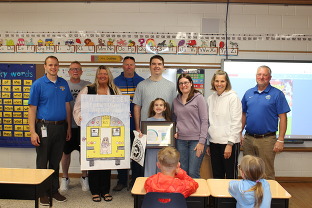
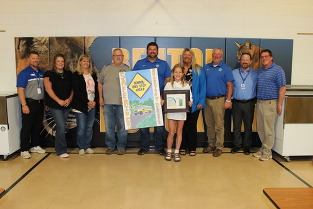
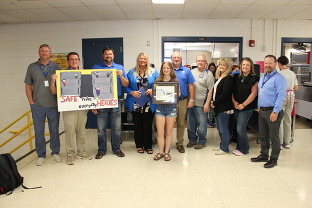
The Department announced the winners of the inaugural 2026 Iowa School Bus Safety Week Poster Contest, showcasing student creativity and commitment to keeping their peers safe on the road.
Winners were selected from three divisions based on grade level and were judged on safety impact, originality, artistic quality, and visual impact of their safety message. Congratulations to the winners and their districts below!
 |
|
Division 1, grades K-2 - Eleanor Draeger, Humboldt Community School District |
 |
|
Division 2, grades 3-5 - Scout Sexton, Benton Community School District |
 |
|
Division 3, grades 6-8 - Lexi Wiley, Benton Community School District |
These three students were recognized for embracing the contest’s theme of 'Safe Rides, Everyday Heroes’ and using their creativity and artistic talents to raise awareness of school bus safety across Iowa.
The poster competition is part of a national initiative to promote school bus safety, encouraging students from kindergarten through eighth grade to illustrate the importance of safe practices around school buses.
Prints of the winning posters will be produced and distributed across the state in time for School Bus Safety Week in October. They were also entered into the national School Bus Safety Poster Contest. The winning posters can be accessed on the Department’s School Bus Safety Contest web page.
For more information on school bus operations and safety in Iowa, visit the Department’s Pupil Transportation web page.
New School Bus Driver Training
The Department’s School Transportation Operator’s Program (S.T.O.P.) training for new school bus drivers consists of the two components listed below.
- Online Component: S.T.O.P. Training for New School Bus Drivers (Online Component) is hosted exclusively via AEA Learning Online.
- In-Person Component: The 3-hour S.T.O.P. face-to-face course is provided by local community colleges and Mississippi Bend AEA.
The online component, updated for FY26, typically takes less than four hours to complete and can be completed in as little as an hour using optional pre-test options.
Accessing AEA Online
All districts/schools that opt into AEA Online already have a verification code. This includes many public and nonpublic schools. Bus drivers that need to establish new accounts must include the related verification code in their profile. Once affiliated, each driver will be able to access the training at no cost to them or the school. Drivers may access the step-by-step tutorial for setting up a new account.
Tip for nonpublic schools and contractors: Step 7 in the tutorial linked above specifically addresses how to affiliate an account with a district.
Required Action
Ensure each driver’s AEA Learning Online account profile includes the driver’s license number.
Directions: How to add/update your Driver’s License Number
Frequently Asked Questions
Q: I don’t have an AEA Learning Online account. What should I do?
A: If you are certain you do not have an account, follow the directions to create a new one.
Directions: How to register for AEA Learning Online (Create an Account)
Q: It's asking me to pay—why?
A: Your account profile currently lists you as a “Pay Customer.”
Directions: Update your profile to reflect your district of employment
Please note, drivers from nonpublic school partners and contractors will also be able to access this training at no cost.
Other helpful tips related to the online training include the items listed below.
- The online portion and the face-to-face portion are now independent and may be taken in any order.
- The online training no longer requires a final proctored exam.
- Each module includes an independent test. All drivers now have the option to test out of each module by scoring 80% or better on the pretest.
The face-to-face component of the new driver S.T.O.P training will continue to be offered through local community colleges and Mississippi Bend AEA.
Returning School Bus Driver Annual Training
The annual S.T.O.P. 3-hour renewal class for current drivers is updated each year and will continue to be available through the community colleges and Mississippi Bend AEA.
The Iowa Pupil Transportation Association (IPTA) provides professional development opportunities available for school transportation directors.
The 62nd Annual IPTA Summer Conference & Trade Show will be held July 20-22 at the Airport Holiday Inn in Des Moines. The conference will once again include the valued “New Directors Workshop” where the Department’s transportation team will provide new transportation directors with useful and relevant information, explain applicable laws and rules, and share best practices for safe and efficient student transportation.
In addition to the workshop, the conference will feature local and national presenters, including Department representatives, who will provide relevant transportation-related information and discuss regulations and best practices.
The Department’s pupil transportation team will also have a table during the IPTA Summer Conference Trade Show on Tuesday, July 21. Transportation directors and other district personnel will be able to stop and pick up prints of the Iowa School Bus Safety Week Poster Contest winning posters.
Additional information, including registration details, can be found on the IPTA web page or by contacting David Johnson, IPTA Executive Director, at david@4ipta.org or 712-830-3242.
Four documents are required to be in every vehicle used for student transportation, and two of these documents are often replaced during this time of year. It is important that these documents are kept current and placed in a secure and dry location in the vehicle where a driver can quickly and easily find these documents when needed, such as in case of a crash, if requested by law enforcement, or during inspections performed by the Department.
- Vehicle Registration - Most vehicles used for student transportation will use official license plates which are registered to the school district and not a specific vehicle. These registrations do not expire. Vehicles not using official license plates will have license plates registered to the specific vehicle and these registrations do expire. If the vehicle is not using official license plates, care must be taken to be sure the registration is current.
- Insurance Card - All vehicles must have a current insurance card.
-
TR-F-27A Chassis Inspection Card - This form is used to document the chassis inspection performed either by school district personnel or an outside vendor. This inspection is required to be performed at least once per year and a current, completed card (or copy) that is signed and dated within the previous 12 months must be in the vehicle.
- Inspection Summary - The previous Department inspection summary must be in the vehicle and it must document any corrections made to deficiencies from the previous inspection. New vehicles that have been put into service following a pre-use inspection must have a completed TR-F-27B Pre-Use Inspection Form (or copy) in the vehicle until Department inspectors perform a regular inspection. The TR-F-27B can then be replaced by an inspection summary.
As published in the April edition of the School Business Alert (SBA), the Federal Motor Vehicle Safety Administration (FMCSA) recently published information related to a United States Department of Transportation (USDOT) update on the use of marijuana by people employed in safety-sensitive transportation positions, which includes school bus drivers. This update followed the Executive Order issued by the President of the United States on December 18, 2025, that directed the Department of Justice to reschedule marijuana from a Schedule I to a Schedule III drug.
Marijuana was still classified as a Schedule I drug when the April SBA was written. Recently, however, the Drug Enforcement Administration (DEA) issued an order that reclassified FDA approved drug products derived from marijuana and marijuana products regulated by a State medical marijuana license from Schedule I to Schedule III drugs under the Controlled Substances Act (CSA).
Question posted to USDOT: Does this mean that a Medical Review Officer (MRO), reviewing a laboratory reported marijuana positive drug test, can deem the test a “negative” if the employee alleges the positive result is from consuming a State licensed marijuana product?
Response from USDOT: The components of the USDOT answer were published in the May 2020 Part 40 Questions and Answers document and are summarized below.
- No. Currently, there is no instance when the MRO could verify a laboratory-confirmed marijuana positive drug test result as “negative” when an employee claims the positive was caused by a State licensed marijuana product.
- Even after rescheduling, State-dispensed marijuana does not constitute an FDA-approved drug. Without FDA approval for a controlled substance, it cannot be prescribed.
- A “legitimate medical explanation” requires use of a legally prescribed controlled substance in compliance with Federal laws governing such a prescription. 49 CFR §§ 40.137(a); 40.141(b)
- Although the MRO may be presented with documentation such as State-issued medical marijuana cards, physician recommendations or certifications, or dispensary records or receipts, these documents do not satisfy part 40 requirements for a “legitimate medical explanation.”
- Marijuana use under State marijuana programs or other non-prescription sources do not qualify as a “legitimate medical explanation” under 49 CFR § 40.137(a). In addition, marijuana use is not compatible with safety-sensitive functions.
As a reminder, the USDOT further states, “It is still unacceptable for people who work in safety-sensitive transportation positions to use marijuana.” This includes school bus drivers.
49 CFR 382.301 requires employers to have a negative controlled substance test result on file before a driver performs safety-sensitive functions for the employer.
|
|
|
It is the policy of the Iowa Department of Education not to discriminate on the basis of race, creed, color, sexual orientation, national origin, sex, disability, religion, age, political party affiliation, or actual or potential parental, family or marital status in its programs, activities, or employment practices as required by the Iowa Code sections 216.9 and 256.10(2), Titles VI and VII of the Civil Rights Act of 1964 (42 U.S.C. § 2000d2000e), the Equal Pay Act of 1973 (29 U.S.C. § 206, et seq.), Title IX (Educational Amendments, 20 U.S.C.§§ 1681 – 1688), Section 504 (Rehabilitation Act of 1973, 29 U.S.C. § 794), and the Americans with Disabilities Act (42 U.S.C. § 12101, et seq.). If you have questions or complaints related to compliance with this policy by the Iowa Department of Education, please contact the legal counsel for the Iowa Department of Education, Grimes State Office Building, 400 E. 14th Street, Des Moines, IA 50319-0146, telephone number: 515-281-5295, or the Director of the Office for Civil Rights, U.S. Department of Education, Cesar E. Chavez Memorial Building, 1244 Speer Boulevard, Suite 310, Denver, CO 80204-3582, telephone number: 303-844-5695, TDD number: 800-877-8339, email: OCR.Denver@ed.gov.
|
|
|
|
|