LIHEAP program update
Every year starting November 1, all Iowa electric and natural gas utilities participate in a moratorium of disconnection of service for qualifying customers of the Low-Income Home Energy Assistance Program, commonly known as LIHEAP. The program is administered by Iowa Health and Human Services.
The moratorium on disconnection of electric and natural gas service ended on April 1. Once the disconnection moratorium ends, customers facing hardship in paying for utility service can still work with their local community action agency to apply for LIHEAP energy assistance funds, through April 30 each year. Both owner-occupied and renter-occupied households may apply, and applications may be submitted in person or by mail, phone, email, or online.
Community action agencies exist in every Iowa county to help Iowans apply for LIHEAP, and they disburse energy assistance funds on behalf of utility customers. LIHEAP is a federally funded program by the U.S. Department of Health and Human Services and is available to homeowners and renters within the federal poverty guidelines.
As of March 31, a total of 66,518 LIHEAP applications had been approved statewide. Approval notifications are issued to all regulated utilities, and community action agencies continue to process customer account payments on an ongoing basis.
LIHEAP assistance may also be available for eligible households facing disconnection. Customers who have received a disconnect notice should contact their local community action agency for support. Crisis funds are limited and are provided on a first-come, first-served basis.
Beyond LIHEAP, under Iowa law, utilities are also required to operate a fund that allows its customers to voluntarily contribute money for deposit in a low-income heating assistance fund. Although these fund programs go by different names (Project Share, ICARE, etc.), they all assist low-income customers with paying energy bills and providing weatherization of their homes. Customers interested in applying for funds from these sources are encouraged to contact their utility provider for assistance.
Customers may also submit an application online and upload required documentation by going to https://liheap-apply.hhs.iowa.gov/s/.
In the state of Iowa, there are four rate-regulated industries overseen by the IUC: electric, natural gas, water, and sewer/stormwater drainage. Anytime a rate-regulated utility seeks to increase its rates, it petitions the IUC for a rate proceeding, either basing its request on costs from a historic test year or a future test year. In addition to those types of “traditional” rate cases, electric utilities can also request a rate proceeding known as advance ratemaking, which involves the utility seeking IUC approval to spend a defined amount of money on a project that has not been developed, without further prudency review, rather than to recover the cost of a finished project.
To some extent, water and sewer also can request advance ratemaking; IUC rule 199 Iowa Administrative Code (IAC) 41.5 provides for ratemaking principles relating to the acquisition of a water, sanitary sewage, or storm water utility. However, this overview will focus on electric rate-regulated utilities and the difference between a general rate case and advance ratemaking as seen by IUC staff.
There are several differences between traditional and advance ratemaking proceedings.
Traditional rate cases
A general rate case is one in which a rate-regulated utility submits an application to the IUC to request an increase in its rates. Iowa Code § 476.6 is the legal authority for utility general rate cases. A utility rate case can be requested by any of the industries previously mentioned. IUC rules at 199 IAC chapter 26 provide specific information on what needs to be filed in a complete rate case application, referred to as the minimum filing requirements. Some information may be requested to be held confidential, but all filings have a public version that is available in the IUC’s electronic filing system.
The utility determines when filing its rate case whether to base its requested rate increase on a historic or future test year. Iowa Code § 476.33 describes these differences more in depth. One main difference is that when a future test year is used, a subsequent proceeding is required roughly 15 months after the final order to verify whether the utility’s actual costs and revenues are reasonably consistent with what was approved as part of the rate case. IUC rules related to this are located at 199 IAC 26.6. The IUC will hold its first subsequent proceeding hearing for a rate case based on a future test year next month. That hearing, in Docket No. RPU-2023-0002, will be May 26-27.
After all the testimony and corresponding exhibits are received in the subsequent proceeding, the Commission will review the revenues and costs for prudency. This helps to determine whether the utility’s rates are “just and reasonable.”
In addition to the just and reasonable standard, the IUC also has to ensure the utility has the opportunity to earn a fair return on its investment — not a guarantee, but a way to encourage the utility to make needed investments. There are two seminal U.S. Supreme Court cases often cited when discussing a utility’s opportunity to earn a fair return on its investment: Fed. Power Comm’n v. Hope Nat. Gas Co., 64 S.Ct. 281 (1944) and Bluefield Waterworks & Improvement Co. v. Pub. Serv. Comm’n of WV, 43 S.Ct. 675 (1923) (often referred to as Hope and Bluefield).
Advance ratemaking
While all states have a form of the traditional rate case proceeding, not all states have what Iowa refers to as “advance ratemaking.” When a rate-regulated electric utility submits an application to the IUC to request approval in advance of an investment in new generation or transmission, that is advance ratemaking. Iowa Code § 476.53 provides the legal authority for utility advance ratemaking.
Advance ratemaking differs from traditional rate case proceedings in that it does not change rates at the time the proceeding occurs. The decisions made in advance ratemaking provide assurances to the utility that the costs incurred, up to the cap set by the IUC, will be allowed to be included in a future rate case when the project is completed. While it may seem similar in that respect to future test year rate cases, a future test year rate case has a limit on how far in advance the investment can be, relative to the test year. While advance ratemaking projects cannot extend endlessly into the future, there is also no requirement that a project must be in service in the next calendar year.
Iowa Code § 476.53 allows rate-regulated electric utilities to request, in advance, that certain generation projects receive ratemaking principles to be in effect when those projects are included in the utility’s rate base. Ultimately, this means that the IUC could determine in 2026 what will be the ratemaking treatment for a project that is added to the utility’s rate base at a 2032 rate case. Using this example, when the 2032 rate case rates become effective, the advance ratemaking projects will be included in the utility’s rate base, and Iowa ratepayers will begin “paying” for the project.
Iowa Code § 476.53(3)(g) specifically states that the ratemaking principles ordered “...shall be binding with regard to the specific electric power generating facility in any subsequent rate proceeding.” This does not mean there is no review; a review occurs during the advance ratemaking proceeding. IUC rules at chapter 41 provide more detail as to what information is needed for an advance ratemaking proceeding. The utility requests these advance ratemaking principles because they provide more certainty than relying solely on traditional ratemaking.
For an example of the difference between a traditional rate case proceeding and an advance ratemaking proceeding, see In re MidAmerican, Docket No. RPU-2013-0004, compared with In re MidAmerican, Docket No. RPU-2018-0003 (commonly referred to as Wind XII), in the IUC’s electronic filing system.
With spring home repair projects underway, now is a good time to search for drips and leaks that waste water in your home and lead to higher utility bills. Leaks in residential plumbing lead to nearly a trillion gallons of water wasted each year in the United States, and the U.S. Environmental Protection Agency (EPA) estimates approximately 10 percent of American homes have a leak that wastes 90 or more gallons of water a day.
The IUC and the EPA’s WaterSense program supported Fix a Leak Week in March by encouraging Iowans to check for sources of home leaks in an effort to catch problems early and conserve water.
The most common water leaks in homes are dripping faucets, worn toilet flappers, and faulty valves. A shower dripping 10 times per minute wastes 500 gallons of water a year and a faucet dripping once per second leaks 3,000 gallons a year, according to the EPA. Simple fixes to household leaks could save homeowners about 10 percent on their water bills.
The EPA offers these tips to check for leaks inside and outside your home:
- Take an initial reading of your water meter and a second reading two hours later when no water has been used. If the meter reading is not the same, you could have a leak.
- Review your water bill to determine whether there has been a large increase in usage that you didn’t notice.
- To check toilets for leaks, place a drop of food coloring in the tank. Without flushing, wait 10 minutes to see if any color appears in the bowl. If it does, you have a leak.
- Observe faucet handles, hoses, gaskets and fittings for signs of water outside the pipe (such as rust, calcification, pooling water, mold, or dampness) that could indicate a leak.
- Check garden hoses and landscape irrigation systems before using them for the season to make sure no damage occurred from frost or freezing.
The EPA offers a checklist for identifying leak sources and additional resources on its website. You can also learn more about problematic leaks and water conservation at epa.gov/watersense.
Sarah Martz was confirmed as the IUC Commission Chair on March 30. She has served in that role since Gov. Kim Reynolds appointed her on May 19, 2025, after the legislative session had ended.
The two-year appointment requires confirmation by the Iowa Senate, which reviews numerous appointments to state boards and commissions each legislative session. The Senate can vote on confirmations en bloc, meaning a group of appointments is voted on simultaneously, or it can single out positions for debate.
An estimated 60 million American households plan to undertake an outdoor digging project in the next year, according to Common Ground Alliance, but roughly one in six homeowners are likely to not have their underground utilities located before that work begins.
In Iowa, contacting 811 to have underground utilities marked before starting an excavation project is the law — and not submitting a locate ticket can damage utilities or lead to serious injury or death.
The IUC and the National Association of Regulatory Utility Commissioners (NARUC) recognized April as National Safe Digging Month, but the agencies remind Iowans to always submit an Iowa One Call ticket before beginning any digging project. Tickets should be requested at least 48 hours before work is to begin — whether you are planting a tree, installing fence posts or mailboxes, or tackling major construction.
Excavators, operators, locators, and residents are all required by Iowa Code chapter 480 to submit plans for any digging project online to IowaOneCall.com or by calling 811. The online ITIC system can be easily navigated via Iowa One Call’s resource page. After a One Call notification is made, the owners of the underground utilities will mark the locations within the intended work area using paint or flags.
The IUC recommends following these steps before beginning any digging project:
- Submit an Iowa One Call ticket at least 48 hours in advance. If a professional has been hired, verify they have submitted the One Call request and the underground utilities are properly marked.
- Confirm that you have received an email from Iowa One Call that all utilities have been marked and that there are no additional steps needed before the project begins.
- Ensure you or the professional hand dig around any utilities identified with paint or flag markings before using heavy or powered equipment.
The IUC participates annually in State Damage Prevention and One Call grant programs conducted by the U.S. Department of Transportation’s Pipeline and Hazardous Materials Safety Administration (PHMSA). Both programs are intended to minimize and eliminate damages to underground utilities and to ensure safe digging practices through education, related compliance activities, training, and the IUC’s agreement with PHMSA to perform pipeline safety inspections.
The Iowa Attorney General’s office enforces the One Call law and the IUC assists by investigating One Call complaints. Visit the Attorney General’s One Call webpage or go to the IUC webpage Iowa's One Call Law for more information.
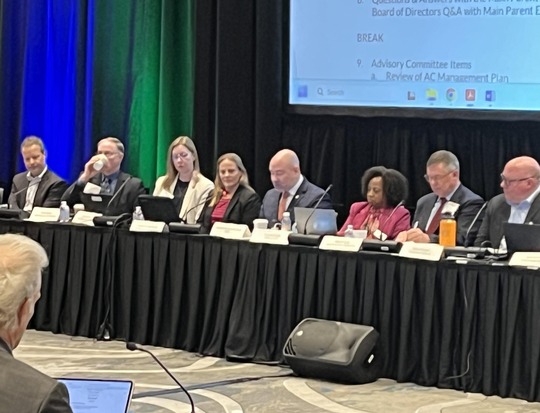
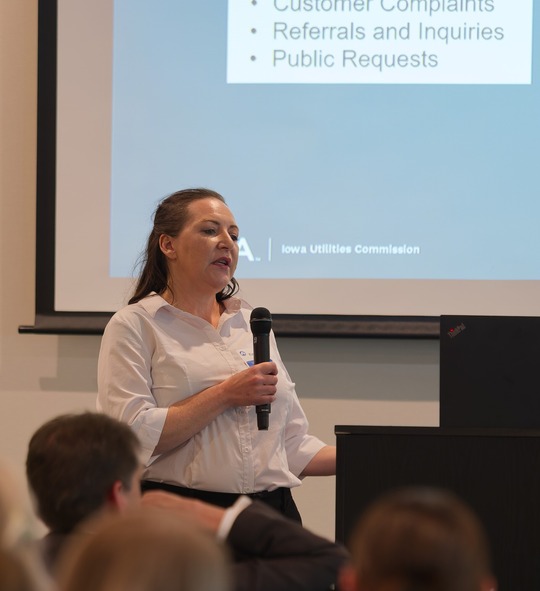 Keetah Horras, a Utility Analyst with the IUC, presented on "Top Issues Facing Small Utilities" at the Iowa Association of Municipal Utilities' 2026 Clerk's Conference, held April 8-9 in Ankeny. She was joined by IUC Management Analyst Alison Whale. | Photo courtesy of IAMU
|