Utility annual reports now available
Utility annual reports are being completed again this year in IUB 24/7, a self-service portal for companies and utilities to maintain their company and contact information with the IUC.
The utility annual reports covering calendar year 2025 opened January 12. Company administrators and annual report submitters are able to see and edit the annual report information and should have received system notifications that the report is available.
The filing deadline is April 1 for all companies required to submit utility annual reports.
Read more about how to file a utility annual report on the IUC’s website, where you can find updated guides including step-by-step instructions to completing annual reports and answers to common questions.
Customer Service staff can help with questions about the annual reports process or your company information in IUB 24/7. Email ITsupport@iuc.iowa.gov or call (877) 565-4450 from 8 a.m. to 4:30 p.m. Monday through Friday.
Telecommunications companies are reminded that Dual Party Relay Service (DPRS) assessment information is now submitted on an annual basis using the company/contact web application IUB 24/7.
Company DPRS reports are now available and companies required to report their revenue-producing telecommunications service phone numbers will need to complete the information covering calendar year 2025 by the April 1 annual filing deadline. The IUC will then issue invoices to the companies for the assessment amounts owed. See the IUC's DPRS webpage for more information.
For instructions on using IUB 24/7, see the Information About IUB 24/7 webpage. Instructions on creating a company profile in IUB 24/7 can be found on the Registration for Telecommunications Companies webpage.
If you're unsure whether your company has filed a report with the IUC, please access your company profile in IUB 24/7, call (515) 725-7300, or email iub.billings@iub.iowa.gov.
For additional information on payments, filing, reporting and more, see Telecom and Video/Cable Company Common Questions for IUB 24/7.
The IUC is funded in part by utility companies under its regulatory jurisdiction. To collect operational revenues, the IUC issues direct bills to all parties associated with billable dockets under Iowa Code 476.10.
“Billable dockets” are projects with associated costs paid by outside parties. IUC staff charge applicable time and expenses to billable dockets and these costs are directly invoiced to the parties responsible.
To ensure uniform and fair billing to all parties, the IUC annually calculates billing rates for each job classification. The rate calculation is based on each of the job classifications and is an average of each employee's total cost in every position, since individual costs may vary. These billing rates are used to charge employee time to utilities and state agencies through quarterly direct invoices.
You can find the finalized FY 2026 billing rates and information on how they are calculated on the IUC's Industry Billing & Assessments webpage.
Is digging part of your job? If so, come and see us January 29 at the Iowa Excavation Safety Summit, an annual statewide event hosted by Iowa One Call. The safety summit, to be held at the Jacobson Exhibition Center at the Iowa State Fairgrounds, brings together excavators, utility operators, and damage prevention stakeholders to promote underground safety and best practices.
The IUC will be there to share information about Iowa’s One Call law and the role of the agency in investigating complaints. You can also learn about penalties for violations, network with other excavators, and participate in the "Excavator Rodeo."
The safety summit is a free resource designed to help educate professional excavators reduce damages to underground facilities and keep Iowa’s underground infrastructures safe. Industry experts will lead sessions on state laws, safety, and best practices, and a number of sponsors will be on hand to demonstrate tools and technology used by excavators.
Register for the free event at iowasafetysummit.com.
The IUC is pleased to announce that Chair Sarah Martz has been appointed to several leadership positions within the stakeholder governance structure of the Midcontinent Independent System Operator (MISO) for the 2026 term.
Martz began in the following roles on January 1:
- Chair of the Regional Expansion Criteria and Benefits Working Group: In this role, Martz will lead the group responsible for developing the criteria used to justify new transmission projects and determining how the costs of those projects are allocated across the 15-state MISO footprint.
- Member of the Planning Advisory Committee (PAC): As a member of the PAC, Martz will provide direct stakeholder input on MISO’s regional planning processes, including the reliability and economic assessments that guide long-term infrastructure investment.
- Member of the Advisory Committee: Martz will join the primary advisory body to the MISO Board of Directors, where she will represent state regulatory interests on matters ranging from market design to resource adequacy.
A Strategic Voice for Iowa Ratepayers
Martz’s elevation to these committees comes at a time when the Midwest faces significant challenges related to load growth — driven largely by industrial expansion and data centers — and the ongoing transition of the generation fleet.
"I am honored to serve in these capacities and to ensure that Iowa's voice is heard as we navigate the complexities of a modernizing grid," Martz said. "My focus remains on ensuring that regional transmission expansion is both cost-effective and reliable for Iowa consumers."
Leadership in the Organization of MISO States
In addition to her committee work, Martz will continue her service within the Organization of MISO States (OMS), where she was recently elected as an At-Large Member for the 2026 Board of Directors. This dual involvement ensures a seamless link between state-level regulatory goals and regional grid operations.
Martz, who was appointed Chair of the IUC by Governor Kim Reynolds in May 2025, brings over a decade of engineering and utility management experience to these roles. Her background in electrical distribution and power plant optimization is expected to be a significant asset to MISO's technical working groups.
A fall project to refresh the pipeline information on the IUC website yielded positive results from auditors who reviewed the site for the 2025 Pipeline Safety Trust (PST) Website Transparency program. PST conducts annual reviews of all state public utility commissions’ pipeline safety website information for accessibility and the amount of public information that is available.
The IUC received a score of 29 of 33 possible points in a site review – an increase of six transparency points from the previous audit.
Changes to the site begin on the Pipelines landing page, where users will find links to safety, permit, One Call regulations, and gas operator information, along with agency contacts.
The permits pages for natural gas and hazardous liquid pipelines have been refreshed with updated forms and useful information about Iowa’s One Call law. On the Pipeline Safety page, you’ll find more simplified information about IUC jurisdiction, the inspection process, and how to search for inspection reports.
The PST review of the website gave the IUC top scores of three points each in all three topics in the Agency Authority category (access to statutes and regulations, descriptions of regulations, and siting and routing information) and three of five categories for Data & Maps (excavation damage data, transmission pipeline maps, and incident data).
The PST report noted that the IUC’s page “excels in transparency regarding the agency’s authority. This helps the public understand the state pipeline safety program’s jurisdiction and the issues it addresses.”
PST recommended further improvements in the areas of enforcement data availability and finding agency and company contacts.
The IUC Pipeline Safety & Engineering team inspects 63 natural gas distribution system operators, one LPG distribution system operator, 34 intrastate pipeline operators, and five interstate natural gas transmission pipeline operators to ensure that gas operators are in compliance with federal and state pipeline safety standards.
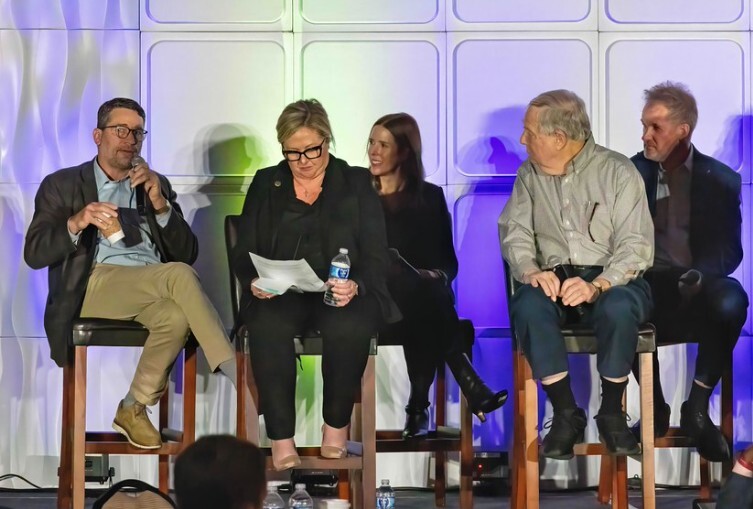 IUC Commissioner Josh Byrnes, far left, talks about the work of the task force at the general session "Silos to Synergy: The GEAR Task Force" during the NARUC annnual meeting. | Photo courtesy of NARUC
GEAR Task Force issues final report exploring gas-electric industry reliability, coordination
The National Association of Regulatory Utility Commissioners (NARUC) Gas-Electric Alignment for Reliability (GEAR) Task Force completed its work in November with the release of a final report that documents efforts to address the growing interdependence between the natural gas and electric industries. IUC Commissioner Josh Byrnes was a member of the task force, whose participants shared their findings at the NARUC annual meeting.
Established in November 2023, GEAR aimed to develop solutions to improve reliability and coordination between these sectors, particularly during extreme weather events. The task force's report highlights the challenges posed by misaligned infrastructure and market operations, which have led to reliability concerns during high-demand periods, such as winter storms.
Key recommendations include creating a Natural Gas Readiness Forum to enhance communication and situational awareness, supporting federal permitting reforms for natural gas pipeline infrastructure, promoting gas storage opportunities, improving load shed practices, and incentivizing demand response programs for natural gas utilities.
The report also emphasizes the importance of market-based solutions to enhance supplier performance during extreme weather and improve generator advance fuel procurement.
GEAR’s work serves as a foundation for ongoing collaboration between regulators and industry stakeholders to ensure reliable and affordable energy systems.
Earlier this month, Gov. Kim Reynolds signed an executive order that established the Iowa Nuclear Energy Task Force to advise the governor, legislators, and relevant state agencies on the development and advancement of nuclear energy technologies and infrastructure in the state.
IUC Chair Sarah Martz was appointed to serve on the task force along with a dozen other Iowans representing utilities, governmental agencies, the legislature, education, and industry. Dr. Mark Nutt, Director of Nuclear Energy Programs at the Pacific Northwest National Laboratory and a graduate of Iowa State University's Nuclear Engineering program, will chair the task force.
In announcing the task force, the Governor said the group’s responsibilities will include exploring opportunities to engage with the federal government to support nuclear energy development and ensure Iowa’s policies and initiatives align with national regulations; assessing emerging nuclear technologies for Iowa’s energy sector; engaging with industry leaders, academic institutions, and others to ensure Iowa develops a highly skilled workforce for the growing nuclear energy sector; engaging with manufacturers and other nuclear energy stakeholders to identify barriers to entry and the partnerships and investments needed to cultivate a nuclear supply chain in Iowa; and evaluating opportunities to enhance economic growth by utilizing nuclear energy.
The task force is directed to submit a final report detailing its findings and recommendations to the governor within 180 days of the January 5 executive order.
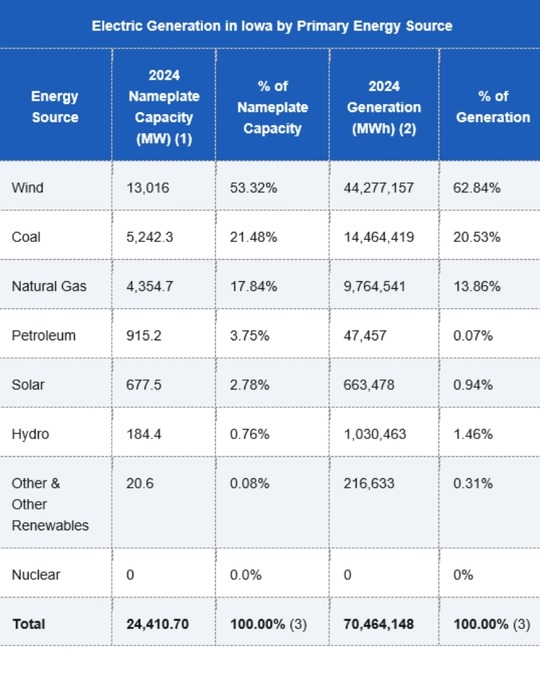
The IUC’s Regulatory Analysis staff compiles information annually from the U.S. Energy Information Administration (EIA), and that data details generation capacity at electric power plants with 1 megawatt or greater of combined nameplate capacity.
The EIA data lags behind by a year; therefore, the latest data includes information reported to EIA through 2024. You can find the table below and additional data on the IUC website.
|