|
Healthy Iowans Newsletter |
|
Supporting Families, Strengthening Communities
Economic stability, income and housing were identified as top health priorities for Iowans in the 2021–22 State Health Assessment. This month, we’re highlighting the Family Development and Self-Sufficiency (FaDSS) program—one of our Partners in Action—and sharing local successes from the Northeast Iowa Community Action Corporation (NEICAC). FaDSS is an Iowa HHS program available statewide in all 99 counties through a network of 15 community action and nonprofit social service agencies. The program provides intensive home-visiting support to families with dependent children who are at or below 175% of the federal poverty level, helping them move toward long-term stability and economic self-sufficiency through relationship-based, strength-focused support.
|
|
How FaDSS Helps Create Stronger Futures |
|
FaDSS Vision
FaDSS engages families in dynamic partnerships to address their basic needs, improve child well-being, and develop career opportunities that, in turn, improve lives, families, and communities.
FaDSS does this by:
- Reducing sources of stress that destabilize families. Address the basic needs and emotional wellbeing of families through support and connection to resources such as housing, food, safety, and physical and mental conditions, among others.
- Strengthening core skills that are essential for work, school, and life. Build the capabilities of families by teaching them goal-directed behaviors that strengthen life skills and improve family functioning and by connecting them to education and training opportunities that build career-related skills and healthy work and school-based habits.
- Creating responsive relationships that are safe and supportive. Cultivate partnerships with families by building trust; holding parents accountable; and practicing unconditional, nonjudgmental positive regard. Collaborate with community partners to address the needs and interests of families. Support healthy parent-child relationships that promote child wellness and development.
Core Program Components
- Structured home visits conducted by skilled family development specialists
- Assessments and screenings that support healthy self-exploration
- Science-informed goal pursuit
- A framework and process for skill building
- Connecting families to stabilizing supports and opportunities in their communities
FaDSS at NEICAC
For nearly 60 years, Northeast Iowa Community Action Corporation (NEICAC) has worked alongside individuals and families to strengthen communities across northeast Iowa. Established in 1965 as part of a national effort to reduce poverty through locally driven solutions, NEICAC began when leaders from Allamakee, Howard, and Winneshiek counties came together to form what is now a seven-county service area that also includes Bremer, Chickasaw, Clayton, and Fayette counties.
 A Whole Family Approach
FaDSS is intentionally designed as a whole-family program. Families define who is part of their family unit. This may include single parents, two-parent households, grandparents raising grandchildren, or other caregivers. Rather than focusing only on one adult, FaDSS works to engage parents, children, and other household members whenever possible.
At NEICAC, this approach shows up clearly in practice. During Fiscal Year 2025 (June 30, 2024, through July 1, 2025), 55% of home visits included active engagement from another family member besides the head of household, more than double the state requirement of 25%. It’s important to note, these family members aren’t just present, they're meaningfully engaged in the visit with their FaDSS Specialist.
Measurable Impact and Success
NEICAC’s FaDSS program consistently operates at or above their allotted capacity of 42 families, averaging 101% capacity throughout FY25. Demand for the program remains strong and NEICAC has maintained a waiting list for several years.
Outcomes from FY25 highlight the program’s effectiveness:
- Employment increased from 57% at entry to 79% at exit
- Employed families saw an average monthly wage increase of $1,263.00
- 64% of families graduated the program with increased income
- Families experiencing significant barriers received strong support:
- 100% of adults with substantiated mental health, substance use, or domestic violence concerns accessed treatment or assistance
To learn more about the real-life impact of FaDSS, read a family success story, or watch a short video featuring a family’s experience in the program.
Looking Ahead
As family needs evolve, NEICAC will continue building on the strong foundation of the FaDSS program by using data, family feedback, and community partnerships to guide services. This work reflects the FaDSS program’s commitment to building partnerships with families to address basic needs, support child well-being, and help parents strengthen skills and career pathways that lead to greater stability for the entire family.
Learn More & Spread the Word
Families and community members can learn more about FaDSS and other NEICAC programs by visiting www.neicac.org and following Northeast Iowa Community Action Corporation on Facebook. If you’re a community partner, you can help by sharing information about FaDSS, making referrals, and encouraging families who may benefit to reach out. NEICAC is also available to provide informational sessions or presentations on their programs and services. If you’re interested in scheduling a presentation or would like more information, please reach out via email to info@neicac.org.
 |
|
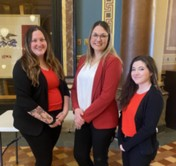
NEICAC’s FaDSS Team, left to right, FaDSS Specialist Paula Duff, FaDSS Coordinator Nichole Griese, and FaDSS Specialist Brooke Fay |
|
|
Trainings and Events
grouped by SHA priority area and sorted by date
|
|
Mental Health & Mental Disorders, Substance Use:
Substance Use and Mental Health: The Impact of Stress, Trauma, and Life Circumstances Webinar
Learn why mental health and substance use challenges often occur together and how trauma, chronic stress, work environments, family habits, and life circumstances affect a person’s risk and recovery. This course emphasizes the underlying causes behind these issues and explains how relationships, the body, and daily environments all play a role. Part 1 in a 3-part series.
Access to Care, Mental Health & Mental Illness:
Cardiovascular Today Conference
Educational event from the Iowa Heart Foundation intended to increase knowledge of the diagnosis, treatment, and prevention of cardiovascular disease. Agenda includes heart-brain connection and the state of heart health in Iowa. New this year is a public health track.
- Hosted by the Iowa Heart Foundation
- Saturday, February 7, 2026, at The Meadows Events & Conference Center in Altoona, IA
- Learn more and register
Access to Care, Mental Health & Mental Disorders:
Peer Support Specialist Training
A Peer Support Specialist (PSS) is an individual who is personally living well in recovery from a serious mental illness and uses their recovery story to instill hope. They provide support to adult peers and assist them in reaching and maintaining their personal recovery goals. In addition, a PSS can serve as an advocate, provide information, help access community resources, and model competency in recovery and wellness. Peer Support Specialists promote skills for improving mental and physical wellbeing and increasing resiliency.
Healthy Eating & Active Living:
Spring into Summer with a Free 6-week Walk with Ease Program
The Spring into Summer initiative integrates the national Move Your Way campaign with an online version of the evidence-based Walk With Ease program to build healthy habits for physical activity. The Move Your Way campaign messages can promote general interest and awareness, but the main goal is to promote enrollment in the FREE (online/self-guided) Walk with Ease program. This effort is guided by the Healthy Iowans’ Active Living workgroup with coordination provided by the ISU Community Connections for Public Health (CCPH) group.
|
|
News and Resources
sorted by SHA priority area
|
|
Access to Care:
Iowa Awarded $209 million for First Year of Federal Rural Health Transformation Program
Governor Kim Reynolds and Iowa HHS announced that Iowa has been awarded funding through the Rural Health Transformation Program, a federal initiative managed by the Centers for Medicare and Medicaid Services. Iowa’s innovative proposal, Healthy Hometowns, will receive $209 million for the first year of implementation. Healthy Hometowns is Iowa’s plan to strengthen health care in rural communities by making care more accessible, connected, and patient focused.
Behavioral Health, Healthy Eating & Active Living, Mental Health & Mental Disorders:
Updated Strategies from What Works for Health
What Works for Health through County Health Rankings & Roadmaps has updated the strategies in the areas below to help address health in your community.
Healthy Eating & Active Living, Housing:
USDA Rural Development Invests $8 million in Water, Housing and Public Safety in Rural Iowa
U.S. Department of Agriculture (USDA) Rural Development’s Iowa State Director Michael Sexton announced that the agency is investing $3,900,000 in loans and $4,170,342 in grants for seven projects to increase public safety, four projects to promote clean water, and two projects to improve rural housing in Iowa.
Mental Health & Mental Disorders:
Social Media and Your Mental Health Guide
Social media is a powerful tool that has transformed the way people connect, communicate, and share information. However, spending too much time online can have negative effects. Share this guide with your community members to help them set boundaries and form healthy habits around social media.
|
|
|
Every day at HHS, we work to improve the lives of our fellow Iowans. As an agency it is important to keep focused on our mission; to help Iowans achieve healthy, safe, stable, and self-sufficient lives through the programs and services we provide.
For more information, please contact: healthyiowans@hhs.iowa.gov
|
|
|
|
|