|
Having trouble viewing this email? View it as a Web page.
|
|

Community College Leader Bulletin
A publication from the Bureau of Community Colleges
Volume 16, Issue 4 December 2025 educate.iowa.gov
|
|
|
|

Earlier this month, the Iowa Department of Education released the latest data on enrollment trends at Iowa’s 15 community colleges, showing overall positive growth and a return to pre-pandemic levels for both student enrollment and number of credit hours.
The 2025 Fall Enrollment Report indicates total enrollment at community colleges increased by 1,937 students from last year. This represents a 2.2% climb in the overall number of students enrolled this fall at 88,530 total students. Comparatively, the pre-pandemic enrollment total was 88,375 students, providing a benchmark for this year’s positive fall enrollment data trends.
Registered credit hours for community college students increased at a higher rate of 2.9% this year, with 742,230 total credit hours compared to 721,586 credit hours in 2024. On average, students enrolled in 8.4 credit hours in the fall semester.
Growth within total enrollment and student credit hours can be attributed in part to strong joint enrollment opportunities in Iowa, which allow high school students to earn high school and college credits simultaneously. This fall, 42,896 high school students participated in joint enrollment courses, which represents nearly a 5% increase from 2024. Additionally, high school students enrolled in 227,639 credit hours this year compared to 215,003 in 2024, which is a growth of close to 6%. Students participating in joint enrollment programs accounted for 48.5% of total enrollment, and 30.7% of all credit hours.
|
 |
|
|
|

During Southeastern Community College's (SCC) recent interim accreditation visit, the Department team identified a promising practice within the student services standard as an exemplary guided pathways student success model that may be beneficial for other community colleges to implement.
SCC developed student success teams composed of faculty and staff aligned with the college’s meta majors. The focus of SCC's student success teams is improving student retention and increasing collaboration among faculty and staff focused on student support. One mechanism for increasing communication and collaboration to support students is using Dropout Detective to identify and address student needs both inside and outside the classroom. The knowledge gained from the collaborative effort led the college to make significant changes to student orientation and onboarding programs, which has received positive feedback from students. Another solution arose when the business meta-major student success team identified that many students lacked access to a laptop, which is required for the program. The college remedied this barrier by selling laptops in the bookstore that could be purchased using financial aid funds.
Further, the student success teams are designed to meet students' individual needs through regular communication. To achieve this outcome, a Student Advocate staff member serves as both an academic advisor and coach for students in the assigned meta-major programs. SCC initially created the advocate position as a result of the statewide guided pathways grant, and then expanded the initiative by increasing the number of Student Advocates from 3 to 10 positions, leveraging a Title III grant focused on extending the guided pathways program. Increasing the number of Student Advocates helped balance the program and advising loads, enabling greater expertise in the meta-major programs and more time to devote to the unique needs of each student.
The impact of the student success teams and Student Advocate positions has led to positive results, as evidenced by their success outcomes data.
For more information on this promising practice, contact Bureau of Community Colleges Administrative Consultant Robin Shaffer Lilienthal at robin.lilienthal@iowa.gov.
|
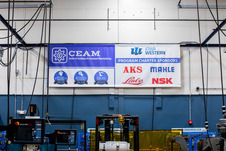
Iowa Western Community College has allocated WTED funds to address workforce training needs in rural communities through subsidized tuition and expanding access to training equipment.
These funds helped create Iowa Western Community College's Center of Excellence for Advanced Manufacturing (CEAM) program, with seven manufacturing employers in the Clarinda and Harlan areas recently participating in CEAM
The CEAM program is designed to train manufacturing employees in electromechanical and tool and die. Participants complete 12 courses totaling 396 hours of training over a 2-year period.
"IWCC's CEAM program has been the most important training tool our company has to upskill our workforce with the education needed to fill the majority of the higher skill manufacturing roles throughout our organization," said Mary Landhuis, the president of Lisle Corporation. "We rely on the program to provide the curriculum tailored to the needs of local manufacturers in a location close to home and work, during hours that fit the needs of working employees and families."
For more information on WTED, contact Bureau of Community Colleges Administrative Consultant Robin Shaffer Lilienthal at robin.lilienthal@iowa.gov.
|

Fresh off the success of last fall’s first work-based learning webinar series, the Iowa Department of Education and Iowa Workforce Development are collaborating on a new series of work-based learning webinars for this academic year.
The webinar series is designed to showcase some of the most proven programs and approaches to work-based learning in Iowa’s most in-demand industries.
Both employers and educators are highly encouraged to register for the series, which is intended to help participants explore and ultimately partner on meaningful work-based learning programs.
Each webinar session is held from 3:30-4:30 p.m. The full schedule with planned session topics and registration links is listed below:
Recordings of the webinar sessions will be available on Iowa Workforce Development’s website after the conclusion of each webinar session.
For more information on career-connected learning and work-based learning opportunities, visit the Department’s webpage. Specific questions on the webinars can be directed to Administrative Consultant Heather Meissen at heather.meissen@iowa.gov.
|
School districts in your region are encouraged to apply to become a Purple Star School. This new initiative is dedicated to supporting the success of Iowa students from military families. Through the inaugural Iowa Purple Star School Program, official designations will be awarded to Iowa schools that show a strong commitment to military-connected students and implement effective strategies that foster stability and achievement.
To earn an Iowa Purple Star School designation, Iowa schools must implement the following requirements:
- Designate a staff member, such as a counselor, teacher or administrator, to serve as a military liaison for students and families.
- Maintain a dedicated webpage with resources tailored to military-connected families.
- Host programs and events that raise awareness and provide support for military-connected students.
- Offer staff professional development focused on the challenges military-connected students may face.
More information on Purple Star Schools is available on the Department’s website or by contacting Iowa Department of Education military veteran and education program consultant Jathan Chicoine at jathan.chicoine@iowa.gov.
|

Mark your calendars now and make plans to attend two exciting annual statewide conference this spring.
Iowa's annual Work Based-Learning Conference is scheduled for April 6, 2026.
Meanwhile the annual Iowa ACTE Conference is slated for June 19, 2026.
|

We’re excited to announce two new changes to our staff.
Cale Hutchings is now the bureau chief for the Bureau of CTE and Postsecondary Readiness. Previously, Hutchings served as education program consultant in the bureau.
Karey Hawkins joined the Bureau of CTE and Postsecondary Readiness as a career and academic planning program consultant. Hawkins previously served as a program planner with the Bureau of Iowa College Aid.
|
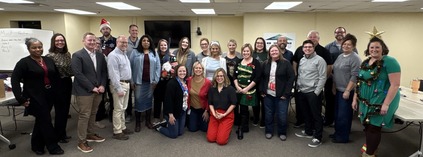
As 2025 comes to a close, the staff from the Division of Higher Education, including the Bureau of Community Colleges, Bureau of Iowa College Aid and Bureau of CTE and Postsecondary Readiness wish you a safe and festive holiday season.
We thank you for another wonderful year of collaboration and innovation in higher education and look forward to our continued partnership in 2026.
|
If you received this copy of the Community College Leader Bulletin from a colleague and wish to subscribe to directly receive future editions, sign up to receive the Community College Leader Bulletin. The monthly newsletter includes information on topics, issues and events relevant to community college stakeholders.
|
|
Iowa Department of Education
400 E 14th Street
Grimes State Office Building
Des Moines, Iowa 50319
Ph: 515-281-5294
www.educateiowa.gov
|
|