|
FOR IMMEDIATE RELEASE
Nov. 18, 2025
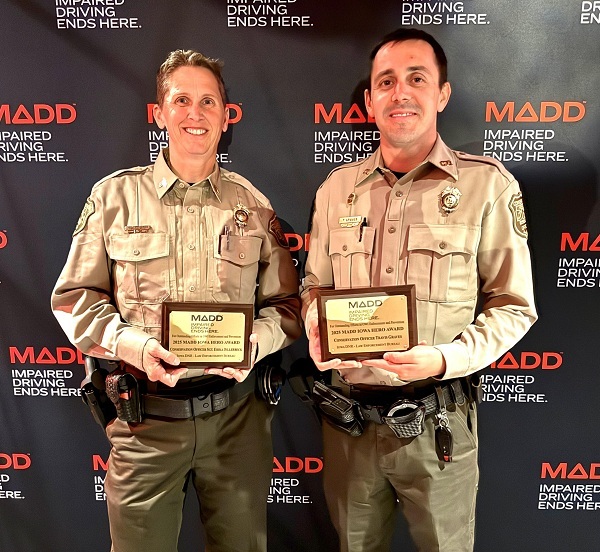
Des Moines —Mothers Against Drunk Driving (MADD) Iowa honored Sergeant Erika Billerbeck (assigned to Johnson County) and Conservation Officer Travis Graves (assigned to Linn County) at a recognition banquet last week in Waukee.
“Sergeant Billerbeck and Officer Graves are top performers in enforcing boating, ATV, snowmobile and motor vehicle impaired driving laws,” said Captain Matt Bruner, with the Iowa DNR’s Law Enforcement Bureau. “They regularly teach fellow officers techniques to detect and apprehend impaired operators, as well as the effects of impaired operators to help keep all Iowans safe while they enjoy our great natural resources.”
Also recognized were officers with the Iowa State Patrol, County Sheriff Offices, and local Police Departments.
Winter paddling can provide solitude, exercise and an opportunity to see amazing winter beauty. The Iowa Department of Natural Resources (DNR) recommends that paddlers be prepared to paddle in cold weather.
Always check the weather conditions before you head out on the water.
“Many paddlers, especially those just starting out, don’t realize how cold the water really is,” said Todd Robertson, Iowa DNR River Programs Water Trails coordinator. “The water is still dangerously cold and cold water shock and hypothermia can set in quickly.”
“Dress for the water temperature, not the air and expect to go into the water,” explains Robertson “A wet or dry suit and a life jacket are crucial to remain safe.”
Review these simple safety tips before you head out on the water this winter.
- Don’t paddle alone. Especially in winter, use a buddy system.
- Always wear a life jacket.
- Choose a shorter paddling trip so you can adjust for any issues, like low water and falling temperatures.
- Check water levels to make sure you won’t need to get in and out of your boat and drag it.
- Make sure the entire water trail route and water body you are paddling is open on both rivers and lakes. Ice jams can form and water freeze as temperatures drop throughout the day.
- Stay away from wood/branch piles and debris, usually found on the outside of river bends, that can pull you underwater and hold you there with little chance of escape.
- Paddle with a group who is experienced in cold water paddling.
- Wear a dry suit or wet suit, along with layers of wool fabrics to help avoid hypothermia or cold water shock. Outer garments should be water- and wind- proof. Dress for the water temperature, not the air.
- Bring along a dry bag with a set of extra clothes you can change into if you get wet, a first-aid kit and a protected cell phone or weather radio.
- Let a friend or loved one know where you are going and when you are expected to return. It will be easier to find you if you need help.
Water recreationists should be aware of bridge construction projects across Iowa. Check the Iowa DNR’s interactive paddling map at www.iowadnr.gov/paddlingmap to help you plan paddling trips and avoid bridge construction areas.
Media Contact: Todd Robertson, Iowa DNR River Programs Outreach Coordinator at 515-205-6845.
Brilliant fall colors are not only found in trees, but also in streams and the Manchester Fish Hatchery. These underwater splashes of color are signs that trout spawning season is in full swing.
Thanks to an increase in self-sustaining, naturally reproducing brown trout populations, there was no need to collect brown trout eggs this fall. Today, all brown trout caught by anglers have spent their entire lives in the stream. Past stockings of French Creek-strain brown trout have helped to establish wild fisheries throughout Northeast Iowa.
“Anglers like these wild, stream-raised fish. They are harder to catch than our hatchery-raised stocked fish,” said Dan Rosauer, Iowa DNR trout hatchery manager. “Nearly all public trout streams have lots of brown trout in them.”
Years of work to protect and enhance the South Pine Creek watershed in Winneshiek County has allowed Iowa’s only native trout, the brook trout, to thrive and continue to naturally reproduce in that stream. Eggs are typically taken streamside in early November from wild South Pine Creek brook trout, fertilized and taken back to the Manchester Fish Hatchery and grown to 2-inch fingerlings by the following June. Those fingerlings are then stocked throughout Northeast Iowa to develop new brook trout populations in other streams.
“The recent drought put additional pressure on our trout streams over the past couple years, so we gave the South Pine Creek brook trout a bit of a break this fall,” said Rosauer. Milt was collected from a portion of South Pine Creek as well as another stream with a restored population of brook trout.
“The milt collected from wild male brook trout will be used to fertilize about 100,000 eggs from South Pine-strain female brook trout currently held at the Manchester Fish Hatchery,” explains Rosauer.
The rainbow trout spawn, the backbone of Iowa’s trout program, takes up much of December and January. Roughly 750,000 eggs will be collected this season.
Crews check for ripe female broodstock once a week. After a quick sedative bath to calm them, each big trout is held over a plastic bowl, as one of the workers rolls a hand down her belly to force out a stream of bright orange eggs—up to 6,000 per fish. The milk-white milt from two males is mixed in. Water is added to activate the eggs and milt, allowing fertilization to occur. The ingredients are gently stirred to avoid bruising the eggs.
The fertilized eggs are poured into an incubator tray and slid into their place below a stream of 50 to 52 degree water until they hatch. Tiny sac-fry hatch about 30 days after fertilization. Dark clouds of tiny fish grow in raceways at the hatchery. The fish are hand-fed for the first month, then “trained” to eat from automatic feeders.
As the trout develop and grow, they are monitored and transferred to larger tanks, then raceways. The fingerlings will be kept at Manchester or transferred to Iowa’s two other stations, near Elkader and Decorah, to be raised for future stocking. In 13 to 15 months, they will be a half-pound and ready to be stocked. Nearly 50 put-and-take streams throughout nine northeast Iowa counties are stocked from April through October and almost 20 community trout fishing locations are stocked through the cold weather months.
“We stock about 370,000 catchable rainbow trout from the hatcheries,” said Rosauer. “We also stock about 60,000 brook and rainbow trout fingerlings each year to grow in the streams.”
There’s natural spawning, mostly brown trout and some brook trout, in more than 100 northeast Iowa streams thanks to improved habitat and trout genetics, and an extended period of above average annual rainfall prior to the drought these past two years. Many trout caught, though, are spawned under the eyes of hatchery workers at Manchester. These coldwater fish are great fighters and beautiful in their spawning colors this time of year.
Find more information about Iowa trout streams and tips for trout fishing on the DNR website at www.iowadnr.gov/trout.
Media Contact: Dan Rosauer, Manchester Fish Hatchery Manager, Iowa Department of Natural Resources, 563-927-3276.
The Iowa Department of Natural Resources is seeking comments on the second comprehensive review and revision to the State Wildlife Action Plan, “Securing a Future for Fish and Wildlife: A Conservation Legacy for Iowans.”
The plan is available for review online at www.iowadnr.gov/iwap. Comments may be submitted by email to Katy.Fullin@dnr.iowa.gov or by mail to Katy Fullin, Iowa DNR, 6200 Park Ave., Ste 200, Des Moines, IA 50321. Comments are due by Dec. 5, 2025.
First approved in 2006, the Iowa Wildlife Action Plan is a 25-year strategy for conservation of all wildlife in Iowa. The plan is the result of a cooperative effort between land managers, fish and wildlife biologists, individual conservationists and others who share an interest in wildlife conservation.
All state wildlife action plans are mandated by Congress to be fully reviewed every 10 years; the last edition of the Iowa plan was reviewed and revised in 2015. The proposed revisions are the result of input from representatives from a variety of entities such as higher education, non-profit organizations, governmental agency staff, and independent fish and wildlife experts.
The temporary, summer employees of the Iowa DNR Law Enforcement Bureau are positions of high responsibility. Diverse duties include checking for compliance with Iowa's navigation and fishing regulations and helping to ensure a safe recreational environment for the public. Water Patrol Officers also provide public assistance and safety education through personal contacts and by participating in DNR's educational programs. Water Patrol Officers are often the first to respond to the scene of emergencies such as accidents, missing persons or other calls for assistance.
For specific job duties, requirements, and application information go to the State of Iowa Career web page. Applications are due by 11:59 p.m., Dec. 15, 2025.
The following are potential positions that may be available. Only indicate on your application those that you are willing and able to work; i.e. only those areas that you would accept employment if offered. Housing is not available with these positions.
- Iowa Lakes/Dickinson County (NW Iowa)
- Storm Lake (in Buena Vista County) (NW Iowa)
- Black Hawk Lake (in Sac County) (NW Iowa)
- North Twin Lake (in Calhoun County) (NW Iowa)
- Mississippi River Pool 10 @ Marquette/McGregor (Clayton County) (NE Iowa)
- Mississippi River Pool 9 @ Harper's Ferry (Allamakee County) (NE Iowa)
- Mississippi River Pool 11 @ Dubuque (Dubuque County) (NE Iowa)
- Mississippi River Pool 12 @ Bellevue (Jackson County) (NE Iowa)
- Clear Lake (in Cerro Gordo County) (NC Iowa)
- Missouri River/Lake Manawa (in Pottawattamie County) (SW Iowa)
- Missouri River/Carter Lake (in Pottawattamie County) (SW Iowa)
- Mississippi River @ Montrose (in Des Moines and Lee Counties) (SE Iowa)
- Mississippi River @ Princeton/Clinton (Scott and Clinton Counties) (SE Iowa)
- Mississippi River @ Fairport (Muscatine and Louisa Counties) (SE Iowa)
- Coralville Reservoir (in Johnson County) (SE Iowa)
- Lake Rathbun (in Appanoose County) (SC Iowa)
- Lake Redrock (in Marion County) (SC Iowa)
- Saylorville Lake (Polk County) (C Iowa)
Get a glimpse into a seasonal Water Patrol Officer position with the DNR YouTube video.
Iowa snowmobilers are no longer required to purchase and display an annual trail user permit, according to a new law that went into effect July 1, 2024. The law folded the trail user permit into the annual snowmobile registration fee, which will now be $30 plus administration fees. The previous price for each type was $15.
Registration and permit fees for snowmobiles are placed in a dedicated account for snowmobile programs in Iowa, including the Iowa Snowmobile Trail Grant Program, which is administered through the Iowa State Snowmobile Association. The grant program supports snowmobile trail development and grooming; equipment purchases and maintenance; and trail signage in cooperation with snowmobile clubs all across Iowa.
Snowmobilers who own a new machine or have not yet entered the snowmobile into the state registration system need to go to the County Recorder’s office in their county of residence to start the registration process. To renew an existing registration, visit the County Recorder or go online to www.gooutdoorsiowa.com.
Nonresident snowmobilers will still need to purchase and display the trail user permit, which are available at any County Recorder’s Office, through retailers that sell hunting and fishing licenses, or online at www.gooutdoorsiowa.com.
Learn more about Iowa's snowmobile programs at: www.iowadnr.gov/snowmobiles.
Media Contact: Jessica Flatt; email: Jessica.Flatt@dnr.iowa.gov
|