|
This year, the Wildlife Diversity Program is highlighting five things YOU can do to help wildlife where you live. In this article, we’ll talk about the risk of artificial light at night to migratory birds, and ways we can improve outdoor lighting to help our feathered friends.
The amount of artificial light in the night sky has dramatically increased since the 1950s, with two thirds of the US population now unable to see the Milky Way with their naked eye. In many urban areas in the US, less than 100 stars are visible. All this artificial light at night not only impacts our enjoyment of the night sky, but has real biological impacts to wildlife, especially migratory birds.
Click on the image for more information! Image by Rosalie Wetzel USFWS.
70% of North American birds are migratory, and 80% of those migrants travel at night. At least some birds use the stars to help them navigate. Research shows that lights can interrupt migration and even harm or kill birds, with birds attracted to or disoriented by building lights from as far as 3 miles away.
Many migratory birds travel thousands of miles each spring and fall and every time they are drawn off course or disoriented because of bright lights, they use up precious time and energy needed to complete their long journeys. Lights also often attract birds to urban areas where they are more likely to encounter additional hazards like collisions with building windows and vehicles, predation from outdoor cats, and exposure to pesticides. Luckily there are many strategies we can use to reduce the impacts of lights on birds.
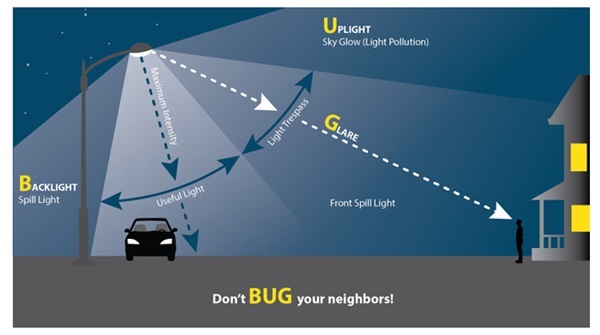
Don’t BUG your neighbors. Maintain useful light while avoiding backlight, uplight and glare. Image from U.S. Bureau of Land Management.
-
Turn off unnecessary lights
Is your porch light really necessary when you aren’t expecting visitors? Does the soccer field need to be lit after 10 pm? Does the office building need to keep all its lights on all night when no one is working? There are many cases where people keep lights on when it isn’t truly necessary for human safety or visibility. By carefully thinking about why lights are on and when they are truly necessary, we can reduce excess light at night. Turning off unnecessary lights is particularly important during spring and fall bird migration. In Iowa, migration peaks from April-May and August-October. Turning off indoor and outdoor lights between 11 PM and 6 AM can be especially helpful to migrating birds. Not sure you can turn off lights all the time but still want to help? You can sign up for migration alerts and turn off lights on the busiest nights when the most birds are flying through.
-
Use only as much light as needed
Think about the last time you had to thread a needle in the shopping mall parking lot in the middle of the night…oh wait. Planning lighting for its intended purpose and not using more than necessary is a great way to reduce electrical bills and help birds and other wildlife. It’s amazing how little light you actually need to be safe at night.
-
Shield lighting
Have you ever seen a street light where to bulb creates a globe of light, sending more than half of the output up into the sky where no one will ever use it? All that extra light is unhelpful to humans and can be dangerous to birds and other wildlife navigating at night. Shielding light, so that it is directed down to where it is useful to humans, is a great way to reduce wasted light and impacts to wildlife.
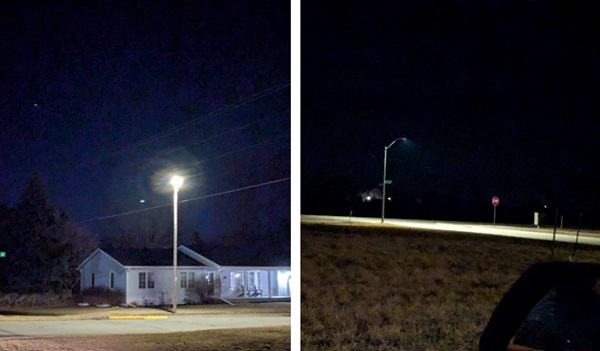 |
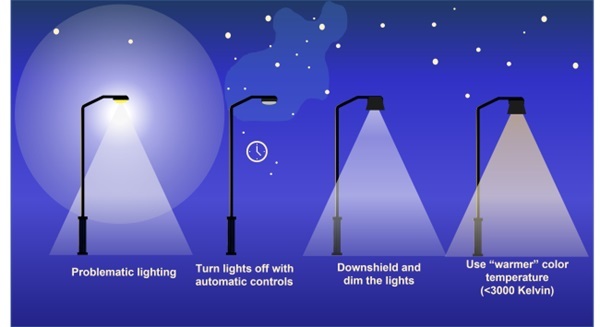
Left: Unshielded light creates sky glow and light pollution Right: Shielded light is directed down for intended use.
-
Use timers, dimmers, and motion sensors
Is the light necessary all the time, or only during certain hours, or when people are present? Using motion sensors, timers, and dimmers to turn off lights when they aren’t being used, is another strategy to reduce unintended impacts to wildlife.
-
Use warm colored light (3000K and below)
You know how people always say blue light keeps you awake and you should avoid it right before bed? Well that general principal applies to wildlife too. Wildlife are more attracted to cool colored, or white/blue light. Using warm lights in the red and yellow spectrum, under 3000 Kelvin, gives plenty of light for human eyes and is less of a distraction or attractant to birds and other wildlife.
Follow these lighting principles to help protect birds and other wildlife. Image from U.S. Fish and Wildlife Service.
|