|
The 2024 Iowa Motus Report and Wood Thrush Tagging
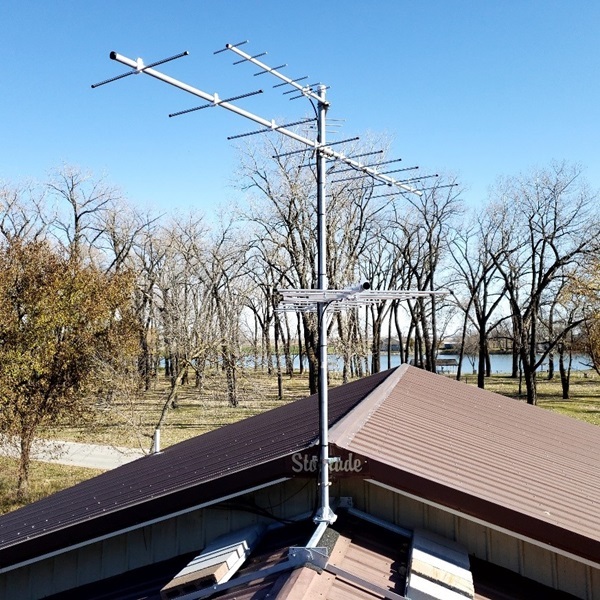
Roof-mounted Motus station in Iowa.
The Motus Wildlife Tracking Network (motus.org) continues to expand in Iowa, with over 30 automated radio telemetry receiver stations across the state detecting tagged migratory wildlife. The Motus system is a collaborative network of wildlife tagging projects and radio receiver stations across the Americas that communicate together and allow researchers to track long-distance movements of small animals, like birds and bats. For example, a bird captured and tagged with a Motus tag in Costa Rica in January has the potential to be detected by a Motus receiver station in Iowa during spring migration. In 2024, Iowa Motus stations recorded 291 detections of 151 individuals from 24 bird species. From the start of Motus in Iowa in 2021 through December of 2024, Iowa Motus stations recorded 607 detections of 340 individuals from 39 bird species. The information gathered by Motus is helping us understand the migratory speed, timing, and habitat use of many bird species that migrate through our state. To learn more about Motus in Iowa, see our annual report.
In 2024, we began placing Motus tags on birds that breed in Iowa. The Iowa DNR is participating in a regional collaboration to tag Wood Thrush across their eastern forest breeding range. Wood Thrush are a Species of Greatest Conservation Need in 25 states, including Iowa, and are considered a common forest bird in steep decline. By tagging Wood Thrush across their range and detecting them on the network of Motus stations throughout the year, we are able to learn about their migratory routes and timing, migratory connectivity, and annual survival.
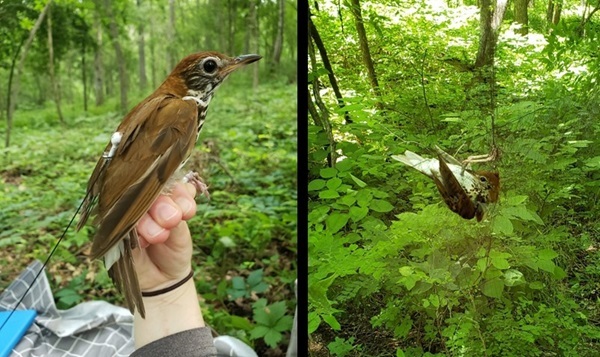
Left: A Wood Thrush fitted with a Motus tag. Right: A Wood Thrush caught safely in a mist net.
To learn more about the project and see bird capturing/tagging in action check out this video!
During summer 2024, Iowa DNR staff tagged 27 Wood Thrush at nine sites across the state near existing Motus stations. Wood Thrush were captured and tagged under Federal Bird Banding permits using targeted mist netting and audio lures. Tags were attached to the Wood Thrush with a leg-loop harness and were 3% or less of the bird’s body weight so they did not impact the bird’s daily activity or flight. The battery lifespan of each tag is at least 400 days, allowing us to track the Wood Thrush during their fall and spring migration routes throughout a full annual cycle.
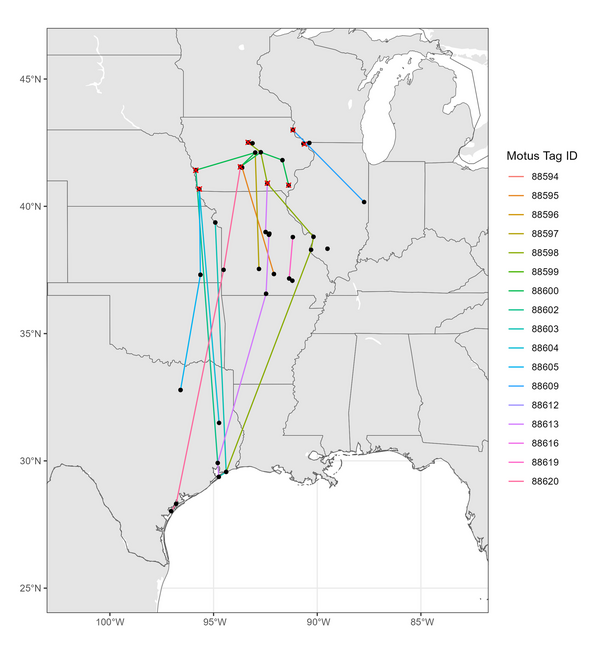
Iowa Wood Thrush started their fall migrations between September 20 and October 11, 2024. Many of the Wood Thrush were detected at Motus stations south of Iowa including in Missouri, Illinois, Kansas, Louisiana, and Texas. Six birds were detected outside the United States in Mexico, Guatemala, and Belize. Particularly interesting were two Wood Thrush that traveled through Belize and were detected at the same Motus receiver as many other tagged Wood Thrush. Wood Thrush from all across the breeding range were detected at this station including birds tagged in Missouri, Mississippi, Ohio, New Hampshire, Pennsylvania, West Virginia, Kentucky, Vermont, New Jersey, Delaware, Georgia, Maine, and the Canadian Province of Ontario. This high detection rate indicates that this particular area of Belize is an important migratory corridor for the species at large, and that habitat conservation efforts in this region are necessary and valuable to Wood Thrush no matter where they breed.
 |
Map showing migration routes of Wood Thrush tagged in Iowa in 2024 that were detected at Motus stations during the 2024 fall migration. Each Motus tag ID number corresponds with an individual bird.
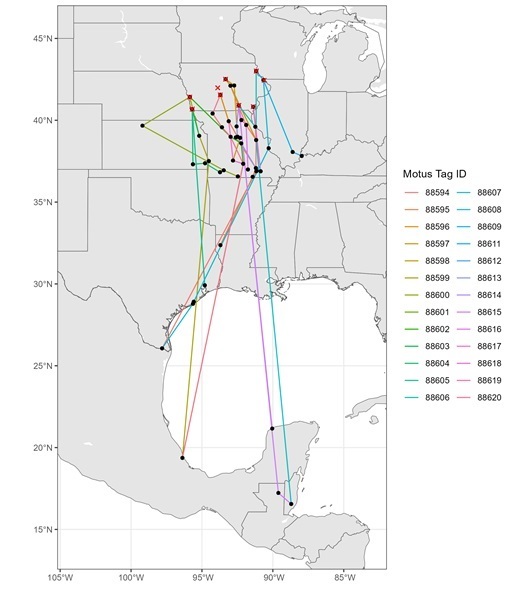
Iowa tagged Wood Thrush began returning to Iowa in April of 2025, with the first detection on an Iowa Motus station on April 29th. A total of 14 Wood Thrush were detected in Iowa by early June, roughly 52% of all the Wood Thrush tagged in Iowa during 2024.
Map showing migration routes of Wood Thrush tagged in Iowa in 2024 that were detected at Motus stations during the 2025 spring migration. Each Motus tag ID number corresponds with an individual bird.
The more stations a bird is detected at during their migration, the better picture we can get of their migration route. For example, a Wood Thrush tagged at Brown's Woods park in Des Moines with a Motus tag ID number of 88620 was detected by 5 stations during its fall migration and 3 stations during its spring migration. This allows us to see that this bird left its breeding grounds at Brown's Woods around October 11, 2024 and traveled through Missouri and was detected by four stations, then detected by a station in José Cardel, Mexico on November 9, and likely traveled as far south as Central America to overwinter. Wood Thrush 88620 was detected during its spring migration first on April 19, 2025 at Aransas National Wildlife Refuge in Texas, then at another location in Texas, then in Missouri, before finally being detected once again at Brown's Woods park in Des Moines on May 1st. See the map below for a visual of Wood Thrush 88620's migration routes.
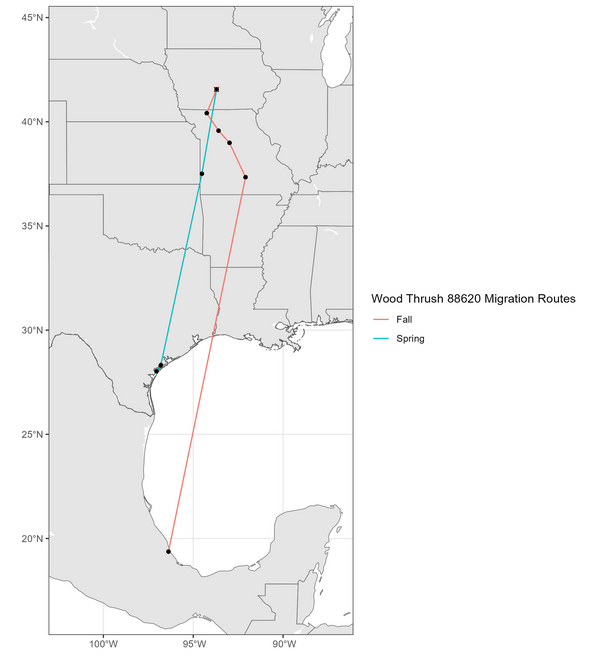 |
Map showing the Motus station locations where the Motus tagged Wood Thrush 88620 was detected during fall 2024 and spring 2025 migrations.
So far in 2025, the Iowa DNR has tagged an additional 10 Wood Thrush at five sites across eastern and central Iowa near existing Motus stations and is also collaborating with researchers at Iowa State University to tag more Wood Thrush in Iowa. These tagging efforts will continue to improve our understanding of Wood Thrush across their full annual cycle and help us to improve conservation efforts for this declining bird species. Check out this link to see where Iowa tagged Wood Thrush have been detected!
Fall bird migration will be starting soon, so keep an eye out for detections on Iowa Motus stations between August and October.
|