|
FOR IMMEDIATE RELEASE
June 17, 2025
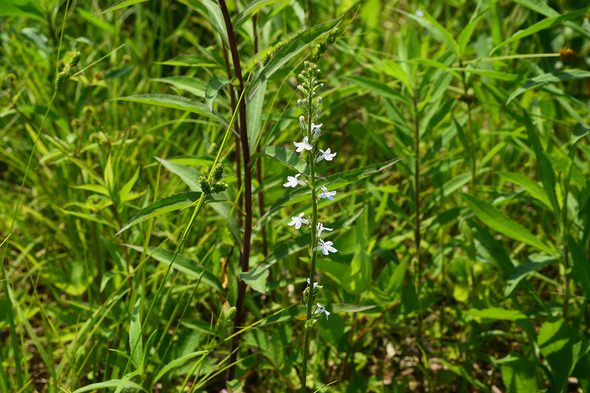 Pale spiked lobelia flowering at Rock Creek Wildlife Area. Photo courtesy of the Iowa DNR.
Some of Iowa’s lesser known native prairie plants have returned to the hills overlooking Rock Creek Lake this spring, after a project last November knocked back invasive species plant species such as honeysuckle and autumn olive that had thickly spread onto the area.
Standing on this patch of newly returning remnant prairie, wildlife biologist Todd Gosselink pointed out native flowers that were just waiting in the soil for the opportunity to reappear.
“Maximillian sunflower, butterfly milkweed, wild bergamot, rattlesnake master, flowering spurge, cream gentian, prairie dogbane, pale spiked lobelia,” he said while pointing to each plant as he saw it. For anyone interested in seeing these unique plants, the flowers won’t hit their peak colors until July and August.
“We need to get fire on this area to keep it in prairie. Historic 1930s and 1950s photos showed it was most likely used for pasture, so we thought if we could open it up from the invasive shrub growth that the prairie would return.”
What also could return is bobwhite quail, Gosselink said, after hearing nearby the call of a field sparrow.
“Having field sparrows present is an indicator that the type of habitat exists that could support quail,” he said. “There have been quail heard here it the past, so this work helps create more habitat for them.”
Managing land as prairie is based on what had historically been the habitat on these rolling hills is at the core of the area’s ten-year management plan, and it takes constant work to reclaim and maintain the prairie to fend off invasive woody encroachment.
Rock Creek Wildlife Area consists of about 850 acres of public land nearly all north of the state park by the same name. The smaller of the two main parcels, separated by about a mile to the west, is the 250-acre Deppe tract that is in prairie, with wildlife food plots and a 24-acre pond that is popular for fishing and as a place to paddle. It was burned as part of the rotational schedule of prescribed fire this spring.
“It’s amazing the difference after you burn, how the plants respond,” Gosselink said. “Grassland birds like openings on the prairie floor, and a diverse prairie plant mix. Pheasant chicks can move more freely versus trying to navigate old prairie grass thatch from the previous year’s growth. And the prairie flowers attract insects and pheasant chicks eat insects.”
Rock Creek Wildlife Area is a popular place for dove and pheasant hunting in the fall, but doesn’t see as many visitors in the spring and summer.
“There’s a lot of opportunity here – a lot of diversity of habitats to explore, from kayaking on the ponds, fishing to wildlife viewing to hiking in the prairie or enjoying everything the state park has to offer,” he said.
With nearly 200 campsites, Rock Creek State Park is one of Iowa’s busiest campgrounds and features a full-service marina offering boat rentals, hunting and fishing licenses, live bait, select groceries, camping supplies, firewood, t-shirts, ice cream, concessions and more.
The park has more than eight miles of multi-use tails, fishing jetties, lakeside campsites and more. The 466-acre Rock Creek Lake offers fishing for bluegills, crappies, largemouth bass, channel catfish and walleyes. The lake has excellent shoreline access.
Media Contact: Todd Gosselink, Wildlife Biologist, Iowa Department of Natural Resources, 515-238-6936.
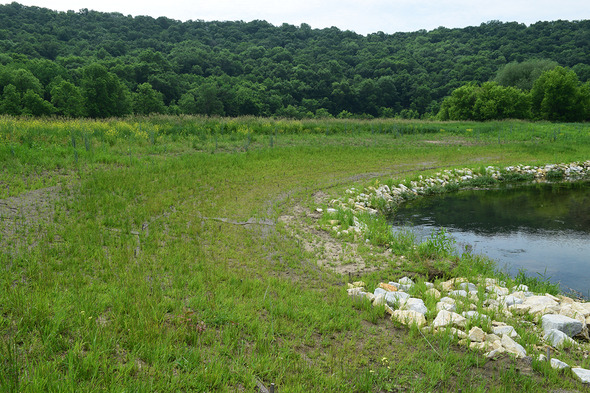 Sections of the streambank at Waterloo Creek were reshaped and armored to allow floodwaters to spread out and reduce bank erosion. Boulders were placed in the stream to deflect the current, break up the water surface and provide places for trout to hide. Photo courtesy of the Iowa DNR.
Waterloo Creek Wildlife Area is 1,980 acres of timber, prairie, with a few small wetlands and roughly four miles of coldwater trout stream. The area is popular for deer and turkey hunting with pheasant numbers on the rise.
“This has something for everyone,” said Troy Anderson, wildlife biologist with the Iowa Department of Natural Resources (DNR). “This is the heart of Iowa’s Driftless region.”
Summertime means trout fishing at Waterloo Creek and on this Wednesday, fishing was good.
“It’s a high quality, large trout stream known for big brown trout below Dorchester, and is stocked weekly with rainbow trout above Dorchester,” said Caleb Schnitzler, fisheries biologist with the Iowa DNR’s Chuck Gipp Trout Hatchery. “Being this close to Minnesota and Wisconsin, we have a lot of nonresidents come here when their trout seasons close.”
A stream improvement project completed in July 2024 will help reduce impacts from future flooding by reshaping the bank to better handle the high water. Boulders were placed in the stream to deflect the current, break up the water surface and provide places for trout to hide.
Waterloo Creek is consistently in the top 10 most popular trout streams and since the stream does not freeze during the winter, it provides fishing all year long.
Staff with the Iowa DNR’s Fisheries Bureau was sampling a small tributary stream for the presence of sculpin and while they found the unique looking native fish, they also found Iowa’s native brook trout in this section. This small, pebble-lined stream was once the site of a small mill, with hand lain stones creating the stream edge. It is now home to the recently reintroduced South Pine Creek brook trout.
Walking alongside the stream on their early June morning, an insect hatch is underway – with trout feeding on the larvae hitting the surface. Fish can be seen in the deeper pools.
In the woodlands, management work follows the forest stewardship plan covering 1,000 acres, that includes creating a soft edge transition zone from prairie to timber. Within the timber, area managers are working to emphasize oaks.
Anderson said 240 acres has been restored to prairie with another 40 acres returning in a few years. The restored prairie mix of grasses and forbs includes flowering spurge, prairie cinquefoil, small skullcap, little bluestem, common blue violet, side oats gramma, false boneset, tall anemone and more.
The steep hillsides are home to patches of native prairie and while plants won’t be in full bloom for another month, a handful are identifiable, including spiderwort, hoary puccoon, leadplant, rough blazing star, and common yarrow. Much of Waterloo Creek is managed with prescribed fire.
Two neighboring producers manage 230 acres of habitat leases with 25 acres remaining as food plots.
“It’s not one landscape, but many – steep hills, valleys, open ground on top with plans to continue to convert former ag fields into prairie,” Anderson said. “We have a few dove fields here that get a lot of use by the locals.”
Given its location, there is the possibility that ruffed grouse could be on the area. Anderson said part of their management plan is to provide grouse habitat through Aspen cuttings to that are preferred by the secretive bird.
“We did a grouse survey here this year, but didn’t record any, but we’re not giving up,” Anderson said.
Early inhabitants
There is evidence that Iowa natives lived on a portion of Waterloo Creek Wildlife Area, based on research from Luther College. Surveying the area uncovered small underground storage and trash pits, and roasting pits. There is also a large ovoid that was dug that aligns with the spring equinox. The ovoid was investigated and no artifacts were found at the site.
Media Contacts: Troy Anderson, Wildlife Biologist, Iowa Department of Natural Resources, 563-379-5725; Caleb Schnitzler, Fisheries Biologist, Iowa Department of Natural Resources, 563-382-8324.
MILFORD —The Iowa Department of Natural Resources (DNR), Iowa Lakeside Laboratory, Buena Vista County Conservation and the Flandreau Santee Sioux Tribe of South Dakota invite you to celebrate the Little Sioux River with summer speaker presentations, riverside chats and paddling events.
Speakers include professional scientists, conservationists, Dakota Tribal members, authors and historians such as Iowa Historian and University of Northern Iowa Professor, Kevin Mason, and Environmental and Sustainability Professor at Drake University, Claire Hruby.
“Summer events will be hosted along the length of the Little Sioux River,” explains John Wenck, Iowa DNR water trails coordinator. “Communities close to the river are encouraged to come learn about the river’s cultural history, water quality, geology, recreation opportunities, and plants and animals.”
Iowa DNR’s Water Trails Program is working to designate nearly 200 miles of the Little Sioux River as the Inkpaduta Canoe Trail to improve access, recreation opportunities and safety along the river.
Find a complete list of events online at: www.inkpadutacanoetrail.org/
Media Contact: John Wenck, Water Trails Coordinator, Iowa Department of Natural Resources, 515-494-8629.
DES MOINES – The popular Trees for Kids grant program is accepting applications through August 22.
Grantees can be awarded up to $2,500 to purchase trees and mulch. All trees for this program must be planted on public community grounds (park, community center, public school, etc.) Youth are required to be engaged in the process, most often helping to plant the trees on site.
“Planting trees is a fun way to connect kids to nature, build on their sense of wonder and explore the benefits trees provide at their school and in their community,” said Chip Murrow, urban forestry program specialist for the Iowa Department of Natural Resources.
Studies show trees planted around schools and in neighborhoods give youth increased levels of concentration, lower levels of aggression, lower levels of obesity and fewer symptoms of ADHD.
To apply for the grant, visit: www.iowadnr.gov/urbangrants.
Media Contact: Chip Murrow, Urban Forestry Program Specialist, Iowa Department of Natural Resources, 515-822-1031.
More than 280 athletes from 36 Iowa teams competed in the 2025 Iowa Scholastic Clay Target Program (SCTP) Sporting Clays Championships, that was held June 12-14 at Highland Hideaway, near Riverside. The course was set by Dave Miller, of Miller Shooting Sports, LLC in Missouri.
Dylan Uitermarkt of Pella Christian Eagles won the Men's Varsity Division, Megan Vos from the Oskaloosa Shooting Team won the Ladies Varsity Division, Pella Christian Eagles won the Varsity and Junior Varsity Team Divisions. Find the complete list of all results online at https://app.sssfonline.com/nationals/4756.
Men’s Varsity Individual Sporting Clays
- Dylan Uitermarkt, Pella Christian Eagles, 191 points
- Ledger Smith, Albia High School, 189 points
- Logan Bruxvoort, Pella Shooters Club, 188 points
Women’s Varsity Individual Sporting Clays
- Megan Vos, Oskaloosa Shooting Team, 183 points
- Madalynn Schroder, Pella Shooters Club, 179 points
- Trista McMullen, Underwood Youth Trap Club, 176 points
Sporting Clays Varsity Teams
- Pella Christian Eagles, 561 points
- Pella Shooters Club, 544 points
- Albia High School, 535 points
The Sporting Clays All-State Teams are determined by the state sporting clays event score selecting the top-5 male and female competitors in the senior division (Junior Varsity and Varsity).
Men’s All-State Sporting Clays Team
- Dylan Uitermarkt, Pella Christian Eagles, Captain
- Ledger Smith, Albia High School
- Logan Bruxvoort, Pella Shooters Club
- Deacon Boot, Pella Christian Eagles
- Hunter Uitermarkt, Pella Christian Eagles
Women’s All-State Sporting Clays Team
- Megan Vos, Oskaloosa Shooting Team, Captain
- Madalynn Schroder, Pella Shooters Club
- Trista McMullen, Underwood Youth Trap Club
- Hayley Burke, Oelwein Trap Club
- Lily Jennings, Ankeny Centennial Jaguars Shooting Sports
Iowa’s SCTP teams will attend the last competition of the season on June 18-21 at the New Pioneer Gun Club in Waukee, for the Iowa Scholastic Clay Target Program Skeet Championship.
For more information on the Scholastic Clay Target or Action Shooting Programs in Iowa, contact Jonathan Jones at 515-313-8048 or Jonathan.Jones1@dnr.iowa.gov.
|