 |
|
Information in this distribution and more is available on the Iowa Rural Healthcare Workforce Connection. Check it out! |
Apply to National Health Service Corps (NHSC) Loan Repayment Program
The FY 2025 NHSC Loan Repayment Program Application is open through Thursday, May 1, 2025.
Start your application
- If you do not have one, create a My BHW account.
- If you have a My BHW account, once logged in select NHSC Loan Repayment Program.
- The application includes screening questions to assist applicants in determining the program for which they are eligible to apply.
Apply to the Nurse Corps Loan Repayment Program
Start your application
- If you do not have one, create a My BHW account.
- If you have a My BHW account, once logged in select Nurse Corps Loan Repayment Program.
- The application includes screening questions to assist applicants in determining the program for which they are eligible to apply.

Healthcare Workforce Summit
May 14, 2025 9:00 AM - 4:00 PM (CDT)
Iowa Hospital Association
100 Grand Avenue, Suite 100
Des Moines, IA 50309
The Iowa Healthcare Workforce Summit will bring together key stakeholders in Iowa's healthcare field for a collaborative, one-day event aimed at developing actionable solutions to address the healthcare workforce shortage. Participants will leave with concrete strategies for their organizations and a shared consensus on necessary actions to tackle the issue. A report showing the voted top overarching themes will be provided after the event.
Register
|
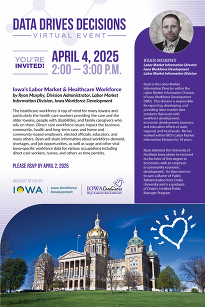
Virtual Event: Data Driven Decisions
April 4, 2025, from 2:00 to 3:00 P.M.
The healthcare workforce is top of mind for many Iowans and particularly the health care workers providing the care and the older Iowans, people with disabilities, and family caregivers who rely on them. Direct care workforce issues impact the business community, health and long-term care, home and community-based employers, elected officials, educators, and others. Ryan will share information about workforce demand, shortages, and job opportunities, as well as wage and other vital Iowa-specific workforce data for various occupations including direct care workers, nurses, and others as time permits.
Register
|
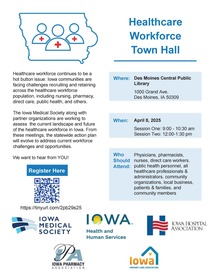
Healthcare Workforce Town Hall
April 8, 2025
Session One: 9:00 - 10:30 am
Session Two: 12:00-1:30 pm
Des Moines Central Public
Library
1000 Grand Ave,
Des Moines, IA 50309
The Iowa Medical Society along with partner organizations are working together to assess and evaluate the current landscape and future of the healthcare workforce in Iowa. From these meetings, the statewide action plan will evolve to address current workforce challenges and opportunities.
We want to hear from YOU! We want to hear from people within communities about their communities.
Who should attend: Physicians, pharmacists, nurses, direct care workers, public health personnel, all healthcare professionals & administrators, human resource professionals, educators, community organizations, local business, patients & families, and community members.
Register
|
FIND Project: Dental Education Loan Repayment
The Fulfilling Iowa's Need for Dentists (FIND) Project is a state and local collaboration to recruit and retain dentists in private practice settings in rural, underserved areas in Iowa. The project includes dental education debt repayment through the Delta Dental of Iowa (DDIA) loan repayment program. Loan repayment includes two levels of funding based on county designation. Note: Every Iowa county is eligible for the program; however, preference will be given to dentists in a high-priority or priority county.
- Up to $200,000 over a 5-year period for a dentist serving in a high-priority county
- Up to $125,000 over a 5-year period for a dentist serving in a priority or non-designated county
In return for the loan repayment award, the selected dentist agrees to allocate 35% of patient visits to underserved populations, including a minimum of 15% Medicaid-insured patients.
More Information Here
Two Iowa dentists are the 2025 recipients of educational loan repayment awards from the Fulfilling Iowa’s Need for Dentists (FIND) project, a collaborative public-private partnership.
- The 2025 FIND award recipients include:
Dr. David Lyle, East Des Moines Dental, Des Moines – Dr. Lyle is from Des
Moines and completed his undergraduate and graduate studies at the
University of Iowa. After receiving his Doctor of Dental Surgery degree in 2019,
he joined his dad’s practice as an associate. In July 2021, he became the sole
owner of East Des Moines Dental.
- Dr. Lauren Schau, Wildflower Kids Dentistry, Dubuque – Dr. Schau graduated
from the University of Iowa College of Dentistry and Dental Clinics in 2016.
After completing a General Practice Residency in Minnesota 2017, she worked
in private practice in New Mexico and at Primary Health Care in Marshalltown.
In 2023, she joined an existing children’s practice and became the sole owner in
2024, renaming it Wildflower Kids Dentistry.
Press Release
Free Public Health Training Available
The Public Health Training for Community Health Workers series provides a comprehensive introduction to public health, covering its core functions and essential services. Designed for CHWs and other front-line health workers, this training equips you with essential public health knowledge and the resources and programs available to support individuals and communities.
This free online training is self-paced, allowing you to complete the modules on your schedule. Upon finishing all the modules, you will receive a certificate acknowledging your completion of the Public Health Training for CHWs.
Application Here
CMS announces application for new residency positions
CMS announced that applications are now being accepted for new residency positions created by Sec. 126 of the Consolidated Appropriations Act (CAA), 2021 and Sec. 4122 of the CAA, 2023. More information on the new residency positions can be found here. Hospitals eligible to apply include those in rural areas, training residents in excess of their Medicare GME cap, in states with new medical schools, and that serve health professional shortage areas.
Applications are due March 31, 2025 via MEARIS.
More Information Here
Technical assistance available for rural and tribal transportation projects
The U.S. Department of Transportation (DOT) released a Notice of Funding Opportunity (NOFO) for the Rural and Tribal Assistance Pilot Program, created by the Bipartisan Infrastructure Law. The NOFO offers $27 million in technical assistance grants to rural and tribal communities for the planning and design phase development of transportation projects. There is no local funding match required to participate in this program. Up to $10 million is designated for Tribal applicants. Applications will be accepted on a first-come, first-served basis beginning Tuesday, March 4, 2025, at 2 PM ET and the application portal will close on Thursday, April 3, 2025, at 4:59 PM ET.
Funding Opportunity
2025 Nursing Innovation Funds Request for Proposals
To help strengthen the nursing workforce, AARP and the American Association of Critical-Care Nurses (AACN Critical Care) have issued an RFP seeking innovative and replicable solutions to create and sustain healthy work environments and improve recruitment and retention rates of registered nurses. Awards of up to $20,000 each will be provided for selected projects that can be completed in one year. Proposals are due no later than 10 pm ET on Friday, April 4, 2025.
More Information
Informational Webinar on NASHP Maternity Care Deserts Policy Academy
Tuesday, March 25 at 11:30 am Eastern
With support from HRSA’s Maternal and Child Health Bureau, the National Academy for State Health Policy (NASHP) will provide an overview and answer questions about the NASHP policy academy, Advancing State Strategies to Address Maternity Care Deserts, where teams of state health officials (e.g. public health, Medicaid, behavioral health, provider groups, etc.) will receive technical assistance to support and advance innovative state-level policy initiatives that address the growth of maternity care deserts and improve access to maternal and child health care.
Register
CDC Updates Urban-Rural Classification for Counties
Last week, the National Center for Health Statistics (NCHS) at the Centers for Disease Control and Prevention (CDC) released the new NCHS Urban-Rural Classification Scheme for Counties. For this update, the NCHS used delineations of metropolitan and micropolitan statistical areas from the Office of Management and Budget as well as estimates from the U.S. Census Bureau to classify counties and county equivalents into six categories – four metropolitan and two nonmetropolitan. This scheme allows researchers, policy makers, and others to study the health of U.S. residents according to how urban or rural their county is.
Announcement
 |
|
Information in this distribution and more is available on the Iowa Rural Healthcare Workforce Connection. Check it out! |
Improving rural health through ‘wealth capital’
In early 2024, Manchester, along with the Iowa-Missouri border community of Van Buren County, was selected from 10 applicant communities to participate in the program that coalition members say aims to improve the health and vitality of rural communities by addressing opportunities in their eight categories or “capital” areas.
The coalition’s six member organizations were already working in different areas of community health. The members are the Governor’s Empower Rural Iowa Initiative, the Iowa Rural Development Council, Iowa State University Extension and Outreach, the Institute for Decision Making at the University of Northern Iowa, the University of Iowa College of Public Health and Wellmark Blue Cross and Blue Shield. Read the article to learn more about this program.
Publication
Lakes Regional Healthcare Recognized as a 2025 Top 100 Rural & Community Hospital
Lakes Regional Healthcare has been named among the Top 100 Rural & Community Hospitals in the United States for the seventh year in a row by The Chartis Center for Rural Health.
The center analyzes rural hospitals through the Hospital Strength INDEX®, the industry’s most comprehensive and objective assessment of rural hospital performance in the United States. Leveraging publicly available data, the INDEX is utilized nationwide by rural hospitals, health systems and rural affiliates, hospital associations and state offices of rural health across the country to measure and monitor performance across a variety of areas impacting hospital operations and finance.
Article
Floyd Valley Recognized as a 2025 Top 100 Rural & Community Hospital
Floyd Valley Healthcare has been named among the 2025 Top 100 Critical Access Hospitals by The Chartis Center for Rural Health. Chartis’ annual Top 100 award program honors outstanding performance among the nation’s rural hospitals based on the results of the Chartis Rural Hospital Performance INDEX®. FVH also was on the top 100 list released in February 2024.
“It is always an honor to receive this recognition. To be listed in the Top 100 is a direct reflection of our amazing team,” Floyd Valley Healthcare CEO Dustin Wright said in a release. “Nationally there are 1,371 CAH with Iowa having the second-highest number of CAH with 82 facilities. So even being listed among top performers in Iowa would be an accomplishment, let alone the entire country.
Article
Fewer clinicians entering primary care: 5 report card findings
Investments in primary care are declining, and fewer clinicians are entering the field at a time when chronic disease rates are rising, according to a new report from researchers at the American Academy of Family Physicians.
Article
Van Diest Medical Center has been recognized as a 2025 Top 100 Critical Access Hospital
VDMC is one of only 11 hospitals in the state of Iowa to achieve this designation. Nationwide, there are 1,371 critical access hospitals.
Article
Iowa State launches new bachelor’s degree in integrated health sciences to address growing demand for health care professionals
An innovative new degree at Iowa State University will prepare students for health care professions through a unique blend of coursework. The Iowa Board of Regents approved the Iowa State undergraduate degree – Bachelor of Science in integrated health sciences – on Feb. 28.
The program is the first undergraduate degree in Iowa to offer a fully integrated, interdisciplinary approach to health sciences. Unlike traditional pre-health majors, the comprehensive program focuses on health and wellness from multiple angles, with classes in life sciences, behavior and social sciences, data sciences, and the humanities.
Article
|
|
Information in this distribution and more is available on the Iowa Rural Healthcare Workforce Connection. Check it out! |
New State Fact Sheets Available
Data is a powerful advocacy tool. That’s why NRHA created state fact sheets and state rural coverage fact sheets for NRHA members to share with their elected officials. State fact sheets include the number of rural providers in each state, health professional shortage area data, and hospital vulnerability information. New this year are state rural coverage fact sheets, which provide nationwide and state-specific statistics on enrollment in Medicaid, the Marketplace, and Medicare Advantage. Please find state fact sheets here and state coverage fact sheets here.
2024
2025
USDA Fact Sheet
The USDA, ERS State Fact Sheets provide information on population, income, poverty, food security, education, employment/unemployment, farm characteristics, farm financial indicators, top commodities, and agricultural exports. Data are available for all States, and for metro/nonmetro breakouts within States (and for Puerto Rico if applicable).
Links to county-level data are provided where available.
Article
Running List of Rural Hospital Closures since January 2005
Each year, we compile a list of operating U.S. Hospitals as a downloadable resource to the public. The spreadsheet includes acute care hospitals (Critical Access, Cancer, Indian Health Service, Medicare-Dependent, Rural Referral Center, Sole Community, and Prospective Payment System Hospitals), and specialty hospitals (long-term acute care, children’s rehabilitation, psychiatric, and religious hospitals), their addresses, bed counts, rural/urban definitions, CMS rural payment designations, and more.
Information is current as of January 1, for each file year. For example, the U.S. Hospital List (2024) includes hospitals that were open as of January 1, 2024.
Hospital List
Health Workforce Research Digest
The Health Workforce Digest is a monthly newsletter created by the Health Workforce Assistance Center (HWTAC) that provides relevant and up-to-date information on a variety of key topics in health workforce research. Each issue of the newsletter includes a curated list of journal articles published in the previous month, categorized by topic.
This online resource is a repository of all issues of the Health Workforce Research Digest newsletter, searchable by topic and by date.
Resource
Check out the Rural Health Legislative Tracker to Track Both Federal and Iowa Bills
NRHA's legislative tracker enables you to view the rural health bills in Congress that the association is monitoring. Bills are searchable and categorized by topic area. By clicking on a bill, you can find its summary, review cosponsors, and stay up to date on congressional actions. Use the FIND dropdown menu to access by Federal or State.
Tracker
Make Medicare Beneficiaries Healthier by Strengthening Primary Care
The Primary Care Collaborative’s latest issue brief, Make Medicare Beneficiaries Healthier by Strengthening Primary Care, highlights how decades of underinvestment in primary care have contributed to rising chronic disease rates and increased healthcare costs. With over 60% of Americans living with a chronic condition, strengthening primary care is essential for improving health outcomes and reducing spending. The report advocates for hybrid payment models that provide primary care teams with upfront, population-based payments, allowing clinicians more time to focus on prevention and chronic disease management. It also calls for policy changes to remove financial barriers for patients and reduce administrative burdens on providers. To amplify these findings, PCC has released a Marketing Toolkit with ready-to-use social media posts, key messages, and outreach strategies.
Brief
Toolkit
Do clinicians complete states’ loan repayment programs debt free? If not, are they disappointed?
Likely every state offers loan repayment programs (LRP) to entice clinicians to underserved areas. Repaying education loans is the core feature/incentive for participating clinicians. However, there has been no data on how clinicians’ educational debt changes with states’ LRPs. PRISM data was used to answer these questions around clinicians’ debt and LRP:
- Do most participants have all debt paid off?
- Do many finish LRPs still hundreds of thousands of dollars in debt?
- Are clinicians happy with the amount of debt their LRPs pay off?
3Rnet held a webinar on the impact of state loan repayment programs on clinician educational debt.
Webinar
Evaluation of the Iowa Health and Wellness Plan: 2023 Survey of Iowa Private Practice Dentists
This report describes the results of a 2023 survey of private practice general dentists in Iowa regarding their participation, experiences, and attitudes with the Dental Wellness Plan (DWP) and DWP Kids, Iowa’s Medicaid dental programs for adults and children, respectively. The survey was fielded in August through October 2023; 58% (n=619) of eligible dentists responded.
Publication
Health Workforce Data Collection in the United States
Consistent and reliable data collection plays is necessary for effective health workforce planning. In the past decade, more states and organizations have prioritized collecting health workforce data. The Health Workforce Technical Assistance Center (HWTAC) tracks states data collection efforts for supply, demand, and education pipeline data through an ongoing survey.
This brief presents current health workforce data collection and analysis efforts across states in the US.
Publication
Rural Americans Don’t Live as Long as Those in Cities, Says New Research.
Recent research published in the Journal of Rural Health highlights a concerning disparity in life expectancy between rural and urban Americans. The study, conducted by researchers from the University of Southern California, found that a 60-year-old man living in a rural area is expected to live, on average, two years less than his urban counterpart, while the gap for women is six months. A key reason for this discrepancy is the higher prevalence of health risk factors in rural communities.
Article
The Growing Impact of Medicare Advantage on Rural Hospitals
Rural hospitals are vital to their communities, providing essential healthcare services and serving as economic anchors. However, these hospitals are under increasing financial pressure, in part due to the rapid expansion of Medicare Advantage (MA) plans.
Without meaningful reforms, rural hospitals may continue to shut down, reducing healthcare access in already underserved areas. Policymakers must take action to ensure rural communities receive the care they need.
Report
Medicaid billing for community health worker services growing, but remains low, 2016-2020
Despite the recognized value of Community Health Workers (CHWs) in improving health outcomes, the integration of CHWs into Medicaid continues to be a challenge. This study examines the trends in CHW billing for Medicaid services across states from 2016 to 2020. Overall CHW billing in Medicaid remained low as of 2020, with the exception of Ohio. Understanding factors associated with Ohio's expansion could yield important insights for current efforts to improve access to CHWs for Medicaid beneficiaries.
Article
Composition of the Public Health Workforce: Distribution, Training, and Tenure
Local public health is increasingly being asked to do more for growing populations with diverse needs related to increases in chronic diseases, mental health, opioid misuse, health equity, and environmental concerns, and respond to more emergencies that are more complex with limited funding, staffing, and other resources.5 Given these changing dynamics, there is a need to better understand the current public health workforce.
Article
Nurse workforce change and metropolitan medically underserved areas in the United States
The continued healthcare crisis in the United States (US) is worrisome, especially as workforce shortages, particularly for nurses, are highlighted, often in some of the highest need areas. As the need for healthcare services grows, especially for services that nurses can deliver, the inability to meet those needs exacerbates existing disparities in access to care and can jeopardize the quality and timeliness of healthcare delivery in underserved communities. This study examines the relationship between changes in the nursing labor force changes and metropolitan medically underserved areas (MUA), defined by Health Resources and Services Administration (HRSA).
Article
Health Workforce Issues and Challenges in the Post-Pandemic Era
The health workforce is an essential component of our health care delivery system. A well-trained, sufficiently sized, and diverse workforce is critical to meet the health care needs of the population. However, in this post-pandemic era, many challenges persist. The aim of this special collection of papers is to provide insight into several key issues currently affecting the health workforce. Topics covered include health workforce shortages, the impact of health professions regulation, and the physical and mental well-being of health care workers, among others.
Each article in this collection was developed by one of the nine federally-funded Health Workforce Research Centers (HWRCs). To learn more about the HWRCS and their work, please visit the research page on the Health Workforce Technical Assistance Center website.
Article
Social care data: How leaders can actually advance community health
Findhelp’s Social Care Data Series examines the role of social care data in whole person care and community health strategies. Part 1 describes the types of social care data available and their part in strategic investment and policy decisions.
Document
This email was sent to you by the Iowa Department of Health and Human Services. https://hhs.iowa.gov/
|