|
FOR IMMEDIATE RELEASE
July 9, 2024
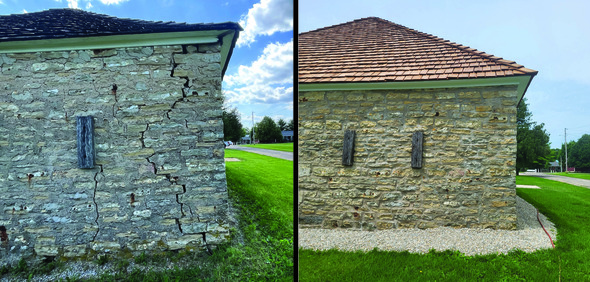 LEFT: Northeast Blockhouse at Fort Atkinson State Preserve with stone walls and roof in disrepair. RIGHT: Northeast Blockhouse with stone walls repaired and stabilized and roof replaced.
FORT ATKINSON -- Fort Atkinson State Preserve is once again open to the public following an extensive preservation project at the historic site.
The preserve is open year-round, with daily hours of 4:30 a.m. - 10:30 p.m.
Fort Atkinson is a nationally significant military post from the 1840s now managed by the Iowa DNR as a state preserve. The historic site includes several original buildings such as barracks and a gunpowder house, along with archaeologically significant artifacts. The repairs were funded in part through a grant from the Save America's Treasures program, through the Historic Preservation Fund, as administered by the National Parks Service, Department of the Interior, and donations from the Friends of Fort Atkinson.
“We are very pleased with the results,” said Iowa DNR district supervisor Detra Dettmann. “These buildings are nearly 200 years old, and the care taken to stabilize and restore them while ensuring historical preservation was impressive.”
According to Dettman, several buildings received repairs that included disassembling walls, tracking each stone that was removed, and putting each stone back into original relative positions.
A public event to celebrate the success of the project is being planned for later this year, although a date has not been finalized. To learn more, visit www.iowadnr.gov and search for Fort Atkinson Preserve.
The DNR is seeking informal comments on administrative rules for Iowa state parks and related programs. Executive Order 10 (EO10), signed by the Governor on January 10, 2023, requires all state agencies to identify which administrative rule chapters will be retained or rescinded. The EO10 process includes public engagement with the opportunity for meaningful input.
The Iowa DNR has reviewed the following rule chapters relating to programs administered by the Parks Forests and Preserves Bureau: 571 IAC Chapter 46 (All-Terrain Vehicles, Off-Road Motorcycles and Off-Road Utility Vehicles) and Chapter 47 (Snowmobiles). Based on the review, DNR has revised these chapters to eliminate redundancies and improve efficiency.
The public is invited to provide informal comments on the proposed rule changes. DNR will accept written comments through July 19, 2024. Written comments or questions regarding the proposed rules should be submitted to Jessica.Flatt@dnr.iowa.gov for 571 IAC Chapters 46 and 47. Comments should be made to specific portions of the rules.
After receiving and reviewing informal comments, the DNR will create a draft Regulatory Analysis and draft Notice of Intended Action. The DNR will host a formal public comment period for these drafts, followed by a public hearing, in September 2024.
Versions of the rules, including a “clean” copy and a version showing revisions, can be found on the DNR webpage: https://www.iowadnr.gov/About-DNR/About-DNR/Administrative-Rules.
Trout need clear and cold water to live and thrive. Sediment flowing into Siewers Spring, the water source for the Chuck Gipp Decorah Fishery Hatchery, creates muddy water conditions after larger rainfall events in the Trout Run watershed.
Over the past 16 years, there have been an average of 42 days per year when the trout could not be fed at the hatchery due to cloudy water.
“Cloudy water not only affects the way we feed the fish, it also stresses the fish to be in the muddy water and the fish get sick,” explains Brian Malaise, manager of the Chuck Gipp Decorah Trout Hatchery. “The muddy water makes it hard for the trout to breathe.”
In April, The U.S. Environmental Protection Agency (EPA) approved the watershed plan for Trout Run and Siewers Spring. The main objective of the plan is to reduce the amount of sediment in the water at Siewers Spring by building soil health in the Trout Run watershed.
“The water at the hatchery does not clean up often until late fall once it gets dirty,” said Malaise. “It’s not just the rain in the summer that causes muddy water. Siewers Spring can become muddy when the snow melts or it rains on the snow.”
Improving water quality at the Chuck Gipp Decorah Fish Hatchery through the Trout Run Watershed Project is essential for the survival, health, and growth of the trout raised at the hatchery. Over 150,000 trout are raised at the hatchery each year then stocked into public trout streams and community trout ponds throughout Iowa, including five of the most popular trout streams.
Megan Giorgenti, Trout Run Watershed Coordinator, completed the Trout Run Watershed Protection Plan following several years of watershed assessments, targeted water monitoring, discussions with farmers and landowners in the watershed, and gaining local support from farmers, the community and local agencies.
The project will offer cost-share for practices that build soil health and reduce sediment delivery to Trout Run and Siewers Spring. Practices that build soil health include cover crops and no-till. Other water quality practices such as filter strips, grassed waterways, conservation cover, sediment basins, and stream bank stabilization are offered through this project.
The project is being administered jointly by Iowa DNR, Winneshiek Soil and Water Conservation District, the Natural Resources Conservation Service, and Iowa Department of Agriculture and Land Stewardship.
Trout Run farmers and landowners interested in learning more about cost-share or technical assistance for building soil health and improving water quality in the Trout Run Watershed may refer to the watershed plan or contact Watershed Project Coordinator Megan Giorgenti at megan.giorgenti@dnr.iowa.gov or 563-929-6979.
Trout Run farmers may also contact the Winneshiek Soil and Water Conservation District at 563-382-4352, Extension 3.
Spend a fun day at the Chuck Gipp Decorah Fishery Hatchery
The Chuck Gipp Decorah Fish Hatchery is a popular tourist destination in northeast Iowa. The picturesque limestone office and residence date back to the 1930s as a project of the Civilian Conservation Corps.
Built in 1935, the hatchery first raised smallmouth bass. Over the years, fish production slowly changed from mainly smallmouth bass and northern pike to trout.
The fish hatchery is open to the public 365 days a year from sunrise to sunset. Informational plaques along the entrance of the hatchery and in the trout raceway areas detail what you are seeing.
Visitors of all ages will have fun exploring the Chuck Gipp Decorah Hatchery:
- Easy access to the raceways makes this a popular stop to see trout of various sizes. Don’t forget your quarters to buy a handful of feed to lure fish to the surface for a closer look.
- Siewers Spring, Iowa’s second largest natural spring, is the perfect place for a picnic, relaxing in the shade or fishing for trout.
- Decorah’s most famous residents, the eagles, are frequent visitors to the hatchery. A short walk on the Trout Run Trail leads you to a spot where you can see the world-famous eagle nest.
- The hatchery is a great place to start your journey on the 11-mile Trout Run Trail that winds through historic and picturesque Decorah and the surrounding area. A shelter with picnic tables, drinking fountain and flush toilets is open year-round.
- Trout Run is the most handicapped accessible trout stream in Iowa.
- Trout Run and the hatchery are great places to watch the migration of songbirds in the spring and early summer.
DES MOINES - The Iowa Department of Natural Resources (DNR) is offering a program to teach skills needed to trap furbearers to people with little to no trapping experience.
The workshop will feature knowledge and skill building sessions with instructors that will teach the basics of trapping in Iowa.
“For those interested in the tradition of trapping as a means of sourcing fur, this program provides the opportunity to gain the skills and the knowledge it takes to do it all yourself,” said Jamie Cook, program coordinator with the Iowa DNR.
Participants will learn basic strategies for trapping such as proper equipment, trap placement, trapping regulations and steps for preparing hides for trade. Participants are expected to dress appropriately for the weather as a significant portion of the class will be held outdoors.
The workshops will take place on various dates and locations across the state. The course is designed for participants of all ages. Space is limited so be sure to register right away.
For more information and to begin the registration process, visit the link below and search by Trapper Education Class event type:
https://license.gooutdoorsiowa.com/Event/EventsHome.aspx
The program is provided through a partnership with the Iowa DNR and Iowa Trappers Association. It is part of a national effort to recruit, retain and reactivate hunters, anglers and trappers due to the overall decline in hunting and outdoor recreation.
Media Contact: Jamie Cook, Iowa Department of Natural Resources, 515.350.8091
|