|
FOR IMMEDIATE RELEASE
May 14, 2024
The final segment of Iowa’s spring turkey hunting season closed Sunday, ending the spring season with a record harvest of 16,059 birds reported, surpassing the 2023 record harvest of 14,843.
Turkeys were reported from all 99 counties, from a high of 649 birds bagged in Clayton County to a low of three in Osceola.
“We have turkeys in all 99 counties, but not all counties are equal. Most of the turkey habitat is in the eastern third of the state,” said Jim Coffey, forest wildlife biologist with the Iowa Department of Natural Resources (DNR).
Iowa has had three straight years of good turkey hatches across much of the state, thanks, in part, to the long-term drought that benefited all ground nesting birds.
“Two-year-old birds drive the population, and we have a large population of two-year-old birds,” Coffey said. “These are birds that do lots of the gobbling and tend to move more than the older toms and make up the bulk of the harvest.”
Iowa’s five spring turkey seasons began April 5 with the youth only season, and ended May 12 with the conclusion of gun/bow season four and the archery only season. Hunters purchased more than 56,600 spring turkey tags across all seasons in 2024.
The higher harvest wasn’t completely unexpected thanks in part to Iowans who participated in the DNR’s annual turkey brood survey that occurs each July and August. Iowans who see young turkeys in July and August are encouraged to report the birds through a link on the DNR’s website at https://www.iowadnr.gov/Hunting/Turkey-Hunting/Wild-Turkey-Survey
Media Contact: Jim Coffey, Forest Wildlife Research Biologist, Iowa Department of Natural Resources, 641-774-2958.
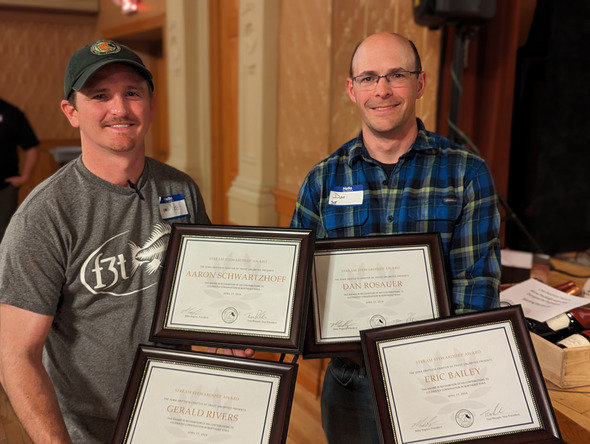 Iowa DNR Manchester Fish Hatchery staff Dan Rosauer, Aaron Schwartzhoff, Eric Bailey and Garald Rivers were recently honored by the Iowa Driftless Chapter of Trout Unlimited with their Stream Stewardship Award.
The Iowa Driftless Chapter of Trout Unlimited recognizes outstanding contributions to Iowa trout conservation, education and public access. Manchester Fish Hatchery staff have helped raise and stock over 192,000 native brook trout fingerlings into more than 60 northeast Iowa streams.
“If anglers catch a wild brook trout in northeast Iowa, there’s a good chance it’s there because of the dedicated current and past staff of the Manchester Fish Hatchery,” said Michael Siepker, Northeast Iowa regional fisheries supervisor.
Brook trout restoration efforts began in 1994, when a genetically-distinct strain of healthy brook trout unique to Iowa was found in South Pine Creek, a tiny spring creek buried between lush vegetation in eastern Winneshiek County. These brook trout have likely called this place home since before the first European settlers came to the region.
To save this fragile native Iowa species, hatchery staff transported 900 fertilized eggs back to the Manchester Hatchery in a coffee cup. That first year, 160 fingerlings were produced.
DNR fisheries staff take special care when spawning South Pine brook trout. Instead of spawning the fish in the hatchery, like they do with domesticated strains of rainbow trout, technicians go on site around the first week of November and spawn the fish on the river bank and bring the eggs back to the Manchester Hatchery. More than 51,430 fingerlings were stocked into 34 streams during the first 23 years of restoration work.
The eggs are hatched and raised to about two inches in size, and reintroduced into other streams to grow up wild. “Our capacity to restore brook trout is limited to the number of eggs we can collect from South Pine,” explains Siepker. “We have to balance collecting as many eggs as possible with minimizing impacts to the South Pine Creek brook trout population.”
To increase egg availability, Manchester Hatchery staff started to hold wild fingerlings at the hatchery and raise them to adults in 2016. By 2018, milt from wild South Pine males was used to spawn females at the hatchery. Captive brookies were maturing one to four weeks later than wild fish, so hatchery staff developed a protocol to store milt for the later spawns.
Siepker estimates that there are more than 500 miles of coldwater streams in northeast Iowa. Not every mile is suitable for brook trout, but there are many miles where brook trout can be restored. “Iowans deserve to have these beautiful native brook trout in any place that we can have them,” Siepker said.
The ability to sustain brook trout indicates great stream health, as they are an indicator species of northeast Iowa’s streams, demanding the coldest and cleanest waters to prosper. DNR staff consider water temperature, current fish populations, and stream habitat conditions before stocking trout in a stream.
Brook trout are stocked into a new stream with suitable habitat three consecutive years to try to establish a strong and healthy population. About three years after the last stocking, fisheries staff sample the stream to see if there are young brook trout in the stream.
The process to determine where this colorful trout that is part of Iowa’s history is stocked is a complex process that involves a lot of partners. The areas that are determined viable to reintroduce brook trout have undergone significant conservation work to reduce bacteria and sediment. In some streams, it’s been decades since trout have been able to naturally reproduce and survive.
Trout lay their eggs in gravel so clear conditions are critical - sediment can smother the eggs and prevent young trout from hatching. Healthier streams have been able to support larger and naturally reproducing trout populations. “You have more robust trout populations with improved water quality and habitat,” said Siepker.
Spring is a great time to explore Iowa’s coldwater streams. Anglers can find wild brook trout in 11 streams that are open to public fishing. Find the list of streams on the DNR Trout Fishing webpage at www.iowadnr.gov/trout.
Media Contact: Mike Siepker, Regional Fisheries Supervisor, Northeast Iowa, Iowa Department of Natural Resources, 563-382-8324.
The Iowa Department of Natural Resources (DNR) reminds all boaters and anglers to “Clean, Drain, and Dry” their boats and equipment this Memorial Day weekend to protect Iowa lakes and rivers from aquatic hitchhikers.
Aquatic invasive species, everything from zebra mussels to Eurasian watermilfoil, move from one waterbody to another by hitchhiking on boats, in bait buckets and on other equipment used in the water. They often grow quickly and spread fast when brought to another lake or stream due to lack of natural controls.
“Boaters and anglers can help slow the spread of aquatic invasive species to new water bodies by checking their boat and equipment for unwanted hitchhikers after each time on the water,” said Kim Bogenschutz, aquatic invasive species program coordinator for the Iowa DNR.
Aquatic invasive species can create serious problems for Iowa waters by reducing native species and making lakes and rivers unusable for boaters, anglers and swimmers.
Clean, Drain, Dry is a simple three step process that boaters need to follow every time they move from one body of water to another.
- CLEAN any plants, animals, or mud from your boat and equipment before you leave a waterbody.
- DRAIN water from all equipment (motor, live well, bilge, transom well, bait bucket) before you leave a waterbody.
- DRY anything that comes into contact with water (boats, trailers, equipment, boots, clothing, dogs). Before you move to another waterbody either: Spray your boat and trailer with hot or high-pressure water; or Dry your boat and equipment for at least five days.
- Never release plants, fish, or animals into a waterbody unless they came out of that waterbody and empty unwanted bait in the trash.
It is illegal to possess or transport prohibited aquatic invasive species. It is also illegal to transport any aquatic plants on water-related equipment in Iowa. Signs posted at public accesses remind boaters to stop aquatic hitchhikers and identify infested waters.
Boaters must also drain all water from boats and equipment before they leave a water access and keep drain plugs removed or opened during transport. It is also illegal to introduce any live fish, except for hooked bait, into public waters.
Find more information about aquatic invasive species and a list of infested waters in the current Iowa Fishing Regulations or at www.iowadnr.gov/ais.
Media Contact: Kim Bogenschutz, Fisheries Bureau’s Aquatic Invasive Species Program Coordinator, Iowa Department of Natural Resources, 515-290-0540.
Several Iowa NASP Archers qualified for and participated in the recent US Eastern and Western Nationals.
2024 NASP® Western Nationals - Sandy, Utah - April 26-27
Bullseye Results
Boys Elementary Individual
6th Place - Simon Peter, 275, West Fork Elementary School, Rockwell
7th Place - Owen Baxter, 275, Alburnett Schools
Girls Elementary Individual
8th Place - Lexi Wentz, 273, West Fork Elementary School, Rockwell
Middle School Team
6th Place - West Fork Middle School, Rockwell, 3251
Girls Middle School Individual
1st Place - Ava Boldt, 294, South Tama County Community Schools
2nd Place - Calina Olson, 291, Springville Community Schools
5th Place - Hailey Ries, 288, West Fork Middle School, Rockwell
High School Team
4th Place - Sergeant Bluff-Luton Senior High School, 3353
10th Place - Spencer High School, 3295
IBO 3D Results
Elementary School Team
8th Place - Alburnett Schools, 1491
Girls Elementary Individual
1st Place - Lexi Wentz, 273, West Fork Elementary School, Rockwell
Middle School Team
1st Place - West Fork Middle School, Rockwell, 1676
10th Place - Spencer Middle School, 1616
Boys Middle School Individual
2nd Place - Eli Reiman, 292, Spencer Middle School
7th Place - Luke Baxter, 283, Alburnett Schools
Girls Middle School Individual
2nd Place - Ava Boldt, 289, South Tama County Community Schools
4th Place - Ava Pearce, 288, West Fork Middle School - Rockwell
6th Place - Hailey Ries, 286, West Fork Middle School - Rockwell
9th Place - Genevieve Foreshoe, 282, West Fork Middle School - Rockwell
High School Team
4th Place - Spencer High School, 1671
6th Place - Alburnett Schools, 1661
Boys High School Individual
10th Place - Carson Bright, 287, Anamosa High School
Girls High School Individual
3rd Place - Morgan Hoth, 288, Alburnett Schools
10th Place - Kelsi Hansen, 285, Sacred Heart School
2024 NASP® Eastern Nationals - Louisville, Kentucky - May 9-11
Bullseye Results
Boys Elementary School Individual
8th Place - Connor Bradley, 284, South Tama Community Elementary School
Girls High School Individual
7th Place - Isabella Johnson, 294, Independence Junior Senior High School
Boys High School Individual
5th Place - Nathan Nederhiser, 295, Mount Vernon High School
IBO 3D Results
Girls Middle School Individual
7th Place - Peyton Lang, 287, Grand View Christian Middle School
The National Archery in the Schools Program is an in-school program aimed at improving educational performance among students in grades 4th – 12th. And through it, students are learning focus, self-control, discipline, patience, and the life lessons required to be successful in the classroom and in life.
For more information on the National Archery in the Schools Program in Iowa, you can contact Zach Benttine, Archery Education and Outreach Coordinator at 515-205-8709 or Zachary.Benttine@dnr.iowa.gov.
Media Contact: Zach Benttine, (515) 205-8709 or Zachary.Benttine@dnr.iowa.gov.
Iowa’s state shooting sports season is here, where thousands of student athletes from elementary to high school and colleges across the state compete in seven shooting sports championship events over the next several weeks, for the chance to earn scholarships, prizes and more.
The Scholastic Clay Target Program (SCTP) and Scholastic Action Shooting Program (SASP) are youth development programs that promote shooting sports and competitive shooting as a means to help young individuals achieve their highest potential and become their best selves. Both program's goals are to instill personal values and character traits, such as fair play, compassionate understanding, individual responsibility, sportsmanship, self-discipline, and personal commitment in young people.
2024 State Shooting Sports Championship Schedule
- May 18, International Bunker Trap at AVAD Hunt Club, Coon Rapids
- May 18-19, International Skeet at New Pioneer Gun Club, Waukee
- May 25, Skeet Doubles at Mahaska County Izaak Walton League, Oskaloosa
- June 3-9, Trap at Iowa State Trap Shooting Home Grounds, Cedar Falls
- June 13-15, Sporting Clays at Black Oak Clays, Pella
- June 20-23, Skeet at New Pioneer Gun Club, Waukee
- June 21-23, Rifle & Pistol at Olofson Shooting Range, Polk City
For more information on the Scholastic Clay Target or Action Shooting Programs in Iowa, contact Marty Eby at 515-313-8048 or Marty.Eby@dnr.iowa.gov .
Media Contact: Marty Eby, (515) 313-8048 or Marty.Eby@dnr.iowa.gov.
Iowa’s Scholastic Clay Target Program’s first ever skeet doubles competition is scheduled for May 25, at the Mahaska County Izaak Walton League, in Oskaloosa.
Skeet doubles differ from other skeet and trap competitions.
Squads consist of three team members of the same age, school and discipline. Skeet doubles has two rounds. Round One: competitors get one pair of targets on each station, shooting from stations 1-7, then get another pair of targets shooting in reverse to station 2, for a total of 24 birds.
Round Two: competitors do the same thing, shooting 1 thru 7 then backward again, but this time going back to station 1, for a total of 26 birds.
Also of note, competitors don’t use an option target, and, on station four, competitors must shoot the high house bird first on the way out, and the low house bird first on the way back.
“This is the first time we’ve offered this as a competitive event in Iowa,” said Marty Eby, who is the interim coordinator of the Scholastic Clay Target and Scholastic Action Shooting Programs for the Iowa Department of Natural Resources. “As a program, we continue to look for ways to expand opportunities for our student athletes to compete.”
Media Contact: Marty Eby, (515) 313-8048 or Marty.Eby@dnr.iowa.gov.
FORT ATKINSON-- The Iowa Department of Natural Resources (DNR) will host a public walking tour on May 18, from 1 to 3 p.m., at Fort Atkinson State Preserve, 303 2nd Street, Fort Atkinson. The tour will allow participants to observe progress of the current repair project impacting several of the historic structures at the preserve. The tour will be led by DNR Field Engineer Ken Howe. The event will be held rain or shine.
Fort Atkinson is a nationally significant military post from the 1840s now managed by the Iowa Department of Natural Resources as a state preserve. The historic site includes several original buildings such as barracks and a gunpowder house, along with archaeologically significant artifacts. The repairs are funded in part through a grant from the Save America's Treasures program, through the Historic Preservation Fund, as administered by the National Parks Service, Department of the Interior, and donations from the Friends of Fort Atkinson.
For more information, or questions about the tour, contact Detra Dettmann, Detra.Dettmann@dnr.iowa.gov; or (563) 608-4597.
|





