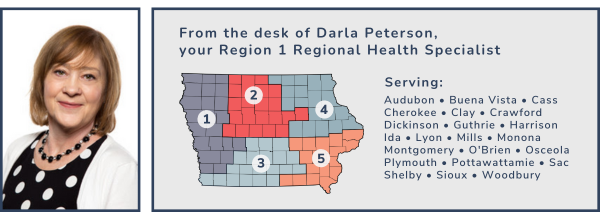
  The Regional Health Specialist newsletter is a monthly update for all community partners. In each newsletter, you'll find updates pertaining to HIV, STIs, and hepatitis C in Iowa, plus other topics of interest. For suggestions on content, please don’t hesitate to reach out!
In this issue:
-
STI Awareness Week is April 14–20, 2023
-
National Youth HIV & AIDS Awareness Day #NYHAAD
-
National Public Health Week 2024—
Protecting, Connecting and Thriving: We Are All Public Health
-
Question Corner: EPT in the Age of Digital Prescriptions
- Health Equity Spotlight
-
Upcoming and Available Webinars
 STI Awareness Week is April 14–20, 2024
STI Awareness Week provides an opportunity to raise awareness about STIs and how they impact our lives; reduce STI-related stigma, fear, and discrimination; and ensure people have the tools and knowledge to prevent, test for, and treat STIs.
Looking to celebrate STI Awareness Week in style? Continue reading for our recommendations!
Expand Your Knowledge with Trainings, Webinars + Events
Podcast: Adolescent Health & STIs (Family & Youth Services Bureau)
In this episode of the Elevate Youth Programming podcast, our team sat down with Christy Altidor and Jerrica Davis from the National Coalition of STD Directors (NCSD) to discuss sexually transmitted infection (STI)/human immunodeficiency virus (HIV) trends and tools and resources to advance adolescent sexual health. Available now!
— — —
Webinar + Online Course:
Words Matter: Minimizing STI Stigma in Healthcare Settings
ASHA has developed five e-learning modules that explore the stigma around STIs, the ways bias and assumptions can impact patient care, and the importance of language choices to minimize stigma. Included is a self assessment module that allows you to examine your own beliefs and values around sexual behavior, sexual orientation, gender identity, and STIs. The content concludes with patient scenarios to help you put the ideas into practice. Available now!
— — —
STI Awareness Week Webinar Series from AVAC:
Syphilis in the US: The state of the epidemic & how it’s being addressed
Tuesday, April 16, noon CT | Register now!
DoxyPEP: Prevention, effectiveness, and AMR
Thursday, April 18, 2 p.m. CT | Register now!
Raise Awareness
Take advantage of the CDC's STI Awareness Week campaign toolkits, which include a ton of fun resources to engage your community and raise awareness. You can even choose from one of three campaigns:
|
Connect to Testing + Sexual Health Resources
Check out a few of our favorite online resources! Here you'll find educational materials, information about testing and testing locations, tools to promote sexual health, and more.
National Youth HIV & AIDS Awareness Day #NYHAAD
National Youth HIV & AIDS Awareness Day (NYHAAD), annually April 10, is a day to raise awareness about the impact of HIV and AIDS on young people. The day also highlights the advocacy of young people in the U.S. around linking people to services, providing sexual health resources, and HIV education.
|
Resources for participating in NYHAAD:
-
From April 5-11, Advocates for Youth (AFY) is coordinating a series of events & activities in the lead-up to NYHAAD. There are tons of great things happening!
-
Want to share about NYHAAD on social media? AFY offers a social media toolkit and the CDC's Division of Adolescent & School Health also has social media resources.
Resources for supporting youth living with or at higher likelihood of acquiring HIV:
Question Corner
Question:
How can I utilize expedited partner therapy (EPT) in the age of digital prescriptions?
Answer:
Expedited Partner Therapy (EPT) is the clinical practice of treating the sex partners of patients diagnosed with chlamydia or gonorrhea by providing prescriptions or medications to the patient to take to their partner without the health care provider performing a physical exam.
How to prescribe EPT when your office uses a digital prescription system is a common question! George Walton, STI Section Supervisor for the Bureau of HIV, STI and Hepatitis, shared the following advice:
There are a couple of options for this question. First, e-prescribing is not required by Iowa law for EPT. See the attached letter from the Board of Pharmacy clarifying this. The last paragraph is applicable to medical providers generally (the middle paragraph is for CBSS sites). So if prescribers have access to written prescription pads, they may be used.
If the prescriber's institution does not provide them with written prescription pads, prescriptions for EPT may be issued electronically. However this often requires working with the institution's IT to make a "dummy" patient for EPT. Sometimes the patient is called "EPT" or "Expedited Partner Therapy Patient" in the EHR. This is not the easiest to set up as it requires coordination with IT but once in place, seems to work well.
Learn more: Expedited Partner Therapy Fact Sheet for Medical Providers
 Over the last three months, we have focused on how specific language can help reduce stigma for the people we serve and those around us. I hope you have found ways to incorporate that new language into your work! The people you serve really appreciate it.
Now, we are going to break down the concept of stigma a little bit more. I think we all have a general understanding of what stigma is but going a bit deeper can increase our understanding and awareness. Our goal is to identify where stigma comes from and how it impacts us all.
What is stigma? This definition is from the American Psychiatric Association:
Stigma: n. the negative social attitude attached to a characteristic of an individual that may be regarded as a mental, physical, or social deficiency. A stigma implies social disapproval and can lead unfairly to discrimination against and exclusion of the individual.
The National Alliance on Mental Illness (NAMI) identifies seven types of stigma; we will review two of those this month. We are using mental illness as an example, but you can insert any situation might make someone feel stigmatized:
Public stigma happens when the public endorses negative stereotypes and prejudices, resulting in discrimination against people with mental illness.
Self-stigma happens when a person with mental illness internalizes public stigma.
When someone hears comments, sees actions and feels stigma from people they interact with or in the places they work, play, learn, live and worship, it is internalized and impacts their feelings of self-worth.
Paying attention to the language we use and using language that is less stigmatizing has a positive impact on the people you serve and those you interact with all the time.
Keep reading: Overcoming Stigma (NAMI)

-
HIV and Syphilis Outbreaks and the Community-Based Approach (MATEC)
Tuesday, April 16, 11:30 to 1 p.m. CT | Register now!
-
Comprehensive Sexual History in Spanish – Language and Cultural Considerations
Positive Sexuality Series (MATEC)
Wednesday, April 17, noon to 1 p.m. | Register now!
-
Sex Positivity: A Tool to Recognize & Engage Diverse Clients
Positive Sexuality Series (MATEC)
Wednesday, March 24, noon to 1:30 p.m. | Register now!
 HIV:
STI:
Online Resources
The Iowa Division of Public Health; Bureau of HIV, STI, and Hepatitis; and the NuCara Capacity Extension Program have numerous web resources available!
Bureau of HIV, STI, and Hepatitis: The Bureau’s website provides state and county resources as well as data on chlamydia, gonorrhea, syphilis, HIV, and hepatitis.
Stop HIV Iowa: Stop HIV Iowa provides information related to FREE HIV testing, prevention, and care services throughout the state.
PrEP Iowa: PrEP Iowa houses resources for providers and consumers related to pre- and post-exposure prophylaxis (PrEP and nPEP). This website also has information on Iowa’s TelePrEP program, which provides PrEP directly to patients using telemedicine.
Iowa Public Health Tracking Portal: The Iowa Public Health Tracking Portal serves as a centralized source for public health data.
Naloxone Iowa: Visit Naloxone Iowa for information on naloxone or Narcan, which can be used to halt or reverse an opioid overdose. Iowans can access free Narcan at commercial pharmacies or via an appointment with Iowa’s TeleNaloxone program, which mails Narcan directly to you.
Epi Update: The Epi Update is a weekly newsletter from the Center for Acute Disease Epidemiology (CADE) and the HHS Bureau of HIV, STI, and Hepatitis.
Your Life Iowa: If you or a loved one are facing a problem with alcohol, drugs, gambling, mental health or suicidal thoughts, you’re not alone. Iowa HHS created Your Life Iowa so Iowans can chat live, text, or call and get reliable information, treatment options, or find nearby help.
|

