|
August 17, 2023
Bumble Bee Zoomies
For most of us, our experience with bumble bees is a feeling that we are somehow in their way. They zoom by us, within an inch of our surprised faces, flying determinedly from flower to flower. It can be alarming to almost collide with these giant, fuzzy insects, but generally bumble bees mean you no harm. They are just busy and single-minded because, after all, they have an important job to do, for their colony and also for the world at large!
For their colony they are gathering nectar and pollen and for the world at large they are helping spread that pollen from flower to flower, facilitating the plants' reproduction. In short, they are some of the best plant pollinators out there and they even have a secret weapon! They can extract pollen from even the stingiest plants, like tomatoes, which must be shaken vigorously to release those precious yellow grains. Only bumble bees can do this through the use of a skill called buzz pollination - they vibrate their wing muscles to, in fact, shake the pollen from the flower.
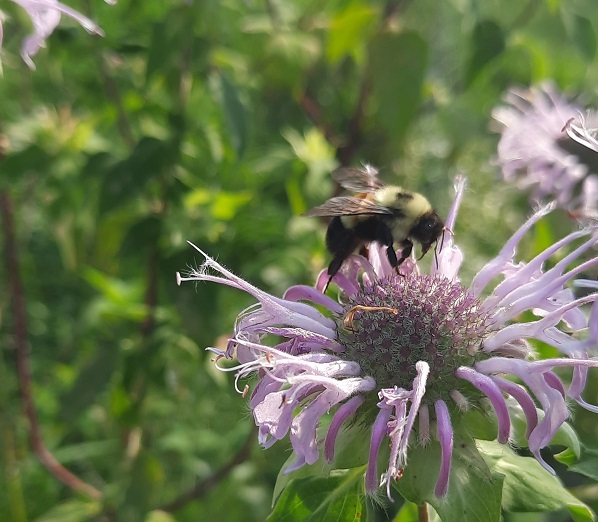
A Rusty-patched Bumble Bee coming in for a landing on a Bee Balm Flower
If you are like I was before bumble bees became a personal passion, you may be a little fuzzy about whether the term "Bumble Bee" refers to a single species of bee or is a grouping of bees with several species. To clear that question up, there are many different species of bumble bees! Iowa is home to at least 15 species of bumble bee and maybe as many as 18 species. Why the uncertainty? There haven't been a lot of comprehensive surveys done for bumble bees in Iowa and there are at least three species, which based on their larger distribution, could be in Iowa but have not been recorded...yet. You can find links to a Xerces Society produced brochure about the bumble bees of Iowa and a pdf checklist of species by clicking the button below.
Other Fun Facts about Bumble Bees!
- Bumble bee species diversity goes up as you move further north! This is an unusual trend and is related to bumble bees' ability to handle cold temperatures.
- Each colony of bumble bees has three kinds of inhabitants: a female queen, lots of female workers, and males.
- Male bumble bees have no stingers!
- Despite their sometimes intimidating size, bumble bees are very docile and rarely sting unless you mess with their nest.
- Iowa has one species of endangered bumble bee, the rusty-patched bumble bee and you can find more information about them below.
- In addition to using buzz pollination, bumble bees will also sometimes drill a hole in the base of a flower to "rob" nectar they can't reach through the flowers regular opening.
- Bumble bee workers don't always return to the nest each night and will sometimes camp out and take a snooze on flowers where they can be found in the early morning.
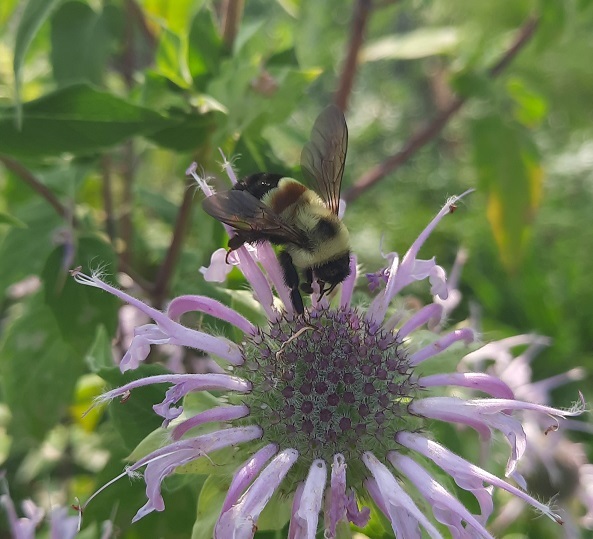
A Rusty-patched Bumble Bee "robbing" nectar from a Bee Balm flower.
The Rusty-patched Bumble Bee
The rusty-patched bumble bee has the unfortunate distinction of being the first bumble bee to be listed as an endangered species in the U.S. It was listed in 2017 because it could no longer be found in much of the Eastern part of its range (along the east coast). Recent surveys revealed that the upper midwest - IL, WI, MN and IA - may be the key to keeping this species thriving.
In Iowa, they've been found in 13 counties in the northeastern half of the state. Their historic known range in Iowa ran from Dickinson to Allamakee County in the north and Polk to Louisa in the south. Colonies are active from April to October but the best opportunity to find a rusty-patched trundling through your garden is late July and August, so right now!
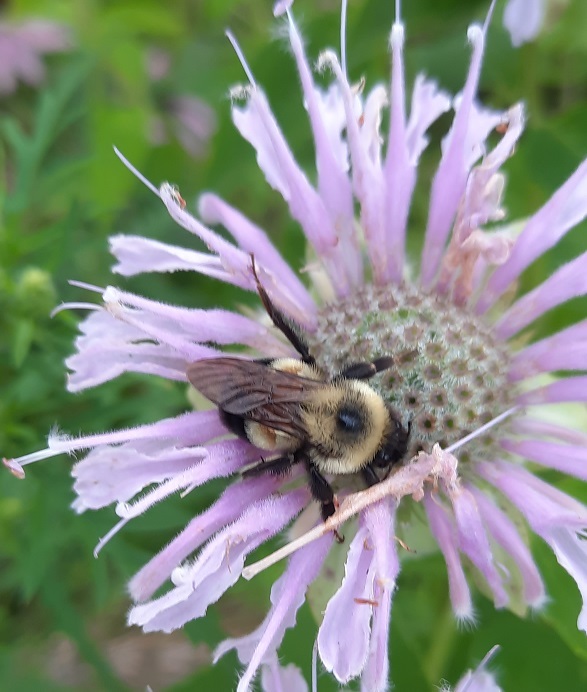
Rusty-patched Bumble Bee seen at first light resting on a bee balm flower.
Take Action!
Bumble bees and all pollinators could use our help and there is something all of us can do!
-
Smile! You're on Candid Camera!: Record bumble bees you see and snap a good picture of their back and profile. Sometimes it's easier to take a video and grab screen shots. These can be uploaded to BumblebeeWatch.org to be reviewed by bee experts. If you suspect you have a picture of rusty-patched bumble bee you can also email them to Stephanie Shepherd at the Iowa DNR.
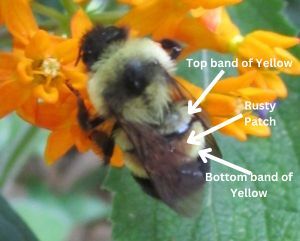
HOW TO I.D. a Rusty-Patched
The key to identifying a female worker or male is, you guessed it, a rusty-colored patch sandwiched in between two bands of yellow. There is a common species, the brown belted bumble bee, which is commonly mistaken for a rusty-patched, but it only has a a yellow band above it's brownish reddish patch and no yellow below.
|
-
Rethink Your Yard: Bumble bees are looking for pollen and nectar and they love getting them from native plants! Try creating new flower beds and replacing some of your ornamentals with native flowers. Some preferred types: Wild Bergamot (Bee Balm, Monarda fistulosa), Purple Coneflower (Echinacea spp.), Native Thistles (Cirsium spp.), Hyssop (Agastache spp.), Prairie Clover (Dalea spp.), Joe Pye Weed (Eutrochium spp.), Sunflowers (Helianthus spp.), Goldenrods (Solidago spp.) and Asters (Symphyotrichum spp.). For nectar in the early season, adding some native shrubs to your landscaping is helpful, species such as serviceberry (Amelanchier spp.) and ninebark (Physocarpus opulifolius).
-
Volunteer: In 2024, Iowa will hopefully be launching a bumble bee atlas project. Volunteers will be needed to learn about bumble bees and then conduct surveys for them in their area. You can sign up to get notifications about this project on the Bumble Bee Atlas website.
So, we hope the next time you have a close encounter with a bumble bee, you won't be afraid and will instead send out a thank you to these industrious fuzz balls as they help keep our natural world running.
|