
Why is monitoring adolescent health and behavior trends important?
Tracking these trends enables us to dedicate time, programming and resources to the areas of highest need. This is especially important as “many of the health-related behaviors that arise during adolescence have implications for both present and future health and development” (source).
In Iowa, there have been many changes in adolescent health and behavior trends over the last ten years (source).
|
Iowa has made significant strides in reducing the prevalence of several key risk factors that lead to early death, disability and disease in adolescence and across the lifespan. Here are a few examples:
- The percent of 9th through 12th grade students in Iowa who…
- “Have rode with a driver who had been drinking alcohol in the past month” decreased from 23.8% in 2011 to 19.0% in 2021
- “Have been in any physical fight in the past year” decreased from 24.4% in 2011 to 17.1% in 2021
- “Ever had sexual intercourse” decreased from 43.9% in 2011 to 29.3% in 2021
- “Ever tried cigarette smoking” decreased from 39.1% in 2011 to 17.4% in 2021
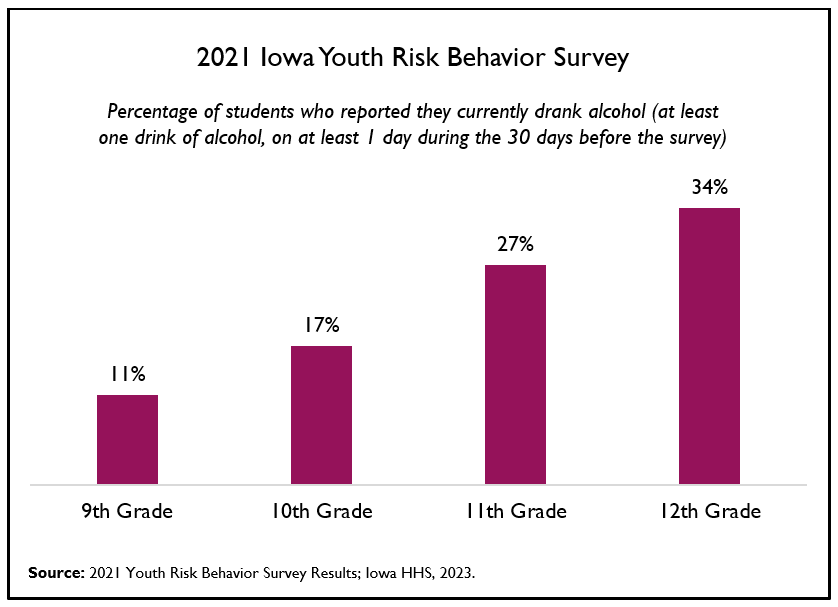
- “Currently drink alcohol, at least one drink on 1 day in the past 30 days” decreased from 37.1% in 2011 to 21.9% in 2021
- Survey results show that the prevalence of current alcohol use among youth increases with grade level (see figure below).
 Other emerging trends in Iowa’s adolescent health reflect larger public health concerns across the state and nation. Here are a few examples:
- The percent of 9th through 12th grade students in Iowa who…
- “Did not go to school because they felt unsafe at school or going to/from school” increased from 4.0% in 2011 to 8.3% in 2021
- “Used a condom at last intercourse” decreased from 61.4% in 2011 to 48.1% in 2021
- In 2021, 9.1% of youth reported that they did not use any method to prevent pregnancy during their last sexual intercourse.
- “Experienced persistent sadness or hopelessness” increased from 17.5% in 2011 to 27.5% in 2021
- “Had suicidal thoughts (seriously considered suicide in the past year)” increased from 14.6% in 2011 to 22.6% in 2021
- “Attempted suicide in the past year” increased from 6.0% in 2011 to 10.2% in 2021
Within these 2021 data, many disparities exist. For example, Iowa’s Asian, non-Hispanic students reported persistent sadness and hopelessness at a higher rate (54.6%) than the other race/ethnicity subgroups analyzed (Black: 38.1%; Hispanic/Latino: 50.3%; White: 36.5%; Multiracial: 42%). Persistent sadness and hopelessness was reported at nearly two times the prevalence rate among female students (49.5%) as compared to males (27.5%). Iowa’s Lesbian, Gay, Bisexual, Transgender, and Questioning (LGBTQ+) students experience significant mental health disparities as well. In 2021, Iowa’s LGBTQ+ students reported the highest rates of suicide attempts in the 12 months previous to the survey (22%), compared to 6.7% of heterosexual (straight) students. Furthermore, LGBTQ+ students reported twice the prevalence rate of experiencing bullying at school as straight students—33% vs. 15.5%. “These data make it clear that young people in the U.S. are collectively experiencing a level of distress that calls on us to act” (source).
**Learn more about the data presented in this newsletter by viewing the full report, or by visiting Iowa HHS’ Youth Health Assessment Program webpage.
Iowa HHS Programming
Adolescent health is a priority area for many of the programs and services offered by Iowa HHS. We encourage you to explore, share, and identify potential connections to these resources and programs.
- Your Life Iowa
- Provides support for individuals struggling with alcohol consumption, drug use, gambling, suicidal thoughts and/or other mental health concerns.
- Includes teen-specific resources
- State of Iowa Youth Advisory Council
- “Fosters communication among a group of engaged youth from across Iowa between the ages of 14 and 20 and the governor, general assembly, and state and local policymakers regarding programs, policies, and practices affecting youth and families; and to advocate for youth on important issues affecting youth.”
- Iowa Youth Congress
- “Seeks up to 100 Iowa high school-aged youth to participate in a year-long program which provides students the knowledge, abilities, and direction to advocate and enact change in their communities and at the state level for issues affecting youth.”
- Youth Action Squads
- “Designed to empower youth by providing opportunities to expand learning and leadership skills. Participants learn leadership skills, conduct research to gain an in-depth understanding of issues, and create an actionable plan to address the issues in their communities or statewide.”
-
The Community Adolescent Pregnancy Prevention Program (CAPP)
- This program “collaborates with community agencies, schools, churches, businesses, youth, and families to provide medically accurate and age-appropriate programming for sexual health and responsible decision-making among Iowa youth” (source).
-
Iowa’s Personal Responsibility Education Program (PREP)
In addition, we encourage you to explore others’ resources that support public health practice for adolescent health.
- CDC’s What Works in Schools program
- “An approach to school-based health that has been shown to improve health behaviors and experiences, support mental health and reduce suicidality in schools that implement the program.”
- YRBS Explorer
- An interactive webpage that provides descriptions, graphs and tables of 2021 YRBS data. Users can view the data for the U.S. as a whole or select a specific state.
Iowa Youth Survey
The Iowa Youth Survey (IYS) will be administered this fall (2023). Every two years, the Iowa Department of Health and Human Services (HHS) partners with Iowa school districts to administer the IYS. Data collected through the IYS is utilized by state agencies, local public health organizations, local school districts, nonprofit organizations, private foundations, researchers and the state legislature to support the health and safety of Iowa adolescents. The data is used with other surveys to understand and describe population health trends and concerns for public health practitioners and other users of quality data. This data-based understanding drives public health and education planning, policy and funding, and provides opportunities for further research on adolescent health behaviors and experiences.
School and student participation in the IYS are critical to Iowa HHS’ ability to provide meaningful data on adolescent health behaviors and experiences. All school districts in the state are invited to participate and the survey is given to sixth, eighth and eleventh grade students. Participating school districts will be required to collect parental permission for any student who participates in the survey. Sixth grade students will receive a modified questionnaire which complies with state laws related to age-appropriate content. The questionnaires and parental consent materials will be available in English and Spanish. The 2023 IYS will be administered electronically.
In order to achieve widespread participation, we need your help! Read on to learn more about suggested outreach activities.
Suggested Outreach Activities
- Contact the school superintendents in your local school districts. You may call, email, or visit—whatever feels most authentic and persuasive.
- Invite community foundations and other local funders to join you in your outreach to school administrators. The data collected can help them to better understand the needs of the community and set meaningful funding priorities in response.
- Invite influential local businesses to join you in your outreach to school administrators. Data collected can help them to better understand the needs of the community and may open opportunities to share resources in response. Data may also inform their understanding of issues impacting their current and future workforces.
- Educate parents on the importance of this survey. Visit PTAs and other parent groups who care about adolescent health and education. Share with them the 2021 Iowa Youth Survey state report and your local county report, if available, by going to https://iowayouthsurvey.idph.iowa.gov/. Communicate that the Iowa Youth Survey is a long-trusted source of necessary health data that has helped the state and local communities support generations of Iowa students.
- Engage students in your outreach. Our students deserve to be heard on the experiences that shape their lives. Explain the value of their participation. Give students the opportunity to engage with recent IYS data and innovate solutions to the issues they prioritize. This engagement by students can deepen the school’s and parents’ commitment to allow future participation in this critical survey.
As stated by the Centers for Disease Prevention and Control, “Health education succeeds when parents, community partners and young people are engaged in developing and planning health education programming” (source).
Meeting the Kids Where They Are: How the Education Sector Implements School Behavioral Health Systems
- “The National Center for School Mental Health will present how to develop and maintain comprehensive school mental health systems. The North Carolina Department of Public Instruction and the North Carolina Department of Health and Human Services will discuss state efforts to increase access to mental health services and programs in schools.”
- Hosted by the Association of State and Territorial Health Officials (ASTHO)
- July 12, 2023 from 12-1pm CST
- To learn more about this webinar series, and to register, visit ASTHO’s website.
CALM (Counseling on Access to Lethal Means): A Suicide Prevention Webinar
- “CALM (Counseling on Access to Lethal Means) provides mental health professionals within a healthcare team working with Veterans and their families an increased knowledge about the association between access to lethal means and suicide and the role of means restriction in preventing suicide. “
- Hosted by the Iowa Department of Health and Human Services and Your Life Iowa
- July 14, 2023 from 8:00-11:00am CST
- To learn more, visit Your Life Iowa’s website.
Innovative Partnerships to Address Mental Health
- This webinar will explore innovative partnerships that are responding to social, environmental and structural determinants of mental health, such as adverse childhood experiences and chronic stress.
- Hosted by County Health Rankings & Roadmaps
- July 18, 2023 at 2pm CST
- To register, visit the County Health Rankings & Roadmaps website.
Preparing for Water, Sanitation and Hygiene (WASH)-Related Emergencies Among People Experiencing Homelessness
- “Join this webinar to explore the latest data about the preparedness and response efforts for people experiencing homelessness during water, sanitation, and hygiene (WASH)-related emergencies. Hear from local jurisdictions that have successfully updated emergency plans to address this population and learn about focus group findings, tools, and resources to support this work.”
- Hosted by the National Association of County & City Health Officials (NACCHO)
- July 20, 2023 at 1pm CST
LGBTQ 101 and Mental Health Best Practices
- “LGBTQ people represent one of the highest-risk populations for depression, anxiety, suicide, and substance use problems. Join Max Mowitz (they/he) from One Iowa to learn about the needs and experiences of LGBTQ people and best practices to support their mental health.”
- Hosted by the Iowa Department of Health and Human Services and Your Life Iowa
- August 2, 2023 from 9:00-10:30am CST
- To learn more, visit Your Life Iowa’s website.
The U.S. Surgeon General released a new advisory on Social Media and Youth Mental Health.
- “This Advisory describes the current evidence on the impacts of social media on the mental health of children and adolescents. It states that we cannot conclude social media is sufficiently safe for children and adolescents and outlines immediate steps we can take to mitigate the risk of harm to children and adolescents.”
- To read a short summary of the advisory, or to read it in full, visit the U.S. Department of Health and Human Services’ website.
The Society for Public Health Education (SOPHE) has developed a new resource titled “School Employee Wellness: A Toolkit for Supporting the Implementation of School Employee Wellness in Districts/Schools.”
- This toolkit covers a wide range of topics, including establishing support, engaging key partners, taking action and creating a culture and climate of wellness.
- To download toolkit factsheets, or the toolkit in full, visit SOPHE’s website.
The FrameWorks Institute has released new framing resources for public health professionals!
The Centers for Disease Control and Prevention has created a new tool to help guide the development of health information for adults with intellectual and developmental disabilities and extreme low literacy (IDD/ELL).
- “The tool includes a user guide, a score sheet with 27 yes/no questions about your material, and instructions on calculating and interpreting your material’s score.”
The Tobacco Control Network has released its 2022 Policy Recommendations Guide.
- “This guide provides evidence-based proposals to reduce tobacco and nicotine use, address health disparities, and combat related issues such as COVID-19.”
|

