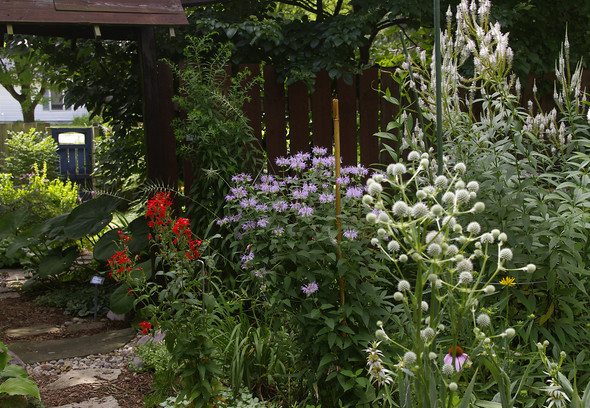
 Photo by Ron Frazier
The Planting Prairie 101 Series will be a handful of articles that walk through the process of planting a prairie garden or a small patch of native prairie at your home. If you have 5 or more acres you’d like to restore to native prairie, please reach out to the DNR’s Private Lands Biologists. You can read pdfs of the first two article in this series on the DNR's pollinator page.
There are several reasons that a landowner may opt to plant plugs, starts or seedlings of native prairie plants versus planting a seed mix. The main ones are:
- You have a small space like a small garden bed.
- You'd like the arrangement of plants to be a little neater or more formal looking than a naturally planted prairie.
- You'd like to have flowers blooming sooner rather than later!
- You'd like to control exactly what species are included.
Not everybody has the space to plant a full prairie or they may live in an urban or suburban environment where turning their yard into a prairie is restricted. In these cases, creating a native garden from plugs or incorporating some native plants into your landscaping is the way to go!
As with most other flowering plants, you want to get your prairie plugs into the ground after the danger of frost has passed. In Iowa, this means planting in the latter half of May through the first half of June.
There are a number of nurseries in the Midwest that specialize in growing and selling native plants. The Tallgrass Prairie Center at the University of Northern Iowa has a number of resources for planting prairie in Iowa including a list of plant and service providers.
Most local nurseries also now carry at least a few native plants, just beware of plant materials that have been treated with insecticides and realize that some of these may be cultivars of native plants and not strictly wild native plants. If possible, opt for the native plant and not any of its modified cultivars. At a local nursery this past week for example, I found cultivars of yarrow, butterfly milkweed and coneflower but was also able to find unmodified plants.
If you're a DIY gardener and like to start plants from seed, this can also be done but it does pose a few more challenges than starting your average tomato. To germinate, most native seeds require some special treatment, usually "stratification" or going through a period of cold before the growing season. Whether a particular seed needs stratification and for how long varies, so you'll need to do some research by species. One of the more thorough resources can be found on the Prairie Moon Nursery website. Even if you follow all the instructions, native seed can also have lower germination rates so be sure to plant plenty! So, while starting your own native plants can be tricky, if you are a person who likes a challenge and/or is on a budget growing seedlings from seed is a good option.
Now for the fun part! What are some good native prairie plants to include in your garden particularly if you are in a more urban environment or would like something a bit neater looking? Thankfully there's a lot to choose from.
Below we present some of our favorite native plants for pollinators, which would also look pretty good in a more formal setting. Generally, it's best to choose plants with a variety of blooming times which serves pollinators well and also makes sure you have color in your garden year round. The 11 plants below are listed in order of when they bloom.
-
Foxglove Beardtongue (Penstemon digitalis): A white (sometimes pink/lavender) flower that blooms in May to early June. Great for bumblebees! 2-3' tall.
-
Golden Alexander (Zizia aurea): A yellow flower that blooms in May, with beautiful and interesting green foliage. Provides nectar primarily to bees. 2-3' tall.
-
Spiderwort (Tradescantia ohioensis): Blue three part flowers that bloom from May into early July. Provides pollen but no nectar. 2-3' tall.
-
Wild Petunia (Ruellia humilis): Large light pink or purple flowers that blooms in June/July and is a host plant for the Common Buckeye butterfly. 1-2' tall.
-
Purple Prairie Clover (Dalea purpurea): Beautiful bright purple flowers that bloom in June and lacy foliage. 1-3' tall.
-
Pale Purple Coneflower (Echinacea pallida): Striking pale purple flowers that bloom in June. 2-4' tall.
-
Butterfly Milkweed (Asclepias tuberosa): Bright orange flowers that bloom in late June and July. Host plant for the monarch butterfly as well as an excellent nectar resource for everyone! 1-3' tall.
-
Anise Hyssop (Agastache foeniculum): Spikes of pale purple flowers that bloom in July and August as well as foliage that smells like licorice. An absolute bumblebee magnet. Warning: It will spread! 3-5' tall.
-
Meadow Blazingstar (Liatris ligustylis): Spikes of clumped bright purple flowers that bloom in August. All of the native blazing stars provide excellent nectar! 3-5' tall.
-
Stiff Goldenrod (Solidago rigida): A bright platform of yellow flowers that bloom in August and September. 3-5' tall.
-
New England Aster (Symphyotrichum novae-angliae): Masses of purple flowers that bloom in August and September. 2-7' tall.
Planting all 11 of these species will make sure you have a garden full of color and bustling with pollinators. However, if your space is too small to accommodate 11 species, picking 4-5 of these which represent a good spread of blooming times will work great too!
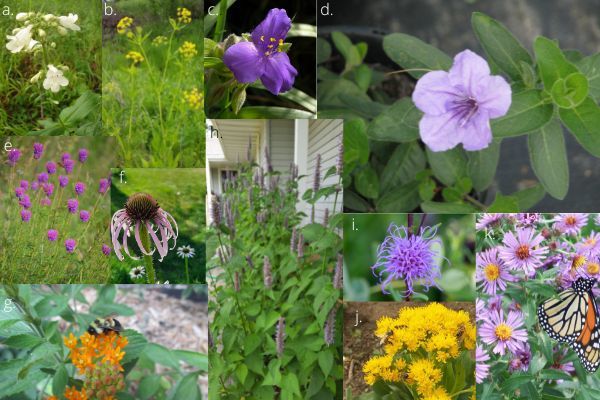 a. Foxglove Beardtongue (Jon Hayes), b. Golden Alexander, c. Spiderwort, d. Wild Petunia (peganum), e. Purple Prairie Clover, f. Pale Purple Coneflower, g. Butterfly Milkweed, h. Anise Hyssop, i. Meadow Blazingstar (Joshua Mayer), j. Stiff Goldenrod, k. New England Aster (Bill Ohde)
You plant native plants just as you would any flowering plant with a few exceptions. The roots will be and will want to continue to grow deep so be sure to make room for them! You won't need to amend the soils or add fertilizers. The only site preparation needed is making sure the area is clear of other unwanted plants.
To help keep things as neat looking as possible there are also a couple of design tips to consider.
First, plant each species in a clump or swath. Rather than planting in some kind of intricate pattern that mixes the different species, plant several individuals (roughly 6-10+) of each species in its own block, with taller plants in back (or the center depending on your gardens shape and placement) and shorter plants up front. This clumping of plants will look less chaotic and can also be beneficial for pollinators by helping their foraging time be more efficient! Bees often exhibit a behavior called floral fidelity where an individual worker will concentrate on gathering pollen from one particular species of plant during their foraging trip. If that one plant species is planted all together, the bees will need to spend less time flying and searching to gather the needed nectar and pollen.
A second strategy to consider is to throw away the plant spacing guidelines and plant individuals much closer together. This is somewhat controversial and may require some experimentation, but one of the pressing problems people run into with natives is that they get too tall and fall over. Choosing the right species can help but it is also worth considering the differences between your garden and a native prairie. In a "properly" spaced prairie garden setting, the plants experience much less competition than they would in a natural setting. They also don't have close neighbors to lean on. Crowding individual plants as well as your blocks of species might help adjust for these issues. It will also help keep any unwanted plants from creeping into the garden.
Here's a list of resources I used to write this article:
If you do plant some pollinator habitat or have already planted some in the last 3-4 years, it would help us track our progress towards our Monarch conservation goals if you would report it via HabiTally (iOS | android). Thanks!
|





