|
FOR IMMEDIATE RELEASE
Nov. 19, 2021
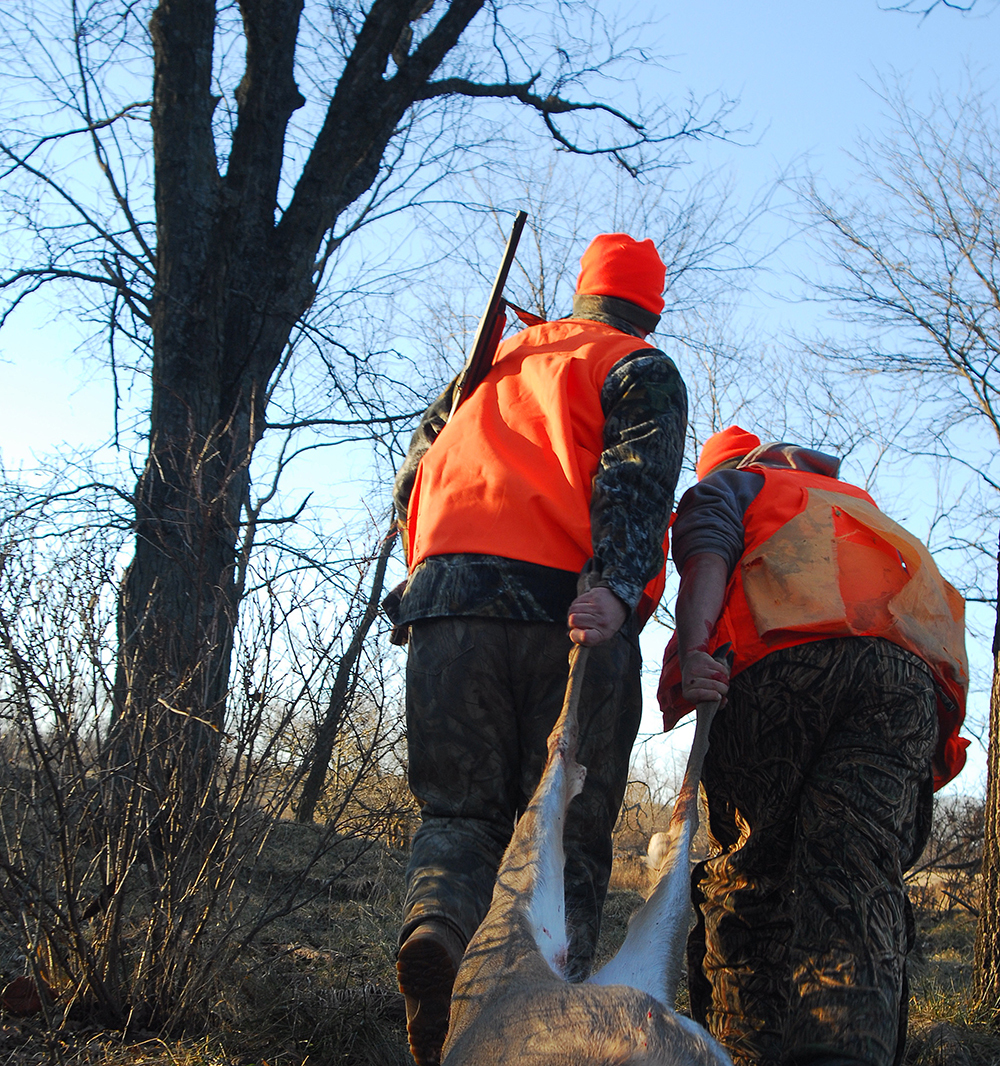 The first of Iowa’s two shotgun deer seasons begins Dec. 4, when an expected 55-60,000 blaze orange clad hunters head to the timber for the annual late fall tradition.
The good news is that Iowa’s deer population is similar to last year statewide, and is continuing its slow upward trend in northcentral and northwest Iowa that has been a goal of the Iowa Department of Natural Resources (DNR) since 2014.
“We’ve been relaxing the regulations on deer in northwest and northcentral Iowa for the past couple of years to allow hunters more opportunities since that population has recovered,” said Tyler Harms, wildlife biologist with the Iowa DNR.
The DNR has removed the buck-only harvest restriction during the first shotgun season in a handful of counties in northcentral Iowa, but left it in place for 17 counties in northwest Iowa.
The DNR manages Iowa’s deer population to provide a harvest of between 100,000 and 120,000 deer annually. Harms said they are expecting the harvest to be similar to last year when Iowans reported harvesting more than 109,500 deer, and given the advanced state of the harvest, everything is setting up nicely.
In 2019, hunters harvested around 95,000 deer, down from 108,000 in 2018.
Media Contact: Tyler Harms, Biometrician, Wildlife Bureau, Iowa Department of Natural Resources, 515-777-5378.
Deer donation program
The Iowa Deer Exchange experienced a successful inaugural season last year, registering more than 650 participants who were either willing to provide deer meat or willing to accept it. Heading in to the shotgun deer hunting seasons, the Iowa Department of Natural Resources is encouraging Iowans who are interested in receiving venison and hunters willing to provide it to again sign up with the program.
Participants who signed up last year are encouraged to review their profile to make sure they are still considered active and the offer good until date hasn’t passed.
“We’re encouraging hunters who are making their plans now to consider picking up another doe tag and registering with the deer exchange to donate venison,” said Harms.
To sign up for the Iowa Deer Exchange, go to www.iowadnr.gov/deer then scroll down to Iowa’s Deer Exchange Program link and fill out the required fields. The database creates a map and table with information deer donors and deer recipients can use to get connected. There is no cost to participate. It is illegal to sell wild fish and game in Iowa.
The deer exchange, along with the Help us Stop Hunger (HUSH) program, allows hunters an opportunity to provide high quality lean protein to their neighbors, while continuing to do what they enjoy – hunting deer.
Hunter who prefer to use the HUSH program are encouraged to contact a participating locker before they harvest a deer to see if the locker has any additional drop off instructions. The list of participating lockers is available at www.iowadnr.gov/deer the scroll down to the Help Us Stop Hunger link. The HUSH program is a partnership between the Iowa DNR, the Food Bank of Iowa and participating meat lockers.
Online Hunting Atlas
Hunters have an online tool that may improve their in-field experience, even before opening day.
The Iowa hunting atlas is an interactive map that shows all available public hunting land that is managed by the state, county or federal governments. The atlas is online at www.iowadnr.gov/hunting. A mobile version is also available.
A click on an area will show basic information like size, habitat type and likely species available.
Text to harvest
Hunters who harvest a deer are required to report their harvest by midnight on the day after it is tagged or before taking it to a locker or taxidermist. The hunter whose name is on the transportation tag is responsible for making the report. If no deer is harvested, no report is necessary.
Options to report your harvest include texting. Simply text the registration number on your deer tag to 1-800-771-4692 and follow the prompts. Hunters are still able to report their harvest online, by phone, or using the Go Outdoors Iowa app. Reporting using the app is straight forward, fast and easy. Hunters have their confirmation right on their phone and also receive it as an email.
Deer harvest numbers are an important component of Iowa’s deer management plan.
Changes to deer seasons
- The buck-only restriction during the first shotgun season has been removed in Hamilton, Webster, and Wright counties.
- Blood tracking dogs for wounded deer. A person having a valid hunting license and a valid deer hunting license who has wounded a deer while hunting may use a dog to track and retrieve the wounded deer. The person must maintain physical control of the dog at all times during the search by means of a maximum 50-foot lead attached to the dog’s collar or harness. Additional requirements are in the hunting regulations.
- The January antlerless-deer-only season has been conditionally reinstated in Allamakee, Appanoose, Decatur, Wayne, and Winneshiek counties only if the number of unsold county antlerless-deer-only licenses exceeds 100 on the third Monday in December.
- County antlerless-deer-only license quotas were increased in 16 counties and decreased in nine counties for a net increase of 1,250 licenses statewide.
The long wait is almost over. For an expected 55-60,000 deer hunters, the shotgun deer seasons are right around the corner and before they head to the timber, it’s important that everyone go through their gear to make sure everything still fits and still works and takes time to review their hunting safety plan.
“Hunting continues to be a safe activity enjoyed by hundreds of thousands of Iowans, which is why hunting injuries make the news - because they’re so uncommon,” said Matt Burner, district supervisor with the Iowa Department of Natural Resources Law Enforcement Bureau for north central Iowa. “And part of making hunting safe is creating a plan for each hunt.”
The hunting plan identifies the hunt location, who’s on the hunt and outlines their role, describes how the hunt will unfold and when the hunters are expected to return home. Hunters are encouraged to leave a copy of the plan with someone or somewhere easy to find, in the event of an emergency.
Hunters will also want to check their blaze orange gear to make sure it still fits and that that orange hasn’t faded to the point of being ineffective. The minimum amount of blaze orange required by Iowa law to hunt in the firearm deer season is a 100 percent solid blaze orange vest, but Bruner said they encourage hunters to wear blaze orange hats and gloves, too.
“Wear plenty of visible blaze orange,” he said. “The more external blaze orange that’s worn, the better the chance that hunters will be seen in the timber. We’re not hiding from deer during the firearm seasons; we want to be seen by the other hunters.”
He also reminded hunters to not only properly identify the target before shooting, but also what is behind the target and to avoid shooting at running deer. It’s also a good idea to talk to the landowner or tenant to confirm permission to hunt and to see if anyone else has permission to hunt the same property.
Before setting foot in the timber on opening morning, Bruner advised hunters to spend some time sighting in their firearm to get reacquainted with its accuracy and the range that the bullets and slugs can travel, to treat every gun as if it were loaded and to always point the gun in a safe direction.
“Remember that we hunt with those who we’re closest to, our family and our friends. If there’s any question about taking a shot, don’t pull the trigger, because once you pull the trigger, you can’t call the shot back,” he said. “No deer is worth taking an unsafe shot; another deer will come along. At the end of the day, we all want to get home safely.”
Media contact: Matt Bruner, district supervisor with the Iowa Department of Natural Resources Law Enforcement Bureau for north central Iowa, 515-336-5456
Information is reported to the Turn in Poachers (TIP) system all year long, with a noticeable increase from September to January as part of the fall and winter hunting seasons. Regardless of the time of year or day of the week, the most important factor for the public in using the TIP system is timeliness.
“Our officers work odd hours and weekends so if you wait until Monday to report what happened over the weekend, the evidence can be gone or destroyed and the poacher is nowhere to be found,” said Matt Burner, district supervisor with the Iowa Department of Natural Resources Law Enforcement Bureau for north central Iowa. “Call as soon as you know something. The quicker we’re on the scene, the better the chance that we can catch them in the act of committing the crime.”
He said callers should provide as much detail as possible, like the location, the person committing the act and their name, if known, the location of the animal that was killed, type of vehicle – make, model, color, and license plate, if possible, and an accurate, step by step account of the event as it happened.
“If you see something that doesn’t look right, take a picture or video and pass that along to the officer,” he said. “Even if it’s something questionable, report it and let the officer determine if they need to dig a little more to see if a follow up is necessary.”
Information can be reported online at www.iowadnr.gov/tip or by calling the hotline at 1-800-532-2020. You can remain anonymous. People who provide information that leads to a successful case are eligible for rewards ranging from $200 up to $1,500 and more. Rewards are paid for in part by the $2 donation option provided by hunters and anglers when purchasing a license. Since 2009, more than 2,100 formal cases been submitted through the TIP program.
“You don’t have to be a hunter or angler to call in a tip,” Bruner said. “We appreciate all of the extra eyes in the field, working together to keep thieves from stealing the fish and game in this state that belongs to everyone.”
Trespassing
Trespassing is a year-round issue but, in the fall, it can often be associated with wildlife violations. When someone witnesses trespassing, ideally, the first call is to the sheriff and a second call is to the local conservation officer. That helps to ensure the officer nearest to the area can respond.
Media contact: Matt Bruner, district supervisor with the Iowa Department of Natural Resources Law Enforcement Bureau for north central Iowa, 515-336-5456
Iowa’s deer hunters are the most effective tool to monitor and manage for chronic wasting disease, and heading in to the two shotgun seasons, the Iowa Department of Natural Resources (DNR) is again asking for their help.
The goal is to test around 5,000 deer samples with the bulk coming from portions of northeast and eastern Iowa near Wisconsin, Illinois; south-central Iowa near Missouri; and western Iowa near Nebraska, where the disease has been detected. Additional testing will be conducted in Pottawattamie, Cerro Gordo and Davis counties, following positive tests from captive facilities. All Iowa counties have at least 15 samples collected annually. The disease has been found in every state around Iowa.
The Iowa DNR is prioritizing samples from adult bucks as they are of higher risk of contracting the disease because they interact with many different family groups. Yearling does are the lowest priority because they are least likely to contract the disease.
“If the disease is going to show up in a new area, it’s likely going to be found in adult bucks,” said Tyler Harms, wildlife biologist for the Iowa DNR. “Hopefully, targeting this group will allow us to catch it early, and then we can put our plan into action.
“Part of our chronic disease plan calls for reducing deer densities in the area around where the positive deer was confirmed. To do that, we’ve created opportunities for hunters to harvest deer in these targeted areas and are encouraging hunters to take advantage of these extra tags. We want to manage the local deer herd in these areas toward the lower end of our population goal,” Harms said.
Chronic wasting disease is a neurological disease belonging to the family of diseases known as transmissible spongiform encephalopathies, or prion diseases. It attacks the brain of infected deer and elk causing the animals to lose weight, display abnormal behavior, lose body functions and die.
The disease is spread from animal to animal through nose to nose contact and through environmental contamination from urine, feces and saliva left by infected deer. There is no cure once an animal becomes infected.
So far during the 2021-22 deer hunting seasons, one hunter harvested wild deer from Wayne County has tested positive for the disease, bringing the total deer testing positive since monitoring began in 2002, to 112.
Hunters willing to provide a sample are encouraged to contact their local wildlife biologist to arrange for collection. The DNR is also working with taxidermists who, after receiving notification from the hunter, can collect the sample without damaging the mount. “Just let them know ahead of time that you would like to provide a tissue sample,” Harms said.
Hunters who provide samples are encouraged to use separate knives and utensils to break down the deer and hold their meat separately until the results are available. They’re also encouraged to wear gloves when processing the animal and to thoroughly wash their hands and equipment. Test results are usually available within 7-10 days during the shotgun seasons.
If the deer is going to a locker, hunters should reach out to the locker ahead of time for their processing schedule and other handing requirements before arriving at their door with the meat. They should also check with their local waste hauler or landfill to see if there are any specific waste disposal requirements for accepting the deer carcass. The other option is to bury the carcass where it was harvested.
Hunters who harvest lower priority deer, like fawns, or after the state DNR sample quota is reached, have the option to provide their own sample to test by the Iowa State University Veterinary Diagnostic Laboratory, in Ames, for $25. There are step by step instructions on how to do it and the form needed online at https://www.iowadnr.gov/Hunting/Deer-Hunting.
Media Contact: Tyler Harms, Biometrician, Wildlife Bureau, Iowa Department of Natural Resources, 515-777-5378.
Hunters donated nearly 4,000 deer hides to Elks Lodges across Iowa last year, which was a slight decrease from the 2020-2021 season. The deer hides are used by the Veterans Leather Program to make professionally-crafted leather gloves for veterans in wheelchairs and also turned into leather used for therapy programs for recovering veterans.
The Veterans Leather Program relies on the charity of hunters to donate their deer hides. Hunters willing to donate their hides are encouraged to contact the local Elks Lodge for drop off locations or visit www.elks.org/lodges to find the nearest lodge. The therapeutic kits and gloves are distributed at no cost to the veterans.
Contact Lisa Widick at 208-360-6294 or ozzywidick@gmail.com for more information.
The Iowa Department of Natural Resources (DNR) has discounted its annual passes for the Banner and Olofson shooting ranges for 2022 by $40 making it the perfect gift for the hard-to-buy-for member of the family.
From Nov. 26 to Dec. 31, individual passes will be available for $200 and family passes for $260 (this is a $40 savings). Annual passes may be purchased at either range and is valid at both shooting ranges. If you currently have a pass this purchase will just add an additional year to your current pass.
Banner Range, between Indianola and Des Moines on Hwy. 65/69 in Warren County, is a multi-use shooting facility that offers a safe, clean shooting environment for handguns, rifles, archery, and shotguns. The range is staffed with professional certified range safety officers during all operating hours. Banner Range is open Monday, Tuesday and Friday, 11 a.m. to 5 p.m. and Saturday and Sunday from 9 a.m. to 5 p.m. Closed Wednesday and Thursday.
The Olofson Shooting Range, located off Hwy. 415, about five miles northwest of Polk City, features a classroom, handgun, rifle, Trap/Skeet, and archery ranges. The Olofson Range is open Wednesday, Thursday and Friday, from 11 a.m. to 5 p.m., and Saturday and Sunday from 9 a.m. to 5 p.m. Closed Monday and Tuesday.
Shooting ranges welcome shooters of all skill levels and abilities. Patrons have the ability to pay $10 per hour or purchase an annual pass to cover their shooting time. Information on Iowa shooting ranges is available at http://www.iowadnr.gov/Hunting/Places-to-Hunt-Shoot/Iowa-Shooting-Ranges
Banner and Olofson shooting ranges are closed December 24, 25, and January 1.
Hundreds of yellow ovals offset the brown and green coloration of each female brown trout ready to spawn at the Manchester Fish Hatchery. The splashes of color are signs that trout spawning season is in full swing.
Brown trout spawning was completed a couple of weeks ago. Brood trout were brought to the hatchery from French Creek in Allamakee County. They are held at the hatchery across two spawning cycles then released back in French Creek, supplementing earlier generations of brown trout.
All brown trout are stocked as 2-inch fingerlings. “Anglers like these ‘wild’ stream raised fish. They are harder to catch than our put-and-take stocked fish,” explains Mike Steuck, Iowa DNR fisheries supervisor for interior streams. “Many of the public streams have lots of brown trout in them.”
Fewer and fewer brown trout fingerlings are raised and stocked as the number of self-sustaining, naturally reproducing brown trout populations increase throughout Northeast Iowa.
Brook trout, Iowa’s only native trout, give up their eggs in late October and early November. Eggs are taken streamside from wild South Pine Creek brook trout, fertilized and taken back to the Manchester Fish Hatchery to be raised and stocked as 2-inch fingerlings in June.
“As a part of DNR’s Brook Trout Restoration Program, we’re working to re-establish populations of Iowa ‘wild’ brook trout in streams with suitable habitat and excellent water quality,” said Steuck.
Rainbow trout, the backbone of Iowa’s trout program, take up much of December and January. Roughly 750,000 eggs will be collected this season.
Crews check for ripe female broodstock once a week. After a quick sedative bath to calm them, each big trout is held firmly over a plastic bowl, as one of the workers rolls a hand down her belly to force out a stream of orange-golden eggs—up to 4,000 to 6,000 per fish. Mixed in quickly is the milk-white sperm from two males. Water is added to activate the eggs and sperm allowing fertilization to occur. The ingredients are gently stirred with a turkey feather to avoid bruising the eggs.
The fertilized eggs are poured into an incubator tray and slid into their place below a stream of 50 to 52 degree water until they hatch. Tiny sac-fry hatch about 30 days after fertilization. Dark clouds of tiny fish grow in raceways at the hatchery. The fish are hand-fed for the first month, then “trained” to eat from automatic feeders.
As the trout develop and grow, they are monitored and transferred to larger tanks, then raceways. The fingerlings will be kept at Manchester or transferred to Iowa’s two other stations, near Elkader and Decorah, to be raised for future stocking. In 13 to 15 months, they will be a half-pound and ready to be stocked. Nearly 50 put-and-take streams throughout nine northeast Iowa counties are stocked from April through October and almost 20 community trout fishing locations are stocked through the cold weather months.
“We stock about 380,000 catchable rainbow trout from the hatcheries,” said Steuck. “We also stock about 60,000 brook, brown and rainbow trout fingerlings each year to grow in the streams.”
There’s natural spawning, mostly brown trout and some brook trout, in more than 75 northeast Iowa streams thanks to improved habitat and trout genetics, and an extended period of above average annual rainfall. Most trout caught, though, are spawned under the eyes of hatchery workers at Manchester. These coldwater fish are great fighters and beautiful in their spawning colors this time of year.
Find more information about Iowa trout streams and tips for trout fishing on the DNR website at www.iowadnr.gov/trout.
Media Contact: Mike Steuck, regional fisheries supervisor, northeast Iowa, Iowa Department of Natural Resources, 563-927-3276.
The Iowa Department of Natural Resources (DNR) released between 1,000 to 2,000 rainbow trout at each of the final three community trout ponds as part of its cool weather trout program that brings trout to areas that cannot support them during the summer.
The following locations are ready for anglers to catch trout: Bacon Creek Lake (Sioux City), Blue Pit (Mason City) and Scharnberg Pond (Spencer). All fall community trout stockings were unannounced this year.
The fall community trout stockings are a great place to take kids to catch their first fish. Snap a photo of your child and their catch and submit it for a free, frameable First Fish certificate on the DNR website at www.iowadnr.gov/Fishing/Master-Angler-First-Fish.
The popular program is supported by the sales of the trout fee. Anglers need a valid fishing license and pay the trout fee to fish for or possess trout. The daily limit is five trout per licensed angler with a possession limit of 10.
Children age 15 or younger can fish for trout with a properly licensed adult, but they must limit their catch to one daily limit. The child can purchase a trout fee which will allow them to catch their own limit.
Learn more about trout fishing in community trout ponds on the DNR trout fishing webpage.
Media Contact: Mike Steuck, regional fisheries supervisor, Northeast Iowa, Iowa Department of Natural Resources, 563-927-3276.
She Goes Outdoors has a new subscription box available focused on ice fishing. The box is packed full of gear, educational resources, and more for only $50, which includes shipping and handling. Boxes are available for purchase now at https://www.sgooutdoors.com/subscriptionbox.
- 150 boxes are available through November 24
- Boxes will shipped on December 10
- A fishing webinar will be held on January 12, 2022 from 7-9 p.m. CST
She Goes Outdoors is a partnership with Nebraska Game & Parks Commission, Kansas Department of Parks and Wildlife and the Iowa Department of Natural Resources.
DECORAH- The Iowa Department of Natural Resources (DNR) is offering a program to teach skills needed to hunt upland birds to anyone who has little to no upland bird hunting experience.
The December 17th workshop will feature a two hour knowledge and skills building sessions with instructors that will teach the safety basics of upland hunting and wingshooting.
“For those interested in the challenge of upland hunting as a means of sourcing their own protein or red meat, this program provides the opportunity to learn the skills and knowledge it takes to do it all yourself,” said Jamie Cook, program coordinator with the Iowa DNR.
Participants will learn basic strategies for hunting upland birds such as proper equipment, where to hunt, safe shooting practices.
The course runs from 5PM to 6:30PM and is designed for participants 18 years of age and older. The course is $35 and will be held at T-Bocks Bar and Grill in Decorah, IA. The event also includes a mentored hunts on Saturday December 18th. Space is extremely limited so be sure to register right away. Participants will receive a hat and a lunch on Saturday provided by Pheasants Forever.
For more information and to begin the registration process please visit:
http://events.constantcontact.com/register/event?llr=dep4qyuab&oeidk=a07eistqzrj796ef903
The program is provided through a partnership with the Iowa DNR and Pheasants Forever. It is part of a national effort to recruit, retain and reactivate hunters due to the overall decline in hunting and outdoor recreation.
Media Contact: Jamie Cook, Iowa Department of Natural Resources, 515.350.8091
Iowa’s 4 yr Collegiate Scholastic Clay Target Teams competed this past weekend in a four discipline competition: American trap, skeet, sporting clays, and super sporting. William Penn Shotgun Sports won the sporting clays and skeet team championships, while the Wartburg Knights won the trap and super sporting team championships.
Nearly 100 athletes from 8 Iowa 4 year colleges and universities braved the wind and cold to participate in the 2021 Iowa Scholastic Clay Target Program (SCTP) 4 yr Collegiate Championships held November 13-14 at the New Pioneer Clay Target Center in Waukee. Top team and individual honors for each discipline are listed below.
The High Over All Team Championship, which combines scores from all 4 events, went to William Penn Shotgun Sports, with the Wartburg Knights in second, and Simpson College in 3rd place.
Sporting Clays Championship
Men’s Individual Sporting Clays
- Dominick Ver Meer, William Penn Shotgun Sports
- Mathew Brindley, William Penn Shotgun Sports
- Evan Guttormson, Wartburg Knights
- Wyatt Heisterkamp, Simpson College Shooting Sports
- Kade Dunkin, William Penn Shotgun Sports
Women’s Individual Sporting Clays
- Erin Neppl, Coe College Clay Target Team
- Holly Boeke, William Penn Shotgun Sports
- Raylee Bishop, William Penn Shotgun Sports
- Quinn Schuppner, Upper Iowa University
- Rachel Rickert, Coe College Clay Target Team
Sporting Clays Teams
- William Penn Shotgun Sports, 245 points
- Simpson College Shooting Sports, 223 points
- Wartburg Knights, 212 points
Skeet Championship
Men’s Individual Skeet
- Dominick Ver Meer, William Penn Shotgun Sports
- Evan Guttormson, Wartburg Knights
- Parker Miklaszewski, Wartburg Knights
- Breydon Paxson, Simpson College Shooting Sports
- Hunter Lucas, William Penn Shotgun Sports
Women's Individual Skeet
- Raylee Bishop, William Penn Shotgun Sports
- Angelina Monfrey, Upper Iowa University
- Holly Boeke, William Penn Shotgun Sports
- KayLynn Sieber, William Penn Shotgun Sports
- Kylie Tierney, Simpson College Shooting Sports
Skeet Teams
- William Penn University, 473 points
- Wartburg Knights, 468 points
- Simpson College Shooting Sports, 461 points
Trap Championship
Men’s Individual Trap
- Christofer Gardner, Wartburg Knights
- Dryden Dekoning, William Penn Shotgun Sports
- Evan Guttormson, Wartburg Knights
- Hunter Block, Grand View University Trap and Skeet
- Breydon Paxson, Simpson College Shooting Sports
Women's Individual Trap
- Raylee Bishop, William Penn Shotgun Sports
- Caitlyn Pendleton, William Penn Shotgun Sports
- Abbey Pals, Grand View University Trap and Skeet
- KayLynn Sieber, William Penn Shotgun Sports
- Ashley Hunter, William Penn Shotgun Sports
TrapTeams
- Wartburg Knights, 481 points
- William Penn University, 479 points
- Simpson College Shooting Sports, 476 points
Super Sporting Championship
Men’s Individual Super Sporting
- Parker Miklaszewski, Wartburg Knights
- Ty Ready, Wartburg Knights
- Jake Frederick, Ballard Clay Bombers
- Noah Seelye, William Penn Shotgun Sports
- Christofer Gardner, Wartburg Knights
Women's Individual Super Sporting
- KayLynn Sieber, William Penn Shotgun Sports
- Quinn Schuppner, Upper Iowa University
- Anna Lopez, Simpson College Shooting Sports
- Janzie Mason, Grand View University Trap and Skeet
- Raylee Bishop, William Penn Shotgun Sports
Super Sporting Teams
- Wartburg Knights, 131 points
- William Penn University, 125 points
- Simpson College Shooting Sports, 122 points
High Over All Championship
Men’s Individual HOA
- Evan Guttormson, Wartburg Knights, Captain
- Dominick Ver Meer, William Penn Shotgun Sports
- Breydon Paxson, Simpson College Shooting Sports
- Parker Miklaszewski, Wartburg Knights
- Mathew Brindley, William Penn Shotgun Sports
Women's Individual HOA
- Raylee Bishop, William Penn Shotgun Sports, Captain
- KayLynn Sieber, William Penn Shotgun Sports
- Angelina Monfrey, Upper Iowa University
- Holly Boeke, William Penn Shotgun Sports
- Quinn Schuppner, Upper Iowa University
HOA Teams
- William Penn University, 1551 points
- Wartburg Knights, 1492 points
- Simpson College Shooting Sports, 1489 points
The Scholastic Clay Target Program is the largest, fastest growing, and most exciting youth clay target program in the US. Student athletes from elementary through high school and college have the opportunity to compete in sports such as trap, skeet, and sporting clays, as well as Olympic disciplines like bunker trap and international skeet.
The SCTP is a youth development program, first and foremost and we do this through the shooting sports and competitive shooting. The SCTP’s mission is to help kids reach their highest potential in becoming the best athletes and young adults they can be. For more information on the Scholastic Clay Target Program in Iowa, contact Chris Van Gorp, DNR Shooting Sports Coordinator at 515-313-8048 or chris.vangorp@dnr.iowa.gov.
Media Contact: Chris Van Gorp, DNR Shooting Sports Coordinator, (515) 313-8048 or Chris.Vangorp@dnr.iowa.gov.
|





