|
FOR IMMEDIATE RELEASE
Oct. 12, 2021
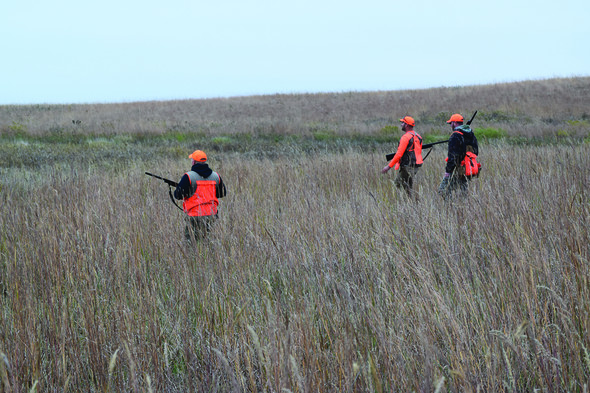 With the annual fall crop harvest running ahead of schedule, Iowa’s 2021 pheasant season is expected to be another good one when 55,000 plus blaze orange clad hunters take to the fields on Oct. 30.
And based on the results of the August pheasant survey, hunters can afford to be optimistic.
The annual August roadside survey found Iowa’s statewide pheasant population to be essentially unchanged from 2020 at 20 birds per 30-mile route. Within the survey, three of the nine regions – northwest, north-central, west central – averaged 30 birds or more per route, which is the first time that has occurred since 2007, and the central region saw a 25 percent increase. The northeast and east central regions were about at their 10-year survey averages.
“Our pheasant population is about the same as last year, which was another good year - we’ve had four or five good years in a row now – and based on our bird counts I expect our pheasant harvest to be around 300,000, but our population would easily support a harvest of half a million. Our final harvest will hinge upon hunter turnout,” said Todd Bogenschutz, upland wildlife biologist with the Iowa Department of Natural Resources (DNR).
The advanced crop harvest and continued good news on the bird numbers has the attention from pheasant hunters beyond the state’s border. Bogenschutz along with other Iowa DNR wildlife staff have been getting calls from nonresident hunters interested in hunting Iowa.
One piece of advice he said, is that hunters in western and northern Iowa impacted by the drought should pre-scout the CRP fields they plan to hunt because the habitat could be gone. An emergency declaration from the U.S. Department of Agriculture opened CRP fields in the drought-stricken area to haying up to 100 percent of the fields.
Iowa Pheasant Season
Iowa’s pheasant season is Oct. 30-Jan. 10, 2022, shooting hours are 8 a.m. to 4:30 p.m. The daily bag limit is three rooster pheasants with a possession limit of 12. Hunters must have a valid hunting license and habitat fee.
Hunters are required to wear at least one article of external clothing with at least 50 percent of its surface area solid blaze orange: hat, cap, vest, coat, jacket, sweatshirt, shirt or coveralls. The same blaze orange rule applies while hunting quail, gray partridge and ruffed grouse.
If hunting on public land that requires nontoxic shot, hunters are encouraged to plan ahead to pick up shells. While the supply isn’t as tight as it was for dove loads, it still isn’t great.
Iowa’s youth enjoy special pheasant season Oct. 23-24
Iowa’s young hunters will get to experience the first cackle and flush of the year during the youth only pheasant season Oct. 23-24, and the 2021 season should be good.
The residents-only youth season gives Iowans age 15 and younger the opportunity to hunt for rooster pheasants without purchasing a license, habitat fee or taking hunter education. Youths must hunt under direct supervision of an adult age 18 or older that has a valid hunting license and habitat fee.
Special youth only seasons allows young hunters an opportunity for success without pressure or competition from other hunters. Only the youth are allowed shoot pheasants and they may bag one rooster per day.
Online Hunting Atlas offers places to go
Iowa hunters have been using the interactive Iowa hunting atlas to find new places to go hunting. The hunting atlas features more than 680,000 acres of public hunting land that is owned by the state, county or federal governments. It’s available online at www.iowadnr.gov/hunting.
This tool allows hunters to see which zone the public area is in, type of shot allowed, wildlife likely to be found and get an overhead look at the terrain. The mobile version of the atlas will show hunter location on the area if granted permission.
The atlas view from above allows hunters to zoom in on an area, see how to get there, the lay of the land and where one parcel of public hunting land is in relation to others and print off maps.
Information is updated as public hunting lands are acquired.
The hunting atlas also includes private land enrolled in the Iowa Habitat and Access Program (IHAP) where private landowners receive assistance to improve habitat on their land in exchange for opening the property for hunter access.
Site maps are available at www.iowadnr.gov/ihap showing boundaries and which species would be most likely attracted to the habitat. Walk-in public hunting through IHAP is available between September 1 and May 31.
Media Contact: Todd Bogenschutz, Upland Wildlife Biologist, Iowa Department of Natural Resources, 515-979-0828.
The Iowa Department of Natural Resources (DNR), through a grant with the U.S. Forest Service, has been awarding communities in counties that have confirmed emerald ash borer (EAB) infestations up to 200 free seedlings from the Iowa DNR’s State Forest Nursery. Seedlings have been awarded to more than 200 Iowa communities since spring of 2019.
Any community within an EAB confirmed county is eligible to apply for these free native hardwood and conifer seedlings, even if they have received seedlings through this grant in previous years. Spring of 2022 will be the last chance for any of the 800 eligible Iowa communities to apply to receive the free seedlings.
The seedlings can be planted on public property or distributed to residents throughout the community to plant on private property. Cities or public organizations can choose to do both public and private property plantings. The seedlings have to be planted within city limits.
This is another opportunity for cities with major tree damage or loss from the derecho to help repopulate the trees in the devastated communities, as long as the county is a confirmed EAB infested county.
Any city or public organization interested in applying for the free seedlings, should complete the grant application online at https://www.iowadnr.gov/Portals/idnr/uploads/forms/5420991.pdf. If awarded the seedlings, they can be picked up from the Iowa DNR State Forest Nursery in Ames or shipped for free.
Iowa has confirmed emerald ash borer in 84 counties. Learn more about EAB and view the latest map with confirmed infested counties at https://www.iowadnr.gov/conservation/forestry/forest-health/emerald-ash-borer.
Media Contact: Aron Flickinger, Forestry Program Specialist, 515-291-2829, aron.flickinger@dnr.iowa.gov
Join the Iowa Department of Natural Resources for an evening of spooky family fun. Experience all sorts of Halloween critters including spiders, bats, owls and snakes with experts to explain more about them and their relationship with the environment.
This FREE family-friendly webinar will take place on Zoom Oct. 25 at 7 p.m. and simulcasted through Facebook Live at facebook.com/iowadnr. Space is limited in the Zoom webinar, so be sure to register right away.
For more information and to begin the registration process please visit: https://us02web.zoom.us/webinar/register/WN_3Tf3vCJfQJWaWKn9B6HvxQ
Media Contact: Anne Riordan, Iowa Department of Natural Resources, 641-295-6028 or Christina Roelofs, Iowa Department of Natural Resources, 712-744-3403.
|





