|
FOR IMMEDIATE RELEASE
Oct. 5, 2021
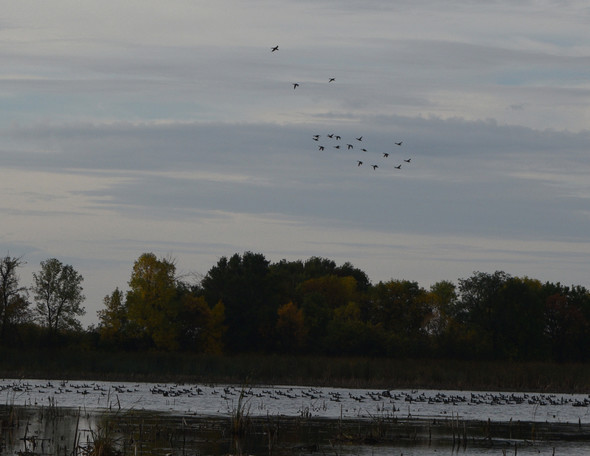 Lizard Lake is a shallow, dynamic system in southeast Pocahontas County, that is an important stop on the migration route north for thousands of waterfowl. The system was renovated a decade ago and has been attracting bird watchers, paddlers and duck hunters to the area since the lake refilled. Photo courtesy of the Iowa DNR.
Lizard Lake Wildlife Area’s resurgence began 10 years ago, when the 270-acre shallow lake was drained to rid itself of an unwanted carp population and to get vegetation established as a way to improve its poor water quality.
“Our driver is water quality and as far as that project is concerned, it has been hugely successful,” said Clint Maddix, wildlife biologist with the Iowa Department of Natural Resources. “If you had been to Lizard Lake before the renovation but not since, I’d encourage you to come back.”
The lake is now used as a stopping point by thousands of migrating waterfowl that target Lizard Lake soon after ice out for its large number of protein packing invertebrates. “It’s an important refueling station for the ducks on their journey north to arrive in a healthy condition,” he said.
And it’s not just the ducks that have taken note of the improved Lizard Lake; hunters and paddlers and bird watchers have, too.
Kayaking, once unheard of here, is now a common activity during the summer and the Pocahontas County Conservation naturalist has been offering courses for those learning how to paddle. The campground is seeing increased use since the lake renovation, especially once duck season begins. A modern restroom was added during the drawdown and has been a welcomed addition.
“There have been a lot of different songbirds passing through the area; bird watchers, too,” he said. “A pair of sandhill cranes spent a month here. This is not the same Lizard Lake that people knew 10 years ago.”
Waterfowl response
The mud motor jerked into gear and the tour of Lizard Lake was underway. Heading south off the east boat ramp, a commotion of nervous coot fled to the safety of cattails while green wing and blue wing teal took flight. As the boat headed west and then north, a handful of mallards, gadwall and shovlers took off.
The amount of waterfowl here is good to see, Maddix said, and those ducks are attracting hunters from Ames, Fort Dodge, Orange City and all-around Pocahontas County to a healthy Lizard Lake.
“We’re hearing that the duck hunters are pretty happy here,” he said.
Expanding the footprint
Post Prairie Wetland Area, just west of the private campground, was acquired and developed after the drawdown by the Pocahontas County Conservation Board. The area includes a restored wetland basin that collects and holds runoff before it can enter the lake as well as a restored prairie providing habitat to grassland birds, including pheasants.
In 2017, roughly 116 acres stretching from the east side around to the north was acquired and planted with more than 100 different native prairie species including big bluestem, Indian grass, sideoats grama, little bluestem, round headed bush clover, compass plant, rattlesnake master, gray headed coneflower, cup plant, rosinweed, prairie sage and more. This protects about 4,000 feet of shoreline and, once the trees are removed, will benefit grassland nesting birds.
Combining the county managed areas with the state areas, the Lizard Lake complex is approaching 600 acres.
Media Contact: Clint Maddix, Wildlife Biologist, Iowa Department of Natural Resources, 712-661-9726.
Iowa’s Resource Enhancement and Protection (REAP) assemblies will begin in two weeks, giving all Iowans an opportunity to share and discuss their visions for Iowa’s outdoor recreation, soil and water enhancement, historical resources and land management and more.
REAP assemblies are locally led meetings where issues can be brought forth and voted upon. Iowans can discuss the program, recommend changes and discuss impacts in their area. Delegates may also be selected from the local meeting to attend the REAP congress in January at the State Capitol in Des Moines.
Each assembly represents a region of counties and participants are required to attend the region for the county in which they reside. Meetings are held in the evening and last approximately 90 minutes. A list of REAP assembly locations is available online at 2021 REAP Assemblies.
“REAP assemblies provide Iowans a perfect opportunity to share their views and learn others’ views about parks, trails, museums and other amenities,” said Kayla Lyon, director of the Iowa Department of Natural Resources (DNR). “It’s critical that community members are engaged in these meetings to help shape the future of and enhance recreational opportunities in our state for the future.”
Each year, REAP provides funding for local projects through a grant process and each year, the requests for city and county grants exceed the amount available by two or three times. Since the program debuted in 1989, more than $365 million has been awarded to more than 15,500 projects.
“REAP benefits every single county, every year, in one way or another, either through improved water quality, by preserving our historical assets or providing outdoor recreation opportunities,” said Michelle Wilson, coordinator for REAP with the Iowa DNR. “REAP significantly impacts the quality of life of all Iowans.”
MEDIA CONTACT: Michelle Wilson, REAP Coordinator, Iowa Department of Natural Resources, 515-446-0535.
Fall fishing has a special look and feel with cool air, picturesque views of splendid scenery, and cooperative fish.
“Fall is a great time to catch fish with family and friends,” said Joe Larscheid, chief of the Iowa Department of Natural Resources Fisheries Bureau. “Pack your gear, rig your rods and get outside in this perfect weather.”
Cooler temperatures and shorter daylight times trigger fish to actively search for food to build energy reserves to survive the long winter. These predictable movements make them easier to find.
“Yellow perch, muskies, crappies, walleyes, largemouth and smallmouth bass are more active and hungry in the fall,” explained Larscheid. “They eat more and more often to get ready for winter.”
The fall bite in lakes and ponds shifts to the main part of the day. Fish are more active during the day and will be close to shore. Target areas of a lake where the water is warmer, mostly in shallow water bays along the north shore.
“Use live bait, particularly minnows, small tackle and fish slowly when fishing in cooler water,” Larscheid said.
Look for panfish schools in open water near structure like a brush pile, underwater hump, drop-offs and rock reefs. Largemouth bass will be close to some type of structure like underwater brush piles, old road beds, rock reeks or weed lines.
Quickly find fish structure locations with the online fishing atlas or download structure location maps from the DNR’s Fishing Maps website.
Find tips for catching yellow perch, crappie, walleye, bass and catfish on the DNR website at www.iowadnr.gov/fishing. Check the weekly fishing report to find out what is biting where.
Media Contact: Joe Larscheid, Chief of Fisheries, Iowa Department of Natural Resources, 515-201-3376.
The best way to prevent the spread of oak wilt is to not prune any oak tree during the growing season.
“It’s best to wait until after Oct. 15 to start pruning oak trees,” says Tivon Feeley, with the Iowa DNR’s forest health program. “Then you can prune your oaks all winter long with the goal to stop pruning by March 1.”
Oak wilt, caused by a fungus, has been present in Iowa for many years. Iowa’s red, black, and pin oak are more susceptible to oak wilt, but it can also infect white and bur oak. Black, pin, or red oak usually die within the same summer they are infected. White oak and bur oak can often take a number of years before they succumb to this disease.
Oak wilt can spread from infected trees to healthy trees in two ways: a small beetle that carries spores of the fungus from a diseased tree to a healthy tree with an open wound during the growing season, and through root grafts connecting nearby oaks. For example, if a red oak is infected and there is another red oak within 50 to 100 feet there is a good chance that the roots of these trees are grafted and the fungus can move from the diseased tree to the healthy tree.
Feeley says symptoms to look for on infected trees usually include leaves turning a bronzed brown along the outer margins of the leaves. These leaves can often still have some green on them as they fall from the tree. The defoliation tends to start at the top of the tree.
If a tree is wounded from storm damage or pruning is required during the growing season, treat the wounds immediately with a wound dressing such as acrylic paint. Do not purchase pruning paints/sealants. Those products slow the tree’s ability to seal over the wound.
Learn more about oak wilt prevention and control at https://store.extension.iastate.edu/Product/sul15-pdf.
Media Contact: Tivon Feeley, Forest Health Forester, Iowa Department of Natural Resources, 515-669-1402.
|





