|
September 29, 2021
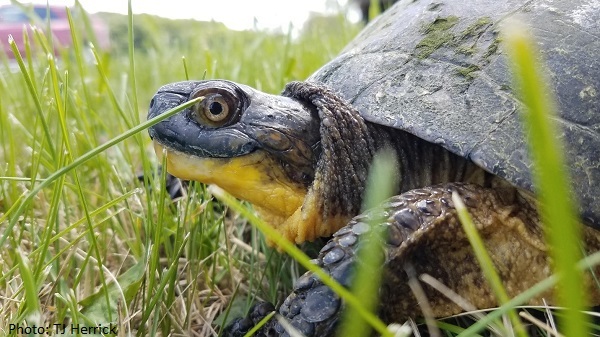
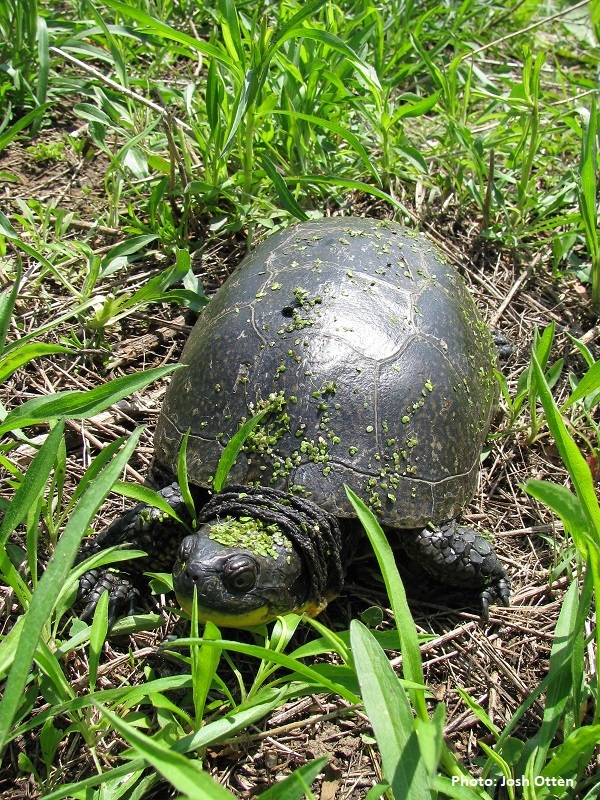
Blanding’s turtles (Emydoidea blandingii) are among Iowa’s rarest reptile species, and easily one of the most charismatic! If you are lucky enough to spot a Blanding’s turtle, they can be quickly identified by their bright yellow throat and unusual shell. Their carapace (upper shell) is lightly speckled and domed (sometimes referred to as “helmet” shaped) while their plastron (lower shell) is hinged. This hinge allows the turtle to close its shell when feeling frightened, hiding its head and front legs from potential predators.
Did you know? Blanding’s turtles have a curved beak, which often gives the impression they are smiling!
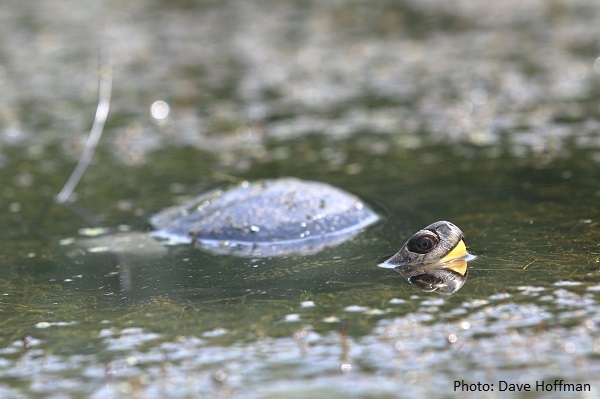
Even for a turtle, Blanding’s are a particularly long-lived species and don’t reach maturity until they are at least 14 years old. The oldest Blanding’s turtles on record have lived to be over 80, and continue to reproduce well into their old age. Although most of their time is spent in shallow water bodies with emergent vegetation such as marshes and wetlands, they are considered more terrestrial (spend time on land) than many other turtle species and may be found in the uplands during certain times of the year.
 In Iowa, Blanding’s turtles are listed as State Threatened and a Species of Greatest Conservation Need. General loss of wetland and nesting habitat is the major reason their populations are in trouble. However, vehicle collision is also considered a big problem for this species, as the turtles regularly cross roadways looking for places to lay their eggs. In fact, population declines across their entire range has prompted the U.S. Fish and Wildlife Service to consider listing them under the Endangered Species Act. Currently, many conservation agencies are researching the causes of the decline and implementing programs aimed to increase their numbers.
Loss of habitat is one reason for the decline of Blanding's turtles
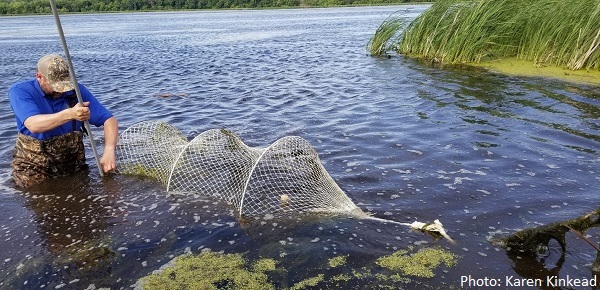
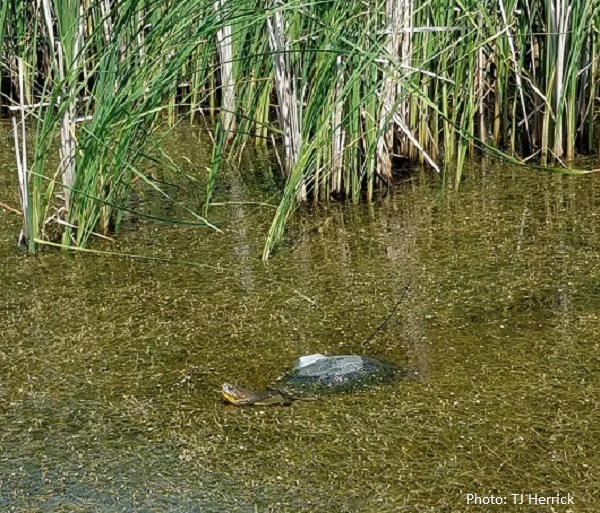
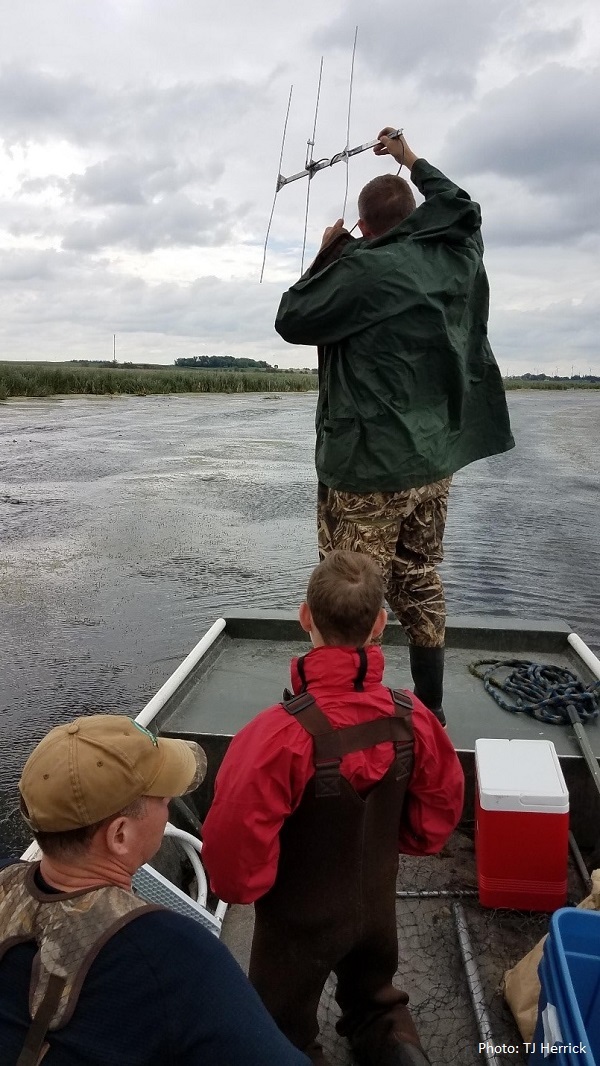
Similar to many other turtle species, Blanding’s are shy and can be difficult to study. To learn more about their seasonal habitat use and survival, the Iowa Department of Natural Resources started a Blanding’s turtle radio telemetry project in 2020. We put out aquatic nets baited with fish to capture adults each spring once the weather warms up and turtles become more active. Currently, we have captured five adult Blanding’s and fitted them with radio transmitters at one site in northern Iowa. Each transmitter has a unique frequency which can be heard from hundreds of feet away using a specialized antenna. This tracking method allows us to relocate each turtle from a distance without influencing their movement or behavior.
Dave Hoffman checks a trap for Blanding's turtles
Blanding's turtle sporting a radio transmitter
Staff use a receiver to try and detect Blanding's turtles with transmitters
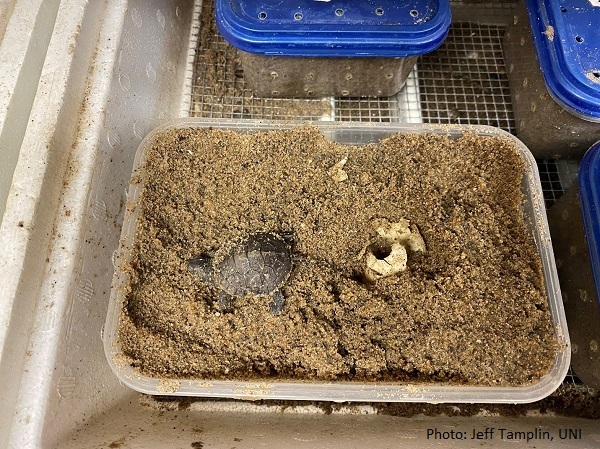
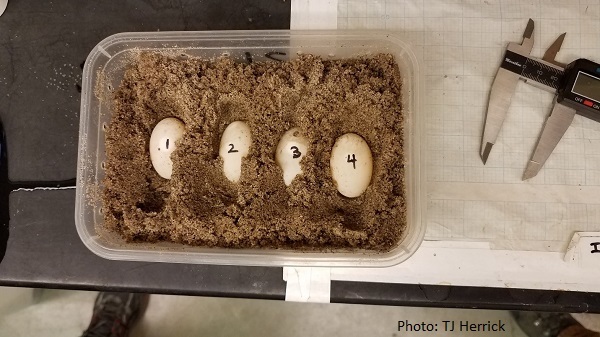
In 2021, a gravid (carrying eggs) female Blanding’s turtle was captured as part of our ongoing telemetry study. Once we suspected the turtle might go to nearby crop field to nest, she was quickly retrieved so her clutch could be laid without risk of damage from heavy equipment. With help from partners at the University of Northern Iowa, the eggs were safely incubated over the summer. While the average Blanding’s turtle lays 12 eggs, this female had a clutch of 20! Unfortunately, most of the eggs were not fertilized, and only two hatched.
 |
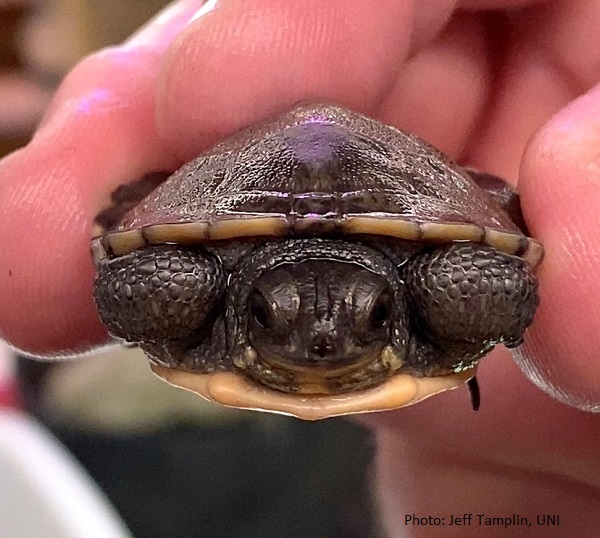
In the wild, the tiny hatchlings break out of their eggs in late summer, and are much more vulnerable than adults during this life stage. Survival estimates for hatchlings after their first winter are only between 12% and 26%. Low hatchling and juvenile survival is one of the barriers Blanding’s turtles face growing or recovering a population. Recognizing this problem, many turtle conservation programs have turned to head-starting programs. This means that hatchlings are reared for several months in captivity before being released back into their natural habitat.
Blanding's turtle hatching in captivity.
Did you know? Blanding’s turtle hatchlings have the same unique yellow coloration as their parents, which gets brighter as they age!
This winter, we plan to head-start the two young Blanding’s that hatched as part of our study. Additionally, we’ll track them with their own (smaller) versions of the adult’s radio transmitters to give us a better understanding of how juveniles use Iowa’s landscape. We hope these efforts will give them the best chance at survival back at their home wetland while also providing valuable information that can be used in future conservation efforts.
Have you seen a Blanding's turtle lately? If so, please report them with a location and a picture. These can be sent to Jenny Fredrickson.
|