|
FOR IMMEDIATE RELEASE
Sept. 28, 2021
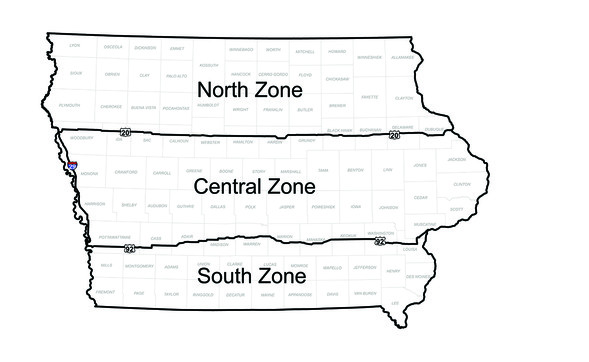 New waterfowl hunting zone boundaries have been implemented for the 2021 waterfowl hunting season and it is important that hunters carefully review the zone boundaries and season dates relative to their intended hunting location as the new boundaries may change which zone certain locations fall within. Graphic courtesy of the Iowa DNR.
Wetland conditions have improved ahead of the Oct. 2 opening day of Iowa’s duck season in the north zone. The most recent migration report shows an increase in the number of ducks that pushed in to Iowa, thanks to a classic September weather change.
“The migrating birds are just beginning to arrive and we’re seeing a modest increase in number of ducks across the state,” said Orrin Jones, state waterfowl biologist for the Iowa Department of Natural Resources. “Our molt migrating geese are also coming back so things are looking really good.”
Iowa offers hunters the opportunity to hunt in three different waterfowl hunting zones – north zone, central zone and south zone – and those zone boundaries are new this year.
“We made some significant changes to our zones so hunters will want to familiarize themselves with the new boundaries and then confirm the season dates for their hunting location,” Jones said.
Iowa’s duck hunters can expect to see good numbers of ducks this fall, but fewer young ducks will be part of the migration.
“Most of the breeding areas across the Continental US experienced a significant drought this spring and that resulted in fewer hatched birds. We also saw the lowest gosling production since 2013,” Jones said.
While the wetlands have improved since the teal season, Jones encourages hunters to scout to see the water conditions and duck use.
“We’re right in the changing of the season and with the new ducks arriving and the change in the wetlands condition, I would encourage the hunters to get out there and put eyes on it before the season begins,” he said.
Iowa Waterfowl seasons
North Zone
- Ducks, Mergansers, Coots: Oct. 2-8 and Oct. 16-Dec. 7
- Geese: Sept 25-Oct. 10; Oct. 16-Dec. 7; Dec. 11-Jan. 8, 2022
Central Zone
- Ducks, Mergansers, Coots: Oct. 9-15 and Oct. 23-Dec. 14
- Geese: Oct. 2-17; Oct. 23-Dec. 14; Dec. 18-Jan. 15, 2022
South Zone
- Ducks, Mergansers, Coots: Oct. 16-22 and Oct. 30-Dec. 21
- Geese: Oct. 9-24; Oct. 30-Dec. 21; Dec. 25-Jan. 22, 2022
New zone boundaries established for the 2021 season
New waterfowl hunting zone boundaries have been implemented for the 2021 waterfowl hunting season and it is important that hunters carefully review the zone boundaries and season dates relative to their intended hunting location. The new boundaries may change which zone certain locations fall within. For example, Green Island WMA in Jackson county was historically included in the North Zone, but will now be in the Central Zone. Season dates differ between zones.
For the fall 2021 through spring 2026 seasons, the North Zone is that part of Iowa north of a line beginning on the South Dakota-Iowa border at Interstate 29, southeast along Interstate 29 to State Highway 20 to the Iowa-Illinois border. The South Zone is that part of Iowa west of Interstate 29 and south of State Highway 92 east to the Iowa-Illinois border. The Central Zone is the remainder of the state.
DNR advising hunters to look for a change in HIP registration **Next Year**
Beginning Dec. 15, 2021, when the 2022 hunting licenses go on sale, all hunters who pursue migratory game birds will be required to register for HIP either through the Go Outdoors Iowa app on their smartphone, through a link at www.iowadnr.gov/waterfowl or at www.gooutdoorsiowa.com. Migratory game birds mean more than ducks and geese; in Iowa it includes ducks, geese, coots, doves, woodcock, rails, and snipe.
Once registered, hunters will need to write a confirmation number on their license, print an updated copy of their license with the confirmation or take a screenshot of their confirmation on their phone to show proof of registration. Requiring a confirmation number will allow the DNR to better track migratory bird hunters – a federal requirement.
The change was necessitated because registering through license vendors at the time of purchase has been inconsistent.
Media Contact: Orrin Jones, State Waterfowl Biologist, Iowa Department of Natural Resources, 641-357-3517.
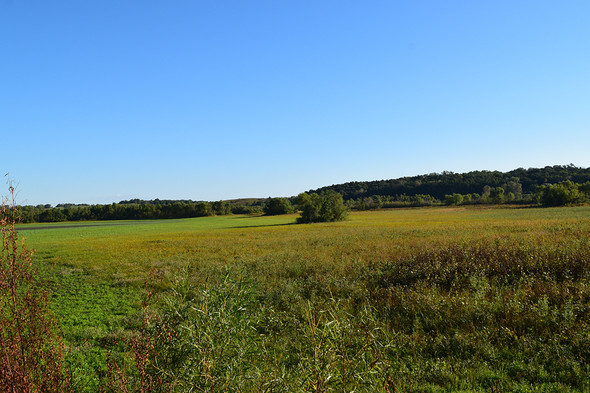 Hayesville Bend’s habitat diversity includes a nice sized wetland that has been manipulated to create different water depths and small islands to attract and support waterfowl, wetland and shoreland birds. Unfortunately, the drought that has impacted much of Iowa has also impacted Hayesville Bend. Photo courtesy of the Iowa DNR.
Delta, Iowa - Hayesville Bend Wildlife Area is a mix of upland, floodplain timber, wetland and upland timber, in an oddly shaped 540-acre public area, four miles south of Delta in southwest Keokuk County.
“From a purely wildlife angle, just look at the diversity,” said Jeff Glaw, wildlife biologist for the Iowa Department of Natural Resources (DNR). “Grassland birds, forest birds, migratory birds, all the butterflies, and reptiles and amphibians. There’s pheasants and quail here. It’s good for deer hunting and, in the right year, for duck hunting – there’s no where else you’d need to go. It’s a well-rounded area.”
The South Skunk River flows along and through the west and south side of Hayesville Bend and has a history of flooding the area.
Since the DNR acquired it in 1997, a lot of time and resources has gone in to repairing dike blowouts. After the 2010 flood, the DNR installed a 500-foot long rock spillway along the west side that allows floodwaters in and out of the large wetland while protecting the dike. A similar project was completed this spring on the south side. Both projects were funded by the Federal Emergency Management Agency.
The wetland basin has been manipulated to create different water depths and small islands to attract and support waterfowl, wetland and shoreland birds.
“It’s a pretty nice sized wetland, we just need rain to put water in it now,” Glaw said. “It’s a beautiful place to come walk the dike to bird watch. In the spring, I’ve seen snow geese cyclone in to the wetland from highway 21.”
Between the uplands, timber and wetland, the area supports more than 100 different bird species, either on migration or as residents, including Henslow’s sparrows, sharp shinned hawks, chimney swifts, pileated woodpeckers and bald eagles. It’s also home to nearly 40 species of butterflies, nearly 20 different amphibians and reptiles and at least 25 different species of dragonfly and damselfly species.
“We raise a lot of hooded mergansers here,” Glaw said. “This spring, I saw more merganser broods than wood duck broods.”
The north side of Hayesville Bend is more upland and upland timber, and is where hunters looking for wild turkey would set up. On the east side is a three-acre pond that offers decent fishing for panfish.
Standing on a ridge near the parking lot on the east side of the area, a mix of native big bluestem, goldenrod, Indian grass and rosinweed has come up through an idled hayfield.
“If you’re going to see Henslow’s sparrows, you’re going to see them here,” Glaw said. “It’s the habitat they prefer.”
These ridges also offer the best view of the area.
“This is one of the best vistas in my unit. You can see right down the Skunk River corridor,” he said.
After spending a day at Hayesville Bend, stop by Pigtail Charlie's Diner, in Hedrick, for its famous lunch special or prime rib dinner on Saturday nights.
Media Contact: Jeff Glaw, Wildlife Biologist, Iowa Department of Natural Resources, 641-799-0793.
Lansing, Iowa – Lansing Village Creek boat channel dredging scheduled to begin Sept. 15 has been delayed to Oct. 1, and is expected to continue through Nov. 1. The boat ramp will remain open, but space will be limited.
The navigation channel from the boat ramp to the main channel Mississippi River will be dredged hydraulically. Hydraulic dredge materials will be pumped into geo-fabric bags that will remain in place for drying on the northwest corner of the parking area. Once material is sufficiently dried, it will be hauled away at a later date. The channel beyond the railroad and highway bridges will be excavated and removed by barge.
Boaters will still have access to the middle and north ramps. Expect delays while equipment is in the area. The northwest corner of the parking lot will be closed to parking. Boaters are urged to use caution and follow signage to avoid active work zones. Work will occur Monday through Saturdays.
Boaters can avoid construction delays by using alternate ramps in Wisconsin at Big Slough and Winneshiek Slough across the Blackhawk Bridge.
Heytman's Landing on Pool 9 is still extremely shallow and is also planned for dredging at a later date.
Media Contact: Karen Osterkamp, Fisheries Biologist, Iowa Department of Natural Resources, 563-252-1156.
The Sny Magill boat ramp on Pool 10 of the Mississippi River is closed until Oct. 9 to repair the concrete under the railroad underpass.
Alternate boat ramps are available in nearby Clayton or Marquette.
Media Contacts: Karen Osterkamp, Fisheries Biologist, Iowa Department of Natural Resources, 563-252-1156 or Matt Tshirgi, Pikes Peak State Park Manager, 563-873-2341.
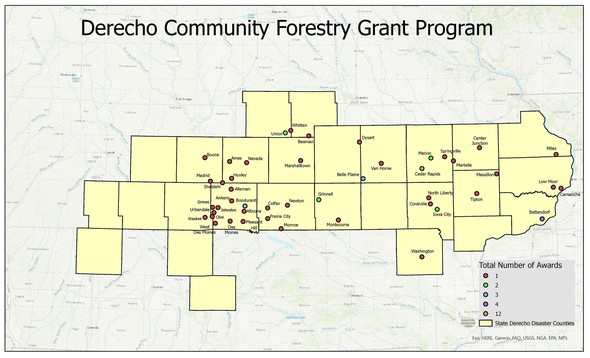 The Derecho Community Forestry Grant Program has awarded funds for 66 projects across the 27 counties included in the Governor’s Derecho Disaster Proclamation. Several communities have multiple tree planting projects. Graphic courtesy of the Iowa DNR.
The Derecho Community Forestry Grant Program has awarded funds for 66 projects across the 27 counties included in the Governor’s Derecho Disaster Proclamation. An estimated 2,484 trees will be planted in 19 counties hard-hit by the 2020 derecho.
The Iowa Legislature appropriated $250,000 of state infrastructure funds to the Iowa Department of Natural Resources (DNR) for the community-based tree-planting program to help recover from the derecho. All $250,000 available funds were awarded.
A USDA Forest Service study found that a large tree planted in the Midwest will provide $3,790 in environmental and other benefits over its lifetime. Trees pay us back through environmental, economic, and health benefits and so much more.
The Derecho Community Forestry Grant Program provides reimbursable grants ranging from $500 to $5,000 to be used to purchase and plant trees suitable to Iowa on publicly owned lands. Qualifying public planting lands include, but are not limited to, street right-of-ways, parks, school grounds, courthouse lawns, public buildings, fairgrounds, cemeteries, libraries and trails. Award recipients are required to provide a dollar-for-dollar cash match for purchase of trees and materials from Iowa businesses.
Media Contact: Gabriele Edwards, Urban Forestry Program Specialist, Iowa Department of Natural Resources, 515-822-1031.
The popular Trees for Kids grant program will be funding 15 projects to plant 239 landscape-sized trees on school grounds or other public places frequented by youth. An estimated 1,041 youth will be engaged with the outdoors through these projects.
The Trees for Kids grant awards up to $2,500 to purchase trees and mulch to be planted on public property. Youth are required to be engaged in the process, most often helping plant the trees on site.
A USDA Forest Service study found that a large tree planted in the Midwest will provide $3,790 in environmental and other benefits over its lifetime. Trees pay us back through environmental, economic, and health benefits and so much more.
The Trees for Kids grant program, funded 100 percent through donations, has been active for the past 31 years. Trees for Kids is a tree education and planting program for students of all ages across Iowa. Its mission is to promote the value of trees to Iowa’s youth by providing educational materials and opportunities for tree planting and tree care. Trees for Kids grants have assisted in planting more than 1.15 million landscape-sized trees and seedlings in communities across Iowa.
“We’re extremely thankful to the Trees for Kids sponsors for their decades of commitment to this program. Every penny that was donated was passed along to the communities through grants to organizations, schools, county conservation boards, and more to plant landscaped-sized trees on public property like at schools, in city parks, or on county areas,” said Jeff Goerndt, State Forester with the Iowa DNR. “It’s been popular with schools, communities and our partners.”
The Trees for Kids grant program faces an uncertain future after the program sponsors shifted their financial support to other priorities. Goerndt said they will explore new funding sources to continue the popular program.
Iowans who want to help, can send a contribution to the Iowa DNR with a note that the funds should go to the Trees for Kids program. Donations can be sent to Trees for Kids Program c/o Gabriele Edwards, Iowa Department of Natural Resources, 502 East Ninth Street, Des Moines, IA 50319-0034
“This is the primary forestry education piece we have at the DNR. It’s a high demand, high impact program that unfortunately has lost its financial support,”Goerndt said. “Donations are appreciated but without new and hopefully sustainable funding, the program will likely go away.”
Media Contact: Gabriele Edwards, Urban Forestry Program Specialist, Iowa Department of Natural Resources, 515-822-1031.
|





