|
FOR IMMEDIATE RELEASE
Sept. 21, 2021
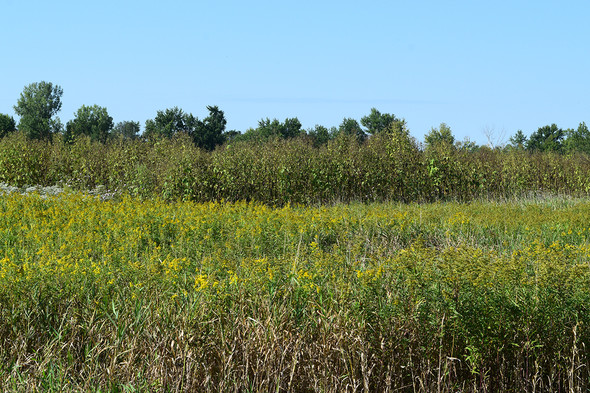 A stand of giant ragweed has temporarily replaced a field of reed canary grass on a section of the Iowa River Corridor. The Iowa Department of Natural Resources has a three-year battle plan to keep the unwanted, hip busting invasive plant at bay and provide benefits to the area’s pheasants, deer and wild turkeys. Photo courtesy of the Iowa DNR.
Born out of the historic flood of 1993, the Iowa River Corridor is a mix of federal and state public land, stretching from Marengo in the east, to west of Chelsea covering more than 15,100 acres of the Iowa River floodplain.
As a floodplain, there is a never-ending battle with moist soil loving plants, primarily reed canary grass, cottonwood, willows, little gray dogwoods and silver maples, all of which provide little, if any, benefits for wildlife.
As the parcels were acquired after the flood, the low-lying land was seeded to native plants, but overtime, was overtaken by reed canary grass. If left alone, reed canary grass would dominate the area, providing no food and minimal habitat benefits.
“It’s an exotic plant that was introduced as a low-cost way to prevent soil erosion, but it’s not a good plant to have in our wildlife areas as it is very invasive,” said Steve Woodruff, wildlife biologist with the Iowa Department of Natural Resources (DNR).
To make this ground attractive to wildlife, the staff at the Iowa River Wildlife Unit began a late summer project of bailing about 300 acres of reed canary grass and then spraying those areas to prevent it from returning.
The following spring, the hayed and sprayed areas would come up in giant ragweed that produces high quality seeds for food and provides important winter cover used by deer, turkey and pheasants. The next year the area will have some taller stems, but other native plants are mixed in creating more diversity and ground cover preferred by young pheasants. But canary grass begins to reappear and by the third year, it’s time again to cut it for hay, spray it and start the process over.
“We don’t get a lot of plant diversity because of all the wetness but we’ll take what we can get,” Woodruff said. “Anything beats canary grass.”
Each year, about one third of the reed canary grass is hayed and sprayed by a local cooperator from nearby Ladora who uses the hay in exchange for mowing and bailing the canary grass and mowing 25-30 miles of fire breaks needed for prescribed fire.
“He’s been a partner for more than a decade and knows the area and our management plan and has been a great guy to work with,” said Rodney Ellingson, wildlife technician with the Iowa DNR’s Otter Creek office. “This rotational practice opens up the area and provides a good place for young birds to feed on bugs.”
Ellingson said they work to turn every inch of canary grass into something better, and that includes drilling triticale into the sod on around 70 to 100 acres each year.
“Triticale suppresses canary grass. It grows quickly and in clean rows that benefits pheasant chicks because it’s good for nesting and brood rearing,” he said. “It’s another area that’s good for bugging.”
Other food and habitat used here that also battle canary grass is winter rye, turnips, sunflowers, crop leases and a three species mix of sorghum. The sorghum species – grain, forage and Sudan grass – vary in height and provide excellent cover and food for pheasants. Between 100-120 acres of the sorghum mix fields are planted around the corridor.
“We can sustain tougher winter conditions because we have food and cover, but our Achilles heel is flooding,” Ellingson said.
In that respect, 2021 has been good for the Iowa River Corridor.
Iowa River Corridor Bird Conservation Area
Stretching from Montour to Homestead, the Iowa River Corridor Bird Conservation Area includes forest, wetland, grassland, woodland and savanna habitats that support 80 percent of Iowa’s bird species of greatest conservation need.
Osprey frequent the area along with bald eagles, least bitterns, grasshopper sparrows, cerulean warblers, black-crowned and yellow-crowned night-herons, bobolinks, loggerhead shrikes, red-headed woodpeckers and more that rely on this area for nesting or migration. There is a heron rookery on the corridor. Sandhill cranes have nested in the area since 1992.
A variety of other wildlife species are provided for by the diversity of habitat, including ornate box turtles, Blanding’s turtles and regal fritillary butterflies.
Etcetera
- A dike system provides an excellent network for hiking certain sections of the corridor.
- The U.S. Fish and Wildlife Service has placed six kiosks up and down the corridor that identify the location, rules and regulations on the area.
- After spending the day on the Iowa River Corridor, the Lincoln Café in Belle Plaine is a good place to a burger, chicken sandwich and more.
- The corridor is steel shot only, except for deer and turkey.
Media Contact: Steve Woodruff, Wildlife Biologist, Iowa Department of Natural Resources, 319-330-7013.
DES MOINES - The Iowa Department of Natural Resources (DNR) is offering a program to teach skills needed to trap furbearers. The workshops feature several knowledge and skill building sessions teaching the basics of trapping in Iowa for those with little to no trapping experience.
Participants will learn basic strategies for trapping such as proper equipment, trap placement, trapping regulations and steps for preparing hides for trade.
“This program provides the opportunity to learn the skills and the knowledge it takes to learn the tradition of trapping as a means of sourcing fur,” said Jamie Cook, program coordinator with the Iowa DNR.
The courses take place in Ruthven on Oct. 10, and in St. Charles on Nov. 20. Each course is designed for participants 16 years of age and older. Space is limited, so early registration is encouraged.
For more information and to begin the registration process for the Oct. 10 workshop in Ruthven, visit: http://events.constantcontact.com/register/event?llr=dep4qyuab&oeidk=a07eikfqc3b1fd7dcac
For more information and to begin the registration process for the Nov. 20 workshop in St. Charles, visit: http://events.constantcontact.com/register/event?llr=dep4qyuab&oeidk=a07eikfrvfd03f426a5
The program is provided through a partnership with the Iowa DNR and Iowa Trapper Association. It is part of a national effort to recruit, retain and reactivate hunters, anglers and trappers due to the overall decline in hunting and outdoor recreation.
Media Contact: Jamie Cook, Iowa Department of Natural Resources, 515-350-8091.
|





