|
FOR IMMEDIATE RELEASE
Aug. 31, 2021
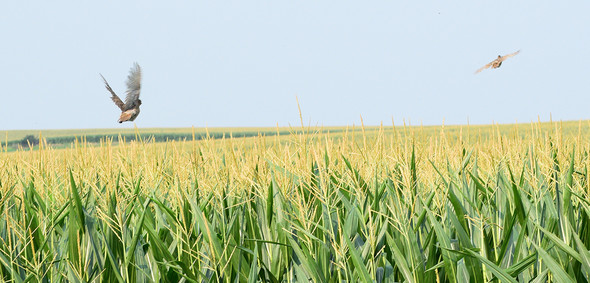 Results of Iowa’s 2021 pheasant population survey shows the impact that weather can have on the popular game birds. In the regions where less snow fell, the counts were better; where more snow and ice fell, the counts were worse.
Overall, the annual August roadside survey found Iowa’s statewide pheasant population to be essentially unchanged from 2020 at 20 birds per 30-mile route.
Within the survey, results showed three of the nine regions – northwest, north-central, west central – averaged at or more than 30 birds per route, which is the first time that has occurred since 2007, and the central region saw a 25 percent increase. The northeast and east central regions were about at their 10-year survey averages. The full report is available at www.iowadnr.gov/pheasantsurvey.
“Hunters can expect a good pheasant season for most of the state again this year, with the best hunting being north of I-80,” said Todd Bogenschutz, upland wildlife research biologist with the Iowa Department of Natural Resources.
Based on the results of the August roadside survey, Iowa hunters can expect to harvest 250,000 to 350,000 roosters again this year, which would match the second highest bird harvest in the past 12 years.
“Bird harvest relies heavily on the number of hunters in the field and last year, we saw an increase of 10,000 pheasant hunters over 2019 and that was reflected in our increased harvest,” Bogenschutz said. An estimated 62,000 hunters participated in 2020, the most since 2009.
“The birds are there, so the harvest totals will depend on how many hunters return,” he said.
While the pheasant count varied by region, the quail count was more consistent; unfortunately, it was consistently lower.
Last winter’s snow and ice across southern Iowa’s quail range led to the drop in the quail population.
“We’re at the northern fringe of the bobwhite quail range and when we have a winter with lots of snow and ice, the quail population is impacted,” Bogenschutz said. “Quail are still out there, but hunters are going to have to look for them.”
The higher counts came from southwest Iowa. Hunters should focus areas where there is a good mix of shrubs, ag fields and weedy cover.
Iowa’s partridge showed an upward trend in north central and northwest Iowa, but overall, the survey found the population to be essentially unchanged from 2020. Iowa’s rabbit population declined from 2020 but is still abundant with better counts coming from east central, southwest, south central and southeast regions.
The annual August roadside survey has been collecting data on Iowa’s upland game populations since 1962.
Hunters have the opportunity to hunt these species on additional acres of private land enrolled into the popular Iowa Habitat and Access Program (IHAP).
Enrollment in the program is at an all-time high of nearly 40,000 acres. The IHAP allows hunters access to the portion of the property covered by the agreement, from Sept. 1 to May 31. Conservation officers will provide assistance and enforcement, if needed.
Hunters who frequent land enrolled in the Conservation Reserve Program should be aware that the land was opened to haying as part of the drought protocol.
- Youth pheasant season is Oct. 23-24
- Pheasant season is Oct. 30-Jan. 10, 2022
- Quail season is Oct. 30-Jan. 31, 2022
- Rabbit season is Sept. 4-Feb. 28, 2022
- Partridge season is Oct. 9-Jan. 31, 2022
Media Contact: Todd Bogenschutz, Upland Wildlife Research Biologist, Iowa Department of Natural Resources, 515-979-0828.
Iowa streams are swollen and swift with consistent rainfall the past several days. Some rivers are already dangerously high, and more rivers could rise fast with chances of rain forecast this week.
“We encourage all paddlers, especially new and inexperienced paddlers, to stay on lakes and flat-water while the rivers are high due to heavy rain”, said Todd Robertson, paddling instructor and Outreach Coordinator for Rivers Programs at the Iowa DNR.
“Swollen rivers are super powerful and have unpredictable current along with tons of wood debris coming downstream to form deadly “strainers”, said Robertson. He said that even experienced paddlers should stay off of rain swollen rivers. “If you get into a situation where you are struggling and fighting the current, the river will win”, said Robertson.
Always know your rivers conditions before you go paddling. For the latest river conditions, contact Iowa DNR Customer Service at 515-725-8200 or your local county conservation board for updates.
Media Contact: Todd Robertson, Iowa DNR River Programs Outreach Coordinator, 515-243-3714.
The good news for Iowa’s cottontail rabbit hunters is that Iowa has an abundant rabbit population, with the southern and east central part of the state seeing the best overall numbers. The better news for hunters is Iowa’s cottontail rabbit season begins Sept. 4 statewide.
“It should be another good year for rabbit hunting not only for experienced hunters, but for young or novice hunters who can learn necessary skills with little competition,” said Todd Bogenschutz, upland wildlife research biologist for the Iowa Department of Natural Resources.
Last year, an estimated 16,000 hunters harvested more than 76,000 cottontail rabbits. The most popular way to hunt is with a shotgun walking brushy areas with grass next to crop fields in the morning or evening. It can be done individually or with a group of friends.
Rabbit hunting does not require a significant investment or high tech equipment, just a shotgun and some shells. Rabbit is a lean, low fat meat and popular table fare considered a delicacy in many culinary circles.
Cottontail rabbit season is Sept. 4 to Feb. 28, 2022. The daily limit is 10 rabbits with a possession limit of 20. Jackrabbit season is closed. While wearing blaze orange clothing is not required to hunt rabbits, it is recommended. Shooting hours for rabbits is sunrise to sunset.
Iowa’s cottontail rabbit population estimates are included in the recently completed August roadside survey of upland wildlife species at www.iowadnr.gov/pheasantsurvey.
Local squirrel populations are variable depending upon acorn production. In areas of lower annual acorn production look for patches of hickory trees as an excellent alternative.
Squirrel hunting is an inexpensive and exciting way to get introduced into hunting. Those new to hunting can gain valuable woodsmanship skills as squirrels will twist and turn hunters through the woodlands.
“One beauty of squirrel hunting is if you mess up and spook a squirrel there is usually another one just down the ridge, this provides lots of opportunities for success,” said Jim Coffey, forest wildlife biologist for the Iowa DNR. “Experienced hunters often say that they haven’t hunted squirrels since they were a kid. Well, this is the year to be a kid again. Get yourself outside chasing squirrels and bring someone new to hunting along. Squirrels are definitely an underutilized resource.”
Be prepared during early squirrel season for mosquitoes and other flying pests, Coffey said, and try and hunt in the early cool mornings as squirrels will be very active before the heat of the day.
Hunters will generally find plenty of squirrels and little competition. This would also be a good opportunity to do some scouting for a spring turkey hunt or to look for whitetail deer rubs before bow season.
“These honed skills will make you an overall better hunter. Many of the skills needed for squirrel hunting are also used for spring turkey hunting,” Coffey said.
Last year, nearly 13,000 squirrel hunters harvested approximately 76,000 squirrels.
Squirrel season is Sept. 4 to Jan. 31, 2022, with a daily bag limit of six total or combination of red fox squirrels or eastern grey squirrels and a possession limit of 12. Fox squirrels are generally found in more open pasture timber and woodlots whereas grey squirrels tend to be in more mature timber. There is no restriction on shooting hours.
Hunters looking for places to go rabbit or squirrel hunting should use Iowa’s online hunting atlas at www.iowadnr.gov/hunting, with more than 600,000 acres of public land that allows hunting.
Hunters have the opportunity to hunt these species on additional acres of private land enrolled into the popular Iowa Habitat and Access Program (IHAP).
Enrollment in the program is at an all-time high of nearly 40,000 acres. The IHAP allows hunters access to the portion of the property covered by the agreement, from Sept. 1 to May 31. Conservation officers will provide assistance and enforcement, if needed.
Media Contacts: Rabbits - Todd Bogenschutz, Upland Wildlife Research Biologist, Iowa Department of Natural Resources, 515-979-0828. Squirrels – Jim Coffey, Forest Wildlife Research Biologist, Iowa Department of Natural Resources, 641-774-2958.
Have the cattails in your pond taken over your favorite fishing spot or crowded you from one side of the dock or swimming area?
Late summer or early fall is the best time to kill cattails, Lotus lily and other emergent or floating-leaved plants that are on the pond’s edge or are above the water. Spraying certain herbicides this time of year will kill the whole plant, and it will not regrow next spring. There is little risk of depleting the oxygen in the pond with treating these plants; they die-back every year at this time and decompose slowly over the coming months.
Starting in late summer, these plants move food to their roots to survive the winter, making systemic herbicides most effective. The most common active ingredient to use is glyphosate (a few brand names with labels for aquatic use include Aqua Neat, Aqua Pro, Aquamaster, GlyphoMate 41, Pond Master, Rodeo, Shore Klear and Touchdown Pro). Find these at local hardware, farm supply or garden stores or try an online search for “aquatic glyphosate.”
A surfactant or spreader-sticker must be added to many of these herbicides to allow it to stick to the plant’s leaves. Read the label and check with your local or online retailer to select a surfactant that you can use in ponds. Spray the above-water part of the plant until just wet (not dripping) and follow instructions on the product label.
When you compare product brands, consider the amount of active ingredient, if a surfactant is needed, and size of the container. A product with a higher amount of active ingredient or one that does not need a surfactant added may provide a better value. The convenience of a ready-to-use (RTU) product that you do not have to mix or add a surfactant may outweigh price considerations.
Be careful to:
- Read and follow the product label for application instructions and precautions.
- Spray when calm, or when winds are low and out of a favorable direction to avoid accidentally spraying other plants valuable to landscaping. Increase the droplet size of the spray to reduce drift.
- Spray plants early in the day with full sunlight after the morning dew has dried to get the best results.
- Obey State law. Shoreline owners on public waters in Iowa may not use herbicides to control aquatic vegetation without a permit. Contact the Iowa DNR fisheries office near you for rules and instructions for removing aquatic plants from public waters.
Learn more about aquatic plants in ponds at www.iowadnr.gov/pondplants.
Media Contact: Darcy Cashatt, Fisheries Technician, Iowa Department of Natural Resources, darcy.cashatt@dnr.iowa.gov, 641-647-2406.
DES MOINES - The Iowa Department of Natural Resources (DNR) is partnering with Pass It On - Outdoor Mentors to expand the Shooting Sports Outreach pilot program begun in 2020.
Last year, Pass It On – Outdoor Mentors, with support from the Iowa DNR, organized 17 hunts in Iowa, engaging 72 high school and college athletes participating in the Scholastic Clay Target Program (SCTP), in spite of COVID and without having a coordinator on-the-ground. This year, Pass It On – Outdoor Mentors will be staffing a program coordinator position who will organize and plan hunting opportunities for SCTP student athletes across Iowa.
Modeled after the rapidly growing Kansas Shooting Sports Outreach Program, Pass It On – Outdoor Mentors expects to see the program in Iowa grow as fast or faster than the program in Kansas. The Kansas program grew from a pilot effort of eight hunts in 2018 to 89 hunts in 2019 and 189 hunts in 2020.
“We’re excited to see some of our shooting sports student athletes introduced to hunting. We are certain that this partnership will result in new lifelong hunters and conservationists,” said Jamie Cook, hunter education coordinator for the Iowa DNR.
In Iowa, about 4,000 student athletes participate in SCTP. This partnership will focus on giving these student athletes opportunities to hunt that they might not otherwise experience.
“Last year, our pilot program was very successful and I am extremely excited about our partnership with the Iowa DNR,” said Brittany French, Pass It On director of field operations. “Because of this partnership, thousands of youth hunters and volunteer mentors will take the field this hunting season and bridge the gap between target shooting and hunting.
“Our goals with this effort are to recruit new hunters by giving those who don’t currently hunt opportunities to pursue upland game, waterfowl, turkey and deer; retain current hunters by giving those youth trap shooters and their parents who are currently hunters the opportunity to engage in more hunting activities; and to reactivate parents and coaches who want to participate in these hunting activities. This model can be applied to numerous different cohorts in hopes to inspire others to have a passion for hunting and fishing,” French said.
To accomplish this, Pass It On – Outdoor Mentors and the Iowa DNR plan to partner with local conservation and nongovernmental organization and private landowners to provide access and volunteers and mentors who assist with the events. Pass It On – Outdoor Mentors has surveyed a cross-section of the high school SCTP participants to measure their current hunting avidity. Pre- and post-hunt surveys and follow-up surveys with be used to measure the impact of the program and to provide the data needed to adjust and improve the program going forward.
Media Contact: Jamie Cook, Iowa Department of Natural Resources, 515-350-8091.
An error during a routine update of the Iowa Hunting Regulations mistakenly posted the 2020-21 waterfowl season dates to the Iowa Department of Natural Resources website late last week. The issue has been corrected.
The 2021-22 Iowa waterfowl season dates are:
North Zone
- Youth Waterfowl Season: Sept. 25-26
- Ducks, Mergansers and Coots: Oct. 2-8, and Oct. 16-Dec. 7
- Dark Geese and Light Geese: Sept. 25-Oct. 10; Oct. 16-Dec. 7; Dec. 11-Jan. 8, 2022
Central Zone
- Youth Waterfowl Season: Oct. 2-3
- Ducks, Mergansers and Coots: Oct. 9-15, and Oct. 23-Dec. 14
- Dark Geese and Light Geese: Oct. 2-17; Oct. 23-Dec. 14; Dec. 18-Jan. 15, 2022
South Zone
- Youth Waterfowl Season: Oct. 9-10
- Ducks, Mergansers and Coots: Oct. 16-22, and Oct. 30-Dec. 21
- Dark Geese and Light Geese: Oct. 9-24; Oct. 30-Dec. 21; Dec. 25-Jan. 22, 2022
Correction Note: The correct dates for the Special September Canada Goose season (Urban Goose Zone) is Sept. 4-12.
|





