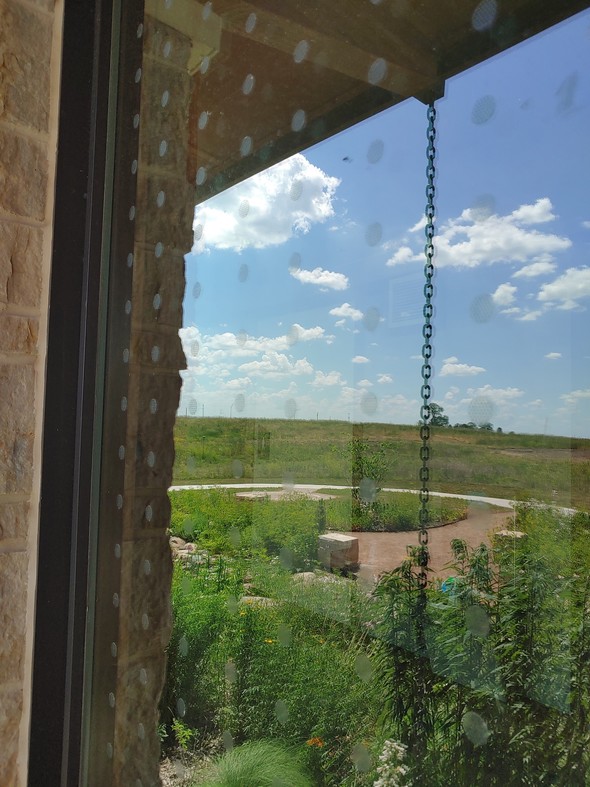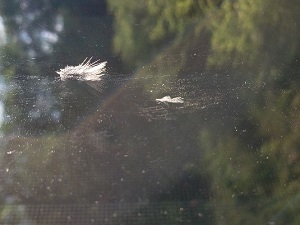
The other day I was working from my home office when I heard a thud. My heart sank as I jumped up to see what had hit the window. I searched the ground and the trees nearby and was glad to find no victim, but after closer inspection, the wing prints and a stray feather of a bird were still present on the window.
|
Collisions with windows are the second largest direct human-cause of mortality to North American birds, after outdoor and feral cats. Research has found that window collisions account for over 500 million bird deaths in North America each year, and occur at buildings of all sizes.
You may have seen pictures of large numbers of birds killed by skyscrapers during migration, but because there are so many low-rises and residences, these smaller buildings actually account for 99% of bird window collisions, with each residence killing an average of 2 birds per year. Although many birds fly away after a collision, it’s estimated that over 50% of collisions are fatal.
Just writing all of these statistics in one place is making me sad, but the good news is, bird window collisions are preventable, and everybody can play a role in reducing this threat to birds.

Windows are invisible to birds, and since birds are used to flying through tight spaces and around obstacles, window and door frames don’t alert them of the presence of a window. Additionally, windows often reflect their surroundings, including trees and sky, which makes a window look like habitat to a bird. In some cases, if birds are frightened or being chased by predators, they see the habitat reflected in a window as an escape route and end up striking the glass. Collisions are most likely to occur during spring and fall migration when birds are moving through in large numbers, but can occur any time of year.
|
1. Bird Feeder Placement
Bird feeders attract birds and in some cases, bring them closer to windows than they would be otherwise, which can put them at risk of collision. To reduce the likelihood of a window collision that is fatal to birds, bird feeders and baths should be placed either within 3 feet of the window, or more than 30 feet from the window. Close placement will reduce the speed and force of any collision that occurs, and farther placement will reduce the chances of running into the window in the first place.
2. Bird Safe Glass
There are a number of strategies that help make windows visible to birds and reduce their likelihood of collision. One strategy is to use bird safe glass, which utilized an ultraviolet pattern on the glass, which is visible to birds, but invisible to the human eye. Etched or patterned glass can also be used, but these are visible to humans and may impede their view. Although it is highly effective, purchasing bird safe glass can be costly and impractical at a large scale.
3. Window Treatments
Luckily, many other less expensive and reversible solutions exist. You may be familiar with the hawk decals people place on windows, these and other decals and stickers are intended to alert birds of the glass, but are only effective if they are dense enough that the birds can’t fly around them. Ultraviolet tape or patterned decals are another option that can be placed on the outside surface of windows. Even using tempera paint on windows can be an effective, fun, and attractive way to make birds aware of glass. Screens or netting placed on the outside of windows can help to make them more visible to birds and is a less dangerous surface to hit in the event that a bird does fly towards the window. Parachute cord curtains are also an aesthetically pleasing option.
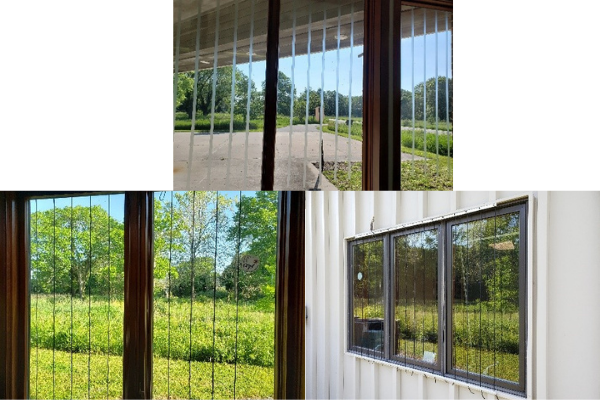 Parachute cord blinds or ultraviolet tape can be aesthetic solutions to bird window collisions. Top: UV tape added to the outside of a window Bottom right: cord added to the outside of a window. Bottom left: the view from inside the treated window.
Some general tips to make these deterrents most effective are to:
- Place window treatments on the outside of the windows when possible to make sure they are visible to birds.
- Make sure the spacing of decals, cord, or paint is close enough that birds won’t try to fly through the treatments.
- Use vertical patterns that are at least ¼ inch wide and 4 inches apart, and or
- Horizontal patterns that are at least ¼ inch wide and 2 inches apart
- Use bright or light colors, because dark colors can be hard for the birds to see if the window reflects dark colors.
- Try several options and see which is most effective at deterring birds in your situation, and which you prefer visually.
Click the button below to learn more about this issue from the U.S. Fish and Wildlife Service:
|