|
FOR IMMEDIATE RELEASE
Aug. 24, 2021
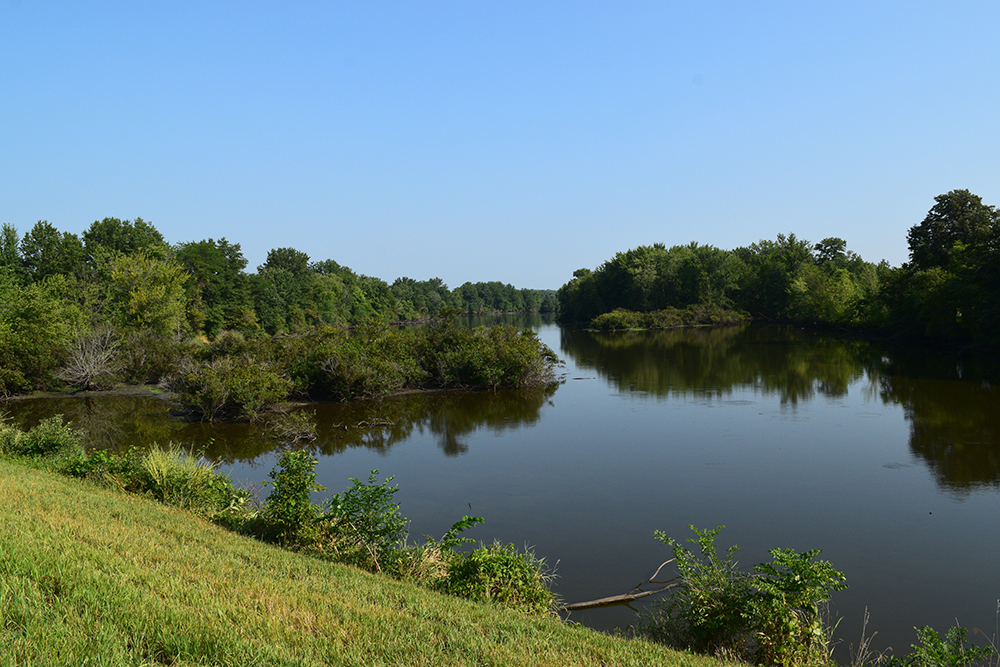 A maintained levy provides access deep into Wapello Bottoms Wildlife Area, where people can enjoy a hike, view a dark sky, fish the large oxbow, or chase a leery late-season rooster. Photo courtesy of the Iowa DNR.
Sometimes, it seems when the stars are aligned, big things can happen. In this case, repeated flood events on the Iowa River in the early 2000s culminating with the flood of 2008 was the thing that allowed farmers who were tired of battling wet farmland to unload that headache and create a 2,800-acre public area.
Wapello Bottoms Wildlife Area is a relatively new area growing from the wet soils of the Iowa River floodplain, in Louisa County. It’s the result of a partnership between the Natural Resources Conservation Service (NRCS), the Iowa Natural Heritage Foundation, the Iowa Department of Natural Resources (DNR), and the wet farmland weary landowners.
Twisting and turning along the Iowa River starting from just northeast of the town of Wapello, Wapello Bottoms stretches downstream, nearly reaching Horseshoe Bend National Wildlife Refuge. It’s a mixture of sloughs, prairie, floodplain timber and the Iowa River.
“This is one area that you could hunt or fish for almost anything,” said Andy Robbins, wildlife biologist with the Iowa DNR. “And the further you’re willing to walk, the more solitary experience you’ll find.”
Often overlooked for deer, the area does offer excellent deer hunting and is frequented by nonresident pheasant hunters coming from the east who stop to hunt the prairie before heading to their final destination.
“It’s made a really nice recreation area for people to enjoy,” he said, while watching a kayaker explore the slough at a relaxed pace on this mid-August morning.
Just south of the boat ramp on the west side of the gravel road is a sunflower field that has been frequented by the local deer herd. A maintained levy is visible and following it north, it winds along with the Iowa River. All the road noise and machinery sounds disappear. There are no powerlines in sight.
“You’re away from everything back here,” he said. The levy offers a nice place to hike, view a dark sky, fish the large oxbow, or chase a leery late-season rooster. The oxbow water ripples as turtles nervously abandon their basking logs and retreat into the safety of the water.
Wapello Bottoms, with its southeast Iowa location and river floodplain habitat, has been the location of regular turtle surveys since 2010.
Chad Dolan, fisheries biologist at the DNR’s Lake Darling office, has been setting nets here to catch and study turtles about four times each year. What he’s found is, that Wapello Bottoms is dominated by red-eared sliders, a turtle species more associated with the south. He’s also found painted turtles, snapping turtles and several species of map turtles, including the less common ouachita map turtle.
“Wapello Bottoms is a turtle rich area,” Dolan said.
Since regulations were placed on the commercial turtle harvest in 2017, Dolan has seen less fluctuation in the numbers in the survey, but has seen a reduction in the number of snapping turtles and softshell turtles over time.
East of the large oxbow, the former pasture ground is now a prairie and along its old fence line, partridge pea’s delicate little yellow flowers are in bloom. Cord grass, cup plant, sideoats grama, big bluestem and golden rod are all visible. The prairie changes colors during the year and right now the yellow flowers are expressing. The asters will be next. This prairie is home to various grassland birds, pheasants and deer.
The drought has lowered the water levels in the sloughs exposing shorelines where button bush is sprouting and other moist soil vegetation is taking hold. “Fluctuation in water level is a good thing,” Robbins said. A pair of wood ducks retreat a short distance into the safety of a small finger off the main slough. Roughly 40 percent of Wapello Bottoms is water which makes it attractive to wetland birds.
This locally known, low-key area is starting to be noticed by people outside the region.
“This place wouldn’t exist without the NRCS and their relationship with the previous landowners, along with the opportunities presented by the USDA wetland reserve program. Without that, it wouldn’t have happened,” Robbins said. “The Iowa Natural Heritage Foundation has also been integral in piecing it together. And what we have is just a really diverse area where you can find just about any species we have in Iowa.”
Mushrooms
“The number of morel mushroom hunters down here is amazing – almost like it’s opening day of a hunting season,” Robbins said. “There are times when there’s more use when the morels are in season that during hunting season.”
Media Contact: Andy Robbins, Wildlife Biologist, Iowa Department of Natural Resources, 319-551-8459.
Parkersburg, Iowa - With much of Iowa currently under drought conditions, many shallow lakes and wetlands will either be dry or nearly dry, making scouting an important part of hunter’s preparation ahead of the 2021 waterfowl season.
The issue is most pronounced at Big Marsh Wildlife Area, near Parkersburg, that relies on the West Fork of the Cedar River to provide water for its expansive network of wetlands.
“Our permit requires us to maintain a minimum of 64 cubic feet per second flow in the river and last Sunday, it had dropped to 59 CFS,” said Jason Auel, wildlife biologist with the Iowa Department of Natural Resources. “That basically means we can’t take any water from the river.”
The rain that recently passed through northern Iowa provided a temporary bump in the river level but unless rain begins to fall consistently in the watershed, Big Marsh will struggle to fill this year.
“Under normal circumstances, it takes us up to two weeks to fill the marsh. The river reached 100 cubic feet per second from the recent storm and at that level, it will take about six weeks,” Auel said. “We’ll take as much rain as we can, but hunters shouldn’t expect normal water conditions in there anytime soon.”
Roughly 30 miles to the east, Sweet Marsh Wildlife Area, near Tripoli, is close to typical water level for teal season.
“My advice is to get out and scout as most areas are dry with a few exceptions being the larger or deeper wetlands,” he said. “What we need is a couple of inches of rain each week for a month.”
In southwest Iowa, the pumps have been running at Riverton Wildlife Area, near Sidney, as soon as it was allowed, but because of the drought, it will take time for water to reach the main boat ramp.
“There should be water in the channel in the Jensen Tract. Smaller boats with mud motors should be able to operate at least in the channels on the north end, but larger boats with outboard motors will probably have trouble getting around,” said Matt Dollison, wildlife biologist with the Iowa DNR in southwest Iowa. “For the early season, the main marsh will have water for birds and be better for walk in hunting.”
As for the other areas in his district, Dollison said many of the other marshes are completely dry, but there is a little water in the deepest portions of the wetland excavations along the Missouri River. “We’re in a drought and when we’re in a drought, scouting becomes important,” he said.
At Goose Lake Wildlife Area, in Clinton County, the drought conditions combined with a construction project means hunters who use the north pool to hunt ducks will probably need to change their location.
The project to replace the dam at Goose Lake is behind schedule and the north pool is mostly dry, said Curt Kemmerer, wildlife biologist with the DNR covering Iowa’s east central region.
“The center pool, which is the smallest pool, will have boatable water and the south pool will have water as usual, but it is walk in hunting,” Kemmerer said.
The drought has impacted Muskrat Slough, in Jones County, that underwent an annual drawdown to revegetate the popular natural marsh. But once the boards were in place to begin holding water, the rains haven’t come.
“One to two big rains could change that,” Kemmerer said. “But it’s likely walk-in hunting unless the rains come. It’s a Mother Nature thing.”
He said the Green Island and Princeton areas have good vegetation and duck food and should be fine unless something happens to the pumps. They will begin pumping water to those areas by the end of August.
In central Iowa, Todd Gosselink, wildlife biologist with the Iowa DNR said the options in his area has been limited by the drought. “We can’t pump at Hartford Marsh is the water being released from the Red Rock dam is at the minimum outflow.”
He said the options for hunters include the Boxcars at the delta, where the Des Moines River meets Lake Red Rock, but the area is so shallow that only kayaks or mud motors can get to the mudflats where teal are feeding on invertebrates. Access will also be difficult to get to the oxbows at Chichaqua, he said.
“The Runnels Marsh has water, but it’s not reaching the vegetation,” Gosselink said. “It’s walk-in hunting and has had good hunting in the past. Other than that, we’re pretty dry.”
The only area not suffering from severe drought is southern Iowa from Lake Rathbun east to the Mississippi River.
“Each impoundment varies in water level. The majority of our wetlands are either half or two thirds full, but hunters will need to put in some time scouting to find huntable water,” said Heath Van Waus, wildlife biologist with the Iowa DNR covering Iowa’s south-central region. “It’s probably not enough water for the big boats but small boats with mud motors, canoes, kayaks can get in to the areas.”
The Iowa DNR posts a report on wetland habitat conditions to its website at https://www.iowadnr.gov/Hunting/Migratory-Game-Birds. The first report will be posted on Aug. 27.
|





