|
FOR IMMEDIATE RELEASE
Aug. 17, 2021
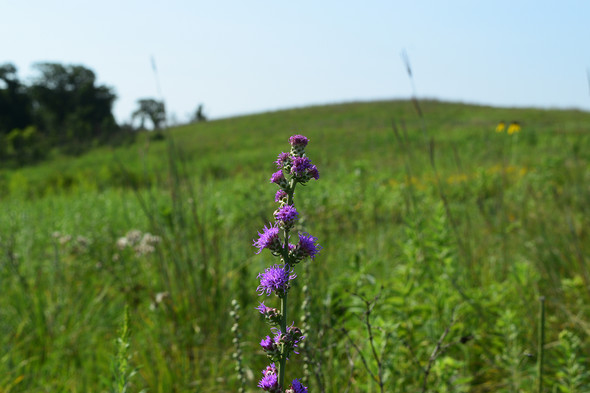 Rough blazing star is in bloom at Anderson Prairie State Preserve, in Emmet County. The native prairie flower is important for pollinators and sought out by monarchs during the late summer. Photo courtesy of the Iowa DNR.
At roughly 200 acres, Anderson Prairie State Preserve is one of the largest remnant prairies in Iowa and with more than 220 different plant species it is one of the most diverse places in the state.
The state preserve is part of Anderson Prairie Wildlife Area, covering 900 acres of upland, timber, oak savanna, bottomland, remnant and restored prairie sitting in northwest Emmet County.
“Anderson Prairie is a very unique place because of its diversity of habitat,” said Rob Patterson, wildlife biologist for the Iowa Department of Natural Resources Prairie Lakes Wildlife Unit that is responsible for managing the area.
With a portion of the 200-acre preserve never having seen a plow, it serves as a window into Iowa’s past. “This is what Iowa once looked like,” Patterson said while standing in the prairie emerging from this year’s late spring prescribed fire.
Keeping the rarest landscape in the state looking this way requires hands-on management. The preserve is divided into eight burn units and fire is used on at least one unit each year during the late spring to keep the diverse prairie plant species from being overtaken by brome grass. By burning late, it gives the prairie a chance to come through.
Walking through the preserve on this August morning, its uniqueness begins to show. Silverleaf scurf-pea, a species only found on remnant prairies, is visible, along with the just-starting-to-bloom rough blazing star, an important native prairie flower for pollinators and sought out by monarchs.
Patterson points out showy tick trefoil, purple coneflower, white wild indigo, thimbleweed, and the less common green milkweed. Anderson Preserve is also home to the federally threatened western prairie fringed orchid and prairie bush clover. These prairie flowers are important to regal fritillaries, a butterfly species of special concern that has been found here.
Anderson Prairie also serves as an outdoor classroom, having hosted students from Iowa Lakes Community College for years and currently provides hands on experience for two Environmental Studies 1 labs.
The first lab has students stretching 10 meter transects on bottomland, midslope, and ridge habitats to identify prairie plant species in each area and then extrapolate the data across the entire tract for estimating populations.
Students later visit during a bird niche lab where they observe grassland bird species and record them for understanding bird adaptations and diets related to the environments where they were encountered.
The high-quality prairie and oak savanna is home to clay colored sparrows, American bittern, redheaded and pileated woodpeckers and nine species of warblers. Pheasants, partridge and turkeys call it home. Short-eared owls use the preserve. Upland sandpipers nested here and northern harriers may be nesting here too.
“The diversity in habitat supports diversity in opportunity out here, too,” Patterson said.
Hunting, hiking, birding, snowshoeing, cross-country skiing, and paddling and fishing on the West Fork of the Des Moines River, which flows through Anderson Prairie.
The popular county managed canoe access to the north provides river access where paddlers can experience the area from the view of the river. It’s an easy float from the access to the city park on Hwy. 9 in Estherville. This stretch of the river is known to offer good fishing for walleyes and channel catfish.
Media Contact: Rob Patterson, Wildlife Biologist, Iowa Department of Natural Resources, 712-837-4850.
Iowa’s sunflower and wheat fields will be popular places on Sept. 1, when thousands of hunters slip into the standing flowers and field edges in the early morning darkness for the opening day of dove hunting season.
Fast paced and fun, dove hunting can be done by nearly everyone regardless of skill level or mobility. It doesn’t require expensive equipment to participate, only clothes that blend in to the background, a bucket and plenty of shells. There’s a lot of action with a steady stream of doves coming in.
The Iowa Department of Natural Resources (DNR) includes a list of wildlife areas at www.iowadnr.gov/doves where dove plots were planted and identifies the access point nearest the plot. Hunters are encouraged to do some preseason scouting to see if the sunflower planting was successful or was damaged from the summer hail storms and to see which areas the doves are using.
“It really comes down to getting out there and looking at the area to check the condition of the dove field, then scout it a day or two ahead of the season to see if and how the doves are using it,” said Todd Bogenschutz, upland wildlife research biologist with the Iowa DNR. “Doves are starting to show up in larger numbers. Success will depend on how many remain here on opening day and that depends on how many cold nights we have between now and the opener.”
Hunters looking for Plan B may want to focus on private land silage or hay fields, or where farmers harvested small grain fields, grazed pastures or feedlots.
Dove plots are getting increasing busy on opening day and hunters are encouraged to be courteous to one another, to pick up their spent shell casings and other trash and leave the field in good condition. Dove hunting is a good opportunity to introduce someone new to the sport because there is often a lot action.
Dove season is Sept. 1-Nov. 29. Shooting hours are one half hour before sunrise to sunset. Daily bag limit is 15 (mourning or Eurasian collared) with a possession limit of 30.
Hunters are reminded that their gun must be plugged to hold no more than three shells. If hunting public areas north of I-80, hunters should check to see if nontoxic shot is required. The Iowa online Hunting Atlas at https://www.iowadnr.gov/Hunting/Places-to-Hunt-Shoot identifies all county, state and federal land open to hunting, zone information and nontoxic shot requirements.
All dove hunters are required to register with the Harvest Information Program (HIP). It’s free, fast and the information is used to help determine participation and harvest. Register by following the instructions at www.iowadnr.gov/doves or by calling 1-855-242-3683.
DNR advising hunters to look for a change in HIP registration **Next Year**
Beginning Dec. 15, 2021, when the 2022 hunting licenses go on sale, all hunters who pursue migratory game birds will be required to register for HIP either through the Go Outdoors Iowa app on their smartphone, through a link at www.iowadnr.gov/waterfowl or at www.gooutdoorsiowa.com. Migratory game birds mean more than ducks and geese; in Iowa; it includes ducks, geese, coots, doves, woodcock, rails, and snipe.
Once registered, hunters will need to write a confirmation number on their license, print an updated copy of their license with the confirmation or take a screenshot of their confirmation on their phone to show proof of registration. Requiring a confirmation number will allow the DNR to better track migratory bird hunters – a federal requirement.
The change was necessitated because registering through license vendors at the time of purchase has been inconsistent.
Nontoxic dove loads hard to come by
While shotgun shell manufacturers are ramping up their production of nontoxic shotgun shells, supplies of #6 steel shot commonly used for mourning dove hunting is not as conveniently available as in the past. Hunters are encouraged to not wait until the last minute if in need of this size of steel shot. This is not an Iowa or Midwest issue but is part of a national shortage.
Media Contact: Todd Bogenschutz, Upland Wildlife Research Biologist, Iowa Department of Natural Resources, 515-979-0828.
Iowa’s 16-day teal only hunting season begins statewide Sept. 1, offering hunters an opportunity to enjoy Iowa’s wetlands and shallow lakes during the mild late summer weather.
The U.S. Fish and Wildlife Service makes the September teal season available when the teal population is above certain levels. It offers hunters 16 bonus hunting days and does not take any days away from the regular duck hunting seasons.
“The teal season is a good opportunity to introduce young or novice hunters to duck hunting because these birds will fly all day and decoy fairly well,” said Orrin Jones, state waterfowl biologist with the Iowa Department of Natural Resources.
Teal will be moving in to Iowa in mid to late August and bird numbers can improve overnight with the change in weather up north.
Teal favor mudflats and shallow water so the current dry conditions across central and northern Iowa will likely be less impactful for teal and teal hunting than other species of waterfowl, which means hunters looking for ducks may want to key on the teal season.
“The drought can produce mixed effects – there are fewer places to hunt because the temporary wetlands are dry and other wetlands are drying up. Shallow lakes have exposed mudflats which teal desire. The result is ducks and hunters will be concentrated on fewer areas,” Jones said.
“Hunting success often depends on the weather,” he said. “In years when we have active weather patterns, multiple cold fronts with northwest wind, we have good teal hunting, and with as dry as it’s been, I’d be sure to scout the wetlands I’m planning to hunt to see if it has water and is holding birds.”
Since this season is only open for teal, it is important that hunters properly identify their target to avoid shooting other species. “Hunters need to take that into account when planning their hunt,” Jones said. “Keep the sun at your back – it’s much more difficult to identify ducks when looking into the sun.”
Legal shooting hours begin at sunrise, which is different from the regular duck season. Hunters are required to have the state migratory game bird fee and federal duck stamp, in addition to their hunting license and habitat fee.
DNR advising hunters to look for a change in HIP registration **Next Year**
Beginning Dec. 15, 2021, when the 2022 hunting licenses go on sale, all hunters who pursue migratory game birds will be required to register for HIP either through the Go Outdoors Iowa app on their smartphone, through a link at www.iowadnr.gov/waterfowl or at www.gooutdoorsiowa.com. Migratory game birds mean more than ducks and geese; in Iowa; it includes ducks, geese, coots, doves, woodcock, rails, and snipe.
Once registered, hunters will need to write a confirmation number on their license, print an updated copy of their license with the confirmation or take a screenshot of their confirmation on their phone to show proof of registration. Requiring a confirmation number will allow the DNR to better track migratory bird hunters – a federal requirement.
The change was necessitated because registering through license vendors at the time of purchase has been inconsistent.
Nontoxic teal loads hard to come by
While shotgun shell manufacturers are ramping up their production of nontoxic shotgun shells, supplies of #6 steel shot commonly used for teal hunting is not as conveniently available as in the past. Hunters are encouraged to not wait until the last minute if in need of this size of steel shot. This is not an Iowa or Midwest issue but is part of a national shortage.
Media Contact: Orrin Jones, State Waterfowl Biologist, Iowa Department of Natural Resources, 641-231-1957.
DES MOINES – The popular Trees for Kids grant program is accepting applications through Sept. 17.
Grants up to $2,500 are available to cover the cost of trees and mulch. All trees for this program must be planted on public property and involve youth education. To apply for the grant, go to https://www.iowadnr.gov/Conservation/Forestry/Educational-Opportunities.
Applications are welcome from across the state and grants will be awarded statewide, but the following counties align with federal grant requirements and will receive first preference: Pottawattamie, Cass, Mills, Montgomery, Fremont, and Page.
Media Contact: Gabriele Edwards, Urban Forestry Program Specialist, Iowa Department of Natural Resources, 515-822-1031 or gabriele.edwards@dnr.iowa.gov
DES MOINES - The Iowa Department of Natural Resources (DNR) is offering a virtual program to that allows participants to ask questions from statewide experts and waterfowl hunting enthusiasts.
The Sept. 2 virtual workshop will feature sessions with DNR staff, waterfowl experts and hunters.
“For those interested in the challenge of waterfowl hunting, this virtual meeting is your chance to ask others about what it takes to become a better waterfowl hunter,” said Jamie Cook, program coordinator with the Iowa DNR.
Participants will learn basic strategies for hunting waterfowl such as proper equipment, where to hunt, safe shooting practices, and how to field dress, butcher and cook them. They’ll also have the chance to ask questions to the panel of experts.
The course runs from 6 to 7:30 p.m. and is designed for participants 16 years of age and older. For more information and to begin the registration process, go to https://license.gooutdoorsiowa.com/Event/ViewEvent.aspx?id=1958
Participants will receive a Zoom link on Sept. 2, prior to the event.
The program is provided through a partnership with the Iowa DNR and Delta Waterfowl. It is part of a national effort to recruit, retain and reactivate hunters due to the overall decline in hunting and outdoor recreation.
Media Contact: Jamie Cook, Iowa Department of Natural Resources, 515-350-8091.
|





