|
In fact, our native species of thistles are important for supporting many of our native insects and birds!
Did you know… That Iowa has six species of Native thistle within the genus Cirsium?
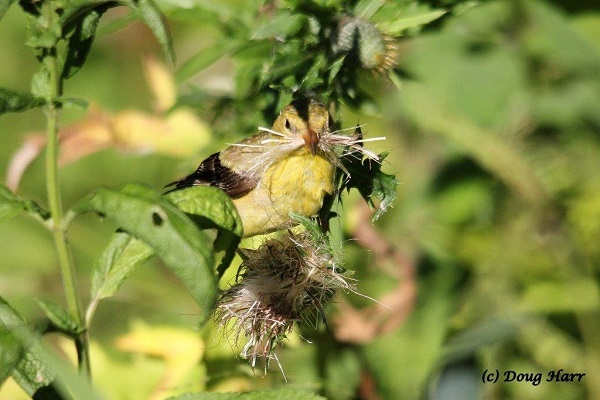
Did you know… That Iowa’s state bird, the American Goldfinch, times their nesting season to coincide with our native thistle plants going to seed?
Did you know… That Iowa’s native thistles are no longer classified as a weed that must be controlled under Iowa law?
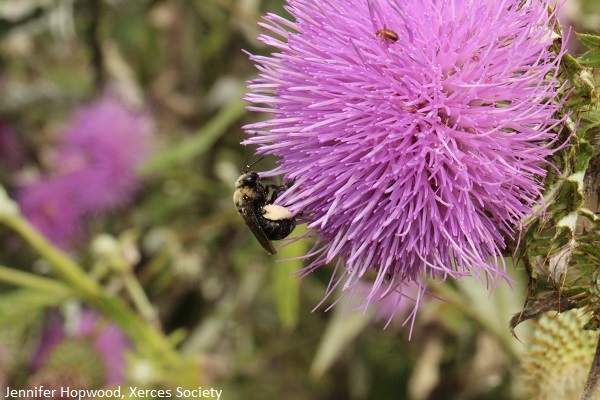
The thistle long-horned bee (Melissodes desponsa) relies on thistle pollen to feed her young.
In the past, “thistles” were viewed with dread by Iowa landowners for having the dubious honor of appearing on the list of Iowa’s noxious weeds, which required landowners to control them when they were found on the property. In fact, non-native species such as Canada, Musk and Bull thistle are invasive and can spread aggressively if left unchecked. What many people may not realize is that Iowa’s six species of native thistle are a natural part of Iowa’s ecosystems and do not spread aggressively nor degrade our natural areas.
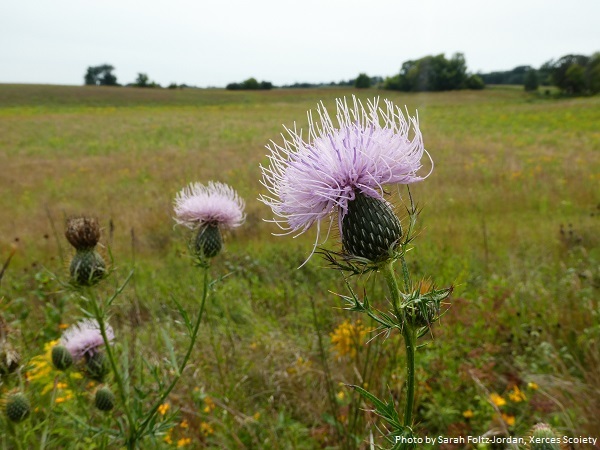 IN JANUARY 2019, Iowa’s noxious weed law was reviewed and modified (under the Chapter 58 Noxious Weed amendment) so that while Canada, Bull and Musk thistle are still considered Class B Noxious Weeds for Control and require management of populations, Iowa’s native thistles are no longer on this list. Removing native thistles as Class B noxious weeds was a positive change for Iowa’s natural communities, but it may cause some confusion to many Iowans. What’s the big deal about this change?
The big deal is that our native thistles are one of the all-star players in our prairies, wetlands and open areas. Thistle flowers contain large amounts of pollen and nectar, making them one of the most sought-after plants by pollinators. As someone who has spent 20 years wandering around prairies, wetlands and old fields looking for butterflies and bumble bees, I learned quickly that as soon as the thistle started to bloom that’s where I wanted to focus my attention. The bright lavender flowers are magnets to nectar seekers and are an incredibly valuable floral resource for these important insects.
And our native thistle’s contribution doesn’t stop there. Have you ever bought thistle (also known as Nyjer) seed for your finch feeder? Many of our native birds rely on the seeds of thistles for nutrients. Our state bird, the American Goldfinch, not only eats the seeds but also lines their nest with the thistle “fluff”. Pay attention to a thistle plant in August and you will often see it visited by cheery yellow goldfinches.
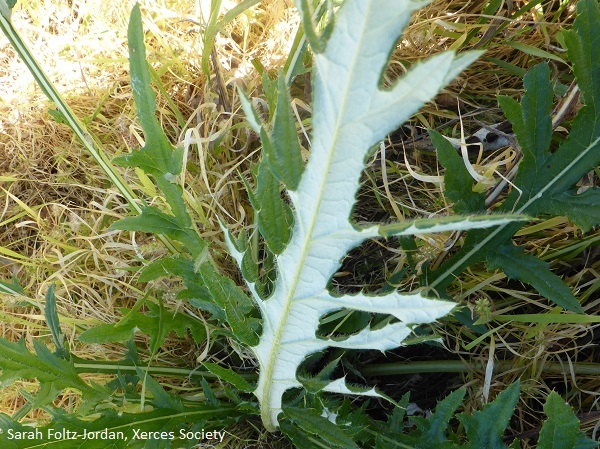
Maybe this account of their usefulness has started to convince you that not all thistles deserve to be eradicated on sight, but how can you distinguish between the non-native invasive thistles and our native species? Good question! A new brochure about Iowa’s Native Thistles has the answers. Produced by the Xerces Society, the brochure goes into detail about the six native species of thistle as well as the three most problematic non-native species. For a quick and dirty way to tell them apart, look at the underside of the leaf. Nearly all of Iowa’s native thistles are wooly and whitish on the underside of the leaf with the exception of Hill’s thistle (Cirsium pumilum var hillii). Nonnative thistles will not be bright white on the underside of the leaf, although Canada thistle (Cirsium arvense) has a pale whitish film.
The underside of a native field thistle leaf
Canada and Bull thistle as well as all thistles in the genus Carduus (Musk Thistle) are listed as Class B noxious weeds and do require control. The key to controlling nonnative thistles is to prevent seed production by not allowing flowers to go to seed. Multiple management tools (e.g., mowing and spot spraying) may be necessary for control and must be timed appropriately to be most effective. In some cases, control efforts may take multiple seasons to result in a reduction or elimination of nonnative thistles.
Hopefully, this information can help you start to appreciate the native species within the genus Cirsium and maybe even consider planting some in your home garden or prairie restoration. For years, when providing programming on how to create a wildlife friendly landscape, I would whisper hesitantly to participants that they might consider including some native thistles in their landscape. I appreciate that I can now recommend these valuable plants whole-heartedly and without reservation. The pollinators and goldfinches will thank you!
|