|
FOR IMMEDIATE RELEASE
July 28, 2021
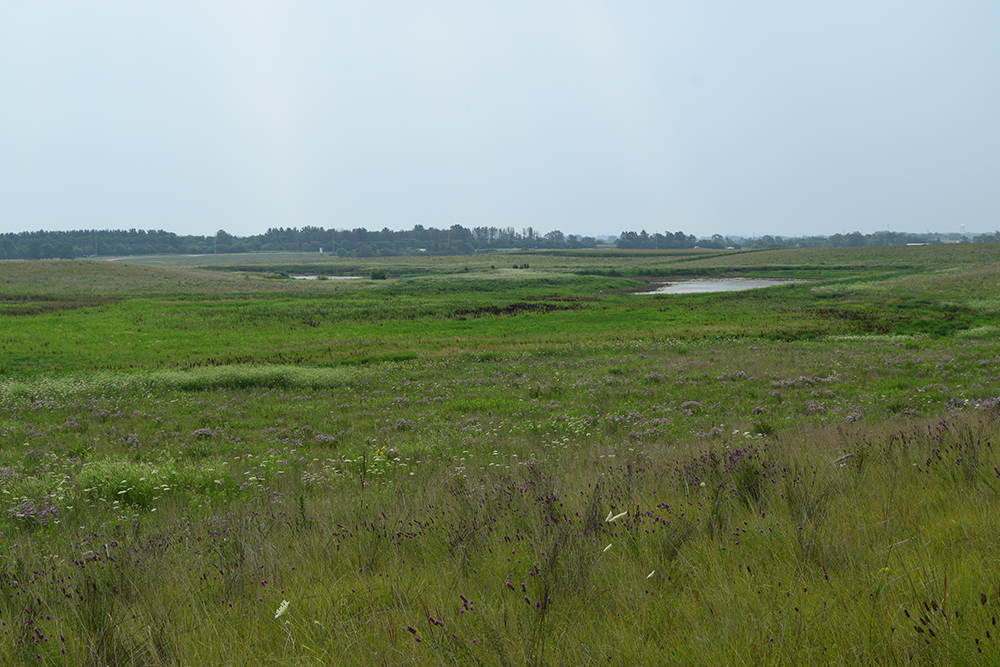 Looking east over the mix of prairie and restored wetlands, the Garlock Slough Wetland Complex filters 11 percent of the watershed for West Okoboji Lake and provides recreation to the birding community, hunters, wildlife watchers and hikers. Photo courtesy of the Iowa DNR.
Milford, Iowa - Garlock Slough Wetland Complex, on the southwest side of West Okoboji Lake, is a 900-acre mix of native remnant prairie, restored prairie, natural marsh and reconstructed wetlands protecting Iowa’s most valuable lake.
It filters 11 percent of the watershed through its 41 wetlands that make up 246 acres of the complex. In addition to water quality benefits, the area reduces soil erosion with restored prairie and shortgrass eskers on the ridges.
“It’s better for the lake, it’s better for wildlife – for the grassland birds, wetland birds - and it’s better for the overall area’s quality of life – for watching wildlife, for hunting, swimming, fishing,” said Chris LaRue, wildlife biologist for the Iowa Department of Natural Resources (DNR). “This is a perfect example of a water quality project coming together over time.”
The complex has expanded over the past 20 years and has resulted in improved water quality in Emerson Bay. A DNR and Ducks Unlimited water quality enhancement project likely set for 2022 will build on those benefits.
Contractors will add a concrete pad and small portable sump pump to the northwest corner of the 77-acre Garlock Slough that will allow the DNR to periodically lower the water level of Garlock Slough to enhance aquatic vegetation and to control rough fish populations.
The water will move west to a seven-acre wetland via low flow pumping then filter back into West Okoboji Lake through the canal that borders Emerson Bay State Recreation Area. A rough fish barrier will be added to prevent carp from entering the slough to spawn.
The project is estimated to cost around $300,000 and will result in improved aquatic vegetation for long-term water quality and habitat benefits.
The areas current mix of quality wetlands and prairie support two nesting pairs of trumpeter swans and is home to some of Iowa’s threatened or endangered species, including Poweshiek skipper, white lady’s-slipper, rattle milk vetch, Dion skipper, fries pondweed and water starwort.
Standing on a ridge on the west end looking east over the prairie, the wild bergamot is in bloom, and pale purple coneflower, compass plant, rattlesnake master and blazing star all stand out. Pheasants can be heard crowing.
“It’s a heck of a waterfowl complex under normal conditions,” LaRue said.
The complex is open to hunting except for certain areas that fall within the rule of no shooting within 200 yards of an occupied building. An award-winning bike trail within Hwy. 86 right of way runs along the south side of Garlock Slough that adds more recreational opportunity and aesthetic enjoyment of the complex.
Trail maintenance is the responsibility of the Dickinson County Trails Association.
Media Contact: Chris LaRue, Wildlife Biologist, Iowa Department of Natural Resources, 712-330-4543.
The impact that a cold and snowy Iowa winter and driest spring since 1994 had on pheasant nesting success will likely be seen when the Iowa Department of Natural Resources (DNR) conducts its annual roadside pheasant counts between Aug. 1-15.
The statewide survey is conducted by Iowa DNR staff who drive 218, 30-mile routes on gravel roads at dawn on mornings with heavy dew. Hen pheasants will move their broods to the edge of the gravel road to dry off before they begin feeding, which makes them easier to count.
“We had a cold and snowy winter from early January till February, which hurts hen survival, then a warm up, and a good March and April – the dry spring was a positive for nest success - so the model says our pheasant population we will likely be status quo to a slightly increasing,” said Todd Bogenschutz, upland wildlife research biologist for the Iowa DNR. “It will be interesting to see the survey results. The conditions for the survey are important as the accuracy of the counts depend on the dew conditions when the routes are run. While the drought conditions have eased across most of Iowa, we are still fairly dry.”
The August roadside survey has been conducted over the same routes since 1962. In addition to pheasants and quail, the survey collects data on partridge, cottontails and jackrabbits. Results will be posted online at www.iowadnr.gov/pheasantsurvey in early September. Iowa’s pheasant season begins Oct. 30.
MEDIA CONTACT: Todd Bogenschutz, Upland Wildlife Biologist, Iowa Department of Natural Resources, 515-979-0828.
DES MOINES - The Iowa Department of Natural Resources (DNR) is offering a program to teach skills needed to hunt, field dress and cook waterfowl to youth who have little to no waterfowl hunting experience on Aug. 28, at the Olofson Shooting Range, near Polk City.
The workshop will feature knowledge and skills building sessions with hands-on learning as well as a live-fire wingshooting.
“For those interested in the challenge of waterfowl hunting as a means of sourcing their own protein, this program provides the opportunity to learn the skills and knowledge it takes to do it all yourself,” said Jamie Cook, program coordinator with the Iowa DNR.
Participants will learn basic strategies for hunting waterfowl such as proper equipment, where to hunt, safe shooting practices, and how to field dress, butcher and cook the ducks and geese. The wingshooting session will provide lessons on shooting techniques and range time for those looking to improve their shooting skills.
The course runs from 2 to 7 p.m., and is designed for participants 8 years of age and older. The cost is $35 for the course and includes a meal and a youth membership to Delta Waterfowl. The event will be held at Olofson Shooting Range, near Polk City. Space is limited so early registration is encouraged. Youth must be accompanied by a parent or legal guardian.
For more information or to begin the registration process go to: http://events.constantcontact.com/register/event?llr=dep4qyuab&oeidk=a07eibwgrcc4dc3d46d
The program is provided through a partnership with the Iowa DNR and Delta Waterfowl. It is part of a national effort to recruit, retain and reactivate hunters due to the overall decline in hunting and outdoor recreation.
Media Contact: Jamie Cook, Iowa Department of Natural Resources, 515-350-8091.
|





