|
FOR IMMEDIATE RELEASE
June 4, 2021
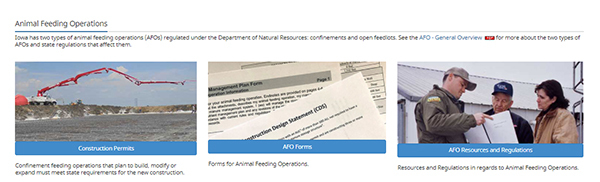 The new AFO website puts the most popular webpages at your fingertips, with nine menu items up front and center.
Please explore the recently updated Animal Feeding Operations (AFO) webpages. Don’t forget to update your bookmarks: iowadnr.gov/afo/
- New layout to help guide you quickly to what you’re looking for
- Important date reminders
- Construction permit information
- Manure application resources
- Easier to find forms, fact sheets and resources
- Mobile-device friendly
Iowa DNR Homepage: www.iowadnr.gov/
Use your smart phone, tablet or PC. Submit the annual MMP (manure management plan) update from home, your truck or office. In your blue jeans, suit or pajamas. Skip the trip to the county office for signatures. Pay fees online or mail them in.
Once you’ve created your account, it literally takes just a couple of minutes to submit the plan and have it approved.
If you haven’t tried it yet, visit the recently updated eMMP page (iowadnr.gov/emmp) for new user information. You’ll find instructions, a webinar and FAQS to get you started.
Join the crowd. The app has a solid track record with more than 14,000 annual updates submitted over the last three years. Call your DNR field office staff if you get stuck.
Applying both manure and commercial fertilizer on cropland is allowed—but only if the combined application rates do not exceed the nitrogen (or phosphorus) needs of the crop—as calculated in your current manure management plan. Confinement site owners are required to submit MMPs and keep a current MMP at the site or within 30 miles of the confinement. You must include all commercial fertilizer as part of your nitrogen (or phosphorus) application.
If applying manure on cropland which they don’t own or rent, confinement site owners need a statement that specifies the planned rate of commercial fertilizer (N and P) for each field that will receive manure. DNR’s Statement of Intent (form 542-8167) is available to help collect this information from the landowners, renters or tenants.
There are times, such as during a wet spring, when you suspect there may be a nitrogen deficiency. If soil test or crop nitrogen test results show a deficit, then additional nitrogen fertilizer may be applied as necessary to obtain the optimum crop yield. In other words, if you can prove a crop is nitrogen deficient, then you can apply additional nitrogen up to the calculated crop nitrogen need.
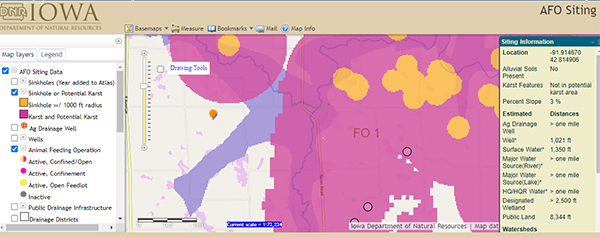 Add or subtract layers in the updated AFO Siting Atlas to see landscape features that influence where a confinement site can be built. Choose a location (yellow pin), and the pop-up on the right shows distances to critical features affecting water quality.
The AFO Siting Atlas was recently updated to improve functionality and accuracy, add layers and include new drawing tools.
Developed in 2005, the AFO Siting Atlas helps livestock and poultry producers determine the best site for an animal feeding operation, expansion or modification. The siting atlas gives a quick overview of landscape features that must be considered when planning construction. Users can find the locations of alluvial soils, alluvial aquifers, karst topography, sinkholes, wells, surface waters, slopes and public lands.
Only roads and DNR field office boundaries will show when first opening the atlas. Zoom in to see current AFO locations. Click on Map Layers on the left, to turn on other layers. For first-time users, zoom in and click on a point, and a pop-up appears on the right showing estimated distances to landscape features such as major water sources.
The February updates included:
- Improved measuring tool accuracy.
- Added a search function for townships.
- Added drawing tools to draw buffers of a specified radius or radii around a point, circle, ellipse, rectangle or polygon.
- Added watershed boundaries.
|





