|
FOR IMMEDIATE RELEASE
May 18, 2021
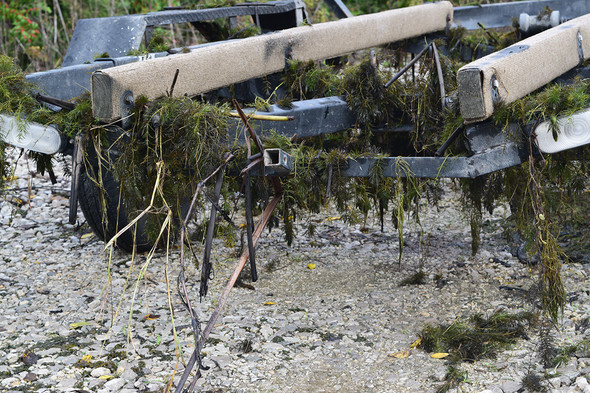 Aquatic invasive species can create serious problems for Iowa waters by reducing native species and making lakes and rivers unusable for boaters, anglers and swimmers. Be sure to check the boat, trailer and equipment for unwanted hitchhikers and clean any plants, animals, or mud from your boat and equipment before you leave a waterbody. Photo courtesy of the Iowa DNR.
The Iowa Department of Natural Resources (DNR) reminds all boaters and anglers to “Clean, Drain, and Dry” their boats and equipment this Memorial Day weekend to protect Iowa lakes and rivers from aquatic hitchhikers.
Aquatic invasive species, everything from zebra mussels to Eurasian watermilfoil, move from one waterbody to another by hitchhiking on boats, in bait buckets and on other equipment used in the water. They often grow quickly and spread fast when brought to another lake or stream due to lack of natural controls.
“Checking your boat and equipment for unwanted hitchhikers will help slow the spread of aquatic invasive species and protect our local waterways for future generations,” said Kim Bogenschutz, aquatic invasive species coordinator for the Iowa DNR.
Aquatic invasive species can create serious problems for Iowa waters by reducing native species and making lakes and rivers unusable for boaters, anglers and swimmers. Boaters and anglers can unintentionally spread aquatic hitchhikers if they do not take the proper precautions each time they leave a lake or river.
Clean, Drain, Dry is a simple three step process that boaters can follow every time they move from one body of water to another.
- CLEAN any plants, animals, or mud from your boat and equipment before you leave a waterbody.
- DRAIN water from all equipment (motor, live well, bilge, transom well, bait bucket) before you leave a waterbody.
- DRY anything that comes into contact with water (boats, trailers, equipment, boots, clothing, dogs). Before you move to another waterbody either: Spray your boat and trailer with hot or high-pressure water; or Dry your boat and equipment for at least five days.
- Never release plants, fish, or animals into a waterbody unless they came out of that waterbody and empty unwanted bait in the trash.
It is illegal to possess or transport prohibited aquatic invasive species. It is also illegal to transport any aquatic plants on water-related equipment in Iowa. Signs posted at public accesses remind boaters to stop aquatic hitchhikers and identify infested waters.
Boaters must also drain all water from boats and equipment before they leave a water access and keep drain plugs removed or opened during transport. It is also illegal to introduce any live fish, except for hooked bait, into public waters.
Find more information about aquatic invasive species and a list of infested waters in the current Iowa Fishing Regulations or at www.iowadnr.gov/ais.
Media Contact: Kim Bogenschutz, Fisheries Bureau’s Aquatic Invasive Species Program Coordinator, Iowa Department of Natural Resources, 515-290-0540.
Over the next two weeks, some of Iowa’s top shooting sports athletes, ranging in age from middle school to collegiate level, will participate in the 2021 Iowa Scholastic Clay Target Program (SCTP) International Championships in Skeet and Trap.
The Scholastic Clay Target Program has seen constant growth in Iowa and across the nation, with increases in participation seen in Iowa middle school and high school teams, which have grown from 1,400 athletes to more than 4,200 athletes since 2011. Collegiate Shooting Sports programs in Iowa have grown from four to 21 teams in the past five years.
“The Scholastic Clay Target Program provides many opportunities to Iowa’s shooting sports athletes. These Championship events in International Skeet and Trap allow the athletes to compete in the same event as the Olympics,” said Chris Van Gorp, shooting sports coordinator for the Iowa Department of Natural Resources. “Athletes that score well enough at the state championship events will receive an invitation to compete at the National Junior Olympic Championships.”
The all-day events will take place at two locations:
- May 22-23 - International Bunker Trap, AVAD Hunt Club, Coon Rapids
- May 29-30: International Skeet Championship, New Pioneer Gun Club, Waukee
“The SCTP is a youth development program, first and foremost and we do this through the shooting sports and competitive shooting. Its mission is to help kids reach their highest potential in becoming the best athletes and young adults they can be,” Van Gorp said.
Scholastic Clay Target Program offers student athletes from elementary through high school and college the opportunity to compete in sports such as trap, skeet, and sporting clays, as well as Olympic disciplines like bunker trap and international skeet. For more information on the Scholastic Clay Target Program in Iowa, contact Chris Van Gorp, DNR Shooting Sports Coordinator, at 515-313-8048 or chris.vangorp@dnr.iowa.gov.
Media Contact: Chris Van Gorp, DNR Shooting Sports Coordinator, (515) 313-8048 or Chris.Vangorp@dnr.iowa.gov.
The nation’s largest recreational boating safety event of the year, National Safe Boating Week, is May 22–28, serves as a reminder to boaters to keep safety front and center all season long. The BoatUS Foundation for Boating Safety and Clean Water offers three tips for boaters to be safety heroes on the water.
- The best life jacket is the one you will wear, meaning one that’s comfortable. There are many lightweight inflatable life jackets that fit the bill. Check the jacket’s label to ensure it’s approved for your type of boating. If the kids are visiting, don’t be tempted to put a child in an ill-fitting adult life jacket.
- Boating safety reports indicate that operator inattention, improper lookout, operator inexperience, excessive speed, and alcohol rank as the top five primary contributing factors in accidents. Focus on eliminating these factors by putting down the cellphone, practicing using S.C.A.N. procedures to avoid distracted boating, taking a free boating safety course, slowing down, and driving more defensively, especially in congested boating areas. Alcohol use is the leading known contributing factor in fatal boating accidents, so save the celebration for after the boat is safely tied up for the night. Boat operators also need to recognize they are responsible for the safety of their guests, including inebriated ones.
- Remember to wear an engine cutoff switch if your boat is less than 26-feet, traveling on plane or above displacement speed. Engine cutoff switches can prevent boat strike injuries after an operator has been ejected from the vessel or displaced from the helm.
Sidebar: What Is SCAN?
SCAN: Search, Concentrate, Analyze, and Negotiate. This is something every attentive skipper does continually, and probably without thinking about it, while underway. Simply put, "scanning" is looking from side to side - and behind you - for boats, people, and objects on the water that may pose a risk of collision. Repeat whenever you’re underway.
Search the area all around your craft. This is a 360-degree examination of everything around your boat. Distances away will close or open depending on your speed or the speed of the observed boat or object. The faster you're operating, the farther out you'll need to search.
Concentrate on what you're seeing. Is it a boat? What type? What is it doing? What is its relative speed? Is it a stationary object? Drifting or anchored? Things can happen fast out there, so these are questions you must consider while you look at the various observed boats or objects.
Analyze what you're watching. Is it closing in on your position or going away from you? Remember, if the object you're observing is getting closer to you and its relative position to you is not changing, it is on a collision course. Never assume you're seen by other boat operators, who may or may not be distracted. Determine this by the way and direction they're operating. Analyze how far away the boat or object is and how fast it is closing the distance between you and it.
Negotiate. What are you going to do? Slow down, turn away from the boat or object, and head in a different direction? Remember the Navigation Rules. Learn the proper action to take while meeting head on, crossing, or overtaking another boat.
Media Contact: Susan Stocker, Boating Law Administrator and Education Coordinator, Iowa Department of Natural Resources, 515-313-6439.
SOLON - The Iowa Department of Natural Resources (DNR) will host a virtual public meeting on May 26, at 7 p.m., to discuss the sale of 58 hardwood logs salvaged from trees at Lake Macbride State Park damaged from the August 2020 derecho.
The DNR contacted certified timber buyers regarding the sale with the bids due by May 13. Salvaging storm damaged trees is a provision of Lake Macbride’s Forest Stewardship Plan.
Contact Ron Puettman, park manager at Lake Macbride State Park, at 319-624-2200, for a link to the virtual meeting.
|





