|
FOR IMMEDIATE RELEASE
March 23, 2021
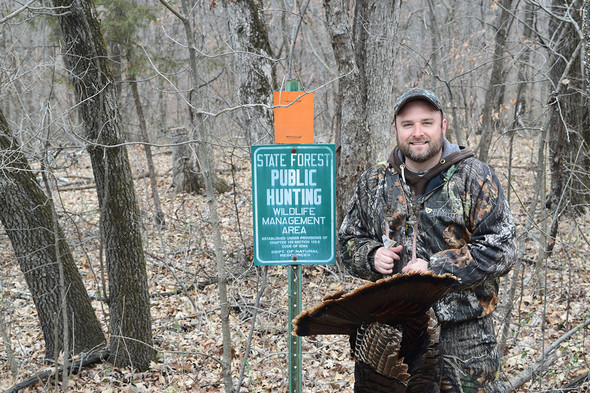 While matching 2020’s record breaking hunter participation and harvest is not likely to happen, Iowa’s 2021 spring turkey season will have plenty of opportunities for those ready to be back in the timber.
“We had good turkey production and poult survival over much of the state, but especially in southeast Iowa, which is good news for hunters in that region,” said Jim Coffey, forest wildlife research biologist with the Iowa Department of Natural Resources. “Hunters should expect to see a number of year-old males (jakes) and also see a good number of mature toms that will include last year’s class of now two-year-old birds.”
Larger winter flocks, are breaking up and are distributing across the landscape ahead of breeding season. Turkeys may not be in the same places this spring as they were during the winter, Coffey said. “They will seemingly disappear.”
Turkey hunting is different than other types of hunting. It’s a close, intimate experience where success isn’t measured by whether a hunter bags a turkey or not. And for good reason. On average, only about one in five spring turkey hunters will bring home dinner.
“Even with the near record level of spring turkey licenses sold last year, we still had around the same percentage who reported harvesting a bird,” Coffey said.
Part of the challenge of hunting in the spring is the way the timber changes from early April to middle May, going from leafless and open to green and lush, and days that can range from snow or rain to warm and sunny – sometimes all on the same day.
The turkey population depends on the quality of the habitat. The better the habitat, the more birds that will be there. Oak and hickory timbers are preferred, but don’t overlook smaller fields. Not all turkey hunting is done in large timbers. Turkeys were harvested in all 99 counties last year.
Matching 2020’s participation level may be a challenge, but Coffey does expect a carryover with more hunters in the timber. And with more bodies in the woods, he is reminding everyone to be aware of their fellow turkey hunters.
“We all want our time in the woods alone and safety is paramount,” he said. “Hunters should avoid wearing patriotic colors – red, white, and blue – because those colors are associated with a tom turkey’s head, should not take the shot until they can positively identify the turkey’s beard, and see not only the turkey, but also what’s behind it.”
Last year, there were two reported injuries during the spring turkey seasons. Conservation officer investigations into shootings have identified a few safety issues that result in most of the injuries: not properly identifying target and what is beyond it, and mistaking the victim for game by shooting at movement or color without properly identifying target.
The Iowa resident youth only season is April 9-11, followed by first regular season April 12-15, second season is April 16-20, third season is April 21-27, and fourth season is April 28 to May 16. The archery only season is April 12 to May 16. Hunters may purchase two gun/bow licenses as long as at least one if for season four.
Successful hunters are required to report their harvest by midnight of the day after it is recovered by going online at www.iowadnr.gov, calling the toll free phone number printed on the tag, at any license vendor during regular business hours, by texting your registration number to 1-800-771-4692 or through the Go Outdoors Iowa app.
Hunting Atlas Available Online
Hunters have an added tool that may improve their in-field experience, even before opening day.
The Iowa hunting atlas is an interactive map that shows all available public hunting land that is managed by the state, county or federal governments. The atlas is online at www.iowadnr.gov/hunting. A mobile version is also available.
A click on an area will show basic information like size, habitat type and likely species available.
Media Contact: Jim Coffey, Forest Wildlife Research Biologist, Iowa Department of Natural Resources, 641-774-2958.
Spring turkey hunting success and safety comes down to the same thing – proper planning.
“Be aware of what’s around you. Even if you’re on private property, there could be other hunters out there who are coming to your call. Remember, turkey hunters are skilled in the art of concealment. Don’t shoot at movement; don’t shoot at sound; no turkey’s worth it. I encourage hunters to only shoot after they see the turkey’s beard and have a safe backstop,” said Megan Wisecup, hunter education administrator for the Iowa Department of Natural Resources. “Being safe is important because the people we hunt with are our family and close friends.”
Hunters who do shoot a turkey are encouraged to not carry it over their shoulder to avoid someone mistaking it for a live bird and take a shot. Wisecup suggested hunters use a blaze orange turkey transport harvest bag.
Practicing safe hunting becomes more crucial as the annual spring leaf out progresses.
“The later it gets in May, the harder it is to see. Hunters need to stay vigilant to identify the bird and the beard,” she said.
Tips
- Plan to wear blaze orange when moving from one spot to another because you never know if someone else is out there, even on private land.
- Avoid wearing patriotic colors – red, white, blue. These same colors are found in a turkey’s head.
- Be aware that mushroom hunters will be moving through the timber in late April and May. Mushroom hunters are encouraged to wear blaze orange and avoid red, white and blue.
- Plan to add bug spray and drinking water to the field bag
- A blind is good for concealment and when taking kids turkey hunting, but not for moving around. If you plan to be mobile, don’t bring the blind.
- If hunting private land, be sure you have permission and know the property boundaries.
- Even if hunting private property, the potential exists that someone else may be out there. Trespassing calls increase during turkey season.
- Be extremely careful if planning to use decoys to hunt. Another hunter may mistake you for a turkey.
Media Contact: Megan Wisecup, Hunter Education Administrator, Iowa Department of Natural Resources, 515-238-4968.
The Iowa Department of Natural Resources (DNR) released between 1,000 to 2,000 rainbow trout at four community trout ponds as part of its cool weather trout program that brings trout to areas that cannot support them during the summer.
The following locations are ready for anglers to catch trout: Banner Lake South (Indianola), Big Lake (Council Bluffs), Moorland Pond (Fort Dodge) and Terra Lake (Johnston).
All spring community trout stockings will be unannounced this year and family fishing events will not be held to help reduce the crowd size at stocking locations and minimize the spread of COVID-19.
Check the DNR website at www.iowadnr.gov/trout and watch for future press releases to find out when the remaining community trout locations have been stocked.
The spring community trout stockings are a great place to take kids to catch their first fish. A small hook with a nightcrawler or corn under a small bobber or small simple spinners such as a panther martin or mepps is all you need to get in on the fun.
Bringing trout to cities and towns offers a “close to home” option for Iowans who might not travel to the coldwater streams in northeast Iowa to discover trout fishing.
The popular program is supported by the sales of the trout fee. Anglers need a valid fishing license and pay the trout fee to fish for or possess trout. The daily limit is five trout per licensed angler with a possession limit of 10.
Children age 15 or younger can fish for trout with a properly licensed adult, but they must limit their catch to one daily limit. The child can purchase a trout fee which will allow them to catch their own limit.
Find more information about trout fishing in Iowa on the DNR trout fishing webpage.
Media Contact: Mike Steuck, regional fisheries supervisor, Northeast Iowa, Iowa Department of Natural Resources, 563-927-3276.
The Iowa Department of Natural Resources (DNR) is sponsoring four how to teach outdoor skills courses for K–12 teachers, naturalists and other educators this summer.
Hands-on sessions (indoors and outside) will provide introductory skills instruction and development, teaching materials and lesson plans. The cost of each course varies. Create an account on the AEALearning website to find the cost, registration deadline and requirements for each course.
-
Introduction to Basic Outdoor Skills, June 15-16 at Annett Nature Center, Indianola. Participants will receive introductory instruction and lesson plans for planning outings, map reading, hiking, paddling, fishing, archery, campfire cooking and basic firearm safety/shooting.
-
Fish Iowa! Basic Fishing, June 28-29 at Jones County Conservation Center, Center Junction. Participants will learn fishing basics including fish identification, fishing locations, casting techniques and cleaning and cooking fish. Instruction will include a variety of demonstration and hands-on, experiential approaches.
-
Archery and Bowfishing, July 12-13 at Mahaska County Conservation Center, Oskaloosa. Participants will learn basic archery and archery instructional skills, as well as bowfishing basics. Participants will receive National Archery in the Schools and Explore Bowfishing instructional materials.
-
Hunter Education, July 19-20 at Olofson Shooting Range, Polk City. Learn the requirements to become a certified hunter education instructor, including firearm handling and safety, hunter education class requirements and policies and procedures.
Educators can earn license renewal for all four courses. Graduate credit is also available for the Introduction to Basic Outdoor Skills and Fish Iowa! Basic Fishing sessions.
Register for the how to teach outdoor skills courses through the AEALearning website at https://aealearning.truenorthlogic.com/. You will be asked to create an account if you do not already have one. After you login, enter “outdoor skills” in the course search to find registration information for each course.
Media Contact: Barb Gigar, Fish Iowa! Coordinator, Iowa Department of Natural Resources, 515-494-3891.
A 17-year-old from Marion was pulled from Lake Darling Friday afternoon after the kayak he was paddling sank from a crack in its hull.
State Park Ranger Zach Haworth was contacted by Washington County Communications Center at 2:45 p.m. about an individual who had become separated from his kayak and was calling for help. Haworth contacted fisheries staff for a boat to assist while he was in route. He was flagged down by onlookers.
The juvenile was an estimated 30-40 yards off shore in 43-degree water and not wearing a life jacket. Haworth removed his uniform equipment, grabbed a life jacket and waded toward him halting once he could no longer touch the lake bottom. “I started to feel the effects of the cold water – shortness of breath, my muscles were tightening, and I didn’t want to put myself at risk and potentially make the situation worse, so I returned to the riprap and continued to shout instructions to him, to keep him focused,” Haworth said.
He reentered the lake this time while carrying a life jacket attached to a tow strap, halting once again where he could no longer touch the lake bottom. On his second attempt, Haworth threw the life jacket close enough to him to grab it and hold on as he was pulled to shore. The kayak was collected by fisheries staff where, upon examination, they discovered a small gash in the stern.
Witnesses estimated the juvenile had been in the water for 15 to 20 minutes. Brighton Fire Department and Brighton First Responders arrived and began treating him for hypothermia before transporting him to the University of Iowa Hospitals and Clinics, in Iowa City, where he was treated and released.
“I can’t thank the bystanders enough to be aware of what was going on and reporting it and the Brighton Fire and First Responders - just appreciate all that they did,” Haworth said. “This is a good reminder of how incredibly important it is to inspect the equipment and have the life jacket on – not just have them, but use them there’s no way around it – especially if you’re out by yourself because water can be extremely unforgiving.”
Media Contact: Zach Haworth, State Park Ranger, Lake Darling State Park, Iowa Department of Natural Resources, 319-694-2323.
It may not feel like boating season yet, but the Iowa Department of Natural Resources (DNR), along with boating safety advocates nationwide, are urging boaters to KeepYourEdge by enrolling in a boating education course this spring.
“Education is the key to having a safe and enjoyable day on the water, and spring is the perfect time to take a course before the summer boating season begins,” said Susan Stocker, boating law administrator and education coordinator for the Iowa DNR.
Traditional and online courses are available. Courses are made to fit every schedule and lifestyle. The Iowa DNR has boater education information online at https://www.iowadnr.gov/things-to-do/boating/boater-education.
“A boating safety course provides critical boating knowledge and better prepares you for the risks you may face while boating,” Stocker said.
Benefits to taking a boater education course
- Boost your confidence and Keep Your Edge by brushing up on essential boating skills.
- Even if you have already taken a course or are an experienced boater Keep Your Edge by taking a new course to sharpen your skills.
- A boating safety course can save boaters money. Many boat insurance providers offer discounts to people who have successfully completed a boating safety course.
Iowa boating statistics
- In 2018, there were 32 reported boating incidents on Iowa waters: 17 of those were personal injury; seven involved property damage and eight resulted in fatalities. Of the eight fatalities, three involved alcohol as a contributing factor
- In 2019, there were 22 reported boating incidents on Iowa waters: 14 of those were personal injury; six involved property damage and six resulted in fatalities. Of the six fatalities, two involved alcohol as a contributing factor
- In 2020, there were 39 reported boating incidents on Iowa waters: 16 of those were personal injury; 17 involved property damage, and nine resulted in fatalities. Of the nine fatalities, six involved alcohol as a contributing factor.
Media Contact: Susan Stocker, Boating Law Administrator and Education Coordinator, Iowa Department of Natural Resources, 515-313-6439.
She Goes Outdoors has a new subscription box available focused on fishing. The subscription box is designed to develop and expand outdoor skills. The box is packed full of gear, educational resources, and more for only $50, which includes shipping and handling. Boxes are available for purchase now at https://www.sgooutdoors.com/.
- 200 boxes are available through April 11
- Boxes will ship the week of April 26
- A fishing webinar will be held on May 5, from 7-9 p.m. CST
A single purchase will get you one skill focused box. Already have fishing equipment - purchase a box for someone else in your life.
She Goes Outdoors is a partnership with Nebraska Game & Parks Commission, Kansas Department of Parks, Wildlife and Tourism and the Iowa Department of Natural Resources.
|





