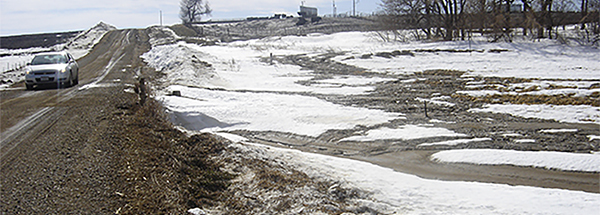
 Runoff into our waters is more likely to occur when manure is land applied during the winter, especially late in the season. Applicators can review rules and recommendations below.
County supervisors who voted to use the Master Matrix by adopting a construction evaluation resolution (CER) must submit the resolution to Kelli Book, Iowa DNR, 502 E. Ninth St., Des Moines, IA 50319. Applications can be mailed, emailed to Kelli.Book@dnr.iowa.gov. However, the county board of supervisors must submit resolutions in January and DNR must receive it by the end of the day Jan. 31.
Sign-ups in January apply to construction permit applications for confinement feeding operations received from February 2021 through January 2022. For more information, search for master matrix on the DNR website at www.iowadnr.gov/afo. Or, check the Iowa State Association of Counties at www.iowacounties.org.
Commercial manure applicators who missed the Jan. 7 training can still complete training by watching the recording in Iowa State University Extension and Outreach offices.
“Be sure to check and pre-register with your county Extension office,” says Jeff Prier, DNR MAC coordinator. “Due to limited seating, walk-ins are not allowed.” Register at the Iowa State University Extension and Outreach office in the county where you will attend.
Two-hour training sessions for Confinement Site Applicators began Jan. 11 and continue through Feb. 26. Training sessions are offered throughout the state.
Dry and solid manure handlers can pick from six training sessions in February, which meet requirements for both commercial and confinement manure applicators.
Plan to follow Extension guidelines to wear face coverings and be socially distant.
Those unable to attend a live session can:
Find more information from Iowa State University Extension and Outreach at confinement site workshops or at commercial workshops.
To learn more about MAC, visit DNR’s manure applicator webpages or contact your local DNR field office.
The drought and warm fall weather helped many producers get crops out early—allowing manure application earlier than during the last couple of years. Here are a few reminders, if winter application is still necessary.
Confinements with liquid manure--restrictions started Dec. 21
Runoff into our waters is more likely to occur during winter manure application. State law limits liquid manure application for confinement operations (roofed facilities) with more than 500 animal units. They cannot apply liquid manure to fields covered with 1 inch of snow or 0.5 inches of ice, except in an emergency.
Restrictions on applying manure to snow-covered ground began Dec. 21 and continue until April 1. Starting Feb. 1, applying liquid manure on frozen ground is also restricted until April 1. You must call the local DNR field office prior to any emergency application. Be sure to update your manure management plan records.
Other limits may apply if you took credit for injection or incorporation as part of a construction permit application using the Master Matrix.
Winter land application of liquid manure from confinements is allowed when producers can inject or incorporate manure on the same date, and when the ground is not frozen or snow-covered.
Rules for all producers
While limits on winter land application do not apply to open feedlots, dry manure and small confinement producers, all producers must prevent water quality violations. Often they can help protect water quality by using common sense, and choosing application areas far from a stream on flat land with little snow cover.
All surface land application must follow setbacks from buildings and environmentally sensitive areas. When winter application is necessary, find 10 more tips for safe application in the Iowa Manure Management Action Group’s November 2019 newsletter.
The Iowa Department of Natural Resources is working with state and local officials to reduce the spread of COVID-19 and has transitioned employees to work remotely. DNR offices are closed to the public during this time and only available by appointment.
In another effort to further reduce the spread of COVID-19, the DNR is encouraging the use of the online services for submitting applications, payments and other daily tasks and interaction with DNR staff.
We thank you for your patience and flexibility during this time. If you need to contact DNR staff you can reach them by email or phone or by calling 515-725-8200.
|





