 Transportation has an enormous impact on our health.
When asked about critical issues needing to be addressed in our statewide health plan, Healthy Iowans: Iowa’s State Improvement Plan, Iowans rated transportation as one of 26 issues calling for attention. However, until recently, few people saw the direct connection between health equity and transportation. According to Healthy, Equitable Transportation Policy: Recommendations and Research (p.26), “…Research shows that how we get around and how we transport goods and services have a profound impact on individual, community, and public health. Further, inequities in transportation resources contribute to the pronounced health disparities in the United States and to the growing income gap between the affluent and the poor. An overarching transportation policy that does not seriously consider public health, environmental quality, and equitable access will inevitably damage all three. Health and equity must be at the center of transportation planning and investments.”
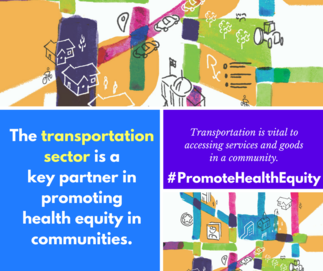
Why Transportation links to health equity in Iowa’s communities
- Transportation costs are a barrier to mobility for households in poverty, disproportionately represented by African Americans and Hispanics.
- Long commute times and high transportation costs are significant barriers to employment and financial stability.
- For rural and other underserved communities, inadequate or complete lack of public transportation poses a barrier to accessing such fundamentals as health services, jobs, and grocery stores.
- Low-income and minority populations are more likely to live near environmental hazards that can contribute to poor health, including such transportation-related sources of pollution and toxic emissions as highways and truck routes.
- Improving neighborhood streets, sidewalks, and crosswalks opens access to persons with disabilities and older Iowans.
Adapted from Communities in Action: Pathways to Health Equity - Transportation Sector Brief.
|
Measuring Transportation Progress in Iowa
So far, based on progress reports for Healthy Iowans: Iowa’s Health Improvement Plan 2017-2021 (https://idph.iowa.gov/healthy-iowans/plan), community and state agencies have reduced motor vehicle-related deaths, created a data system to better understand the causes of motor vehicle crashes, assisted communities in solving their transportation needs, and expanded street access to everyone.
Motor Vehicle Crashes: Reducing death and injury
- Fatalities from motor vehicle crashes have decreased almost 20% from 2016-2018; male death rates have decreased 22.5%--Iowa Department of Public Safety/Governor’s Traffic Safety Bureau (Health Measurement IV-4).
- Alcohol-related driving fatalities have declined 10%--Iowa Department of Public Safety/Governor’s Traffic Safety Bureau (Objective 1-1, Strategy 1-1.2).
- Seat belt use, a major death and injury deterrent, has increased by nearly 1%--Iowa Department of Public Safety/Governor’s Traffic Safety Bureau (Objective 1-1, Strategy 1-1.3).
- The Iowa Office of the Medical Examiner has developed a data system that is expected to improve policy development and reduce motor vehicle, crash-related fatalities--Iowa Office of the Medical Examiner, Iowa Department of Transportation, and Iowa Department of Public Safety (Objective 1-1, Strategy 1-1.2).
Transportation: Accessing vital services
- Regional planning agencies and public transit agencies are identifying and funding projects to increase access for persons needing health prevention and medical-related services--Iowa Department of Transportation (Objective 1-1, Strategy 1-1.1). See also the Iowa Public Transit Long Range Plan for additional public transportation strategies.
Obesity, Nutrition, & Physical Activity: Enhancing opportunities for active transportation & leisure-time activity
- Thirty-one cities in Iowa have a complete streets policy to assure street access for everyone including pedestrians, bicyclists, motorists, and transit riders; 21 of Iowa’s largest 58 cities have the policy in place--Iowa Department of Public Health and American Heart Association (Strategy 1-1.2).
Goals in Healthy People 2030: Moving away from an autocentric nation
Transportation-related objectives in Healthy People 2030 continue a long-standing national effort to reduce motor vehicle crash deaths involving an alcohol-impaired driver, but also attempt to move the country away from its dependence on the automobile, consistent with the Community Preventive Task Force recommendation that combines one or more interventions to improve pedestrian or bicycle transportation. Following are these objectives:
- Increase the proportion of adults who walk or use a bicycle to get to and from places
- Increase the proportion of adolescents who walk or bike to get places
- Increase trips to work made by mass transit
County Public Health Agencies Catalyze Action on Transportation
In their health improvement plans (https://idph.iowa.gov/chnahip/health-improvement-plans), these Iowa county public health agencies have identified transportation as a critical issue: Dallas, Davis, Greene, Henry, Humboldt, Iowa, Lee, Linn, Lucas, Mills, Pocahontas, Pottawattamie, Poweshiek, Sioux, and Van Buren. Working with other community organizations, public health has served as a catalyst for community action which includes the following:
- conducting community surveys that have pinpointed barriers and gaps in transportation resources
- helping organize transportation task forces
- developing plans to address identified needs
- recruiting volunteers for rides to medical appointments
- expanding hours of transit services
- increasing awareness of available services through the media
- paying special attention to people new to the transportation system or needing assistance
Resources
Rural Health Information Hub, HRSA. Rural Transportation Toolkit. Models in this toolkit contain resources and information focused on developing, implementing, evaluating, and sustaining rural transportation programs. There are more resources on general health strategies available in the Rural Community Health Toolkit.
Sarah Treuhaft, Allison Karpyn. The Grocery Gap: Who has Access to Healthy Food and Why It Matters. This report, under the auspices of PolicyLink and The Food Trust, summarizes current knowledge about food deserts and their impacts on communities and provides evidence to inform policy making. Reaching grocery stores is a challenge to people living in low-income urban communities of color as well as well as in rural areas.
Shireen Malekafzali, ed. Healthy, Equitable Transportation Policy: Recommendations and Research. PolicyLink, the Convergence Partnership, and the Prevention Institute offer a comprehensive summary of research on how transportation affects health through all five pathways (Active Transportation, Safety, Cleaner Air, Connectivity, Equity), with an emphasis on protecting vulnerable populations. It offers policy recommendations for increasing health and equity in general and in relation to specific transportation modes and key transportation planning issues.
Thomas W. Sanchez et al. Moving to Equity: Addressing Inequitable Effects of Transportation Policies on Minorities. This report summarizes findings on disproportionate transportation-related health impacts in communities of color, including higher asthma and pedestrian fatality rates; it describes the connections between these impacts and the built environment.
|




