|
FOR IMMEDIATE RELEASE
Jan. 12, 2021
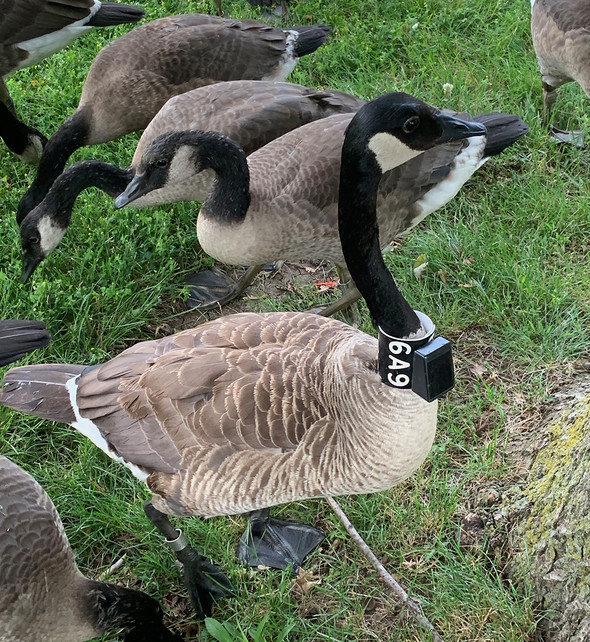 The Iowa DNR and Iowa State University wrapped up a three-year study on the movements of Canada geese in the Des Moines metro area, that will be used to modify the state Canada goose management plan. Geese in the metro area are highly visible and interact with Iowans at a disproportionately high rate versus rural birds potentially influencing perceptions towards these birds. Photo courtesy of the Iowa DNR.
A recently completed three-year study to better understand how Canada geese utilize metro Des Moines will be used to revise the Iowa Department of Natural Resources’ (DNR) Canada goose management plan.
Orrin Jones, state waterfowl biologist with the Iowa DNR, collaborated with Iowa State University to mark 71 urban and rural female Canada geese with GPS GSM transmitters and monitored their movements between 2018-2020.
“Modern urban development, specifically short grass adjacent to open water, is very attractive to geese. It’s remarkable how geese have learned to exploit habitat in urban areas and how well they move through urban areas from May to August despite being largely flightless for most of that time,” Jones said.
Geese in the metro area are highly visible to Iowans and interact with Iowans at a disproportionately high rate versus rural birds, Jones said, and this high rate of interaction could influence perceptions of Iowans towards these birds.
Canada geese are a tremendous conservation success story. After being locally extinct in Iowa from 1907 to 1964, the Iowa Conservation Commission, the agency that preceded the DNR, and its fellow states within the Mississippi Flyway Council, worked together to restore Iowa’s breeding population. By 1993, there was at least one nesting pair of Canada geese in all 99 counties.
“Canada geese are an important natural resource that provide Iowans with aesthetic and ecological values in addition to recreational harvest by waterfowl hunters. Goose use of urban areas is a relatively recent occurrence and our collective knowledge about how the birds behave in this novel habitat was limited,” he said. “This study showed us that urban geese use habitat that is less accessible to hunters than rural geese, but survive at a similar rate as the statewide population, and are most susceptible to hunter harvest in September and October when their range and movements are the largest.”
Jones said the DNR will review and refine the Canada goose hunting seasons and urban zone boundaries based on this study, while recognizing municipal ordinances constrain the use of hunting to address conflicts with geese within city limits.
“We believe there is an opportunity to increase the effectiveness of hunting as a population management tool if municipalities allow hunting within city limits at locations where it is safe and feasible to hunt waterfowl,” Jones said. “We are also learning more about nonlethal management of geese, such as nest removal, habitat management, and improving our monitoring program.”
The study included more than 2 million recorded goose locations which produced some interesting patterns.
“We found that the behavior and movement of individual geese was highly variable. For example, we had one goose that from August to September roosted on a rooftop in an industrial complex in West Des Moines, once winter weather occurred in December the goose migrated to Missouri and spent the winter in a rural area near a large wildlife refuge. In March the goose returned to nest on a rooftop in West Des Moines. We removed the nest to monitor the response to this management action. After an unsuccessful nesting effort the goose migrated north to the western shore of Hudson Bay in the province of Nunavut, spent the summer there and returned to Iowa in September. That’s a round trip of more than 2,000-miles.”
And, according to the transmitters, she wasn’t alone. The largest migration occurred in late May and early June when unsuccessful nesters headed to northern Canada.
“This study provided a tremendous amount of data and answered a lot of our questions. We have a better understanding of Canada geese, from both urban and rural Iowa. This will allow us to better tailor our management to the resource,” Jones said.
Urban goose research project presented live online
Join state waterfowl biologist Orrin Jones and his fellow researchers for virtual meeting via Facebook and Zoom on Feb. 3, starting at 11:30 a.m., where they will discuss research project, unique goose stories, what they learned and how the data will be used.
To participate via Zoom go to https://us02web.zoom.us/j/89003071283?pwd=QTNvdnUrSDRCYTlKRTk5ODhsRVp2QT09 to join, and if a passcode is required, use Goose2021. To participate via Facebook go to www.facebook.com/iowadnr/
Media Contact: Orrin Jones, State Waterfowl Biologist, Iowa Department of Natural Resources, 641-231-1957.
Winter paddling can provide solitude, exercise and an opportunity to see amazing winter beauty. The Iowa Department of Natural Resources (DNR) recommends that paddlers wait for warmer weather to allow for warmer water and conditions.
“Many paddlers, especially those just starting out, don’t realize that although temperatures may be above average during some of the winter, the water is still dangerously cold- and cold-water shock and hypothermia can set in quickly,” said Todd Robertson, Iowa DNR River Programs Water Trails Coordinator.
“Dress for the water temperature, not the air and expect to go into the water,” Robertson said. “A wet or dry suit and a life jacket are crucial to remain safe.”
Review these simple safety tips before you head out on the water this winter.
- Don’t paddle alone. Especially in winter, use a buddy system.
- Make sure the entire water trail route you are paddling is open on a river. Ice jams can form and water freeze up as temperatures drop throughout the day.
- Stay away from wood/branch piles and debris, usually found on the outside of river bends, that can pull you underwater and hold you there with little chance of escape.
- Paddle with a group who is experienced in cold water paddling.
- Always wear a life jacket.
- Wear a dry suit or wet suit, along with layers, to help avoid hypothermia or cold-water shock. Do not wear cotton. Dress for the water temperature, not the air.
- Bring along a dry bag with a set of extra clothes you can change into if you get wet, a first-aid kit and a protected cell phone or weather radio.
- Let a friend or loved one know where you are going and when you are expected to return. It will be easier to find you if you need help.
The DNR reminds paddlers to abide by the physical distancing protocols recommended by the state to help stop the spread of COVID-19. Follow these recommendations to keep you and your family safe:
- Keep at least six feet of distance between you and other boaters and avoid popular areas where people may congregate.
- Stick with your immediate family, but keep groups to fewer than 10 people.
- Only touch your own gear. After the trip, wipe down gear to disinfect surfaces.
- Avoid sharing snacks/water.
- Bring along hand sanitizer.
- Plan your shuttle carefully. Stick with only your immediate family in your vehicle.
Explore the Iowa DNR’s interactive paddling map at www.iowadnr.gov/Things-to-Do/Canoeing-Kayaking/Where-to-Paddle to help you plan your first paddling trip this year.
Media Contact: Todd Robertson, Iowa DNR River Programs Outreach Coordinator at 515-243-3714.
A tip that an individual with a rifle may be trying to kill a deer at night in Brayton Memorial Forest Wildlife Area, near Hopkinton, resulted in one person being charged with illegally taking a white-tailed deer, and a number of individuals being charged with helping him.
Iowa Department of Natural Resources Conservation Officer Dakota Drish was alerted to the activity and set up surveillance at 8 p.m. on Oct. 31, near the Brayton Memorial Forest Wildlife Area. At 9:18 p.m., he conducted a traffic stop involving two vehicles.
Drish saw multiple flashlights and two-way radios in the vehicles, items often used to coordinate movement and spotlight animals. He found additional evidence that the individuals may have been involved with freshly killed animals, which they confirmed, saying they had been hunting squirrels and were successful. A quick check of licenses found some of the individuals were not properly licensed while others had purchased licenses, but were not carrying the license, as required.
Further investigation uncovered additional violations including two uncased and loaded guns in the trunk of the car, one uncased gun under the backseat of the pickup. It also revealed white tailed deer parts in four plastic bags.
Interviews revealed that Shar Reh, 32, of Waterloo, shot the deer with a 7 MM Magnum rifle, while everyone else shown flashlights on the deer so he could see to shoot. They then all butchered and bagged the deer jointly, before heading for home.
Shar Reh was charged with unlawful taking of a white-tailed deer with a prohibited rifle ($210.25) and hunting by artificial light ($210.25). Drish seized the rifle, lights and antlerless deer. The fines totaled $420.50.
Drish charged Nay Reh, 32, Soe Reh, 30, Law Reh, 28, Soe Reh, 29, Heh Reh, 31, and Lucy Reh, 28, all of Waterloo, with joint criminal conduct in one count of unlawful taking of a white-tailed deer with a prohibited rifle ($237.25) and one count of hunting by artificial light ($237.25). The fines totaled $474.60 each.
Each person involved had their hunting fishing and trapping licenses suspended for one year.
The photos are showing up online and in social media feeds – ice fishing is finally here and is spreading across Iowa.
“Living in Iowa, we are blessed with four seasons and ice fishing is a great way to enjoy our winters,” said Susan Stocker, boating law administrator and education coordinator with the Iowa Department of Natural Resources.
As Iowan’s head out on frozen water to their “go to” spot, they are encouraged to follow ice safety recommendations: don’t go out alone, be sure to bring at least 50 feet of rope and a throwable floatation device, check the ice frequently with a spud bar and cut plenty of holes to check thickness, and it’s always advisable to let someone know where you’re going and when you’ll return. Adding a float coat to the safety gear is one more way to prevent a catastrophe if the worst should happen on the ice.
Outdoor gear is becoming more technical in design and function, including improved safety features. Float coats incorporate the floatation aspects of a lifejacket into the coat, offering protection against hypothermia with the added benefits of drowning prevention. Float coats come in a variety of colors including camouflage, making them a great option for duck hunters as well.
“Ice fishing is a social activity where we get together – while personally distancing - and spend quality time outdoors. The ability to have your coat serve as a floatation device provides an additional level of safety and peace of mind,” Stocker said.
Media Contact: Susan Stocker, Boating Law Administrator and Education Coordinator, Iowa Department of Natural Resources, 515-313-6439.
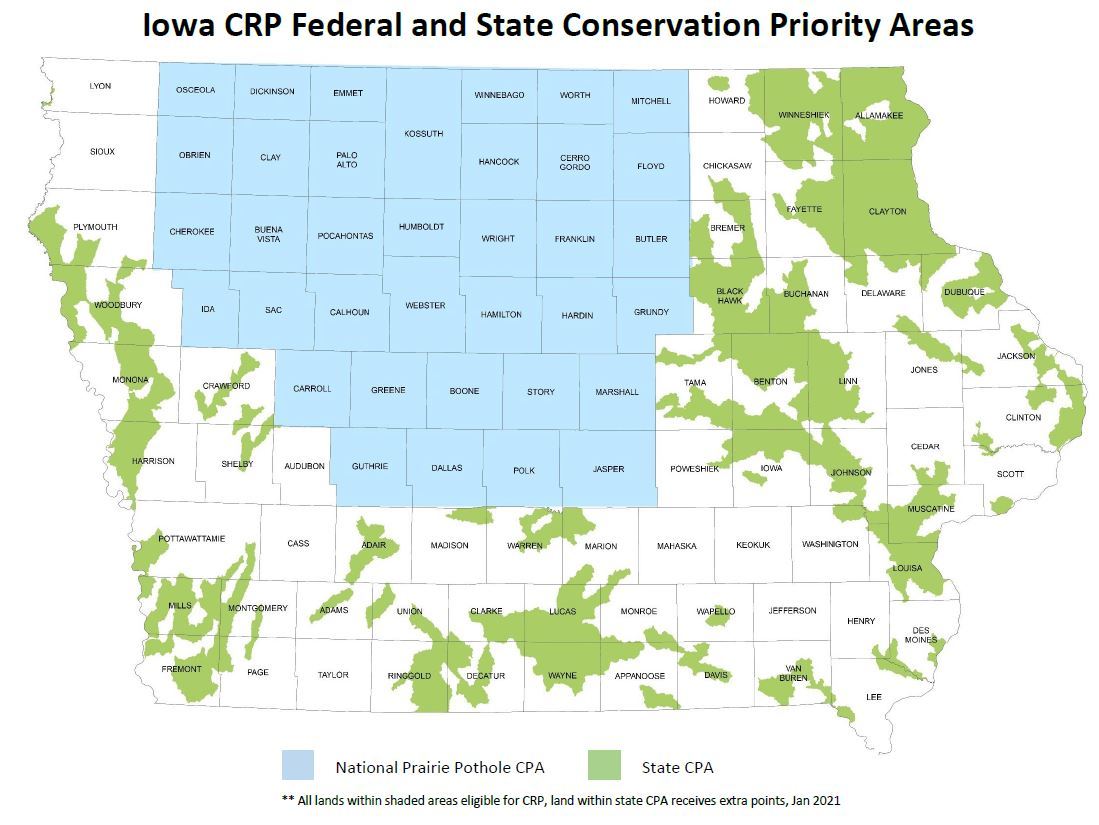 Iowa has about 45,000 acres enrolled in general Conservation Reserve Program (CRP) contracts expiring this fall and all of it is eligible to reenroll as part of the recently opened 56th general CRP signup. The sign up is open through Feb. 12.
The rules and eligibility requirements for this general signup are similar to the last one, where the cutoff was around 210 points. Landowners with expiring CRP, croplands having an erodibility index greater than eight, or located national and state priority conservation areas are eligible to apply. Those in the state conservation priority area will receive extra points as part of their offer.
A link to a map highlighting those areas is under the General CRP Information list online at https://www.iowadnr.gov/Conservation/Wildlife-Landowner-Assistance/Conservation-Reserve-Program.
“Landowners interested in finding out what their rental rate would be should go to their local FSA office or contact one of our private lands staff,” said Todd Bogenschutz, upland wildlife biologist for the Iowa Department of Natural Resources. A map and contact information for private lands staff is available on the same webpage.
“Habitat is key for so many things, from supporting wildlife to improving water quality, and the CRP plays a huge role in the amount of habitat we have on the ground,” Bogenschutz said.
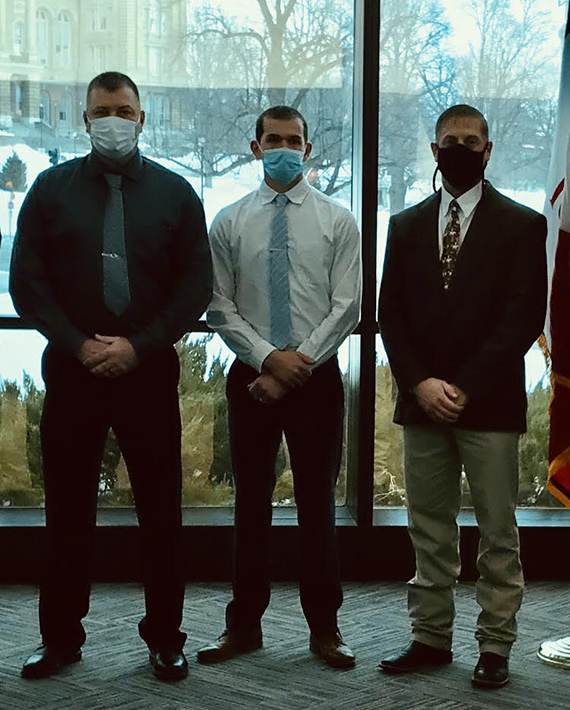 Iowa’s newest state conservation officers are, from the left, Chad Horn, assigned to Wapello and Davis counties; Nate Carr, assigned to Hamilton and Hardin counties; and Lynn Koch, assigned to Black Hawk and Bremer counties. Not pictured is Blake Mills, assigned to Dickinson County. Photo courtesy of the Iowa DNR.
The Iowa Department of Natural Resources swore in four new state conservation officers on Jan. 8, who will undergo several months of training before reporting to their assigned territories later this year.
The new officers are Chad Horn, assigned to Wapello and Davis counties; Nate Carr, assigned to Hamilton and Hardin counties; Lynn Koch, assigned to Black Hawk and Bremer counties; and Blake Mills, assigned to Dickinson County.
The Iowa DNR’s Law Enforcement Bureau has 85 conservation officers including six captains, 10 sergeants, and five recreational safety officers. All are fully certified state peace officers with the authority to enforce all Iowa laws. As U.S. federal deputy game wardens, they also may cross state lines when violations of federal wildlife laws have been committed.
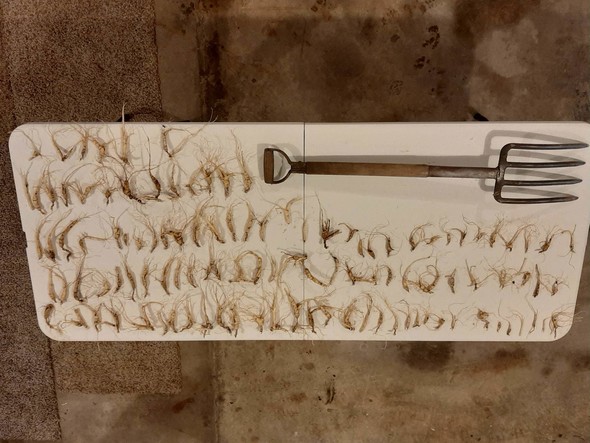 Photo courtesy of the Iowa DNR.
Two northeast Iowa men pleaded guilty to illegal taking of wild ginseng on state managed land after they were encountered by a state conservation officer in the late afternoon on Sept. 11, 2020.
Iowa Department of Natural Resources Conservation Officer Dakota Drish encountered Gregg Latham, 58, of Oelwein, who was in his vehicle and serving as the driver and lookout for Dustin Millard, 49, of Strawberry Point, who was in the nearby timber, illegally scratching and digging wild ginseng roots.
Millard exited the timber and, after learning of Latham’s encounter with the officer, decided to leave the ginseng roots behind, hidden to be retrieved later. However, the Iowa DNR found it first. The investigation led offers to search Millard’s and Latham’s residences where interviews were conducted and evidence photographed.
The result was Millard being charged with 112 counts of unlawfully harvesting wild ginseng plants from state managed lands, 112 counts of harvesting wild ginseng without retaining the entire plant, one count of theft in the fifth degree, one count of littering and one count of trespassing.
Latham was charged with aiding and abetting 112 counts of unlawfully harvesting wild ginseng plants from state managed lands, 112 counts of harvesting wild ginseng without retaining the entire plant, one count of theft in the fifth degree, one count of littering and one count of trespassing.
The current market value of wild ginseng was $500 to $550 per dried pound. The state requested 150 percent of the current market value, or $750 per dried pound, for reimbursement for the value of the dried ginseng root. After weighing the dried ginseng roots, the state sought $515.62 in gross reimbursement and requested that each individual reimburses the State half of the total amount of the current market value, which is $257.81.
Millard and Latham each pleaded guilty to 24 ginseng violations ($5,046), one theft violation ($237), one first offense trespass violation ($354), and one littering violation (106.75), totaling $5,743.75 in criminal penalties. The Court also found the men liable for reimbursing the State of Iowa $257.81 each for their portion of the stolen wild ginseng.
Wild ginseng falls under the Convention of International Trade of Endangered Species of Wild Fauna and Flora, which is an international agreement between governments, that’s aim is to ensure that international trade in specimens of wild animals and plants does not threaten their survival. Its popularity in Asian countries has essentially led to its extirpation there.
Ginseng harvest is regulated by the U.S. Fish and Wildlife Service. At no point can a person possess a wild ginseng plant, seed or any part of a wild ginseng plant on state owned or managed areas. The State of Iowa is required to highly regulate the plant. More information on ginseng is available online at https://www.iowadnr.gov/About-DNR/About-DNR/Iowa-DNR-Forms-Permits under Ginseng Growers, Harvesters & Dealers drop down.
A joint investigation on Sept. 29, 2020, between the Iowa Department of Natural Resources and the Buchanan County Sheriff’s Office into illegal wild ginseng harvest led officers to Mathew Wilkinson, 34, of Independence, who was found in possession with 10 separate wild ginseng roots totaling three ounces, and evidence that Wilkinson had dug the roots from a Buchanan County Conservation Board property.
Wilkinson pleaded guilty to five charges of failing to retain the entire plant while transporting ginseng roots. The scheduled fine for each count of illegal ginseng harvest is $195, totaling $975 for the five counts.
Wild ginseng falls under the Convention of International Trade of Endangered Species of Wild Fauna and Flora, which is an international agreement between governments, that’s aim is to ensure that international trade in specimens of wild animals and plants does not threaten their survival. Its popularity in Asian countries has essentially led to its extirpation there.
Ginseng harvest is regulated by the U.S. Fish and Wildlife Service. At no point can a person possess a wild ginseng plant, seed or any part of a wild ginseng plant on state owned or managed areas. The State of Iowa is required to highly regulate the plant. More information on ginseng is available online at https://www.iowadnr.gov/About-DNR/About-DNR/Iowa-DNR-Forms-Permits under Ginseng Growers, Harvesters & Dealers drop down.
Ledges State Park will host its annual meeting virtually at 6:30 p.m., on Jan. 14. Staff with the Iowa Department of Natural Resources will review activities from 2020 and preview what visitors can expect to see, find and experience in the park in 2021.
Participants need to register in advance of the meeting by going to https://us02web.zoom.us/meeting/register/tZwtfuCvrTwqHN1qfVf7BbkQjsmY2H23c49S.
Media Contact: Andy Bartlett, Ledges State Park Manager, Iowa Department of Natural Resources, 515-432-1852.
The Iowa Department of Natural Resources is working with state and local officials to reduce the spread of COVID-19 and has transitioned employees to work remotely. DNR offices are closed to the public during this time and only available by appointment.
In other efforts to further reduce the spread of Covid-19, the DNR is encouraging the use of the online services for purchasing licenses, submitting applications, payments and other daily tasks and interaction with DNR staff.
The FREE Go Outdoors Iowa app is available at the App store and Google Play. The Go Outdoors Iowa app allows users to purchase and view hunting and fishing licenses and submit harvest and quota reports, all from your cell phone.
Full list of DNR’s online services: https://www.iowadnr.gov/about-dnr/about-dnr/online-services-databases.
Up-to-date information on DNR services, facilities and events impacted by Covid-19: https://www.iowadnr.gov/About-DNR/Covid-19.
Technical information for regulated businesses in regards to Covid-19: https://www.iowadnr.gov/About-DNR/Social-Media-Press-Room/Disaster-Assistance#3057321-covid---19-outbreak.
Thank you for your patience and flexibility during this time. If you need to contact DNR staff you can reach them by email or phone or by calling (515) 725-8200.
|





