|
FOR IMMEDIATE RELEASE
Nov. 17, 2020
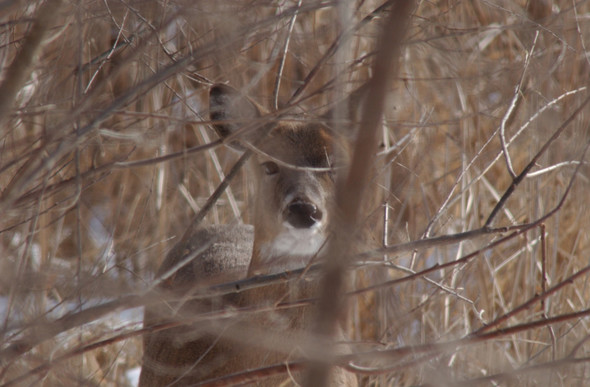
Blaze orange clad hunters moving through Iowa’s timber will be a common sight when the first of two shotgun deer seasons open Dec. 5. An estimated 120,000 hunters participate in the shotgun seasons, harvesting about half of the total number of deer for the year.
“Shotgun deer seasons are important tradition for Iowa deer hunters as well as an important time for herd management,” said Tyler Harms, deer program leader for the Iowa Department of Natural Resources (DNR).
Hunters have reported harvesting more than 26,000 deer so far this year, which is about 1,000 more than this time last year, and that’s good news, Harms said.
“From our standpoint, that’s something we like to see because coming in to the season, people were concerned about reduced deer numbers due to the widespread hemorrhagic disease outbreak last year. If we project this harvest out, not factoring in any curveball Mother Nature would throw at us, we are trending to our goal of harvesting between 100,000 and 120,000 deer,” Harms said.
Iowa’s first shotgun deer season is Dec. 5-9, and second shotgun deer season is Dec. 12-20.
Changes to deer seasons
- The antlerless deer quota has been adjusted in 23 counties.
- The January antlerless deer season will not be offered this year except in certain zones for chronic wasting disease management.
- The first shotgun season buck-only restriction has been removed in Winnebago, Worth, Hancock, Cerro Gordo, Franklin, Hardin and Grundy counties.
Deer donation program
The inaugural season for the Iowa Deer Exchange has attracted 350 Iowans who indicated they were interested in receiving venison and 60 hunters willing to provide it. The deer exchange, along with the Help us Stop Hunger (HUSH) program, allows hunters an opportunity to provide high quality lean protein to their neighbors, while continuing to do what they enjoy – hunting deer.
“We’re pleased with the participation we’ve seen thus far, and the large number of registered recipients shows there’s an audience who wants venison. We’re encouraging hunters who are making their plans now to consider picking up another doe tag and registering to donate venison,” said Harms.
To sign up for the Iowa Deer Exchange, go to www.iowadnr.gov/deer then scroll down to Iowa’s Deer Exchange Program link and fill out the required fields. The database creates a map and table with information deer donors and deer recipients can use to get connected. There is no cost to participate. It is illegal to sell wild fish and game in Iowa.
Hunter who prefer to use the HUSH program are encouraged to contact a participating locker before they harvest a deer to see if the locker has any additional drop off instructions. The list of participating lockers is available at www.iowadnr.gov/deer the scroll down to the Help Us Stop Hunger link. The HUSH program is a partnership between the Iowa DNR, the Food Bank of Iowa and participating meat lockers.
Text to harvest
Hunters who harvest a deer are required to report their harvest by midnight on the day after it is tagged or before taking it to a locker or taxidermist. The hunter whose name is on the transportation tag is responsible for making the report. If no deer is harvested, no report is necessary.
New this year is the option to report your harvest via text message. Simply text the registration number on your deer tag to 1-800-771-4692 and follow the prompts. Hunters are still able to report their harvest online, by phone, or using the Go Outdoors Iowa app. Reporting using the app is straight forward, fast and easy. Hunters have their confirmation right on their phone and also receive it as an email.
Deer harvest numbers are an important component of Iowa’s deer management plan.
CWD sampling
The Iowa Department of Natural Resources (DNR) has a goal each year of collecting more than 4,600 deer tissue samples statewide to test for chronic wasting disease and the majority of those samples come from the two shotgun deer seasons.
The disease surveillance effort includes colleting a minimum of 15 samples from each county, with higher quotas assigned to counties where the disease has been found in wild deer or have high risk of the disease due to adjacent counties with positive animals. To date, the DNR has collected and submitted more than 1,100 samples for testing this year.
“We are prioritizing samples this year to try to improve the information we are getting from this important effort. The deer that give us the best opportunity to detect this disease in new areas are adult bucks,” Harms said. After adult bucks, priority goes to adult does, then yearling buck and finally yearling does.
Hunters willing to provide a sample are encouraged to contact their local wildlife biologist to arrange for the collection.
In the event that the county or priority area quota has been filled, or if the hunter is interested in testing a fawn or other nonpriority deer, hunters may choose to pay for their own test through a new partnership with the Iowa State University Veterinary Diagnostic Laboratory.
Hunters will need to contact their local wildlife staff and ask how they can get their deer tested through the new hunter submitted option. The DNR will collect and submit the sample on their behalf. There is a $25 fee for the laboratory to run the test. Results should be available within 2-3 weeks.
Deer Management Zones
Special antlerless deer licenses are available, outside of regular county quotas, in specific areas where the DNR would like to focus additional harvest to increase deer samples as part of its surveillance effort for chronic wasting disease.
The DNR has identified 12 of these deer management zones in nine counties. Information on these zones, where to buy a license and local contacts for samples is on pages 33-34 of the Iowa Hunting Regulations. Boundary maps are available online at www.iowadnr.gov/cwd. A stipulation of purchasing one of these licenses is that successful hunters are required to provide a tissue sample.
Media Contact: Tyler Harms, Biometrician, Wildlife Bureau, Iowa Department of Natural Resources, 515-777-5378.
The first of Iowa’s two shotgun deer seasons opens on Dec. 5, and while optimism for a successful hunt is the primary focus, hunters are encouraged to brush up on safe hunting practices.
Basic firearm rules are pretty straight forward: treat every firearm as though it were loaded; always point the muzzle in a safe direction; be sure of your target and what’s beyond it; keep your finger off the trigger until ready to shoot.
“Our deer hunting tradition is shared with our friends and our family,” said Megan Wisecup, hunter education administrator for the Iowa Department of Natural Resources. “Practicing safe hunting techniques is important to make sure we all get home at the end of the day.”
An estimated 120,000 hunters are expected to take to the timber during Iowa’s two shotgun deer seasons and Wisecup said self inflicted injuries and property damage continue to be prominent.
“Those incidents could be avoided by simply following the basic rules of firearm safety and ensuring there is a safe backdrop prior to taking a shot,” she said.
“Hunters tend to get fixated on their target and when a deer is running, they forget about their surroundings. Look beyond your target and clearly identify the target before taking the shot,” Wisecup said. “You must be certain you have a clear, safe shot. Never point your firearm at anything you do not want to shoot.”
That advice can help to prevent self inflicted wounds as well.
Wisecup encouraged hunters to wear plenty of blaze orange and to discuss the hunting plan with everyone in the group.
“You want to be seen from all sides in the woods,” she said. “It is also important to discuss the hunting plan that will outline the role for each person and where they will be during the hunt. Plan your hunt and hunt your plan. It is critical to communicate with your hunting partners to ensure everyone knows where each other is at all times.”
In 2019, there were eight deer hunting incidents in Iowa: six personal injuries and three property damage, including one that was both property damage and personal injury.
Hunting Safety Tips
- Treat every firearm as if it were loaded
- Always keep the muzzle pointed in a safe direction
- Be sure of the target and what is beyond it
- Keep finger off the trigger until ready to fire
- Keep the barrel clear and choose the proper ammunition.
Winter Weather Factors
- Unload the firearm and open the action when crossing obstacles – if snow and ice is on the ground, the risk of slipping or falling dramatically increases
- Visibility – put the hunt on hold if visibility is poor due to fog and/or snowy conditions
- Bundled up – keeping your finger off the trigger and muzzle control are both extremely important as bulky coats and gloves increases chances of an accidental discharge
Hunter Visibility
- Wear plenty of solid blaze orange. Hunters want to be seen from all sides in the woods and fields
- Discuss the hunting plan with everyone in the group. Outline the role for each person and where they will be throughout the hunt. Plan your hunt and hunt your plan. Communication is critical to ensure everyone knows where each other is at all times.
Ultimate Goal
- Everyone gets home safely
Media Contact: Megan Wisecup, Hunter Education Administrator, Iowa Department of Natural Resources, 515-238-4968.
Hunters donated more than 4,100 deer hides to Elks Lodges across Iowa last year, which was a slight decrease from the 2018-2019 season. The deer hides are used by the Veterans Leather Program to make professionally-crafted leather gloves for veterans in wheelchairs and also turned into leather used for therapy programs for recovering veterans.
The Veterans Leather Program relies on the charity of hunters to donate their deer hides. Hunters willing to donate their hides are encouraged to contact the local Elks Lodge for drop off locations or visit www.elks.org/lodges to find the nearest lodge. The therapeutic kits and gloves are distributed at no cost to the veterans.
Contact Lisa Widick at 208-360-6294 or ozzywidick@gmail.com for more information.
Hundreds of yellow ovals offset the brown and green coloration of each female brown trout ready to spawn at the Manchester Fish Hatchery. The splashes of color are signs that trout spawning season is in full swing.
Brown trout are currently being spawned. Brood trout are brought to the hatchery from French Creek in Allamakee County. They are held at the hatchery across two spawning cycles then released back in French Creek, supplementing earlier generations of brown trout.
All brown trout are stocked as 2-inch fingerlings. “Anglers like these ‘wild’ stream raised fish. They are harder to catch than our put-and-take stocked fish,” explains Mike Steuck, Iowa DNR fisheries supervisor for interior streams. “Many of the public streams have lots of brown trout in them.”
Brook trout, Iowa’s only native trout, give up their eggs in late October and early November. Eggs are taken streamside from wild South Pine Creek Brook Trout, fertilized and taken back to the Manchester Fish Hatchery to be raised and stocked as 2-inch fingerlings in June.
“As a part of DNR’s Brook Trout Restoration Program, we’re working to re-establish populations of Iowa ‘wild’ brook trout in streams with suitable habitat and excellent water quality,” said Steuck.
Rainbow trout, the backbone of Iowa’s trout program, take up much of December and January. Roughly 750,000 eggs will be collected this season.
Crews check for ripe female broodstock once a week. After a quick sedative bath to calm them, each big trout is held firmly over a plastic bowl, as one of the workers rolls a hand down her belly to force out a stream of orange-golden eggs—up to 4,000 to 6,000 per fish. Mixed in quickly is the milk-white sperm from two males. Water is added to activate the eggs and sperm allowing fertilization to occur. The ingredients are gently stirred with a turkey feather to avoid bruising the eggs.
The fertilized eggs are poured into an incubator tray and slid into their place below a stream of 50 to 52 degree water until they hatch. Tiny sac-fry hatch about 30 days after fertilization. Dark clouds of tiny fish grow in raceways at the hatchery. The fish are hand-fed for the first month, then “trained” to eat from automatic feeders.
As the trout develop and grow, they are monitored and transferred to larger tanks, then raceways. The fingerlings will be kept at Manchester or transferred to Iowa’s two other stations, near Elkader and Decorah, to be raised for future stocking. In 13 to 15 months, they will be a half-pound and ready to be stocked. Nearly 50 put-and-take streams throughout nine northeast Iowa counties are stocked from April through October and almost 20 community trout fishing locations are stocked through the cold weather months.
“We stock about 380,000 catchable rainbow trout from the hatcheries,” said Steuck. “We also stock about 100,000 brook, brown and rainbow trout fingerlings each year to grow in the streams.”
There’s natural spawning, mostly brown trout and some brook trout, in more than 75 northeast Iowa streams thanks to improved habitat and trout genetics, and an extended period of above average annual rainfall. Most trout caught, though, are spawned under the eyes of hatchery workers at Manchester. These coldwater fish are great fighters and beautiful in their spawning colors this time of year.
Find more information about Iowa trout streams and tips for trout fishing on the DNR website at www.iowadnr.gov/trout.
Media Contact: Mike Steuck, regional fisheries supervisor, northeast Iowa, Iowa Department of Natural Resources, 563-927-3276.
Polk City - Two Polk County minors have been cited for intentionally hitting and killing a buck deer with their pickup truck in Big Creek State Park on the evening of Nov. 11.
Jeff Poen, state park ranger with the Iowa Department of Natural Resources (DNR) for Big Creek State Park, was contacted by the Polk City Police Department regarding an accident by the beach parking lot where a pickup truck struck a tree after swerving unsuccessfully to avoid hitting a deer.
After visiting the scene and reviewing the police report, Poen felt that the evidence contradicted their statement, and then reached out to an Iowa State Patrol investigator in the technical collision investigations unit for help.
The investigator visited the site, reviewed the evidence and came to the same conclusion. He estimated the 92 Ford pickup was traveling between 50-55 miles per hour, well above the 35 MPH speed limit posted throughout the park, when they struck the deer.
When Poen confronted them, they confessed.
The driver was charged with careless driving, driving on the wrong side of the road, prohibited destructive acts, hunting on a game refuge, illegal taking of deer, and no deer license or tag. The fines totaled more $900 and he will remain on his intermittent driver’s license until age 18. The passenger was charged with hunting on a game refuge and restriction on taking game. The fines totaled nearly $350.
Both minors will lose their hunting and fishing privileges for a year and may be facing liquidated damages of up to $20,000.
Aaron Arthur, state conservation officer for the Iowa DNR assigned to Polk County, assisted with the case.
Media Contact: Jeff Poen, State Park Ranger, Iowa Department of Natural Resources, 515-205-9135 or Mick Klemesrud, Iowa Department of Natural Resources, 515-725-8280.
DES MOINES, Iowa -- All Iowa Department of Natural Resources offices will be closed on Wednesday, Nov. 25 through Friday, Nov. 27. Normal business operations will resume on Monday, Nov. 30.
DNR offices will also be closed Thursday, Dec. 24 and Friday, Dec. 25 for the Christmas holiday.
Many DNR services are still available electronically, 24/7 via www.iowadnr.gov.
The Iowa Department of Natural Resources is working with state and local officials to reduce the spread of COVID-19 and has transitioned employees to work remotely. DNR offices are closed to the public during this time and only available by appointment.
In other efforts to further reduce the spread of Covid-19, the DNR is encouraging the use of the online services for purchasing licenses, submitting applications, payments and other daily tasks and interaction with DNR staff.
The FREE Go Outdoors Iowa app is available at the App store and Google Play. The Go Outdoors Iowa app allows users to purchase and view hunting and fishing licenses and submit harvest and quota reports, all from your cell phone.
Full list of DNR’s online services: https://www.iowadnr.gov/about-dnr/about-dnr/online-services-databases.
Up-to-date information on DNR services, facilities and events impacted by Covid-19: https://www.iowadnr.gov/About-DNR/Covid-19.
Technical information for regulated businesses in regards to Covid-19: https://www.iowadnr.gov/About-DNR/Social-Media-Press-Room/Disaster-Assistance#3057321-covid---19-outbreak.
Thank you for your patience and flexibility during this time. If you need to contact DNR staff you can reach them by email or phone or by calling (515) 725-8200.
|





