|
FOR IMMEDIATE RELEASE
Oct. 13, 2020
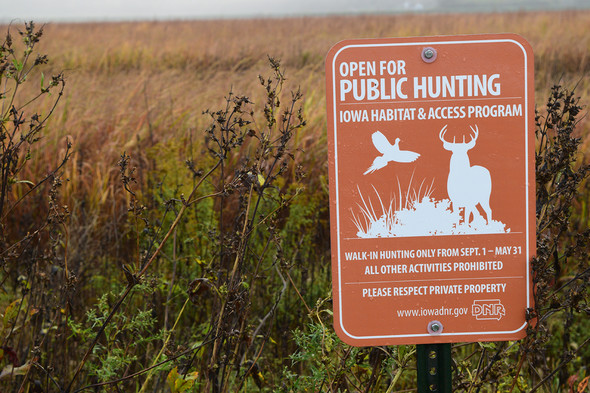 The popular Iowa Habitat and Access Program (IHAP) is accepting applications from landowners interested in receiving technical assistance and financial incentives in exchange for allowing hunters to access the improved area.
Interested landowners should contact their local private lands staff with the Iowa Department of Natural Resources (DNR), who will come to the property to walk the site with the landowner and help write a habitat plan. A map of private lands staff is available online at https://www.iowadnr.gov/About-DNR/DNR-Staff-Offices then scroll down to the Private Lands Staff pdf.
Land enrolled in IHAP allows public hunting access but remains under private ownership. Hunters may access the improved area from Sept. 1 to May 31. The Iowa DNR’s conservation officers provide assistance and enforcement if needed. Trapping is not allowed on IHAP areas.
“The program benefits landowners, wildlife and provides additional hunting opportunities, which are all priorities of the DNR and important to our landowners and our hunters,” said Brian Hickman, coordinator for the Iowa DNR’s private lands program.
IHAP began a decade ago as a way to provide hunter access to private land while creating quality habitat. Feedback provided by landowners in the program found more than 95 percent are satisfied with the program and 92 percent would recommend it to others.
“Landowners have seen a great benefit to having a biologist at their disposal providing them technical assistance as they establish habitat as well navigating Federal and State conservation program rules and requirements,” Hickman said.
Hunters are also happy with 99 percent stating they would hunt IHAP again and demonstrate that support by traveling to specifically hunt these areas. And each time they travel to hunt, they spend an average of $71 on the trip, often in nearby communities.
The program is partially funded by the U.S. Department of Agriculture’s Voluntary Public Access and Habitat Incentive Program.
Media Contact: Brian Hickman, Private Lands Program Coordinator, Wildlife Bureau, Iowa Department of Natural Resources, 712-250-0518.
Colder temperatures this weekend mean it’s time to start pruning oak trees with minimal to no risk of spreading oak wilt. The best way to prevent the spread of oak wilt is to prune during the tree(s) during dormant season.
“There have been a few days in a row that were at or near freezing and with the weekend forecast the risk of oak wilt is very minimal,” says Tivon Feeley DNR Forest Health Program Leader. “For that reason, we suggest that you start pruning your oak tree now until about the first of March.”
Oak wilt has been present in Iowa for many years, and it is caused by a fungus. The trees in Iowa most commonly impacted by this disease are species such as red, black, and pin oak, but it can also infect white and bur oak. If black, pin, or red oak are infected by the fungus that causes this disease they usually die within the same summer they are infected. White oak and bur oak can often take a number of years before they succumb to this disease.
A healthy tree can be infected by the fungus that causes this disease two different ways. The first is through open wounds during the growing season. The fungus is carried from a diseased tree to a healthy tree with an open wound by a small beetle.
The second form of infection is through root grafts between oak trees of the same species. For example, if a red oak is infected and there is another red oak within 50 to 100 feet there is a good chance that the roots of these trees are grafted and the fungus can move from the diseased tree to the healthy tree.
Symptoms to look for on infected trees usually include leaves turning a bronzed brown along the outer margins of the leaves. These leaves can often still have some green on them as they fall from the tree. The defoliation tends to start at the top of the tree. The best way to prevent the spread of oak wilt is to prevent any wounding to oak trees during the growing season. If a tree is wounded from storm damage or pruning is required during the growing season, treat the wounds immediately with a wound dressing such as acrylic paint. Do not purchase pruning paints/sealants as those products slow the tree’s ability to seal over the wound.
More information on oak wilt prevention and control can be found here: http://na.fs.fed.us/pubs/howtos/ht_oakwilt/identify_prevent_and_control_oak_wilt_print.pdf
Information on finding a local Arborist for hire can be found here: https://www.treesaregood.org/findanarborist/findanarborist
Media Contact: Tivon Feely, DNR Forest Health, (515) 725-8453, Tivon.Feely@dnr.iowa.gov.
DRAKESVILLE, Iowa -- The Iowa Department of Natural Resources will hold a public meeting on October 28, 2020 at 5:00pm at the Lake Wapello State Park Lodge, next to the beach area.
During the meeting, the public can provide comments in regard to the proposed Timber Sale of Site #19 at Lake Wapello State Park, in accordance with the Forest Stewardship Plan for Lake Wapello State Park.
Anyone in attendance is encouraged to wear a mask and socially distance while in the meeting.
Media Contact: Ron Moore, Park Manager at Lake Wapello State Park, (641) 777-9266, Ron.Moore@dnr.iowa.gov.
The Iowa Department of Natural Resources is working with state and local officials to reduce the spread of COVID-19 and has transitioned employees to work remotely. DNR offices are closed to the public during this time and only available by appointment.
In other efforts to further reduce the spread of Covid-19, the DNR is encouraging the use of the online services for purchasing licenses, submitting applications, payments and other daily tasks and interaction with DNR staff.
The FREE Go Outdoors Iowa app is available at the App store and Google Play. The Go Outdoors Iowa app allows users to purchase and view hunting and fishing licenses and submit harvest and quota reports, all from your cell phone.
Full list of DNR’s online services: https://www.iowadnr.gov/about-dnr/about-dnr/online-services-databases.
Up-to-date information on DNR services, facilities and events impacted by Covid-19: https://www.iowadnr.gov/About-DNR/Covid-19.
Technical information for regulated businesses in regards to Covid-19: https://www.iowadnr.gov/About-DNR/Social-Media-Press-Room/Disaster-Assistance#3057321-covid---19-outbreak.
Thank you for your patience and flexibility during this time. If you need to contact DNR staff you can reach them by email or phone or by calling (515) 725-8200.
|





