|
FOR IMMEDIATE RELEASE
Sept. 29, 2020
An estimated 60,000 hunters will be heading to the timber in the next few weeks as Iowa’s archery deer season gets underway Oct. 1. For hunters in the derecho corridor, this year will not be like seasons past.
“Scouting is always important, but if you’re hunting in the area damaged by derecho, it will be particularly important this year,” said Tyler Harms, deer program leader for the Iowa Department of Natural Resources (DNR).
Deer are habitual animals, Harms said, but in the area impacted by the historic August storm, deer travel lanes, food sources and even some bedding areas – their habits – have likely been changed.
Hunters should spend time getting reacquainted with the new landscape and to pattern deer habits and identify the locations of any downed trees as hunters are most likely going to be walking out there in the dark. They may also need to reset or rebuild tree stands or move the tree stands to new travel corridors or to new cover.
Deer movement will likely be increasing with the activity in the field, between the crop harvest underway as well as fields being chopped as part of the damaged crop removal requirement for insurance.
“The current weather pattern and crop removal will make for an interesting start to the season, especially for the first weekend,” Harms said.
In a typical year, deer tend to focus on existing food sources, then turn to green browse as the harvest continues. Given the amount of waste grain in the derecho fields, bow hunters may need to rethink their strategy.
Iowa deer population down slightly
The results of Iowa’s annual spring spotlight survey indicate the population is 3 percent lower than last year, said Harms, who coordinates the project. Part of the decline could be related to last year’s outbreak of epizootic hemorrhagic disease in certain locations.
“What we know is that the population can recover,” he said. “While we were in a pretty significant drought this year, we haven’t received any reports of the disease. That may change as the crops come out, but so far, so good.”
Bowhunters hunt a lot
Bowhunters wait all year for November when they cash in a large chunk of their vacation hours so they can spend time in the tree stand during the rut waiting for that hormone charged stag to come along. The rut is the deer breeding season, when deer, especially-bucks, loose their usual cautiousness and become active and aggressive during all hours of the day.
Bow hunters fall on the avid range of the participation scale. Based on the annual bowhunter survey, they go out an average of 12 trips per year and spend an average of 3-1/2 hours per trip. They tend to be more selective and harvest fewer does than other regular deer seasons.
CWD sampling
While chronic wasting disease sample collection is often associated with the shotgun seasons, the Iowa DNR does collect deer tissue samples during bow season as part of its statewide annual effort to monitor for the fatal disease.
“Those adult bucks harvested early in the fall by bow hunters are the best samples for us when looking for the disease in new areas,” Harms said.
The DNR has a goal of collecting a minimum of 15 samples from each county, with higher quotas assigned to counties where the disease has been found in wild deer or have high risk of the disease due to adjacent counties with positive animals. Hunters willing to provide a sample are encouraged to contact their local wildlife biologist to arrange for the collection.
In the event that the county quota has been filled, or if the hunter is interested in testing a fawn or other nonpriority deer, hunters may choose to pay for their own test through a new partnership with the Iowa State University Veterinary Diagnostic Laboratory.
Hunters will need to contact their local wildlife staff and ask how they can get their deer tested through the new hunter submitted option. The DNR will collect and submit the sample on their behalf. There is a $25 fee for the laboratory to run the test. Results should be available within 2-3 weeks.
Changes to deer seasons
- The antlerless deer quota has been adjusted in 23 counties.
- The January antlerless deer season will not be offered this year except in certain zones for chronic wasting disease management.
- The early muzzleloader and first shotgun season buck-only restriction has been removed in Winnebago, Worth, Hancock, Cerro Gordo, Franklin, Hardin and Grundy counties. The early muzzleloader buck-only restriction has been removed in 20 additional counties in northwest corner of the state.
Deer donation program
The Iowa DNR, the Food Bank of Iowa and 39 meat lockers are participating in the Help Us Stop Hunger program for 2020. Hunters are encouraged to contact a participating locker before they harvest a deer to see if the locker has any additional drop off instructions.
Hunters may also sign up as a deer donor with the Iowa Deer Exchange at www.iowadnr.gov/deer then scroll down to Iowa’s Deer Exchange Program link. There, donors can provide their information on what they are willing to donate. The database creates a map and table with information deer donors and deer recipients can use to get connected. There is no cost to participate. It is illegal to sell wild fish and game in Iowa.
Text to harvest
Hunters who harvest a deer are required to report their harvest by midnight on the day after it is tagged or before taking it to a locker or taxidermist. The hunter whose name is on the transportation tag is responsible for making the report. If no deer is harvested, no report is necessary.
New this year is the option to report the harvest via text message. Simply text the registration number to 1-800-771-4692 and follow the prompts. Hunters are still able to report their harvest online, by phone, or using the Go Outdoors Iowa app.
Don’t Veer for Deer
The combination of cool fall weather and tractors and combines removing crops in fields across Iowa will likely get deer moving early this year. With the peak of the deer breeding activity still more than a month away, drivers need to remain vigilant with their defensive driving skills.
“Try to minimize distractions, like cellphones or eating while driving, and, if possible, avoid driving during dawn and dusk which are when deer are most active,” said Harms. “Slow your speed, look fencerow to fencerow and for the reflection of their eyes. If a deer jumps on to the roadway, don’t veer or try to avoid it, but use a controlled braking technique.”
Drivers passing through the storm damaged part of the state need to be aware that deer may not be traveling through the usual corridors, Harms said.
Media Contact: Tyler Harms, Biometrician and Deer Program Leader, Wildlife Bureau, Iowa Department of Natural Resources, 515-777-5378.
Tree stand incidents can happen to deer hunters regardless of skill level or experience and result in serious injury or even death. Unfortunately, in nearly every case, these incidents were preventable.
To help prevent injuries, the Iowa Department of Natural Resources is encouraging hunters to practice the ABC’s of Tree Stand Safety.
Always remove and inspect your equipment
Buckle on your full-body harness
Connect to the tree before your feet leave the ground
“Hunters should take tree stand safety seriously, every time you hunt from, hang, or move a tree stand. By performing these three simple steps and properly using a haul line, tree stand users can virtually eliminate their risk of falling to the ground as the majority of falls occur outside the stand,” said Megan Wisecup, hunter education administrator for the Iowa Department of Natural Resources.
Media Contact: Megan Wisecup, Hunter Education Administrator, Iowa Department of Natural Resources, 515-238-4968 or Jeff Barnes, Recreation Safety Officer, Iowa Department of Natural Resources, 515-290-4907.
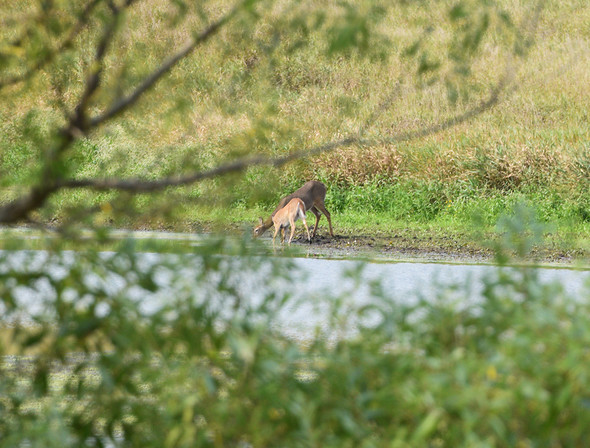 A doe and her fawn drink from the pond at Vern and Wilmer Petersen Wildlife Area. The 450-acre public area attracts hunters, anglers, birdwatchers, and nature lovers all year long. Photo courtesy of the Iowa DNR.
Manilla, Iowa – Just southwest of Manilla on the Crawford-Shelby County line is a 450-acre gift to Iowans who love to be outdoors.
Vern and Wilmer Petersen Wildlife Area is the former Petersen farm that was donated to the Iowa Department of Natural Resources in 1993 to provide public outdoor recreation all year long.
The rolling prairie with small woodlots on the southwest and north side surround a two-acre pond. That pond has been a popular place thanks to a $15,000 donation from the Crawford County Pheasants Forever chapter that allowed Boeck Construction, out of Manilla, to build and gravel an access lane to the pond this spring.
Standing at the gravel parking area near the pond, 10 blue winged teal flushed and circled a few times before disappearing over the west ridge. Two small islands served as goose nesting sites producing three broods this year. Pheasants are heard crowing to the north.
“This area was a grassland and we’re going to manage it as a grassland to benefit pheasants and quail and all other grassland birds,” said Doug Chafa, wildlife biologist with the Iowa DNR. Chafa has been working the Crawford County PF chapter to reclaim the prairie by pulling cedar and other non-target trees encroaching on the area. The trees are stacked in piles just waiting for the right winter conditions to get burned.
Crawford County Pheasants Forever has donated $14,000 over the past three years - matching the DNR’s investment - to pull and shear trees off the landscape. “The PF donation has doubled what we have gotten done for tree removal,” Chafa said.
Once a section of the land is cleared, its farmed for two or three years as a process to get rid of the brome and to prepare the soil for a diverse mix of prairie grasses and flowers. Chafa applies the income from farming process to tree removal.
The DNR uses a local ecotype prairie seed mix from its Prairie Resource Center that is broadcast over the still frozen ground. For the first two years, it looks like a weedy mess, but in year three, the prairie begins to express itself.
“It just gets better as it gets older,” said Jon Saunders, of Manilla and member of the Crawford County Pheasants Forever chapter.
Looking out over the prairie, visitors will see wild bergamot, gray-headed coneflower, compass plant, tick trefoil, common milkweed, cup plant, sideoats grama, little bluestem, Indian grass, partridge pea, Virginia rye, rattlesnake master, black-eyed Susan, oxeye sunflowers and more.
Because it was installed at different times, the prairie is in different stages of maturity offering short and sparse habitat to thick and deep habitat that benefit birds of different species. Chafa uses prescribed fire on different sections each year with a goal of burning the entire area every five years.
As the brome is replaced with native prairie, wildlife has responded. Quail and pheasants are here as well as more grassland birds, like bobolinks and dickcissels. The first record of a prairie skink in Shelby County was confirmed here in the spring of 2019. The five- to six-inch long reptile is considered a species in decline in Iowa.
“I like to see the habitat,” Saunders said. “I like to see if for the kids. We host youth days out here. I like the public hunting component – it’s nice habitat to hunt. And it’s good for out of state hunters.”
Vern and Wilmer Petersen
The Petersen’s had a second house on their farmstead where they would host visitors who had taken the train in to attend local cattle auctions. They would bring in live bands to entertain their guests. When the auction was over, the visitors and their cattle would return home on the train together.
The Petersen family had an interest in conservation and improving water quality and decided to donate their farm to the Iowa DNR for everyone to enjoy. With a small pond, remote and scenic setting, with opportunities to fish and learn to paddle, hike through rolling hills, enjoy grassland birds and prairie plants, their vision is becoming reality.
“I’d hate to guess how many people hunt this area,” Saunders said. “Come by every morning on the weekend during the season and there’s at least one group hunting it. There’s a lot of traffic to the pond, especially from those who are less mobile.”
Dove fields
Chafa rotates sunflower plots around the area, making sure the fields are fairly close to the road. A former sunflower field on the south side was planted with a cover crop after the dove season then allowed to go idle. It came up in weeds that produce a lot of seeds and provides overhead cover over bare ground that is great for pheasant chicks and quail to run and feed on bugs out of sight.
Media Contact: Doug Chafa, Wildlife Biologist, Iowa Department of Natural Resources, 712-420-2437.
 Longtime leader with the Iowa Department of Natural Resources (DNR), Dr. Dale Garner, will retire on Sept. 30, after serving the people of Iowa for more than 25 years.
"I am forever grateful for Dale’s many years of service to our state,” said Kayla Lyon, director of the Iowa DNR. “His invaluable expertise and knowledge of wildlife is unparalleled and he has been an incredible benefit to the state of Iowa and beyond. Iowans should be very proud of Dale’s dedication and passion to Iowa’s natural resources during his tenure."
Garner spent most of his career in the Wildlife Bureau beginning as a research biologist for forest wildlife species in the Chariton office in 1995, before moving to Des Moines in 2001 to become the coordinator of the North American Wetland Conservation Act grant programs and other special projects, like heading up the chronic wasting disease program.
He was promoted to chief of the Wildlife Bureau in 2004, then promoted to administrator over the division that houses Fisheries; Parks, Forests and Preserves; Engineering, Land and Waters; Law Enforcement and Wildlife bureaus in 2017.
Throughout his career, Garner managed by the philosophy of keeping the resource first.
“That should always be number one,” he said. “Public places belong to the citizens of this state. We’re just the custodians of them. Our job is to manage these resources in perpetuity.”
That philosophy goes back decades and can be seen first hand in the form of the restoration of Iowa’s shallow lakes, the forward-looking forest stewardship plans, restored lakes, the number of trout streams supporting naturally reproducing trout, converting upland areas into high quality, diverse native prairies and the efforts to restore and update Iowa’s state parks.
“What an opportunity to work in natural resources for those of us fortunate enough to do that,” he said. “It’s just a blessing.”
Garner, a Wisconsin native, received his Ph.D. in Environmental and Forest Biology, from the State University of New York at Syracuse.
Fall is a great time to catch fish with family and friends. The air is cool, the views are picturesque and the fish are easy to catch. Make lasting memories together and put your worries behind you.
“Fantastic fishing opportunities await both new and expert anglers,” said Joe Larscheid, chief of the Iowa Department of Natural Resources Fisheries Bureau. “Grab your tackle box, take the family, and get your lines in the water.”
Cooler temperatures and shorter daylight times trigger fish to actively search for food to build energy reserves to survive the long winter. These predictable movements make them easier to find.
“Yellow perch, muskies, crappies, walleyes, largemouth and smallmouth bass are more active in the fall,” explained Larscheid. “They eat more and more often to get ready for winter.”
The fall bite in lakes and ponds shifts to the main part of the day. Fish are more active during the day and will be close to shore. Target areas of a lake where the water is warmer, mostly in shallow water bays along the north shore.
“Use live bait, particularly minnows, small tackle and fish slowly when fishing in cooler water,” Larscheid said.
Look for panfish schools in open water near structure like a brush pile, underwater hump, drop-offs and rock reefs. Largemouth bass will be close to some type of structure like underwater brush piles, old road beds, rock reeks or weed lines.
Quickly find fish structure locations with the online fishing atlas or download structure location maps from the DNR’s Fishing Maps website.
Find tips for catching yellow perch, crappie, walleye, bass and catfish on the DNR website at www.iowadnr.gov/fishing. Check the weekly fishing report to find out what is biting where.
Media Contact: Joe Larscheid, Chief of Fisheries, Iowa Department of Natural Resources, 515-201-3376.
AMES, Iowa – The Shimek State Forest in Iowa’s southeast corner will again be featured for this year’s fall forestry field day – this time in a free online format.
Three educational sessions will highlight different aspects of forestry and bird life, in a series of short videos to be shown during a webinar Oct. 1 from 11 a.m. to noon.
“The central theme this year is forest management for birds, but we’ll cover a wide range of practical forestry topics relevant to private woodland owners,” said Billy Beck, assistant professor and extension forestry specialist with Iowa State University Extension and Outreach.
Presenters at three sites will highlight a unique forestry or silviculture practice, and how those practices are important to different species of birds.
Topics will include clear-cutting, shelterwood and regenerating desired species; forest health and issues with disease and insects, as well as weather events like the recent derecho; and a timber market update.
“We want to make people aware of what’s going on across Iowa and provide them with the additional resources they may need,” Beck said.
Shimek State Forest encompasses more than 9,000 acres in Iowa’s Lee and Van Buren counties. The pre-dominant trees are oak-hickory and bottomland hardwood. Although the event focuses on this forest, the content will pertain to people across Iowa and the Midwest.
Other speakers will include Adam Janke, assistant professor and extension wildlife specialist; John Byrd, area forester at Shimek; Anna Buckhardt-Thomas, ecologist with the Iowa Department of Natural Resources; and a representative from the Iowa Woodland Owners Association.
Participants must register in advance for the webinar, and should test their equipment and connection in advance of the start time. After registering, you will receive a confirmation email containing information about joining the meeting.
A viewing will also be available at the ISU Extension and Outreach Lee County office, for those unable to connect from home. The webinar will also be archived online.
For more information, contact Beck at 515-294-8837, or wjbeck@iastate.edu.
The Iowa Department of Natural Resources is working with state and local officials to reduce the spread of COVID-19 and has transitioned employees to work remotely. DNR offices are closed to the public during this time and only available by appointment.
In other efforts to further reduce the spread of Covid-19, the DNR is encouraging the use of the online services for purchasing licenses, submitting applications, payments and other daily tasks and interaction with DNR staff.
The FREE Go Outdoors Iowa app is available at the App store and Google Play. The Go Outdoors Iowa app allows users to purchase and view hunting and fishing licenses and submit harvest and quota reports, all from your cell phone.
Full list of DNR’s online services: https://www.iowadnr.gov/about-dnr/about-dnr/online-services-databases.
Up-to-date information on DNR services, facilities and events impacted by Covid-19: https://www.iowadnr.gov/About-DNR/Covid-19.
Technical information for regulated businesses in regards to Covid-19: https://www.iowadnr.gov/About-DNR/Social-Media-Press-Room/Disaster-Assistance#3057321-covid---19-outbreak.
Thank you for your patience and flexibility during this time. If you need to contact DNR staff you can reach them by email or phone or by calling (515) 725-8200.
|





