|
FOR IMMEDIATE RELEASE
Sept. 22, 2020
COUNCIL BLUFFS, Iowa -- The Iowa Department of Natural Resources (DNR) and local community groups will host a groundbreaking ceremony for a new campground at Lake Manawa State Park at 1 p.m. on Sept. 24, 2020.
The new campground will be located west of the current beach area, with an anticipated opening date of September 2021. The new 40-site campground will have a shower/restroom facility, along with full hook-up sites and paved camping pads.
According to Todd Coffelt, DNR Parks, Forests and Preserves bureau chief, the campground will expand local recreation and tourism opportunities, while enhancing park amenities.
The groundbreaking ceremony will take place at Shelter #6, which is located near the Dreamland Playground and Lake Manawa Beach. In attendance will be Kayla Lyon, director of the DNR, Todd Coffelt, chief of the DNR’s Parks, Forests and Preserves Bureau, Michelle Reinig, district supervisor for Parks, Forests and Preserves Bureau, and members of the Lake Manawa Friends Group, among other community members and dignitaries.
The new campground facilities will cost $3 million, with funding from Parks and Institutional Roads Fund, Land and Water Conservation Fund, and state capital infrastructure funds.
Media are invited to attend. Due to COVID-19, please practice social distancing and consider wearing a mask when distancing is not possible.
MEDIA CONTACT: Todd Coffelt, (515) 330-9204, Todd.Coffelt@dnr.iowa.gov
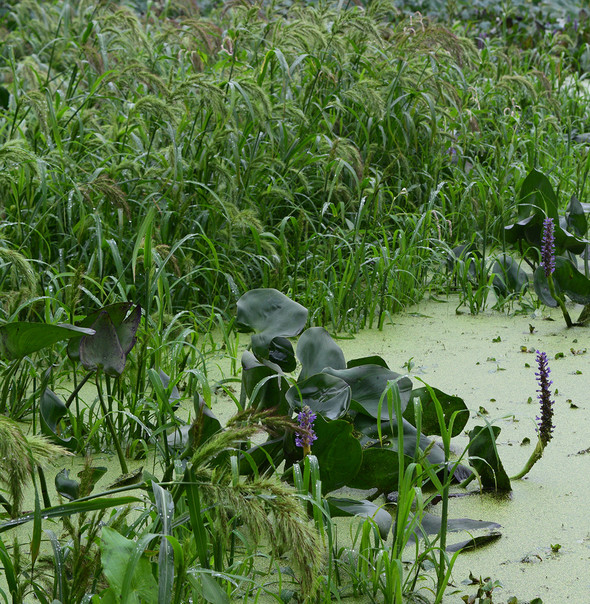 A new water control structure allows wildlife experts the flexibility to manipulate the water level in the wetland to create habitat and food that is important for waterfowl, and migrating wetland and shorebirds. A late drawdown this year produced a good crop of millet, barnyard grass, pickerelweed and smartweed on the north end. Once the frost comes, the lotus, pickerelweed and other wetland plants will defoliate creating more open water. Photo courtesy of the Iowa DNR.
CONESVILLE, Iowa - Cone Marsh is the most diverse wetland in Southeast Iowa. It’s part of the first in the nation Amphibian and Reptile Conservation Area and has a history of waterfowl hunting that dates back to the late 19th Century.
A recent project to replace a failing water control structure has allowed area managers to manipulate the water level in the wetland to encourage vegetation that provides food and cover for waterfowl and other wetland birds.
In short – for wetland wildlife, Cone Marsh Wildlife Area is kind of a big deal.
“It’s the most diverse wetland complex in southeast Iowa,” said Andy Robbins, wildlife biologist with the Iowa Department of Natural Resources. “If you’re in pursuit of wetland birds, whether with gun or camera, they’ll likely be here.”
Cone Marsh’s 728 acres benefits from its location adjoining privately owned marshes on its east and south side, bringing the combined habitat to more than 1,800 acres, of which, 1,000 acres are wetlands. The neighboring marshes benefit from a recent project at Cone Marsh allowing wildlife experts to better control the water level in the wetland to produce vegetation and food needed by ducks during the migration.
Fixing the infrastructure
The previous water outlet structure was too small to manage the water level in the marsh and was in a failing state, threatening the integrity of the dike. The structure was replaced in 2017 that allows Robbins to manipulate the water level and the habitat has had the desired effect making Cone Marsh more attractive to waterfowl, and to migrating wetland and shorebirds.
Robbins has been able to manage the water level to produce different outcomes, like the late drawdown this year that produced a good crop of millet, barnyard grass, pickerelweed and smartweed on the north end.
“This new structure was part of a North American Wetland Conservation Act grant and was engineered by our partners with Ducks Unlimited. It is a good design and it should last for decades,” Robbins said.
Hunting History
Cone Marsh and its surrounding wetlands have a history of waterfowl hunting dating back to the late 19th Century. It was an area used by hunters who would harvest ducks in large numbers then taken to the nearby train station and sent to markets across the country. The practice of market hunting was banned as part of the Migratory Bird Act of 1909.
Private hunt clubs adjoining the marsh have been around since the early 1900s. The public area was assembled in the 1960s and 70s, with the first acquisition coming from the Iowa City Moose Lodge that owned one of these hunt clubs.
The area draws hunters from Muscatine, Johnson, Washington and Louisa counties. It’s a popular place during the regular duck season and to avoid the crowds, Robbins advises to come on a week day. “Acre for acre, more people hunt here than at any of my areas,” Robbins said.
Restoring the Prairie
On the surrounding upland, Robbins and his staff have been focused on eliminating the thick, dense groves of black locust and honey locust and creating a diverse native prairie plants like blazing star, rattlesnake master, wild bergamot, coneflowers, big and little bluestem and more. A few small hayfields are part of the management plan to provide places for pheasants to nest.
“It’s a constant battle to keep the unwanted trees from creeping back on the prairie and marshland, but we’re getting a handle on it,” he said. “It’s been a lot of work and it’s nice to see that work is getting a response from wildlife. We’ve always had wetland birds here, but now grassland birds like bobolinks, are showing up.”
Birdwatching
Cone Marsh draws birdwatchers year-round from Iowa City, Washington and Muscatine, but visit less often during the hunting season. They tend to set up spotting scopes more frequently at the north end of the wetland.
Sandhill cranes have been nesting here since the 1990s. Black necked stilts, avocets, ibises, a large variety of shorebirds, trumpeter and tundra swans all migrate through Cone Marsh. In the spring, tens of thousands of snow geese pass through, which is a more recent development,
Cone Marsh has been a trumpeter swan release site but for whatever reason, they haven’t nested here. “I don’t know why,” he said. “Trumpeters like everything that’s here. I just don’t think that they like to nest this far south.”
Reptiles and Amphibians
Cone Marsh is included in the Amphibian and Reptile Conservation Area, which covers parts of seven counties in Southeast Iowa where there’s the highest number of amphibian and reptile species, including a high percentage of Iowa’s rarest amphibians and reptiles. An important emphasis of this area is to support healthy source populations of amphibians and reptiles, but is especially focused on Iowa’s declining amphibians and reptiles.
“Blanding’s turtles are here, tons of other herps are here including frogs, turtles, and all the usual water and upland snakes,” he said.
It’s also a place popular with those who enjoy catching bullfrogs.
Media Contact: Andy Robbins, Wildlife Biologist, Iowa Department of Natural Resources, 319-551-8459.
As Iowa’s annual harvest preparation hits full stride, the Iowa DNR encourages farmers to get reacquainted with fire prevention practices to keep the farm ‘firewise.’ The following simple steps can save time and money.
-
Properly prepare machinery to reduce the chance of a field fire from an overheated bearing (check the manufacturer’s recommendations). A spark from an improperly lubricated combine can instantaneously ignite dry plants and field debris. Check that all fire extinguishers carried on the machinery are fully charged with loose powder inside. If the powder is not loose, remove the extinguisher from its bracket then thump the canister with a rubber hammer until the powder moves when shaken. Make sure the size of the extinguisher is appropriate for the size of the machinery. You may need larger and/or additional extinguishers. Also make sure you have the correct extinguisher for the type of fire to be extinguished. There are two types of extinguishers, the powder extinguisher for electrical and petroleum-based fires and the water extinguisher for vegetative fires. This means that you may need to carry both kinds of extinguishers.
-
Keep equipment clean. Check and remove combustible harvest debris from motors, exhausts, ledges, and brackets several times a day. A portable gas-powered leaf blower is great for blowing debris from the various surfaces of the combine.
-
Service grain storage and drying equipment. Storage facilities are like your bank vault! Protect their contents by properly servicing all bearings, belts, motors, and drags. Dryers frequently cause fires, so before drying grain have a qualified service technician perform the necessary maintenance. Also keep weeds mowed around the facilities to discourage a fire from spreading. Again, all extinguishers should be handy, fully charged, and the proper size and type for the area.
-
Turn off interior lighting in overfilled bins. A grain fire will start if the grain surrounds the bulb! Turn off the light’s breaker to avoid accidentally turning the light on. This also applies to hay storage facilities.
-
Handle hay properly. Improper hay storage commonly causes or complicates farm fires. Preventative measures greatly reduce this risk. Planning proper hay storage is crucial. Store hay away from combustibles such as gasoline, fertilizers, and pesticides, as well as open burning areas like burn barrels, brush piles, and vegetative burning. Arrange round bales in groups of 10 or fewer and place at least 100 feet away from structures. Leave 30 feet of mowed grass, bare ground, or rock between the bale groups, creating a solid fire break. Many hay fires occur by spontaneous combustion of moist hay, usually within six weeks after baling. Plan to bale hay at its driest stage and do not bale in the morning dew or too soon after a rain. Check stored hay frequently for hot hay or an internal hay fire. Be aware of a caramel or strong burning odor, a visible vapor or smoke, a strong musty smell, and/or hay that is hot when touched. If any of these occur, call the fire department immediately and do not move the hay. Moving it exposes overheated or smoldering hay to oxygen, speeding the fire.
-
When tilling in the fall, till a 30-foot break around building sites, remote bin sites, and outside storage facilities to minimize fire spread. Again, remove weeds and other combustibles around structures and stored equipment.
-
If a fire occurs, remain calm, call 911 immediately. Provide clear, concise directions to your location. Many field and bin sites do not have 911 addresses, so be prepared to identify an intersection or landmark to direct responders.
To help control field fires until firefighters arrive, remain calm and act swiftly. Quickly disk a fire break approximately 15 feet wide around the fire. Be cautious when doing this as smoke will starve and stall a motor and will make hazards and bystanders hard to see. To assist with a structural fire, make sure there are no flammable objects nearby and if the circuit panel is safely accessible turn off the building's electricity. If time allows, evacuate any livestock to a distant pasture. Also, if possible spray high-pressure water on any surrounding vegetation or structures, discouraging spreading embers. Do not take risks.
After using any equipment to fight a fire, check air filters, ledges, nooks and crannies for burning debris. For more detailed information, visit www.iowadnr.gov/forestry/fire/firewise.html.
Remember, in a fire emergency, call 911 immediately. Do not wait until all your means of fighting the fire are exhausted. Every minute impacts your losses.
The Iowa Department of Natural Resources Forestry - Fire Program, working in coordination with the U.S. Forest Service, has grant money available for Iowa’s rural fire departments to help battle wildfires.
The grants offer funding assistance for wildfire suppression equipment, slide-in units, hoses, nozzles, adapters, portable tanks and pumps, personal protective equipment and communications equipment. Additionally, if a fire department has a special need that can be tied directly to wildfire suppression, this grant allows for such special requests.
The grant provides 50 percent reimbursement for wildland fire equipment with a maximum reimbursement grant of $3,500 per department. The 2020 Volunteer Fire Assistance grant applications are due on October 15.
Gail Kantak, DNR state wildland fire supervisor, reminds fire departments to send her a Wildland Fire Report whenever they respond to a wildland fire or provide assistance to a prescribed or controlled wildland fire. “Departments actively returning these reports can receive priority points in the Volunteer Fire Assistance grant application scoring process,” she said.
All Iowa volunteer fire departments were mailed information about the 2020 Volunteer Fire Assistance Grant. The grant application package and the Wildland Fire Report form are attached and are also available online at www.iowadnr.gov/fire.
For more information, contact Gail Kantak at gail.kantak@dnr.iowa.gov or 515-689-0083.
The Iowa Department of Natural Resources is working with state and local officials to reduce the spread of COVID-19 and has transitioned employees to work remotely. DNR offices are closed to the public during this time and only available by appointment.
In other efforts to further reduce the spread of Covid-19, the DNR is encouraging the use of the online services for purchasing licenses, submitting applications, payments and other daily tasks and interaction with DNR staff.
The FREE Go Outdoors Iowa app is available at the App store and Google Play. The Go Outdoors Iowa app allows users to purchase and view hunting and fishing licenses and submit harvest and quota reports, all from your cell phone.
Full list of DNR’s online services: https://www.iowadnr.gov/about-dnr/about-dnr/online-services-databases.
Up-to-date information on DNR services, facilities and events impacted by Covid-19: https://www.iowadnr.gov/About-DNR/Covid-19.
Technical information for regulated businesses in regards to Covid-19: https://www.iowadnr.gov/About-DNR/Social-Media-Press-Room/Disaster-Assistance#3057321-covid---19-outbreak.
Thank you for your patience and flexibility during this time. If you need to contact DNR staff you can reach them by email or phone or by calling (515) 725-8200.
|





