|
FOR IMMEDIATE RELEASE
Sept. 15, 2020
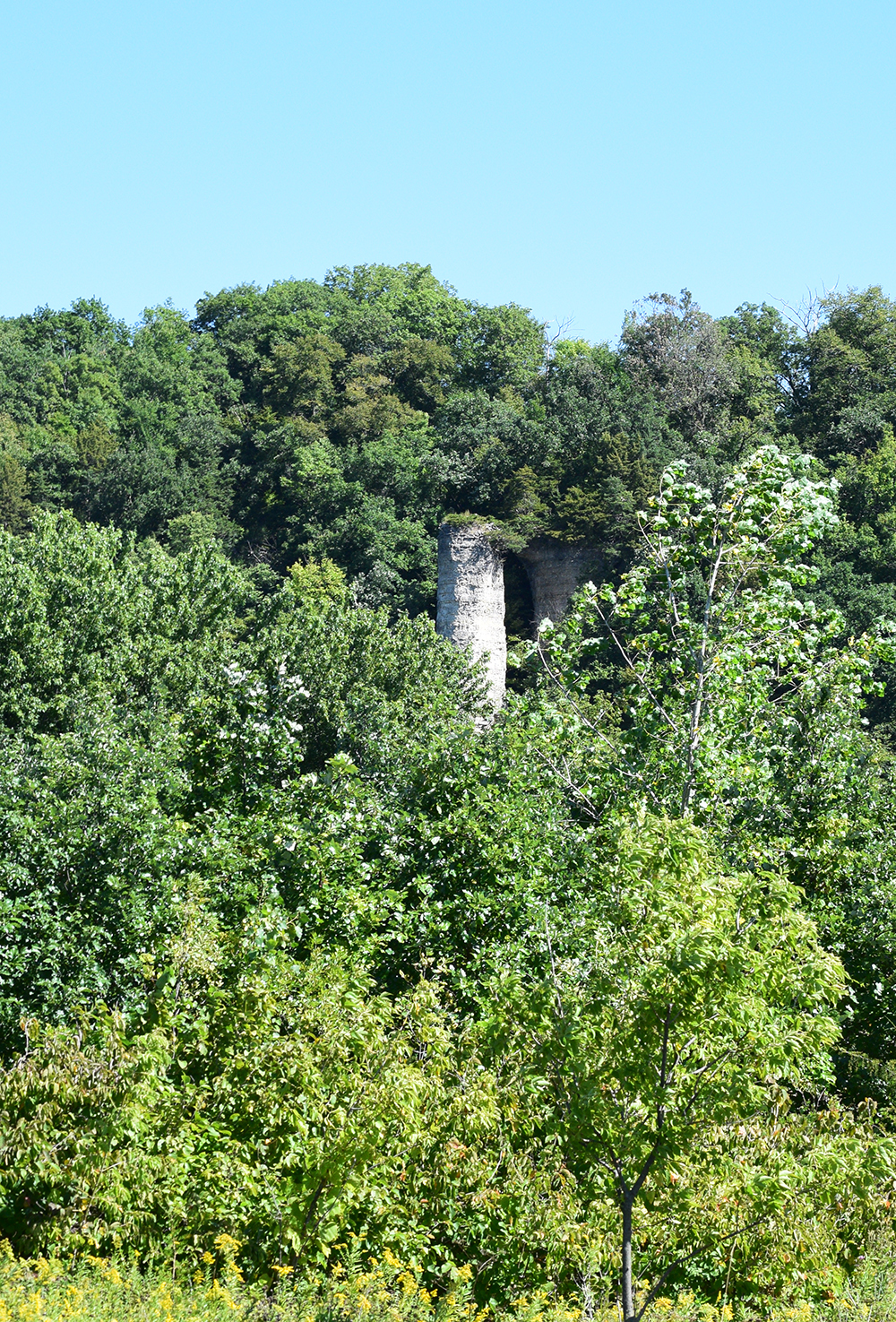 The often-photographed chimney rocks tower over the Upper Iowa River, adding to the public wildlife area’s picturesque scenery. Photo courtesy of the Iowa DNR.
DECORAH - Nestled in the heart of Bluff Country in Winneshiek County, the Upper Iowa River Chimney Rocks Wildlife Area offers visitors scenic views of its namesake chimney rocks, reconstructed prairie and a high-quality trout stream emptying into the legendary Upper Iowa River.
“Whether your hunting, hiking, fishing or birdwatching, Chimney Rocks checks a lot of boxes,” said Troy Anderson, wildlife biologist for the Iowa Department of Natural Resources.
Visitors come from across Iowa and Minnesota to the 440-acre public area hidden in the countryside, 10 miles south of the Minnesota state line, for its quality pheasant, deer, turkey, dove and squirrel hunting, and to test their skills against rainbow and brown trout in Coldwater Creek and smallmouth bass and walleyes in the Upper Iowa River.
“I’ve encountered anglers on occasion willing to make the mile plus hike from the parking lot back to the mouth of Coldwater Creek, looking for big brown trout,” Anderson said. “It’s a very popular trout stream.”
There are closer parking lots to the trout stream – one a few hundred yards north of the Chimney Rocks boundary and one with a canoe access one-half mile south of the mouth of the trout stream on the Upper Iowa River, but access is temporarily restricted due to bridge construction.
Chimney Rocks is a popular area with paddlers who float this section of the Upper Iowa specifically to see the chimney formations and this summer was one for the record books.
“Usually paddler use depends on river conditions and weather, but this year it didn’t matter – it was busy the entire summer. I can’t even guess at the number of paddlers,” Anderson said.
For example, he said the local conservation officer checked 106 vessels in one day – three canoes, 103 kayaks. With two miles of the river flowing through Chimney Rocks, paddlers have used the sandbars on the wildlife area as places to hangout or to camp.
“The chimney rocks are something cool to see; it’s picturesque. That’s why this stretch is so popular,” he said.
The area is also home to algific talus slopes – rare north facing cool-air bluffs only found in the driftless region. They stay cool all season and are a unique and fragile ecosystem. A showy lady slipper, an orchid listed as threatened in Iowa, has been found on the algific talus slopes.
West of the river, Anderson has been overseeing the results from an oak regeneration project on a ridgetop and a 100-acre prairie reconstruction. The oak regeneration project was part of the forest wildlife stewardship plan written in partnership with the district forester.
“We removed the elms, hackberries, ironwood and basswood and other non-target trees to allow for oak regeneration. Once you open up the understory and give the floor some sunlight, we see oaks sprouting from acorns and from cut stumps,” he said. “It’s responded really well.”
The prairie was reconstructed using a local ecotype prairie plant mix including rattlesnake master, blazing star, New England aster, native sunflowers and more. The prairie attracted rusty patched bumblebee which Anderson found here last year. The bumblebee, with a rusty patch centrally located on the backs of workers and of males, was listed as an endangered species by the U.S. Fish and Wildlife Service in 2017.
On the bottomland, the Iowa DNR partnered with the Iowa Natural Heritage Foundation in 2006 to purchase 130 acres on the inside bend of the Upper Iowa River.
This area was planted with bur oak, swamp white oak, hackberry, silver maple, cottonwood and green ash trees adjacent to four rows of ninebark, hazelnut, silky dogwood and wild plum shrubs to create a floodplain forestland and buffer near a native prairie.
The planting was part of a floodplain protection grant from the U.S. Environmental Protection Agency’s nonpoint source pollution program providing floodwater storage and retention, sediment and pollutant retention, riparian corridor protection and riparian forest habitat for a wide variety of wildlife.
Heading south on the gravel road along the west side of Chimney Rocks, monarchs were lining the trees as the annual migration was getting underway.
“There’s a variety of wildlife species here on many different landscapes and that’s pretty special,” he said.
Media Contact: Troy Anderson, Wildlife Biologist, Iowa Department of Natural Resources, 563-379-5725.
The Iowa deer hunting tradition will be passed on to about 10,000 young hunters who are participating in the youth deer season, which opens on Sept. 19. This season is designed as a mentor-styled hunt, matching young hunters with a licensed adult to teach proper deer hunting techniques, wildlife behavior, and safe hunting practices without the added pressure of other hunters in the field.
For many young hunters, this will be their first experience hunting deer, and mentors are encouraged to take the needs of the new hunter into account when planning the hunt.
The goal of the hunt should be a positive, enjoyable, and ethical experience, and harvesting a deer should be considered a bonus, not define success.
The youth season coincides with the disabled hunter deer season for hunters who meet certain criteria. Each season runs Sept. 19 through Oct. 4.
Each youth must be under direct supervision of an adult mentor, with a valid license and habitat fee (if required). The youth license is valid statewide and for any legal deer.
In 2019, hunters purchased more than 10,000 licenses for the youth season and reported harvesting more than 3,500 deer. An unfilled youth season tag may be used during any subsequent deer season, while following all other rules specified for each season. Party hunting with a youth tag is not allowed. A deer must be harvested by the youth with the tag. However, that tag holder may obtain deer tags for other seasons, just as any other hunter can do.
The youth deer season usually has mild temperatures and biting insects. Hunters should be prepared to properly handle any harvest made, including having bags of ice along to cool the deer cavity and to have contacted a locker before the hunt begins that can accept the deer for processing.
A youths first hunting experience can bring a lifetime of memories. Mentors should be prepared for to make this a wonderful, adventurous and safe outing.
All deer taken must be reported using the harvest reporting system by midnight the day after the deer is recovered. Harvest reporting is a very important part of the deer management program in Iowa, playing a vital role in managing deer populations and hunting opportunities. Hunters can report their deer on the DNR website at www.iowadnr.gov, by calling the toll-free reporting number 1-800-771-4692, or at any license vendor.
Media Contact: Jim Coffey, Forest Wildlife Biologist, Iowa Department of Natural Resources, 641-774-2958.
In celebration of the Iowa state park centennial in 2020, Iowans are invited to lend a hand at several volunteer events on Saturday, Sept. 26. More than 30 parks across Iowa are hosting events.
According to Todd Coffelt, State Parks, Forests and Preserves Bureau chief, volunteer projects will focus on caring for parks after a busy summer season, along with clean-up efforts at some parks impacted by August storm damage.
“Iowa state parks are important places many people enjoy for their natural beauty and outdoor recreation,” Coffelt said. “We know volunteering in state parks is important to many people who want care for them, and Statewide Volunteer Day is a great opportunity to lend a hand.”
Clean-up efforts on Statewide Volunteer Day will be unique for each park depending on needs, but may include picking up tree limbs and debris, litter pick-up, staining or painting, planting trees, clearing trails and more.
Citizens interested in volunteering can learn more at www.iowadnr.gov/volunteer. If weather looks inclement on Saturday, volunteers should contact the individual park office in case changes to date, time or meeting location for the event occur. Park staff will encourage social distancing.
Volunteers can share their activities on social media with #IowaStateParks100.
Media Contact: Todd Coffelt, Chief, State Parks Bureau, Iowa Department of Natural Resources, 515-725-8485
DES MOINES - The Iowa Department of Natural Resources (DNR) is offering a free virtual workshop to teach skills needed to hunt, field dress and cook pheasant to individuals who have little to no pheasant hunting experience.
This virtual workshop consists of two separate online knowledge and skills building sessions with instructors that possess the experience to teach skills necessary to become efficient upland hunters.
“For those interested in the nostalgia of pheasant hunting as a means of sourcing their own protein or red meat, this program provides the opportunity to learn the skills and knowledge it takes to do it all yourself,” said Jamie Cook, program coordinator with the Iowa DNR.
Participants will learn basic strategies for hunting pheasant such as proper equipment, where to hunt, safe shooting practices, and how to field dress, clean and cook waterfowl.
The course is geared for participants 16 and older and split into two sessions. Those under 16 must have an adult register and participate in the course as well. Space online will be limited so register right way to ensure your spot.
Course one will be held Oct. 6, and cover pheasant habitat and biology, hunting regulations and equipment. Course two will be held Oct. 13, and cover hunting strategies, safety in the field, cleaning and cooking. Participants can sign up for either or both courses. For more information and to begin the registration process visit:
Course 1 - Oct. 6: - https://www.register-ed.com/events/view/162577
Course 2 - Oct. 13: https://www.register-ed.com/events/view/162578
The program is provided through a partnership with Pheasants Forever and the Iowa DNR. It is part of a national effort to recruit, retain and reactivate hunters due to the overall decline in hunting and outdoor recreation.
Media Contact: Jamie Cook, Iowa Department of Natural Resources, 859-779-0222.
DES MOINES -- If you enjoy photographing Iowa state parks, the Iowa DNR invites you to enter your photos in the America’s State Parks 2020 Photo Contest, hosted by the National Association of State Park Directors. Photos will feature state parks from Iowa and other states, and could be included in calendars and other publications.
Participating photographers can showcase Iowa’s beauty while winning prizes and earning national recognition for photo entries. Photos categories include: friends and family, camping, scenic and seasons, wildlife and activities. Participants must be aged 18 or older; the easy-to-enter contest ends on October 31, 2020. Visit https://stateparksphotocontest.org/ to learn more and submit your photos.
Waterloo – The boat ramp for George Wyth Lake in George Wyth State Park is closed until Oct. 12 while a new boat ramp is installed.
The boat ramp is being replaced in conjunction with a water quality and access improvement project scheduled to be completed on George Wyth Lake this fall.
Other boat ramps in George Wyth State Park will remain open, including Brinker Lake, Alice Wyth Lake, Fisher Lake and the Cedar River.
Media Contacts: Dan Kirby, Fisheries Biologist, Iowa Department of Natural Resources, 563-927-3276 or Lori Eberhard, George Wyth State Park Manager, Iowa Department of Natural Resources, 319-232-5505.
The Iowa Department of Natural Resources is working with state and local officials to reduce the spread of COVID-19 and has transitioned employees to work remotely. DNR offices are closed to the public during this time and only available by appointment.
In other efforts to further reduce the spread of Covid-19, the DNR is encouraging the use of the online services for purchasing licenses, submitting applications, payments and other daily tasks and interaction with DNR staff.
The FREE Go Outdoors Iowa app is available at the App store and Google Play. The Go Outdoors Iowa app allows users to purchase and view hunting and fishing licenses and submit harvest and quota reports, all from your cell phone.
Full list of DNR’s online services: https://www.iowadnr.gov/about-dnr/about-dnr/online-services-databases.
Up-to-date information on DNR services, facilities and events impacted by Covid-19: https://www.iowadnr.gov/About-DNR/Covid-19.
Technical information for regulated businesses in regards to Covid-19: https://www.iowadnr.gov/About-DNR/Social-Media-Press-Room/Disaster-Assistance#3057321-covid---19-outbreak.
Thank you for your patience and flexibility during this time. If you need to contact DNR staff you can reach them by email or phone or by calling (515) 725-8200.
|





