|
FOR IMMEDIATE RELEASE
July 14, 2020
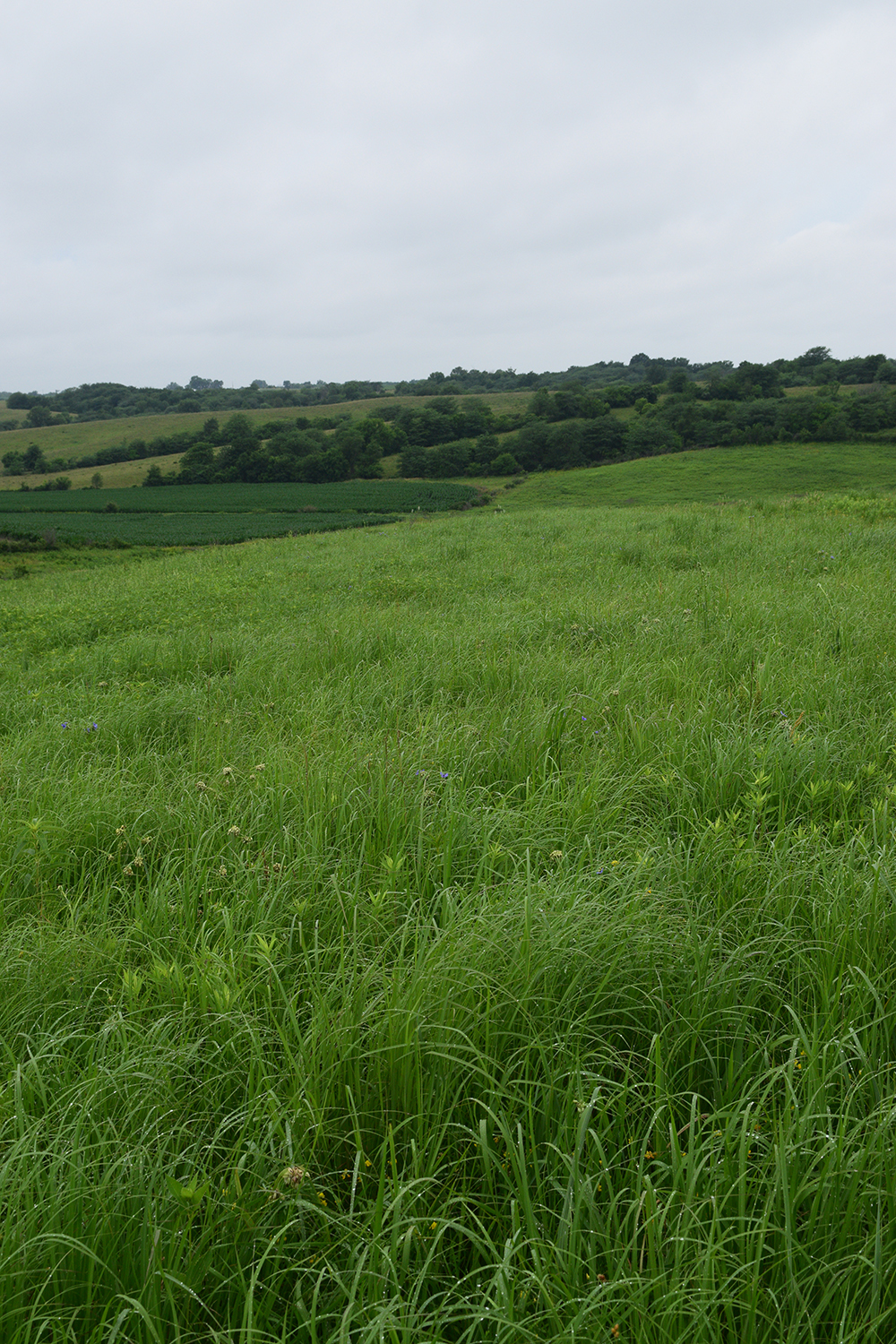 Hundreds of acres of prairie is being restored at Hawthorn Wildlife Area replacing what was a dense tangle of non-native invasive brush. The maturing prairie has attracted an increasingly diverse bird population, especially during the migration, and a growing pheasant population. Photo courtesy of the Iowa DNR.
Barnes City, Iowa - The change going on at Hawthorn Wildlife Area has been nothing short of extraordinary. Gone are hundreds of acres of non-native invasive brush and in its place is reconstructed prairie using local native prairie grass and wildflowers.
What was once an intimidating tangle of bush honeysuckle, Osage orange, cherry and sedge, with some bur oaks and bitternut hickories mixed in, has become a highly productive mix of native prairie, oak savanna and an improved timber stand focusing on encouraging the existing oaks and hickories. Once a final 30-acre parcel is added later this fall, Hawthorn Wildlife Area will cover more than 1,800 aces which includes a 160-acre fishing lake.
“It’s a high-quality area that’s underutilized,” said Steve Woodruff, wildlife biologist with the Iowa Department of Natural Resources. “Part of that could be that it’s not close to high population center, but that could also be one of its benefits.”
The changing face at Hawthorn has caught the eye of certain groups, including the Iowa Prairie Network and a science class from a nearby high school who make annual treks here to study and learn more about the emerging prairie and what lies beneath. Hawthorn is also part of a monarch study by Cornell College, in Cedar Rapids.
Hawthorn’s prairie features several forbs common to Iowa, including rattlesnake master, purple coneflower, butterfly milkweed, and partridge pea as well as some that are not, like ladies tresses, brown stemmed fox glove, bush sedge, ear leaf fox glove and hills thistle. Some sections of Hawthorn have never been plowed and part of the work removing trees and using prescribed fire is intended to encourage the native plants to return.
Its improving habitat attracted a small quail population two years ago, on top of the existing squirrel, rabbit, pheasant, deer, turkey, otter, bobcat and more that call Hawthorn home. It also hosts less common species like northern long-eared bat, smooth green snake, Coopers hawk, prairie skinks and Henslowe’s sparrows. “It would be a good place to come for bird watching,” he said, as a nervous indigo bunting darted into the safety of the dense shrubs.
The changes on the landscape started a decade ago as part of a project to fix the lake.
The lake restoration project looked into the watershed to fix issues associated with runoff and installed six silt collection ponds and changed the habitat to grasses in targeted areas to prevent erosion and improve the water quality.
It addressed shoreline erosion by installing about 1-1/2 miles rap-rap. Parts of the shoreline was deepened and the material removed was used to create mounds and reefs to attract fish. Finally, the fish population was re-set to eliminate carp and gizzard shad, and the lake was restocked with largemouth bass, bluegills, crappies and channel catfish.
Today, Hawthorn boasts a high-quality largemouth bass and crappie population, including some crappies caught this spring that measured over 14 inches.
It is also one of Iowa’s musky lakes. These fish of a lifetime will occasionally surprise an unsuspecting bass angler with a follow or a strike.
“The quality of muskies here are outstanding,” said Mark Flammang, fisheries biologist with the Iowa DNR. “There are plenty of 40-plus inch fish in the system.”
Hawthorn has a number of fishing jetties near each of the two boat ramps, providing angler access to deeper water and habitat designed to draw fish near. The DNR works with a local cooperator from nearby New Sharon to mow the fishing jetties and accesses, on top of planting the food plots and maintaining the hayfields.
“Having him so close helps us to be efficient with our time and budget,” Woodruff said.
Outside of watching wildlife and catching fish, Hawthorn offers hiking through the prairie and open timber, and kayaking on the lake. During early May? “This place is nuts with mushroom hunters,” Woodruff said.
While the progress has been impressive, it is not finished. Woodruff said they will continue removing brush this fall and winter, and battle the Reeds canary grass this spring, and more of Hawthorn will return to Iowa prairie.
Visitors who work up an appetite after a day at Hawthorn can stop by the Longhorn Saloon in Barnes City for a burger or plowboy.
Media Contact: Steve Woodruff, Wildlife Biologist, Iowa Department of Natural Resources, 319-330-7013.
Fishing for catfish is a summer tradition for many Iowa families. You can always count on channel catfish when the bite slows down for other fish in the heat of Iowa summers.
“Catfish will bite most of the time, no matter what the water temperature,” explains Daniel Vogeler, Iowa DNR fisheries technician. “They are biting in most lakes, ponds, rivers and streams across Iowa.”
Bring along two coolers with ice, one to keep your bait firm and fresh and another to keep your catch cold and preserve that great taste.
Catfish have a great sense of smell and taste. Try prepared dip baits, chicken livers, minnows or chubs, green sunfish, bluegill, crawdads, frogs, night crawlers or dead, but fresh, goldeye or gizzard shad.
Lakes stratify, or form layers, this time of year, with cool, oxygen-deprived waters sinking to the bottom. Don’t fish in water deeper than 8 to 10 feet on most lakes.
Look for areas with vegetation, brush piles or rock. Fish the upper ends of the larger reservoirs where the water is shallower and baitfish like gizzard shad gather. Use baits fished on the bottom or suspended off the bottom with a bobber and let current or breeze move the bait to find active catfish.
Iowa rivers are loaded with catfish. Look for fish around downed trees and brush piles, but don’t overlook rock piles or other objects that deflect water and form a current seam. Position your bait just upstream of brush piles so the scent of the bait is carried downstream into the structure to draw the catfish out. Anchor the bait with a heavy weight so it doesn’t drift into snags. If fishing the big rivers, try upstream and on the tips of wing dykes and wing dams on the Missouri and Mississippi rivers.
Find more tips for catching, cleaning and cooking catfish on the DNR website at fishing.iowadnr.gov.
Media Contact: Daniel Vogeler, Fisheries Bureau, Iowa Department of Natural Resources, 712-336-1840.
Wichita, Kan. - Pass It On - Outdoor Mentors announced today a partnership with the Iowa Department of Natural Resources to pilot a program to engage high school and college trap shooters in hunting activities. Based on the Shooting Sports Outreach Program that Pass It On – Outdoor Mentors launched in Kansas in 2019, the pilot program will engage student athletes from at least 15 different Scholastic Clay Target Program (SCTP) teams, both college and high school, in dove, pheasant and waterfowl hunts.
“In 2019, Pass It On – Outdoor Mentors hosted 89 hunts involving over 220 youth from 44 different high schools across Kansas. We are looking forward to piloting this effort in Iowa this fall,” said Brittany Waldman, Director of Field Operations for Pass It On – Outdoor Mentors.
“We recently surveyed several hundred of our student athletes, their parents, and their coaches regarding current interest and past participation in hunting. Even though 86% of our student athletes who responded indicated they come from a household that has hunted, only 53% of those surveyed have hunted themselves in the past year. This leaves us with a significant opportunity to provide quality mentored experiences in hopes to pique their interest in giving hunting a try. Even though we plan to pilot this effort with only a handful of our college and student athletes in 2020, our hope is to expand the program offerings across the state in subsequent years,” said Megan Wisecup, Iowa DNR Hunter Education Administrator.
In Iowa, there are approximately 4,000 student athletes participating in SCTP. This partnership will focus on giving these student athletes opportunities to hunt that they might not otherwise experience.
“Almost all of these youth have taken hunter education and have learned one of the basic skills needed to hunt,” Brittany said. “Our goal is to increase their interest and motivation to hunt by providing as many different hunting opportunities as we possibly can.”
Brittany further indicated that, “Our goals with this new effort are to 1) recruit new hunters by giving those who don’t currently hunt opportunities to pursue upland game, waterfowl, turkey and deer; 2) retain current hunters by giving those youth trap shooters and their parents who are currently hunters the opportunity to engage in more hunting activities; and 3) to reactivate parents and coaches who want to participate in these hunting activities. This model can be applied to numerous different cohorts in hopes to inspire others to have a passion for hunting and fishing.”
To accomplish this, Pass It On – Outdoor Mentors and the IA DNR plan to partner with local chapters of NGO’s and private landowners to provide access and volunteers and mentors who assist with the events. IA DNR will be surveying the coaches, parents and student athletes to establish a baseline of hunting participation and interest over the coming months. Pre- and post-hunt surveys and follow-up surveys with be used to measure the impact of the program and to provide the data needed to adjust and improve the program going forward.
About Pass It On - Outdoor Mentors
Pass It On - Outdoor Mentors is a Wichita, Kansas-based national organization dedicated to providing children with mentors who will share with them the experiences of traditional outdoor activities. The heart of the group's mission is to give children opportunities to connect with nature that they more than likely won't have without a mentor showing them the way. For more information about Pass It On - Outdoor Mentors, please visit http://www.outdoormentors.org.
Media Contact: Michael Christensen, Pass It On - Outdoor Mentors, Inc., 316-253-7221 or mchristensen@outdoormentors.org
The Iowa Department of Natural Resources is working with state and local officials to reduce the spread of COVID-19 and has transitioned employees to work remotely. DNR offices are closed to the public during this time and only available by appointment.
In other efforts to further reduce the spread of Covid-19, the DNR is encouraging the use of the online services for purchasing licenses, submitting applications, payments and other daily tasks and interaction with DNR staff.
The FREE Go Outdoors Iowa app is available at the App store and Google Play. The Go Outdoors Iowa app allows users to purchase and view hunting and fishing licenses and submit harvest and quota reports, all from your cell phone.
Full list of DNR’s online services: https://www.iowadnr.gov/about-dnr/about-dnr/online-services-databases.
Up-to-date information on DNR services, facilities and events impacted by Covid-19: https://www.iowadnr.gov/About-DNR/Covid-19.
Technical information for regulated businesses in regards to Covid-19: https://www.iowadnr.gov/About-DNR/Social-Media-Press-Room/Disaster-Assistance#3057321-covid---19-outbreak.
Thank you for your patience and flexibility during this time. If you need to contact DNR staff you can reach them by email or phone or by calling (515) 725-8200.
|





