|
FOR IMMEDIATE RELEASE
July 21, 2020
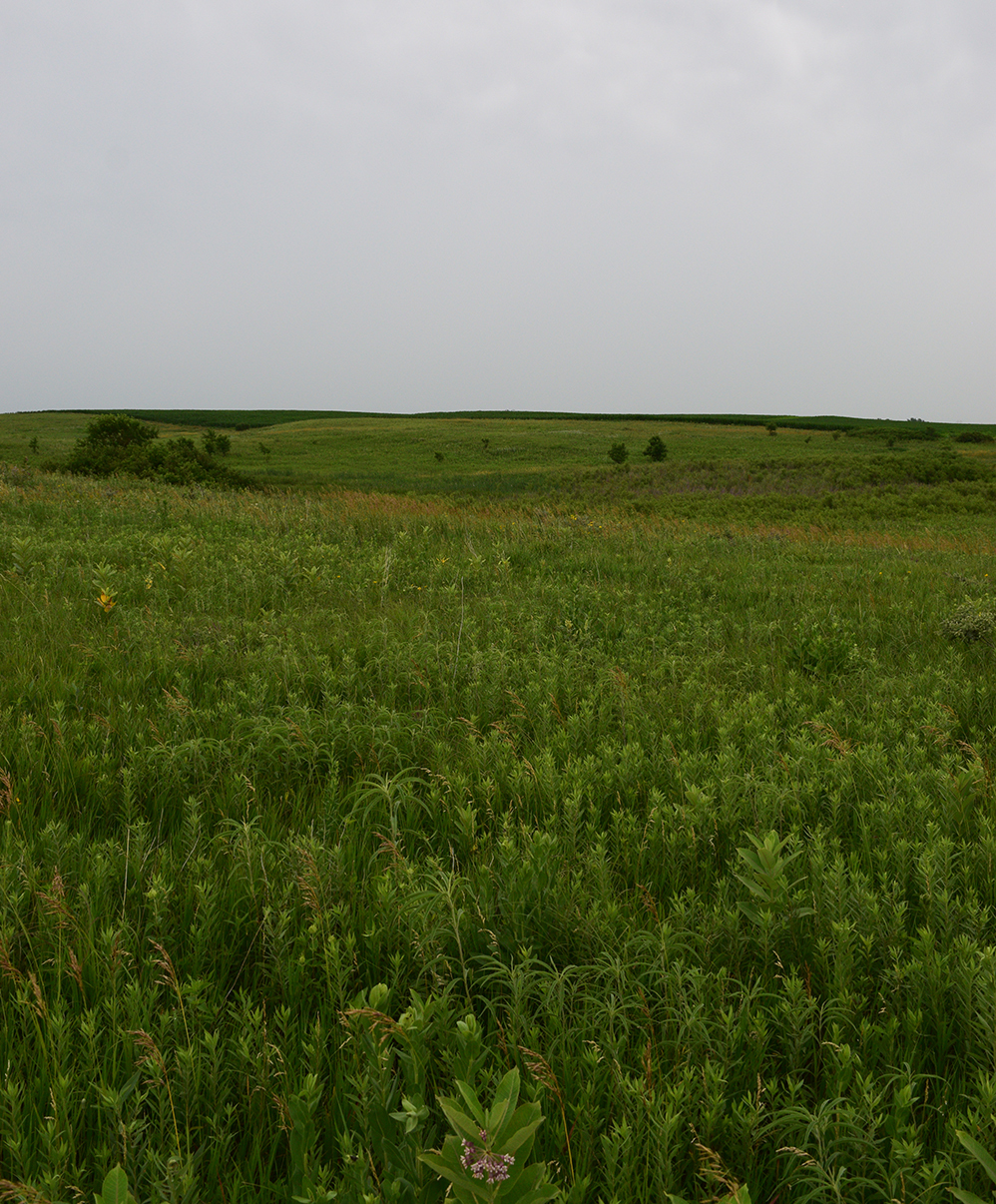 Cayler State Preserve is a very good representation of what Iowa’s prairie heritage looks like - roughly 220 native plant species growing on a gently rolling topography. Photo courtesy of the Iowa DNR.
Standing on a vista overlooking the expansive Cayler Prairie, it’s easy to imagine bison - the icon of the open prairie - at home on this historic area.
The 1,200-acre rolling prairie complex in Dickinson County, a short three miles west of West Okoboji Lake, boasts some of the highest quality and diverse virgin prairie in Iowa.
At the heart of it is Cayler State Preserve, a destination prairie popular with academics, prairie groups, birders, hunters, school groups and more. And why not? With the preserve supporting around 220 different native plant species adjacent to hundreds of acres of quality upland habitat with natural shallow wetland potholes and the Little Sioux River corridor mixed in, Cayler Prairie Wildlife Area literally “has it all.”
“It’s a really unique site. It’s a birders Mecca. The stretch of the Little Sioux is popular with kayakers. It’s known for good pheasant, duck, deer and dove hunting,” said Chris LaRue, wildlife biologist with the Iowa Department of Natural Resources (DNR). “My favorite part is the preserve based on its unique topography and extremely high plant diversity. The river adds to the natural setting.”
The quality of prairie on Cayler State Preserve was confirmed in 1944 by noted Iowa State University botanist Ada Hayden who was touring the state as part of a project to identify high quality areas. The 160-acre former hayfield and pasture was acquired in 1958. It was dedicated as a National Natural Landmark by the National Parks Service in 1966, one year after Iowa established its state preserve system. It was dedicated as a state preserve in 1971.
To this day, it is one of the best places to view native prairie in Iowa.
“Cayler State Preserve is a very good representation of what Iowa’s prairie heritage looks like,” said John Pearson, botanist with the Iowa DNR. He advised visitors heading to Cayler Prairie to manage their expectations.
“It’s not the Grand Canyon. It’s not mountains. Its native plants growing on a gently rolling topography – not a dramatic topography or scenery. But be impressed with the sheer number of plant species on the property,” Pearson said.
In 1998, Cayler quadrupled in size creating a one square mile prairie. The new acquisition offered a buffer of protection to the state preserve, and in turn, was provided a unique opportunity to increase its plant diversity simply through its location. There is no better example than the discovery of prairie bush clover, a federally threatened species, which has now been found on the 1998 acquisition.
“What we thought was an isolated population on the state preserve has been found on the steep slopes on the buffer area,” Pearson said.
Etcetera
Cayler Prairie’s mix of uplands, pothole wetlands and timber river corridor attract pheasants, waterfowl and deer, that, in turn, brings pheasant hunters, duck hunters and deer hunters. The Twin Forks section offers a change in landscape. The riverine valleys where the West Fork of the Little Sioux joins the main branch of the small prairie stream. It’s a popular section for kayakers.
Cayler Prairie was designated as a state Bird Conservation Area in 2011, due, in part, to the area providing important nesting habitat for declining grassland birds, such as upland sandpiper, northern harrier, bobolink, and Henslow’s sparrow.
Trumpeter swans nested successfully in 2020, producing four cygnats on one of Cayler’s wetlands. It was the first time trumpeter swans nested successfully at Cayler in recent history.
Wildlife biologist Chris LaRue uses a combination of rotating prescribed fire on select small areas, and grazing cattle on the reconstructed prairie to replicate what Mother Nature and the bison did for centuries.
Cayler State Preserve is one of the most studied prairies in the state including an early study published in the Proceedings of Iowa Academy of Science in 1956, that provided a thorough identification of plant species on the area. Other studies focused on mosses and liverworts, and another on vertebrates. The high-quality pollinator habitat on Cayler has benefitted butterflies and bees which has attracted scientists here to study butterflies, especially monarchs, insects and more.
Media Contact: Chris LaRue, Wildlife Biologist, Iowa Department of Natural Resources, 712-330-4543.
The positive impact Iowa’s mild winter and reasonably dry spring has had on pheasant nesting success will likely be seen when the Iowa Department of Natural Resources (DNR) conducts its annual roadside pheasant counts between Aug. 1-15.
The statewide survey is conducted by Iowa DNR staff who drive 218, 30-mile routes on gravel roads at dawn on mornings with heavy dew. Hen pheasants will move their broods to the edge of the gravel road to dry off before they begin feeding, which makes them easier to count.
“Conditions for the survey are important as the accuracy of the counts depend on the dew conditions when the routes are run,” said Todd Bogenschutz, upland wildlife research biologist for the Iowa DNR.
Iowa’s mild winter and relatively dry nesting season are two important factors that would indicate an upward trend in the state’s pheasant population. A mild winter means more hen survival. A dry nesting season means better nesting success.
“It will be interesting to see the survey results,” Bogenschutz said.
The August roadside survey has been conducted over the same routes since 1962. In addition to pheasants and quail, the survey collects data on partridge, cottontails and jackrabbits. Results will be posted online at www.iowadnr.gov/pheasantsurvey in early September. Iowa’s pheasant season begins Oct. 31.
Media Contact: Todd Bogenschutz, Upland Wildlife Biologist, Iowa Department of Natural Resources, 515-979-0828.
Operation Dry Water took place July 3-5, 2020 and focused eliminating boating under the influence (BUI). This year, in Iowa, 140 officers spent over 2,500 hours making contact with over 6,400 boaters on Iowa waterways.
During that enforcement operation, 11 people were arrested for BUI. There were 392 additional citations or warnings issued.
The DNR reminds boaters to always obey these rules:
- Alcohol and boating don’t mix. Wind, sun glare and heat can enhance the effects of alcohol, hindering the operator’s ability to make necessary decisions.
- The same limit of .08 for operating a vehicle under the influence applies to boating.
- Always have a designated operator that avoids consuming alcohol.
- Wear your life jacket, it floats, you don’t! Any children 12 and under must wear a lifejacket at all times on a vessel underway in Iowa.
The DNR Law Enforcement Bureau partnered with DNR State Parks, U.S. Fish and Wildlife Service, Dubuque Police Department, Illinois DNR, Nebraska Game & Parks, Wisconsin DNR, Linn County Conservation and the Johnson, Mills, Fremont, Clayton, and Crawford County Sheriff’s Offices.
Media Contact: Susan Stocker, DNR Boating Law Administrator and Education Coordinator, 515.313.6439 or Susan.Stocker@dnr.iowa.gov.
COLO - Story County Conservation (SCC) and the Iowa Department of Natural Resources (DNR) are partnering to renovate the remaining fishery in Hickory Grove Lake. The DNR will treat Hickory Grove Lake on August 4th (pending workable weather conditions) with rotenone, a botanical pesticide, to eliminate the remaining fish population.
An attempt was made last fall/winter to drain and dry the lake basin to rid the lake of common carp, grass carp, and black bullhead. These injurious fish species reduce water clarity, destroy aquatic plants, and prevent the fishery from reaching its full potential.
Unfortunately, common carp were observed this spring as the lake was refilling. “The most effective method to eliminate the remaining fish population is to apply rotenone to the lake basin and tributaries,” said Ben Dodd, DNR fisheries management biologist.
Eliminating injurious fish species is an imperative and final step to achieve water quality and fishery improvements.
The project area includes Hickory Grove Lake and a portion of the associated watershed. The treatment area includes both public and private property. A map of the specific treatment area is available at https://www.storycountyiowa.gov/1375/Hickory-Grove-Lake-Restoration. Treated public areas will be posted with placards and closed to public use until the placards are removed. Private property owners adjacent to treated water have been notified. It will likely take 48 hours for the rotenone to dissipate from flowing streams and 7 to 14 days from ponds and the main lake. Avoid human and pet contact with water in the treatment area, do not use dead fish for food or feed, and do not use treated water to irrigate crops or lawns.
Rotenone is used world-wide and has been since the 1930s. It is a common tool that fisheries managers use for managing sport fish, improving water quality, and managing endangered species. Rotenone is a naturally occurring compound that comes from the roots of a tropical plant in the bean family. The DNR commonly uses the commercially available formulation, 5 percent Prenfish, which has been approved for fisheries management by the U.S. Environmental Protection Agency (EPA).
The EPA has concluded that the use of rotenone for fish control does not present a risk of unreasonable adverse effects to humans or the environment. The EPA certifies all pesticides based on use according to label directions, which the DNR is equipped to fulfill these obligations.
Find more information about rotenone and the treatment area at https://www.storycountyiowa.gov/1466/Fishery-Renovation
Media Contacts: Ben Dodd, Fisheries Management Biologist, Iowa Department of Natural Resources; ben.dodd@dnr.iowa.gov; 641-891-3795.
Michael Cox, Director, Story County Conservation; mcox@storycountyiowa.gov; 515-232-2516.
The Iowa Department of Natural Resources (DNR) recently confirmed that zebra mussels are in Lake Manawa.
A homeowner on Lake Manawa reported finding zebra mussels on rip-rap along his shoreline. Investigation by DNR staff discovered low numbers of zebra mussels around the lake. DNR staff will conduct additional surveys at Lake Manawa this fall and next summer to monitor the abundance and distribution of zebra mussels.
The documentation of zebra mussels in another lake highlights the spread of aquatic invasive species in Iowa waters. “The zebra mussels in Lake Manawa probably arrived on or in a boat that had picked up the mussels from an infested water body, like the nearby Missouri River,” said Kim Bogenschutz, DNR Aquatic Invasive Species Program coordinator.
Zebra mussels look like small, D-shaped clams that have alternating light and dark bands. Most are less than one inch long. They are filter feeders that can form dense clusters as they attach to hard underwater surfaces. Large infestations may interfere with aquatic food chains, kill native mussels, clog water intakes, increase algae blooms, and cover beaches with dead shells. Currently there is no effective treatment to control zebra mussels once they have infested a lake.
Young zebra mussels are microscopic and can be unintentionally transported with water in live wells, bilges, ballast or bait buckets. Adult zebra mussels can attach to boats, trailers and aquatic vegetation.
It is illegal to possess or transport prohibited aquatic invasive species, such as zebra mussels, in Iowa. Boaters must also drain all water from boats and equipment before they leave a water access and must keep drain plugs removed or opened during transport.
“Boaters and anglers can unintentionally spread zebra mussels and other aquatic invasive species if they do not take the proper precautions to clean, drain, and dry after each time out on the water,” said Bogenschutz.
- CLEAN any plants, animals or mud from boat and equipment before you leave a water body.
- DRAIN water from all equipment (motor, live well, bilge, transom well, bait bucket) before you leave a water body.
- DRY anything that comes into contact with water (boats, trailers, equipment, boots, clothing, dogs). Before you move to another waterbody either:
- Spray your boat and trailer with hot, high-pressure water; or
- Dry your boat and equipment for at least 5 days.
- Never release plants, fish or animals into a water body unless they came out of that water body and empty unwanted bait in the trash.
“Draining all water is a critical step in preventing the spread of zebra mussels,” reminds Bogenschutz.
Find more information about aquatic invasive species and a list of infested waters in the 2020 Iowa Fishing Regulations booklet or on the DNR’s website at www.iowadnr.gov/ais
Media Contacts: Kim Bogenschutz, Boone Wildlife Research Station, 515-290-0540 or Bryan Hayes, Cold Springs Fisheries Office, 712-769-2587.
The Iowa Department of Natural Resources is working with state and local officials to reduce the spread of COVID-19 and has transitioned employees to work remotely. DNR offices are closed to the public during this time and only available by appointment.
In other efforts to further reduce the spread of Covid-19, the DNR is encouraging the use of the online services for purchasing licenses, submitting applications, payments and other daily tasks and interaction with DNR staff.
The FREE Go Outdoors Iowa app is available at the App store and Google Play. The Go Outdoors Iowa app allows users to purchase and view hunting and fishing licenses and submit harvest and quota reports, all from your cell phone.
Full list of DNR’s online services: https://www.iowadnr.gov/about-dnr/about-dnr/online-services-databases.
Up-to-date information on DNR services, facilities and events impacted by Covid-19: https://www.iowadnr.gov/About-DNR/Covid-19.
Technical information for regulated businesses in regards to Covid-19: https://www.iowadnr.gov/About-DNR/Social-Media-Press-Room/Disaster-Assistance#3057321-covid---19-outbreak.
Thank you for your patience and flexibility during this time. If you need to contact DNR staff you can reach them by email or phone or by calling (515) 725-8200.
|





