Thank you for your service
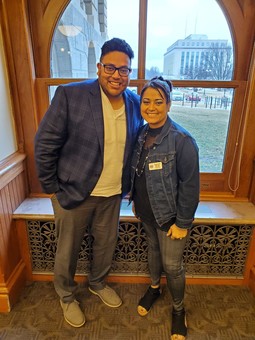
The Iowa Commission of Latino Affairs would like to thank Jeannette Brown and Valerie Nolte for their service to the Commission and Iowa's Latinos.

Jeannette Brown served as the Chair of the Commission for the past four years.
Commission initiatives under Jeannette's Leadership:
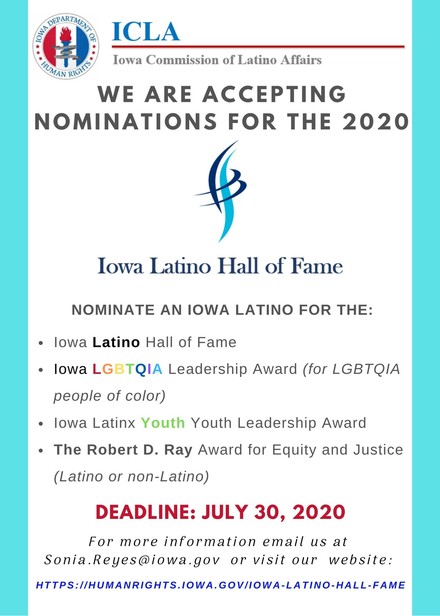
- Iowa Latino Hall of Fame
- Iowa Queer Communities of Color Coalition
- Latino Day on the Hill
- PILA (Association of Iowa Latinx Professionals
|
Valerie Nolte. Initiatives Valerie assisted with:
- Iowa Queer Communities of Color Coalition
- 2020 Latino Day on the Hill
|
|
 |
New Commission Chair
New Commissioners
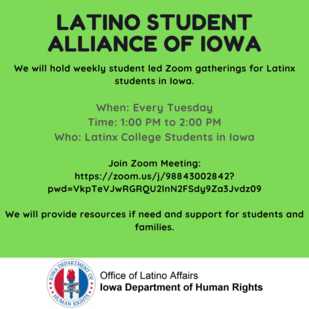
Our Latinos Can Coalition invites you to our weekly check in with Latinx College Students!
Simpson Meets the Spanish-speaking Community of Des Moines
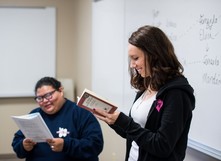
Professors Lau Cesarco Eglin and Molly Tun from Simpson College received a grant titled “Simpson Meets the Spanish-speaking Community of Des Moines” which will be used to research the historical development and current institutions, organizations, and communities of Spanish-speakers in the metro area, with the goal of creating more experiential learning opportunities for students in the Spanish program at Simpson College.
Through the World Language and Culture Studies department, students not only learn a language, but gain critical intercultural skills that allow them to mediate between cultures by deepening their ability to understand and analyze different cultural perspectives including their own. They become familiar with different cultures across the Spanish-speaking world, immerse themselves in historical and cultural events that have marked Spanish-speaking societies and how they are perceived, grapple with issues currently facing the Spanish-speaking world, and participate in discussions about its future.
With this grant they hope to foster strong connections between Simpson students and the Latinx community of the larger Des Moines area. If you would like student support and collaboration on projects within the Latinx community, please reach out to:
laura.cesarcoeglin@simpson.edu and molly.tun@simpson.edu.
|
 |
The Iowa Queer Communities of Color's mission is to use an intersectional lens to address the inequity of services, lack of support and space, socioeconomic disparities, and institutional racism experienced by our communities through education, advocacy, intentional inclusivity and organizing.
Are you interested in being part of the Iowa Queer Communities of Color Coalition? Fill out this form.
|

The Iowa Commission of Latino Affairs in partnership with Hola Iowa are accepting nominations for the 20 Latino-Iowans You Have to Know project.
DEADLINE: August 15, 2020
|
THE SUPREME COURT DECISION ON DACA
Sonia Parras Konrad & Shelby Bird, Immigration Attorneys
On November 12, 2019, the Supreme Court of the United States heard oral arguments to decide whether the Department of Homeland Security (DHS) can lawfully rescind the Deferred Action for Childhood Arrivals policy (DACA). On June 18, 2020 they released their decision on the case.
WHAT IS DACA?
DACA was created under the Obama administration on June 15, 2012. The policy has enabled people who came to the United States before the age of 16 to apply for “deferred action,” a form of prosecutorial discretion, and a work permit. The program has protected over 700,000 people in the United States. On September 5, 2017, then Attorney General Sessions announced that DACA would be rescinded. The Supreme Court reviewed this decision.
WHAT DID THE SUPREME COURT DECIDE?
1. On June 18, 2020, the Supreme Court of the United States held 5-4 that the decision by
the DHS to terminate DACA was reviewable in federal court and also “arbitrary and
capricious” under the Administrative Procedure Act (APA).
2. The Court mainly stated that DHS:
a. must defend its actions based on the reasons it gave when it acted
b. failed to consider that applicants were relying on the program and ended it
abruptly without accommodations for transition
3. The Court then
a. remanded all three (consolidated) cases for further proceedings.
b. rejected the claim that the rescission of DACA was motivated by animus in
violation of the Equal Protection Clause of the U.S. Constitution.
QUESTIONS AND ANSWERS
1. IS THE DACA PROGRAM THEN SAVED?
Not necessarily. Today’s decision is limited to how the DHS ended DACA in 2017.
Specifically, the Court found that DHS failed to provide a reasonable explanation for
ending DACA. Now we need to wait until DHS next step and see whether they will
continue the DACA program or attempt to end it again.
2. CAN I APPLY FOR DACA IF THIS IS MY FIRST TIME?
1. The Supreme Court’s decision means that DACA should be fully reinstated as it was,
allowing for first time DACA requests.
2. DHS will need to reopen the DACA policy for new requests consistent with today’s
decision.
3. You may not be able to file a first time DACA application immediately since DHS
needs to provide further instructions on filing dates for first applicants.
3. CAN I RENEW MY DACA?
1. If you have been granted DACA before, you should be able to submit an application to
renew DACA.
2. If you let your DACA lapse, you can try to re-apply when DHS provides instructions.
4. CAN I REQUEST ADVANCE PAROLE TO TRAVEL ABROAD?
1. Advance parole is a mechanism by which DACA recipients could be approved to travel
abroad and return back into the USA legally in specific situations.
2. The Supreme Court’s conclusion that DACA was terminated unlawfully means that
advance parole should be reinstated as before.
3. DHS will need to reopen the DACA policy for advance parole requests consistent with
today’s decision.
4. You may not be able to file for advanced parole immediately. DHS has to take further
actions before you can apply for advance parole.
 |
|
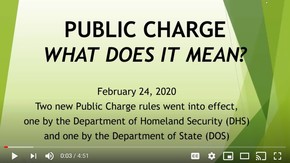
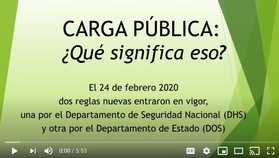
Understanding the Public Charge - English
|
Información sobre la Carga Pública - Español
|
|
 |
No se necesita seguro de salud - Health insurance is not needed
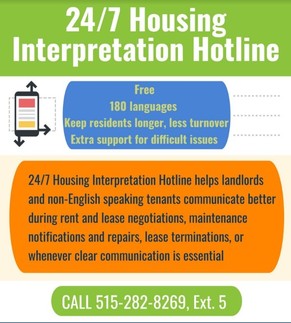
Iowa International Center's Interpretation Hotline
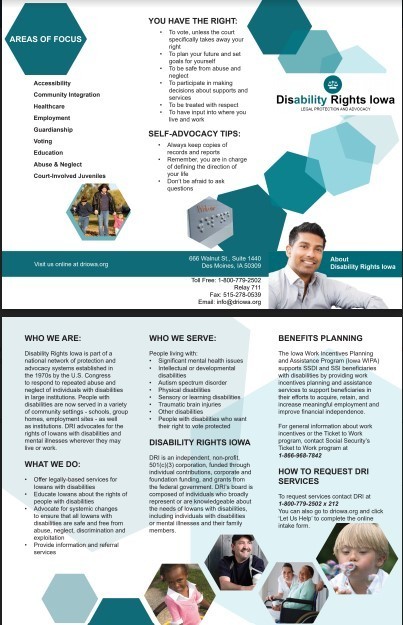
Disability Rights Iowa - Services
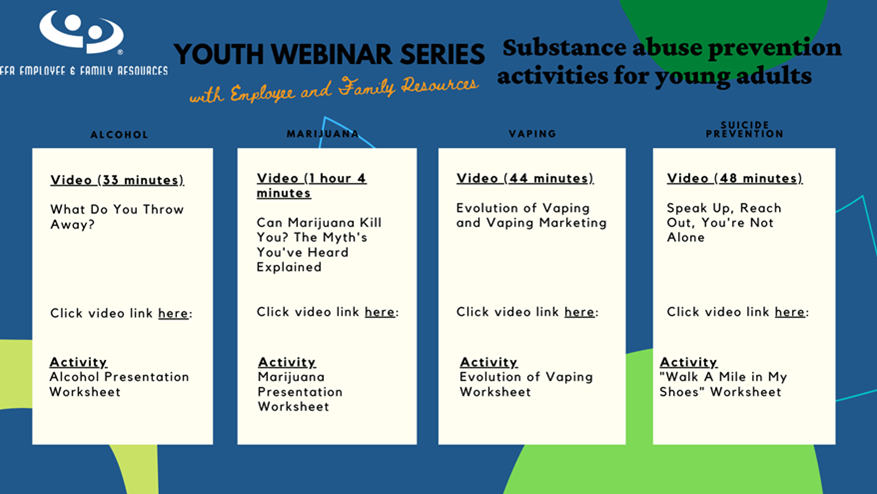
Free Youth Webinar Series
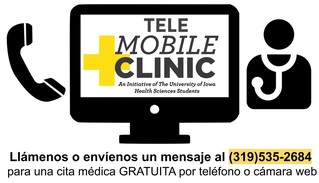
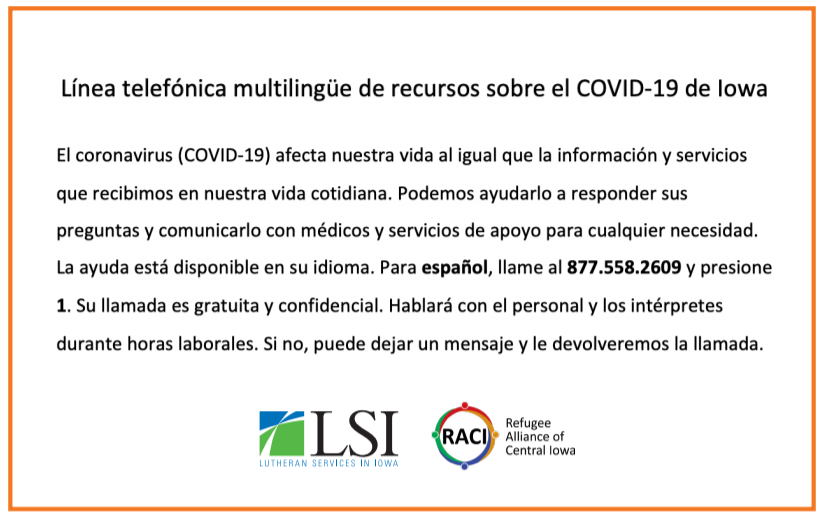
Hotlines with Information about COVID-19 in Multiple Languages
Líneas Directas con Información sobre COVID-19 en Varios Idiomas
News are shared via translations, video, and audio recordings in ethnic languages from Burma including:
- Spanish
- Hakha Chin
- Mizo Chin
- Karenni
- Karen (ကညီ)
- Burmese (ဗမာ)
Information will also be provided in Kirundi, Kunama, Lingala, French and Swahili, through EMBARC's Community Catalyst Project, an initiative that was launched in 2018 to engage newly arrived refugee-led groups to grow leadership, build collective capacity, and increase impact.
|
Iowa Covid-19 Help Line for Iowans with limited English Language 1-877-558-2609
Interpreters will be available 8:30-5:00 with a 24 hour voicemail. For more information click here.
Iowa State University Extension and Outreach

HOTLINES
Iowa Concern 1-800-447-1985
A confidential, free resource answered 24 hours a day, 7 days per week, aimed to support Iowans with legal, finance, stress, and crisis/disaster concerns. Language interpretation available. Dial 711 for TTY/TDD.
- 24/7 Phone Support: Trained staff take your calls via the toll-free hotline.
-
Email an Expert: Send your questions related to legal issues, finances, stress and crisis or disaster to our staff.
-
Live Chat: One-on-one, secure communication through typed text with a stress counselor.
AnswerLine 1-800-262-3804
Information and resources for consumers with home and family questions. Toll-free Monday through Friday, 9 am-12 noon and 1-4 pm.
- 1-800-735-2942 (Relay Iowa phone linkage for deaf and hard-of-hearing individuals)
-
Email an Expert: Send your home and family questions to our trained staff.
|
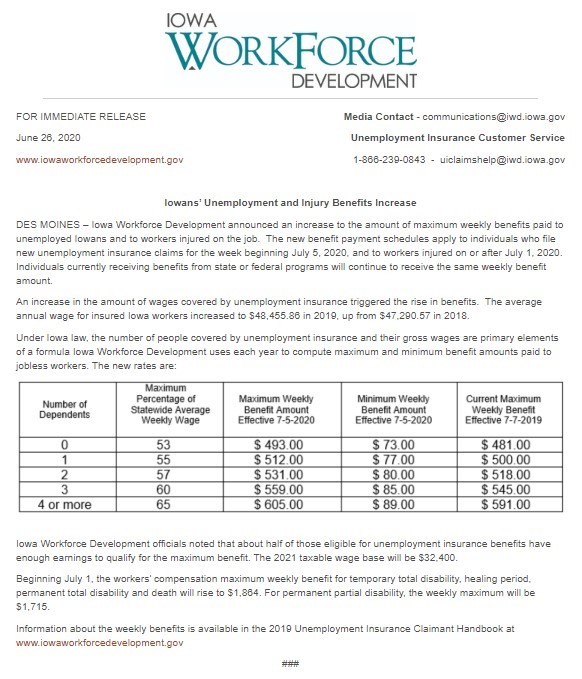
Iowans’ Unemployment and Injury Benefits Increase
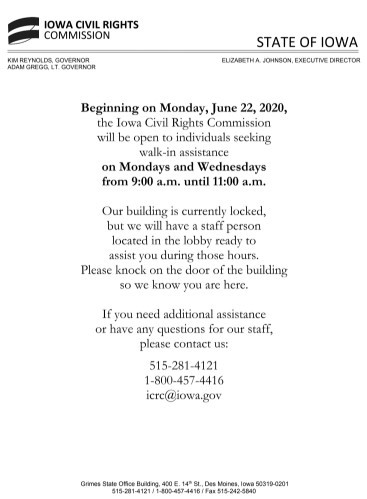
The Iowa Civil Rights Commission Established Walk-In Hours
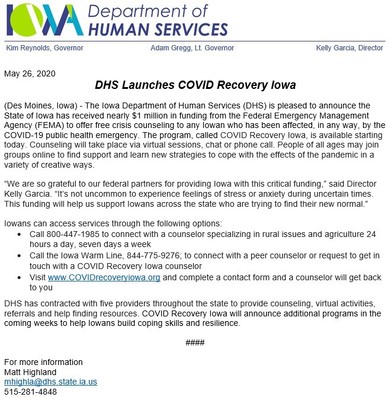
Launch of a NEW response to the Pandemic
-
Iowa Latino Hall of Fame Nominations Deadline | July 30, 2020
-
Commission Meeting - 2020 Iowa Latino Hall of Fame Inductees | August 4, 2020
-
Commission Meeting | September 11, 2020
-
Iowa Latino Hall of Fame Induction Ceremony | October 17, 2020
|